
 Worksheets
Global Climate Review
Total questions: 60
Worksheet time: 30mins

Which is an example of anegative feedback loop?
Decreasing temperature ➜increase in ice cover ➜increase in reflection of sunlight ➜decrease in temperature
Decreasing temperature ➜decrease in plant cover ➜decrease in absorption of carbon dioxide ➜increase in temperature

Warming ocean temperatures increasing the rate of dissolved ocean CO2 outgassing
Positive feedback loop
Negative feedback loop
Not a feedback loop
Increasing atmospheric CO2 concentrations increasing the rate of photosynthesis by plants and ocean phytoplankton
Positive feedback loop
Negative feedback loop
Not a feedback loop
Increase in droughts from climate change resulting in more frequent and severe wildfires
Positive feedback loop
Negative feedback loop
Not a feedback loop
Increase in global temperatures causing more melting of polar sea ice (albedo of ice = 0.6, albedo of water = 0.06)
Positive feedback loop
Negative feedback loop
Not a feedback loop
A ________________ feedback loop makes a system more stable.
Positive
Neutral
Negative
Circular
A _________________ feedback loop moves a system to an extreme.
Positive
Neutral
Circular
Negative
As the Earth warms, increased evaporation produces more clouds. Clouds increase albedo, reflecting more light away from the Earth. The temperature falls. Rates of evaporation fall.
Positive Feedback Loop
Negative Feedback Loop
As the Earth warms, upper layers of permafrost melt, producing waterlogged soil above frozen ground. Methane gas is released into the environment. The greenhouse effect is enhanced. The Earth warms, melting more permafrost.
Positive Feedback Loop
Negative Feedback Loop
As the Earth warms, ice cover melts, exposing soil or water. Albedo decreases. More energy is absorbed by the Earth’s surface. Global temperature rises. More ice melts.
Positive Feedback Loop
Negative Feedback Loop
As the Earth warms, ice cover melts, exposing soil or water. Albedo decreases. More energy is absorbed by the Earth’s surface. Global temperature rises. More ice melts.
Positive Feedback Loop
Negative Feedback Loop
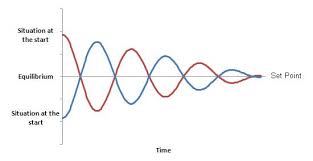
Does the graph show positive or negative feedback?
Positive, because when the red line shifts, the blue one does also
Negative, because the blue line starts below equilibrium
Negative, because the two actions are keeping each other near equilibrium
Both positive and negative because the graph moves up and down


Select ALL examples of greenhouse gases from the list below.
Carbon dioxide (CO2)
Methane (CH4)
Water vapor (H2O)
Oxygen
What happens to the temperature of the atmosphere if more greenhouse gases are added? (Hint: think about Venus)
Temperature goes up
Temperature goes down
Without the Greenhouse Effect the Earth would be...
too warm for life
too cold for life
The gas that is most abundant (highest percentage) in the atmosphere is
oxygen
nitrogen
carbon dioxide
argon
In what form is radiation emitted from the Earth's surface back into the atmosphere?
As visible light
As UV light
As gamma rays
As Infrared light (heat)

How could climate change cause sea levels to rise? Choose the best answer.
By causing it to rain more often
By melting glaciers and polar ice caps
By increasing the number of undersea volcanic eruptions
By creating bigger and more powerful hurricanes
What results from livestock and other agricultural practices and by decay in municipal landfills?
Carbon Dioxide
Methane
Water Vapor
Fluorinated Gases
Nitrous Oxide
Which is a true statement?
Humans depend on oxygen, plants depend on carbon dioxide
Plants produce carbon dioxide only
Humans depend on carbon dioxide, plants depend on oxygen
Humans don't depend on plants for the air they need
What does NOT produce atmospheric carbon dioxide?
Photosynthesis
Burning Fossil Fuels
Animal respiration
Anything living in the ocean.
Plants use ____________________ to make their own food.
Carbon Dioxide
Oxygen
Materials
Gravity
How do animals get carbon?
By eating plants and or other animals.
They absorb it from the atmosphere.
From the ground
They do not get carbon from anywhere.
What are fossil fuels made from?
Plants and animals that are buried underground for millions of years.
They absorb it from the atmosphere.
Water
Wind
A ____________ is a reservoir that takes up a chemical element and stores it for a long period of time.
Sink
Source
Bucket
Location
What is a carbon source?
A reservoir contributing carbon to the biosphere
A reservoir contributing carbon to the atmosphere
A reservoir contributing carbon to the lithosphere
A reservoir contributing carbon to the hydrosphere
What is a flux?
movement of air
movement of water
movement of carbon
movement of 2 of the above
Fossil fuel emissions release carbon into the atmosphere, this is an example of?
carbon sink
carbon source
Photosynthesis is a process which uses carbon from the atmosphere, this is an example of?
carbon sink
carbon source

What has the highest albedo?
the oceans
Ice in the Arctic or Antarctic
the ground
roads

How does heat energy from the sun reach Earth?
conduction
insulation
radiation

What heats faster, land or water?
Land
Water

Which would you expect to have the lowest albedo?
dark soil
white sand
ice and snow
deep sea water
If you want to keep your house cool all year, should you design the house roof to have a high or a low albedo?
High
Low
Which object below would have an albedo score of 1.
A green forest
A deep blue ocean
Fresh clean snow
A pitch black rooftop
Which object below would have an albedo score of 0.
A green forest
A deep blue ocean
Fresh clean snow
A pitch black rooftop

The amount of light reflected by a surface. Represented by a value between 0-1.
Carbon Cycle
Albedo
Photosynthesis
Nuclear Fusion

Light colored surfaces ____________ more radiation than dark colored surfaces.
reflect
absorb

Dark colored surfaces _________ more radiation than light colored surfaces.
reflect
absorb
Which of these are the main characteristics that define climate?
weather and humidity
temperature and precipitation
pressure and preciptitation
weather and pressure
What does most sunlight do when it reaches earth?
Gets absorbed by the surface
Gets reflected by the surface
Gets absorbed by the air
Gets reflected by the air
High or low albedo: thick clouds
high
low
What is climate?
weather
rain, sleet, snow, or hail
average weather in a region over a long period of time
the amount of ice cream available in a city

