
 Worksheets
DNA RNA structure , Transcription and Translation
Total questions: 105
Worksheet time: 2hrs 16mins

Which macromolecule is shown?
lipid
protein
nucleic acid
carbohydrate
For which discovery about DNA do Watson and Crick receive credit?
A. DNA is the molecule that genes are made of.
B. The amount of adenine equals the amount of thymine in an organism
C. Phosphate–pentose bonding along the nucleotide backbone is covalent.
D. The shape of DNA is a double helix.

The image shows a DNA nucleotide.
Which correctly identifies the parts labelled I and II?
A. Base (I), Phosphate (II)
B. Ribose (I), Uracil (II)
C. Deoxyribose (I), Base (II)
D. Ribose (I), Adenine (II)
A.
B.
C.
D.
The percentage of thymine in the DNA of an organism is approximately 30 %. What is the percentage of guanine?
A. 70 %
B. 30 %
C. 40 %
D. 20 %

This question refers to the following diagram of DNA.
What does the structure labelled Y represent?
A. Ribose
B. Thymine
C. Guanine
D. Deoxyribose
What are monomers of nucleic acids?
Nitrogenous bases
DNA
Nucleotides
Nucleus
Purine bases include:
C, T
A, G
C, G
A, C
C, T, U
Which feature is common to both mRNA and DNA?
A. Covalent bonds between adjacent nucleotides
B. Hydrogen bonds between guanine and cytosine
C. Ribose sugar attached to phosphate
D. Antiparallel arrangement of polynucleotide strands
What is a similarity between DNA and RNA?
A. Both are polymers of nucleotides.
B. Both are composed of antiparallel strands
C. Both contain adenine, cytosine and thymine.
D. Both contain ribose sugar

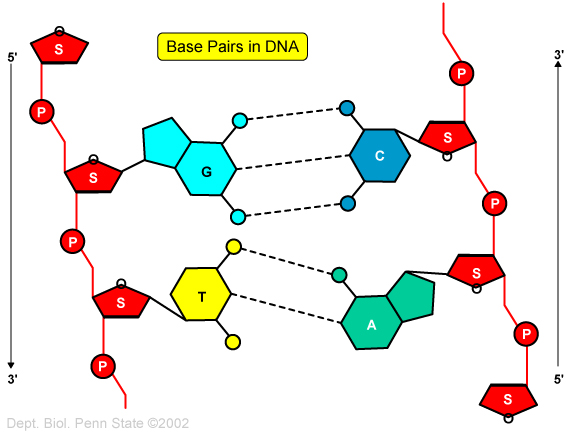
The following diagram shows a short stretch of DNA. What bases are indicated by labels Y and Z?
A. Thymine (Y), Uracil (Z)
B. Thymine (Y), Guanine (Z)
C. Uracil (Y), Guanine (Z)
D. Uracil (Y), Adenine (Z)
A.
B.
C.
D.
The nucleus contains DNA. Which statement BEST describes how DNA controls the working of the cell?
It codes for proteins.
It inhibits division of cells.
It helps in energy transformation.
It regulates traffic in and out of the cell.
DNA molecules contain the genetic information that determines the characteristics of a living organism. How do DNA molecules express the genetic information they contain?
by breaking down proteins within the cell
by directing the process of protein synthesis
by regulating the storage of cellular proteins
by controlling the movement of protein molecules
Which part of a DNA molecule represents encoded information?
phosphate
sugar
guanine
hydrogen bond
What aspect of the DNA molecule encodes hereditary information concerning an organism's traits?
the molecular mass
the sequence of base pairs
the distribution of electrical charges
the folded three-dimensional shape
During replication, the DNA sequence ACT results in which sequence on the new strand?
ACT
TCA
TGA
UGA
How is the DNA sequence AATTA replicated in a new strand during semi conservative replication?
AATTA
AATAA
TTATT
TTAAT
A single-stranded sequence of DNA is TAC CGC AAG. Which series represents the complimentary strand of DNA?
CGT TAT GGA
ATG GCG TTC
GCA ATA CCT
AUG GCG UUC
An RNA nucleotide contains which 3 things?
ribose sugar
deoxyribose sugar
phosphate group
nitrogen bases (G, C, A, U)
nitrogen bases (G, C, A, T)
Which type of RNA are ribosomes made of and reads the mRNA?
mRNA
rRNA
tRNA
Base Pairing in DNA G pairs with C and A pairs with T, BUT in RNA G pairs with C and A pairs with
G
C
A
T
U

Is this nucleotide a purine or a pyrimidine?
Purine
Pyrimidine

Which of these is 5'?
A
B
C
D
E
Which of these is 3'?
A
B
C
D
E
If cytosine accounts for 32% of a DNA molecule's total bases, what percentage will guanine account for?
68%
32%
64%
18%
If cytosine accounts for 32% of a DNA molecule's total bases, what percentage will thymine account for?
68%
32%
64%
18%

Which of the following differences between DNA and RNA is NOT true?
DNA and RNA have a different sugar in their nucleotides
RNA is a single-stranded helix
RNA can be found in the nucleus and cytoplasm of the cell
DNA is only found in the cell nucleus
RNA has the following base paring: A-T, C-G

Who is responsible for producing this image?
Francis Crick
James Watson
Rosalind Franklin
Maurice Wilkins
Erwin Chargaff

The work of Erwin Chargaff allowed Watson and Crick to determine the rules of.......
protein synthesis
transcription
hydrogen bonding
nitrogenous base pairing

RNA and DNA are similar in that....
they both comprise of the 5 nitrogenous bases: adenine, thymine, cytosine, guanine, and uracil
they are both double helixes
they both contain ribose sugar
they both contain a phosphate group


Which carbon atoms on the pentose sugar does the phosphate molecule bond to?
1' & 2'
2' & 3'
3' & 4"
4' & 5'
5' & 3'
Which carbon atom on the pentose sugar does the nitrogenous base bond to?
1'
2'
3'
4'
5'

What did Erwin Chargaff conclude from his experiments?
Nitrogen bases are held together by peptide bonds
A and T, C and G always occur in equal amounts
Proteins are the carriers of genetic information
C and G rarely occur in eukaryotic organisms
When does DNA Replication occur?
Just before the cell divides
Just after the cell divides
The M phase
The S phase

Which enzyme is responsible for building nucleotides?
Helicase


Which letter in the picture below depicts the leading strand in DNA replication?
A
C
B
None of the above
Which letter in the picture below depicts the lagging strand in DNA replication?
Letter A since it is copied from 5' to 3'
Letter A since it is copied from 3' to 5'
Letter B since it is copied from 3' to 5
Letter B since it is copied from 5' to 3'
DNA replication puts down nucleotides ______' to _____' and is said to be ______________________
5, 3, antiparallel
3, 5, antiparallel
5, 3, parallel
3, 5, parallel
What is amplified using the polymerase chain reaction (PCR)?
Large amounts of RNA
Small amounts of DNA
Small amounts of protein
Large amounts of polymers
Which process is used in polymerase chain reaction (PCR)?
Transcription
Translation
Replication
Mutation
What happens during translation?
Copying of DNA to produce DNA
Copying of DNA to produce mRNA
Copying of DNA to produce tRNA
Polypeptide synthesis
What is a codon?
A sequence of nucleotides on rRNA that corresponds to an amino acid
A sequence of nucleotides on mRNA that corresponds to an amino acid
A sequence of nucleotides on tRNA that corresponds to an amino acid
A sequence of nucleotides on DNA that corresponds to an amino acid

What is the sequence of the amino acids that is being translated from the following mRNA sequence?
5' AUGGGUGCUUAUUGGUAA 3'
Met-Pro-Arg-Ile-Thr
Met-Cys-Ser-Tyr-Trp
Met-Gly-Ala-Tyr-Trp
Met-Gly-Tyr-Ala-Thr
Which enzyme catalyzes the elongation of the leading strand?
RNA polymerase
Helicase
DNA polymerase
Ligase
Which of the following are involved in both replication and transcription?
DNA only
DNA and RNA
DNA and ribosomes
DNA, RNA and ribosomes
What is formed during transcription?
RNA strand complementary to DNA strand, formed by RNA polymerase
DNA strand complementary to DNA strand, formed by DNA polymerase
RNA strand complementary to RNA strand, formed by DNA polymerase
DNA strand complementary to RNA strand, formed by RNA polymerase
The base sequence of a fragment of DNA is:
ACC GTG CAG GAT
What is the base sequence on the messenger RNA (mRNA) molecule transcribed from it?
TGG CAC GTC CTA
TGG CUC GTC CTU
UGG CTC GUC CUT
UGG CAC GUC CUA
What is required to replicate DNA?
Temperature of 37 °C
Free nucleotides carrying A, C, G and T bases
Plasmids
Endonuclease

Meselson and Stahl investigated DNA replication by first feeding bacteria with bases containing 15N (heavy), and then with bases containing 14N (light). The results are shown in the photographs.
From this information, what would be the composition of the DNA in generation 3?
There will be a single 14N band.
There will be a single 15N band and a single 14N band.
There will be a darker 14N band and a lighter hybrid band.
There will be a single 15N band, a single hybrid band and a single 14N band.
Some yeast genes can be replaced by human genes that then continue to produce the same human proteins in the yeast cells. Which statement helps to explain this evidence?
The DNA of yeast and humans is identical.
Yeast and humans have the same number of chromosomes.
The genetic code is universal.
Yeast and humans are both eukaryotes.

Describe how transcription happens (transcription= DNA to mRNA)
1. RNA Pol binds to promoter sequence
2. Uses one DNA strand as template to make mRNA transcript
1. RNA Pol binds to ribosomal subunit
2. rRNA from subunit is read to make mRNA transcript
1. DNA Pol is transported to the cytoplasm
2. One DNA strand is used as a template to make mRNA transcript
1. DNA Pol binds to start codon
2. each codon is read and once stop codon is reached, mRNA is synthesized
Where in the cell does transcription happen?
Cytoplasm
Nucleus
Endoplasmic Reticulum
Golgi apparatus

Describe how translation occurs
1. amino acid attaches to DNA sequence
2. tRNA reads each codon to grow the amino acid chain
3. once stop codon reached, polypeptide chain is released
1. RNA pol attaches to promoter sequence
2. DNA is translated to mRNA
3. sequence is translated into protein
1. amino acid attaches to start codon on mRNA
2. each codon is read to grow the amino acid chain
3. once stop codon reached, new polypeptide chain is released
Which type of RNA is involved in transcription?
mRNA
(messenger)
tRNA
(transfer)
rRNA
(ribosomal)
dRNA
(deoxyribose)
Which type(s) of RNA are involved in translation?
tRNA
tRNA
rRNA
rRNA
tRNA
dRNA
mRNA
tRNA
rRNA
What is an anticodon?
Sequence of 3 nucleotides in mRNA that corresponds to a complimentary sequence in tRNA
Sequence of 3 nucleotides in tRNA that corresponds to a complimentary sequence in mRNA
Sequence of 3 nucleotides in tRNA that corresponds to a complimentary sequence in rRNA
Sequence of 3 nucleotides in dRNA that corresponds to a complimentary sequence in tRNA
DNA strand reads TAC CCG GCA
Find the mRNA that matched
ATG GGC CGT
AGG GGC CGU
AUG GGC CGU
AUG GGC CGA


Using this DNA sequence ATA CGA GGA TTT, what is the complementary RNA sequence will be
UAU GCU CCU AAA
UAU GCU CCU TTT
TAT GCT CCT AAA
TAT GCT CCT TTT
5' end of a nucleotide is
free phosphate group
free hydroxyl group
free sulphate group
free nitride group
3' end of a nucleotide is
free phosphate group
free hydroxyl group
free sulphate group
free nitride group

Human gene can be placed into a bacteria. The bacteria can then use it to make a human protein like hair.
True
False

A polypeptide is a sequence of ____________________ held together by a ______________ bond.
amino acids; peptide
fatty acids; ionic
proteins; hydrogen
fatty acids; covalent
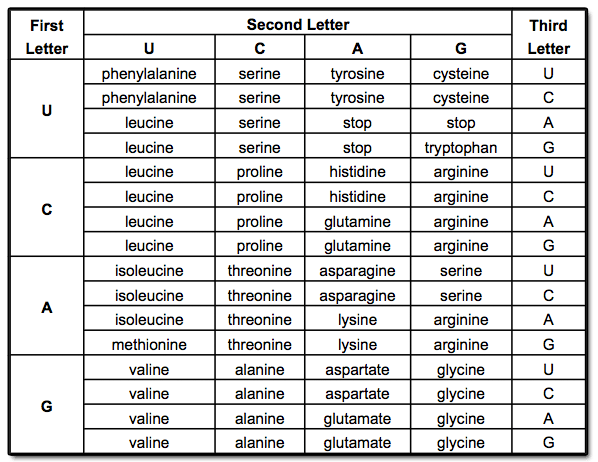
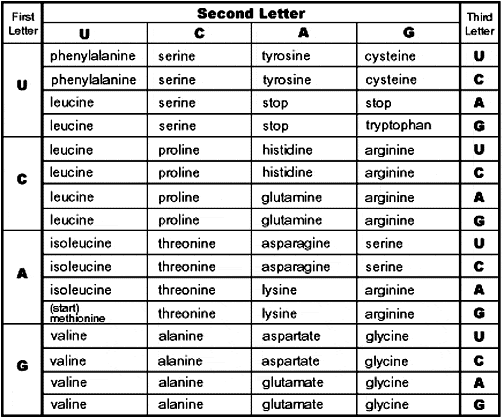
Which of the following polypeptides are coded for by the mRNA sequence
5' AUG GUU AAA 3'
Val, Lys, Phe
Met, Asp, Phe
Met, Val, Lys
Ile, Gln, Lys
Okazaki fragments are used to elongate
)the leading strand toward the replication fork
the lagging strand toward the replication fork
both strands in both directions
)the leading strand away from the replication fork
the lagging strand away from the replication fork
Which of the following statements about DNA replication is not true?
The process insures that each new cell will have the same genetic material as the original cell
The process begins at a single location on the DNA molecule called the origin of replication
The process is defined as semiconservative replication
Results in chromosomes that contain 2 DNA molecules called sister chromatids
DNA and RNA polymerases move in a 3'-5' direction.
True
False
The leading strand is produced continuously, while the lagging strand is produced discontinuously.
True
False
The elongation of Okazaki fragments during DNA synthesis progresses away from the replication fork.
True
False
Uses snRPs to edited its product.
replication
transcription
translation
At the end of this process a strand containing exons and introns have been created.
replication
transcription
translation
Uses SSBs to prevent the DNA from reannealing or snapping back together.
replication
transcription
translation
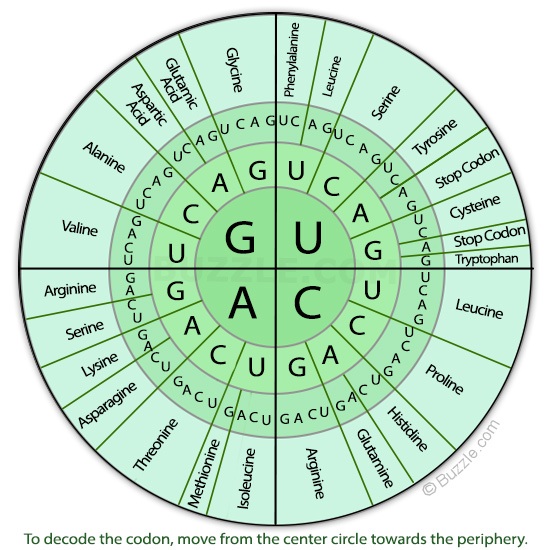
A sequence of a DNA template strand is shown.
3' TCC AAT GGC TTA TTT 5'
Which of these is the correct amino acid chain produced from the DNA template strand?
Arginine, Leucine, Proline, Asparagine
Tryptophan, Phenylalanine, Leucine
Serince, Leucine, Proline, Asparagine
Tryptophan, Phenylalanine, Leucine, Glycine
What is a chromosome?
a piece of DNA
DNA wrapped around protein
the complete genome of an organism


what is the complementary tRNA anticodons?


This acts like an “operator” - it contains genes for a metabolic pathway:
intron
operon
exon
None of the responses are correct

DNA directed DNA synthesis is also known as _______________.
Replication
Transcription
Translation
Translocation

DNA directed RNA synthesis is also known as _______________.
Replication
Transcription
Translation
Translocation

If an mRNA sequence has 12 nucleotide bases, how many amino acids would it code for?
2
4
6
8
The problem of replacing the lagging strand - adding bases in the 3' -> 5' direction - is solved through the use of
Base pairing
Replication forks
DNA helicase
Okazaki fragments
What is the primer that is required to initiate the synthesis of a new DNA strand?
RNA
DNA
Protein
Ligase
If a protein is 9 amino acids long, how many DNA bases would make up the gene?
3
9
18
27
Which of the following is NOT true of operons
Controlled by methylation in eukaryotes
Controlled by the presence of a repressor protein
Prevents an excess of material
Controls the transcription of digestion proteins

In the bacterial transformation lab, a cell that has taken up the pGFP plasmid (view image) is grown on a plate with agar infused with ampicillin. We would expect the bacteria to
Be killed by ampicillin
Be ampicillin resistant and glow
Be ampicillin resistant but not glow
Will only glow

