
 Worksheets
INT-SCIENCE REVISION TEST
Total questions: 56
Worksheet time: 37mins
Which of the following is other term for trachea
Pharynx
Throat
Windpipe
Larynx
The narrow tube that branched from the trachea connected to each of the two lungs
Bronchi
Epiglottis
Veins
Cilia
The tube that leads from the nose and mouth to the trachea
Esophagus
Pharynx
Trachea
Larynx
What are tiny air sacs at the end of each bronchiole, where exchange of gases takes place?
Alveoli
Capillaries
Bronchus
Cilia
Which of the following statement is FALSE?
Nose serves as the entrance and exit of the respiratory system
Sneezing can expel particles from nose when they accumulate
Particles stick to mucus membrane lining the nasal passages
Mucus membrane filter the dust and other particles that enters the air
Which of the following is the pair of spongy air filled organs which occupy a region in the chest?
Rib cage
Heart
Lungs
Kidney
The organ which is domed shape located below the lungs and primary muscle used in respiration
Diaphragm
Lungs
Bronchi
Heart
What is the narrow blood vessels that covers the alveoli?
cilia
capilliaries
epiglottis
voice box
Which organ makes sound when you talk?
Larynx
Pharynx
Tongue
epiglottis
Which of the following would protect lungs?
cilia and mucus membrane
pleural membrane and ribcage
diaphragm and linings
it is safe from where it is located
Right atrium
Has muscular wall
Has thin wall
Carry deoxygenated blood
Carry oxygenated blood
Allows the flow of blood in only one direction from right atrium to the right ventricle
Bicuspid valve
Tricuspid valve
Semilunar valve
It has one layer of cells
Has no valves
Has the smallest lumen
Based on the characteristics above, what is the type of blood vessel?
(a)

name the blood vessel in the diagram
(a)

What is the functions of the blood vessel above
Transports oxygenated blood from heart to the whole body - except lungs
Transport deoxygenated bills back to heart from the whole body - except lungs
Human have double blood Circulatory system...what are those
Pulmonary circulatory system
Systemic circulatory system
Systole circulatory system
Diastole circulatory system
In pulmonary circulatory system, blood from right ventricle is pump to pulmonary artery. And it will go to
(a)
Which of the following describes systole during heartbeat
Closure of tricuspid and bicuspid valve
Closure of semilunar valve
Relaxation of ventricle
Contraction of ventricle
Tools needed to take blood pressure
Barometer
Sphygmomanometer
Stethoscope
Telescope
Who has the higher pulse rate


Name the muscular wall which separates the left side and right side of heart
(a)

What is transpiration?
Excess water being released from the aerial parts of plants in the form of water vapor
Excess sugar being released from the leave
The way a plant makes its food
When the plant uses sugar for energy
Transpiration is a part of____________?
Condensation
Sublimation
Evaporation
Precipitation
Water transported from stems to leaves through what?
xylem
phloem
stems
roots
Select all of the environmental factors that would increase transpiration.
Increased humidity
Increased wind speed
Increased temperature
Decreased surface area
What is a cuticle? Choose 2
A waxy layer of a fatty substance called cutin covering the epidermis
A waxy layer of a fatty substance called cutin covering the dermis
Part of Xylem
A plant cuticle is a protecting film covering the epidermis of leaves
Which is true?
99% of water taken by the plant evaporates through transpiration
9% of water taken by the plant evaporates through transpiration
Evaporation through transpiration accounts only for 1% of all the water the plant takes in
Evaporation through transpiration is minuscule
Adaptation to reduce transpiration
Broader leaves
absence of cuticle
More stomata
Narrow leaves
Kidney shaped cells at the border of the stomata
Lenticels
Cuticle
Guard cells
Hydathodes
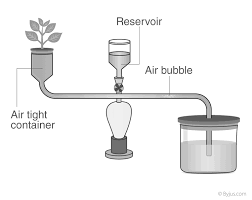
What happens to the movement of air bubble if apparatus is kept in front of a fan
Air bubble does not move
Air bubble moves very little
Air bubble does not change its position
Air bubble moves very fast

If plants don't store up water, how does water leave the plant?
The roots get rid of excess water.
Most plants DO store water.
It is released from the leaves by TRANSPIRATION.
Which picture shows the cuticle?


Remember when you put the celery in the water? What happened to the water level by the next day?
The level dropped A LOT, because the celery sucked it up.
The level stayed the same, because the celery was dead.
The level dropped a little, because of evaporation.
Water molecules pull each other up the xylem due to ______________.
capillary action
root pressure
osmosis
active transport
All of the following are forces involved in the process of transpiration EXCEPT ____________.
root pressure
capillary action
active transport
transpiration pull

is considered the founder of the study of microscopy and an played a vital role in the development of cell theory.
Leeuwenhoek
Chester Moore
Zaccharias Janssen
Hans Lipperhey
What type of microscope is most used in science classes?
simple microscope
electron microscope
compound microscope
On the microscope stage, what is used to hold the glass slide in place and prevent it from moving?
Condenser
Stage clip
Fine adjustment knob
Stage
Which of the following are low power lenses?
4X
40X
400X
100X
COVID-19 virus can't be seen under 25x optical magnifying microscopes
True
False

