
 Worksheets
Big Bang, Scientific Theory/Law, Spectral Lines
Total questions: 70
Worksheet time: 2hrs 45mins


The color of emitted light with the LONGEST wavelength is
violet
green
red
indigo
The color of emitted light with the SHORTEST wavelength is
violet
green
red
indigo

A wave with a long wavelength will have a ______ frequency and _____ energy
high, low
high, high
low, high
low, low
The color of emitted light with the HIGHEST frequency is
violet
green
red
indigo
The color of emitted light with the LOWEST frequency is
violet
green
red
indigo

The unknown emissions spectra belongs to the element
Hydrogen
Mercury
Neon
Sodium

The unknown emissions spectra belongs to the element
Hydrogen
Mercury
Neon
Sodium

The unknown emissions spectra belongs to the element
Hydrogen
Mercury
Neon
Helium


Which form of radiation has the highest frequency?
radio waves
ultraviolet
x-ray
gamma

What element is the unknown spectra?


Which element(s) is/are in Unknown W?
Cadmium, Potassium, and Helium
Hydrogen, Potassium, and Lithium
Cadmium and Sodium
Only Sodium

What kind of spectrum is this?
absorption spectrum
continuous spectrum
emission spectrum
The unknown emissions spectra belongs to the element
Hydrogen
Mercury
Neon
Sodium
Most scientists believe the Big Bang Theory explains which of the following questions?
How our planets and moons formed
How our universe began
How the sun turns hydrogen into helium
How fast light travels through space
Where is the center of the universe located?
There is no center of the universe.
At the center of the Milky Way galaxy.
14.5 billion light years away from Earth.
In a large singularity near the Andromeda Galaxy.
How is the "Big Bang" described?
an explosion
an expansion
a contraction

The leftover energy from the origin of the universe that we see today. It is detected as "noise" or static.
Cosmic microwave radiation
sunlight
Doppler effect
Cosmic explosions
As galaxies move away from our galaxy
a shift on the electromagnetic spectrum is noticed. This phenomena is
called _____________.
redshift
blueshift
Hydrogen was the first element to be formed after the big bang, because...
It is the simplest element
the temperature at that time was just right for hydrogen
It is used as fuel for stars
it was chosen completely at random
An infinitely small, infinitely dense, and infinitely hot point that is believed to have existed before the big bang.
Singularity
Antimatter
Little bang
condensation nuclei
350,000 years after the big bang, gravity pulled all the hydrogen atoms into big balls of gas that ignited under pressure, creating the first __________.
Stars
Planets
Amoebas
Light
How old was the universe when the very first atoms started to form?
Atoms formed at the instant of the Big Bang
Atoms formed a few hundred million years after the Big Bang
Atoms formed in the first minutes after the Big Bang
Atoms still haven't formed. We can't see them, so they don't exist.
What does the Big Bang Theory hypothesize about the size of the early universe?
The universe used to be much much larger than it is today.
The universe used to be a tiny speck of super-dense matter.
The universe has always been the same size
What observation have astrophysicists made about the rate at which the universe is changing size?
The universe is growing faster and faster
The universe is still growing, but it's slowing down
The universe is shrinking faster and faster
The universe is shrinking, but it's slowing down and should stop soon.
Which formed first after the "Big Bang?"
Galaxies
Stars
Planets
Quarks, Protons, Neutrons and Electrons that eventually formed the first atoms
Which of these explain how a natural phenomenon works or happens?
theory
law
Which of these describes a natural phenomenon or relationship that always occurs under specific conditions
theory
law
Check all the statements that apply to a scientific theory.
States that an event will occur
A repeatable pattern in nature
Can be rejected or modified
Based on repeated observations
Explains how or why an event occurred
Check all the statements that apply to a scientific law.
States that an event will occur
A repeatable pattern in nature
Can be rejected or modified
Based on repeated observations
Explains how or why an event occurred
The Big Bang is an example of a
Scientific Theory - we cannot prove how the universe began but we have evidence that suggests some kind of "big bang" beginning
Scientific Law - we know the universe exists and that it has gravity

The universe is EXPANDING! This means that:
all of the galaxies are spreading out or MOVING APART.
the universe must have started from a many points around the universe.
the universe is getting HOTTER
all of the above.

Galaxies that are REDSHIFTED are:
actually BLUE
really NEAR earth
invisible or not visible
moving AWAY from us.

When objects move away from you, the wavelength....
Increases (gets longer)
Decreases (gets shorter)

The top spectra is the laboratory spectra and is not moving. What type of shift is shown with the bottom spectra and is the object moving towards or away from the observer?
Red Shift
Towards
Red Shift
Away
Blue Shift
Towards
Blue Shift
Away

The top spectra is the laboratory spectra and is not moving. What type of shift is shown with the bottom spectra and is the object moving towards or away from the observer?
Red Shift
Towards
Red Shift
Away
Blue Shift
Towards
Blue Shift
Away

Based on the picture above, which has the longest wavelength?
infrared
x-ray
microwave
ultraviolet

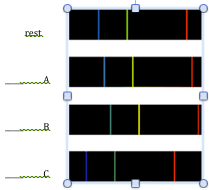
Is Galaxy A moving
Away
Towards
Stationary

Based on these spectra, which Galaxy is moving at the fastest speed away from the Milky Way?
Según estos espectros, ¿qué galaxia se está alejando a mayor velocidad de la Vía Láctea?
Galaxy B
Galaxy C
Galaxy D
Based on these spectra, which Galaxy is moving at the slowest speed away from the Milky Way?
Según estos espectros, ¿qué galaxia se está alejando a la velocidad más lenta de la Vía Láctea?
Galaxy B
Galaxy C
Galaxy D

The spectral lines for the Distant Galaxy are ___, indicating it is moving ___ us.
Las líneas espectrales de la galaxia distante son ___, lo que indica que se mueve ___ hacia nosotros.
red-shifted, toward
red-shifted, away from
blue-shifted, toward
blue-shifted, away from
According to theory, the universe started out:
Steady State
Frozen
Hot and dense
Ripped
*Which statement BEST summarizes The Big Bang Theory?
whole universe began as a black hole and rapidly expanded, but is now collapsing
whole universe began as a cool dense point and rapidly collasped, but is now expanding
whole universe began as a single mass, rapidly expanded, and continues to expand
the whole universe began as a hot dense point and rapidly expanded, but is now collapsing
What type of galaxy is the Milky Way?
Spiral
Elliptical
Irregular
Transition
This type of galaxy is generally considered to be older and is no longer forming stars.
Spiral
Irregular
Elliptical
Transition Galaxies



