Wayground logo

Free Printable Worksheets

Font size

S
M
L
XL
Worksheets

Energy in Ecosystem- Unit 6

Total questions: 77

Worksheet time: 1hrs 7mins

Name
Class
Date
1.
What energy role describes an organism that makes its own food, usually by using energy from the sun?
a)
consumer
b)
producer
c)
carnivore
d)
decomposer
2.
Hetetrotroph is another word (a synonym) for
a)
scavenger
b)
producer
c)
autotroph
d)
consumer
3.
All of the following are types of consumers EXCEPT for
a)
carnivore
b)
herbivore
c)
omnivore
d)
producer
4.
These organisms break down decaying biotic wastes and then return the materials to the ecosystem.
a)
decomposers
b)
scavengers
c)
carnivores
d)
producers
5.
An maple tree takes in energy from the sun and uses it to make food for itself. This energy role is
a)
herbivore
b)
omnivore
c)
producer
d)
consumer
6.
Vultures use their excellent sense of smell to find newly dead organisms to eat. This energy role is 
a)
scavenger
b)
decomposer
c)
carnivore
d)
herbivore
7.

In the food web above, what eats the rabbit?

a)

Fox

b)

Hawk

c)

Vole

d)

Grass

8.

In the food web above, what organism is missing from this food chain:

Grass --> Slug --> ________ --> Hawk

a)

Vole

b)

Frog

c)

Insect

d)

Thrush

9.

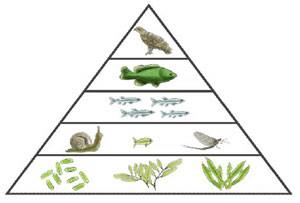
In the energy pyramid, what is the bottom level composed of?

a)

Producers

b)

First-Level Consumers

c)

Second-Level Consumers

d)

Third-Level Consumers

10.

In the energy pyramid, what comes after the producers?

a)

Producers

b)

First-Level Consumers

c)

Second-Level Consumers

d)

Third-Level Consumers

11.
Which organism gets its energy by eating sea otters?
a)
Sea urchins
b)
Sea Stars
c)
Sharks
d)
Large crabs
12.
Which organism in the food web is a producer?
a)
Mouse
b)
Owl
c)
Green Plant
d)
Snake
13.
Which organism in this food web is an herbivore?
a)
Frog
b)
Grasshopper
c)
Mouse
d)
Snake
14.
Which of the following diagrams would show all of the feeding connections within an ecosystem?
a)
Food web
b)
Food Chain
c)
Energy Web
d)
Energy Pyramid
15.
Which of the following diagrams would show how much energy is transferred between feeding levels in an ecosystem?
a)
Food web
b)
Food Chain
c)
Energy Web
d)
Energy Pyramid
16.

Position that an organism occupies based on what it eats

a)

Producer

b)

Trophic level

c)

Heterotroph

d)

Consumer

17.
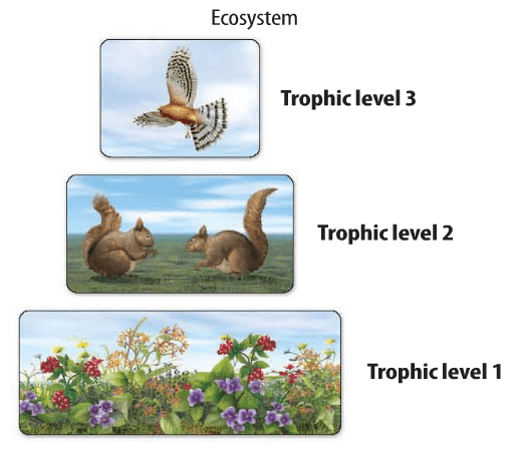
If there is 1000 Kcal available in the producers in trophic level 1, how much energy is available in the herbivores in trophic level 2?
a)
10 Kcal
b)
1 Kcal
c)
100 Kcal
d)
1000 Kcal
18.
If these organisms were arranged in a food pyramid, which organism would have the least amount of total energy available?
a)
coyote
b)
insect
c)
lizard
d)
shrub
19.

Using the food web what would happen if the eagle became extinct?

a)

The frog population would decrease.

b)

The frog population would increase.

c)

The butterfly population would increase.

d)

The snake population would decrease.

20.
A connection of food chains with many food energy paths in an ecosystem is a ____________
a)
ecosystem
b)
food web
c)
environment
21.

What would happen to the bird if the green fish died out?

a)

the bird population would grow

b)

the bird population would die out

c)

the smaller fish will die out

22.

What is the bottom layer of the an energy pyramid?

a)

producer

b)

tertiary consumer

c)

Secondary consumer

d)

primary consumer

23.

the top layer of an energy pyramid a primary consumer?

a)

true

b)

false

24.

All tertiary consumers are scavengers

a)

true

b)

false

25.

What would happen if their were no producers?

a)

Every population would grow larger

b)

Everything would die out

c)

The animals would make their own food

26.

What would happen if the primary consumers died out?

a)

the producers would grow and the secondary and tertiary consumers would die

b)

producers would die out

c)

consumers would grow

27.
How much energy is lost when organisms consume another organism from a different level? 
a)
90%
b)
20%
c)
50%
d)
10%
28.
Where do producers get their energy? 
a)
soil
b)
decomposers
c)
sun
d)
garbage
29.
These organisms exit within every trophic level giving nutrients back to the soil.  
a)
plants
b)
bees
c)
birds
d)
worms
30.
Makes its own food
a)
autotroph
b)
heterotroph
c)
herbivore
d)
biomass
31.
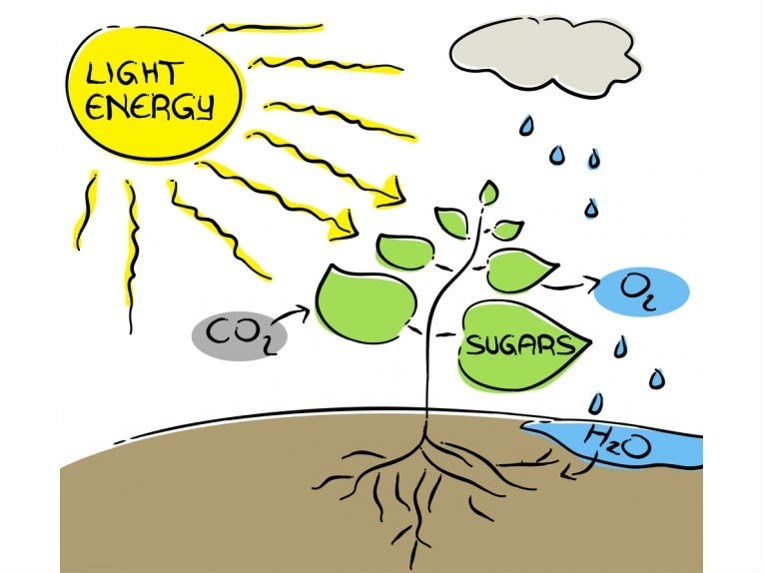
Process through which plants make their own food
a)
autotroph
b)
producer
c)
photosynthesis
d)
biomass
32.
Position that an organism occupies based on what it eats
a)
biomass
b)
autotroph
c)
trophic level
d)
carnivore
33.
Cannot make its own food
a)
heterotroph
b)
autotroph
c)
producer
d)
decomposer
34.
Living organic matter
a)
trophic level
b)
photosynthesis
c)
herbivore
d)
biomass
35.
Only eats plants
a)
omnivore
b)
carnivore
c)
herbivore
d)
tertiary consumer
36.
Only eats meat
a)
omnivore
b)
herbivore
c)
carnivore
d)
primary consumer
37.
All energy transformations in an ecosystem begin with
a)
a scavenger
b)
the sun
c)
a decomposer
d)
a herbivore
38.
What is the study of the interactions among organisms and  between organisms and their environments called?
a)
Biology
b)
Ecology
c)
Astronomy
d)
Biosphere
39.

Which of the following would be the most likely effect, if there were a sudden increase in the cricket population?

a)

There would be a decrease in the small bird population.

b)

There would be a decrease in the grass/flowers population.

c)

There would be a decrease in the mice population.

d)

There would be an increase in the grass/flowers population.

40.
A food chain shows the transfer of ___ from one organism to another. 
a)
matter
b)
consumers
c)
energy
d)
habitat
41.
What level consumer is the owl in the food chain?  
a)
Tertiary
b)
Primary
c)
Secondary
d)
Quarternary
42.
What organism consumes both rabbits and birds?
a)
The Hawk
b)
The Wolf
c)
The Plant
d)
The Mushroom
43.
How many primary consumers are in this food web?  
a)
1
b)
2
c)
3
d)
4
44.
Who are the primary producers in this food web?  
a)
The lizard and the Hawk
b)
The Grasshopper and the Mouse
c)
The rabbit and the Hawk
d)
The lizard and the snake
45.
What level consumer could you consider the deer?  
a)
Primary
b)
Secondary
c)
Tertiary
d)
Quarternary
46.
A food web, is a series of interconnected food chains put together to represent an environment.  The arrows which represent energy transfer, show energy leaving an organism, to be consumed by another.  Who or what does the rabbit, get its energy?  
a)
grasshopper
b)
fox
c)
rabbit
d)
green plants
47.
oxygen is a gas produced by _ and used by  _ 
a)
plants and animals 
b)
photosynthesis and carbon dioxide 
c)
animals and plants 
d)
carbon dioxide and photosynthesis
48.
All of the carbon in existence is continually recycled in the carbon cycle
a)
True
b)
False
49.
Which of the following removes carbon from the atmosphere?
a)
Combustion
b)
Respiration
c)
Photosynthesis
d)
Death
50.
Which of the following is an example of a decomposer?
a)
Owl
b)
Fish
c)
Tree
d)
Mushroom
51.
Organisms that do not decompose can be buried and become what?
a)
water
b)
nutrients
c)
air
d)
fossil fuels
52.
Which process converts carbon in the form of sugar into carbon dioxide gas?
a)
Bioremediation
b)
Photosynthesis
c)
Respiration
d)
Transpiration
53.
If the plant population decreased, the amount of carbon would _________.
a)
Stay the same
b)
Increase
c)
Decrease
54.
carbon dioxide is a gas produced  by ________ and used by __________
a)
plants and animals 
b)
carbon and photosynthesis
c)
animals and plants 
d)
photosynthesis
55.

Which describes the relationship between plants and animals in the carbon cycle?

a)

Plants produce and release oxygen that animals need

b)

Plants produce and release carbon dioxide that animals need

c)

Animals produce and release oxygen that plants need

d)

Animals produce oxygen that plants turn into carbon dioxide

56.

Which is a true statement?

a)

Humans depend on oxygen, plants depend on carbon dioxide

b)

Plants produce carbon dioxide

c)

Humans depend on carbon dioxide, plants depend on oxygen

d)

Humans don't depend on plants for the air they need

57.

Plants use ____________ to make their own food

a)

Water

b)

Sunlight

c)

Carbon dioxide

d)

All of these

58.

Which gas do plants release, that humans depend on for survival?

a)

Water

b)

Carbon Dioxide

c)

Oxygen

d)

Sugar

59.
Carbon can be found in...
a)
The atmosphere
b)
Soil
c)
Fossil fuels
d)
All of the above
60.

Which of the following is correct?

a)

There is as much carbon on earth as when it was formed

b)

Carbon is being created whenever it is recycled

c)

Carbon is lost every time it is recycled

d)

Carbon changes to different forms and is never recovered

61.

A network of feeding interactions that shows all the interrelated food chains in an ecosystem

a)

trophic level

b)

food web

c)

biomass pyramid

d)

pyramid of numbers

62.

Each step in a food chain or web

a)

trophic level

b)

food web

c)

biomass pyramid

d)

pyramid of numbers

63.

Who is on the third energy level?

a)

leaf

b)

catepillar

c)

chamelon

d)

snake

e)

mongoose

64.

Who is the producer?

a)

leaf

b)

catepillar

c)

chamelon

d)

snake

e)

mongoose

65.

Who is the primary consumer?

a)

leaf

b)

catepillar

c)

chamelon

d)

snake

e)

mongoose

66.

Who is the tertiary consumer?

a)

leaf

b)

catepillar

c)

chamelon

d)

snake

e)

mongoose

67.

Who is the herbivore?

a)

leaf

b)

catepillar

c)

chamelon

d)

snake

e)

mongoose

68.

There are 40,000g of biomass energy available on trophic level one. How much energy is available for the tertiary consumer?

a)

400,000g

b)

4,000g

c)

400g

d)

40g

e)

4g

69.

Which organism is a top consumer in this food web? Pick all that apply

a)

rabbit

b)

owl

c)

bird

d)

fox

e)

carrot

70.

Which is NOT a food chain in this food web?

a)

carrot --> rabbit --> fox

b)

grasses --> grasshopper --> owl

c)

bird --> grasshopper --> grains --> owl

d)

grains --> mice --> owl

e)

grasses --> grasshopper --> bird --> fox

71.

Total amount of living tissue found in an organism.

a)

biomass

b)

ingested energy

c)

egested energy

d)

cellular respiration

72.

There are 40,000g of biomass energy available on trophic level one. How much energy is available for the secondary consumer?

a)

400,000g

b)

4,000g

c)

400g

d)

40g

e)

4g

73.

If there are 5 top consumers, how many producers would be available?

a)

50

b)

500

c)

5000

d)

50,000

74.

Natural overlapping food chains in an ecosystem

a)

Food chain

b)

Energy pyramid

c)

Food web

d)

Trophic level

75.

Organisms that produce their own food from nonliving sources (producers)

a)

Autotroph

b)

Consumers

c)

Heterotroph

d)

Omnivores

76.

Organisms that get their nutrition from other living things (consumers)

a)

Heterotroph

b)

Autotroph

c)

Carnivore

d)

Abiotic

77.

Each level in an ecosystem where organisms share the same role in a food chain

a)

Energy pyramid

b)

Trophic level

c)

Heterotroph

d)

Food web