wayground logo

Free Printable Worksheets

Font size

S
M
L
XL
Worksheets

Unit 9-11 Review

Total questions: 86

Worksheet time: 43mins
Name
Class
Date
1.
The cause of the split in Islam after Muhammad's death was a difference of opinion concerning -
a)
leaders
b)
pilgrimages
2.
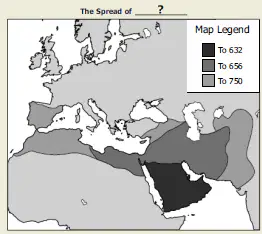
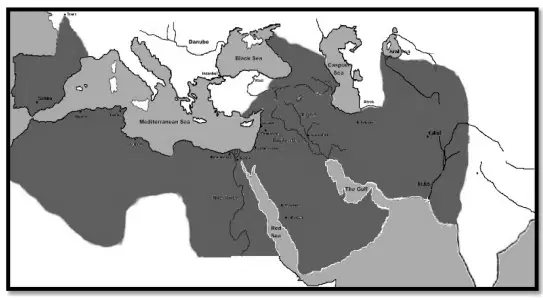
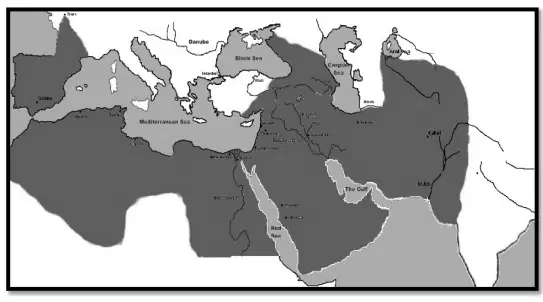
The darker shaded area shows Islam spread, after Muhammad’s death, across Asia and Africa into –
a)
Spain.
b)
England.
3.
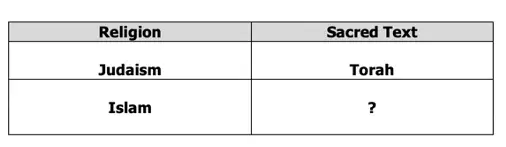
Which is the sacred text for Islam?
a)
Qur’an (Koran)
b)
Torah
4.
Muslims perform individual duties shown which are called the –Based on the text above, your fourth question.
a)
Ten Commandments.
b)
Five Pillars.
5.
Which was the result of the death of Ali?
a)
split between the Sunni and Shiite Muslims took place
b)
Political unity in the Muslim community was preserved
6.
By 750, the Islamic capital city was moved by the Abbasids from Damascus to which city that eventually exceeded Constantinople in wealth and size?
a)
Medina
b)
Baghdad
7.
Which group was most responsible for spreading this cultural characteristic?
a)
Islamic traders
b)
Egyptian pharaohs
8.
Which characteristic describes the earliest followers of Islam?
a)
Nomads in West Africa
b)
Migrated from Central Asia
c)
Lived on the Arabian Peninsula
d)
Sea traders from South Asia
9.
Once the Arabs united, they conquered areas in Syria and Palestine controlled by the Byzantine Empire. Which two cities were part of this conquest?
a)
Mecca and Medina
b)
Damascus and Jerusalem
c)
Baghdad and Cairo
d)
Tours and Alexandria
10.
As the Muslims moved into northern territories, they were defeated by Frankish armies at –
a)
Jerusalem.
b)
the Battle of Tours.
c)
Constantinople.
d)
the fall of Baghdad.
11.
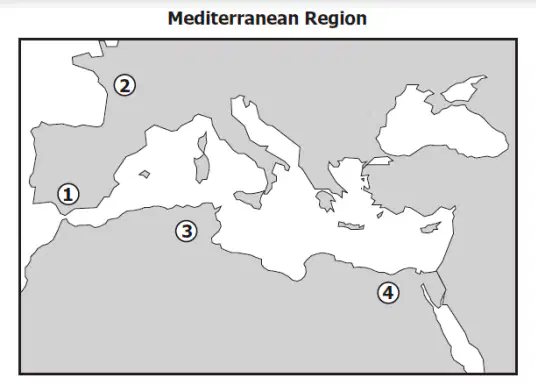
Which number marks the location where the Battle of Tours took place?
a)
1
b)
2
c)
3
d)
4
12.
Which best facilitated trade across the Islamic lands?
a)
Climate
b)
Priests
c)
Slavery
d)
Language
13.
Which is a factor that helps explain the series of Muslim victories into the Fertile Crescent, Iran, and Central Asia?
a)
Natural disasters kept some regions from defending themselves
b)
Roman troops attacked the provinces at the same time
c)
The Byzantine and Persian empires had weakened
d)
Leaders hoped to increase their prestige by proclaiming allegiance to the Muslim armies
14.
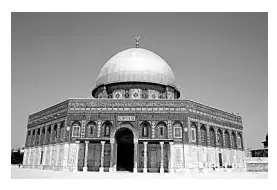
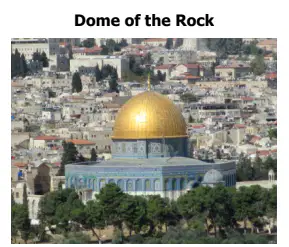
In 637, Muslims gained control of Jerusalem. The site known for its architecture shown is the -
a)
Church of the Holy Sepulcher.
b)
Al-Aqsa Mosque.
c)
Kaaba.
d)
Dome of the Rock.
15.
Arabic numerals including zero were spread to Europe, but were adopted from –
a)
Rome.
b)
China.
c)
India.
d)
Persia.
16.
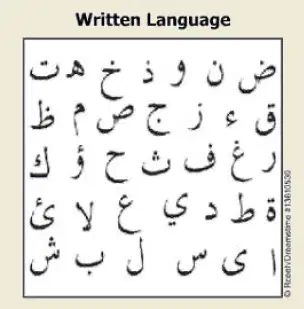
All were considered cultural contributions and achievements of the Islamic civilization except –
a)
mosaics.
b)
Arabic alphabet.
c)
architecture.
d)
destruction of ancient texts.
17.
What helped spread knowledge, culture, products and technology from Mecca and Medina to other regions?
a)
Geographic barriers
b)
Buddhism
c)
Slavery
d)
Trade routes
18.
The Battle of Tours was significant because it marked the —
a)
end of Muslim expansion into Western Europe
b)
end of the Crusades in the Middle East
c)
beginning of British dominance in Northern Europe
d)
beginning of Turkish rule in the Balkans
19.
The Dome of the Rock is an example of which civilization’s achievements in art and architecture?
a)
Chinese
b)
Greek
c)
Islamic
d)
Roman
20.
Which religion encourages its followers to make a pilgrimage to this site?
a)
Islam
b)
Hinduism
c)
Buddhism
d)
Christianity
21.
What best completes the title of this map?
a)
the Plague
b)
Islam
c)
Judaism
d)
the Crusades
22.
Which of the following did not occur as a result of Arab advancements and gaining of new territory?
a)
New knowledge spread across the region
b)
Muslims gained control of important trade route
c)
Trade increased in the new territoriy
d)
Islam replaced Christianity as Europe's main religion
23.
Which demonstrates one democratic feature of the Roman Republic?
a)
Rule was dominated by a powerful king
b)
Recommendations were passed by a Senate
c)
Military leaders were promoted based on wealth
d)
a priest had the authority to manage political affairs
24.
Which Indicates the importance of Constantinople's location?
a)
Strategic protection of the western frontier
b)
close to Germanic invasions
c)
protected by mountainous terraine
d)
crossroad for trade
25.
Along with trade Justinian also
a)
accepted islam within his kingdom
b)
codified Roman Law
c)
kept Latin the official language.
d)
outlawed Christianity.
26.
The acceptance of the authority of the pope in the West and the patriarch in the East caused what response between the Eastern and Western Churches?
a)
A division between the churches took place
b)
A war occurred between both sides
c)
A determination to mend differences developed
d)
An agreement was made to recognize only the Pope
27.
Emperor Constantine chose the location for a new capital partly for its distance from –
a)
trade routes.
b)
feudal kingdoms.
c)
Mongol hordes.
d)
Germanic invaders.
28.
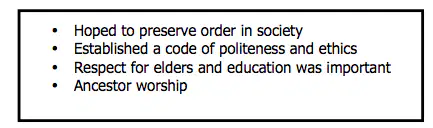
Which individual was responsible for the Chinese social movement shown?
a)
Qin Shi Huangdi
b)
Asoka
c)
Confucius
d)
Buddha
29.
Taoism stresses which of the following?
a)
Eightfold path to Enlightenment
b)
Four Noble Truths
c)
Harmony with nature and humility
d)
Karma
30.
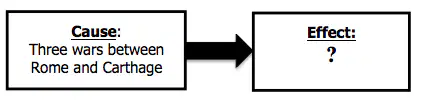
Victory eventually led to Roman Diffusion of culture and control of--
a)
Northern Europe.
b)
Asia Minor.
c)
the Middle East.
d)
the Mediterranean Basin.
31.
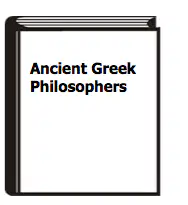
Which of the following would most likely be included in the book shown?
a)
Aristotle
b)
Sophocles
c)
Archimedes
d)
Herodotus
32.
Which is true of the role of Constantinople?
a)
The city was founded and permanently controlled by the Ottomans
b)
Was considered the capital of the Western Roman Empire
c)
Was a link to the past preserving classical Greco-Roman culture
d)
The city was too isolated making trade impossible
33.
Who was accepted as the highest authority by Byzantine Christians?
a)
The Pope
b)
The Friar
c)
The Patriarch
d)
The Cleric
34.
All are ways the Byzantine culture influenced Eastern Europe and Russia except –
a)
ideas spread through trade routes of the Black and Baltic Seas
b)
adoption of the Greek alphabet for the Slavic languages
c)
adoption of the Roman Catholic Church
d)
aspects such as religious art and architecture were adopted
35.
Constantinople was the seat of the Byzantine Empire until –
a)
trade declined.
b)
the Ottoman conquest.
c)
the Pope died.
d)
the Second Triumvirate.
36.

After the collapse of the Roman Empire, all established the

foundations for early medieval society in Western European

except -

a)

classical heritage of Rome

b)

customs of Germanic tribes

c)

ties with advanced civilizations to the east

d)

Christian beliefs and traditions

37.

What was the mahor effect of Pope Leo III anointing

Charlemagne Emperor in 800 A.D. (C.E.)?

a)

The power of the Church was established in political life

b)

Authority of the Roman Catholic Church declined

c)

The Franks rejected Catholic beliefs and doctrine

d)

Allowed for secular authority to increase

38.

In medieval Europe, a lord who was granted land in exchange for

service and loyalty to a greater lord was called a –

a)

fief.

b)

vassal.

c)

serf.

d)

baron.

39.

In medieval times, each parcel of land was called a –

a)

fief.

b)

vassal.

c)

serf.

d)

convent.

40.

In feudal society, the peasants that worked the land were called –

a)

fiefs.

b)

vassals.

c)

serfs.

d)

lords.

41.

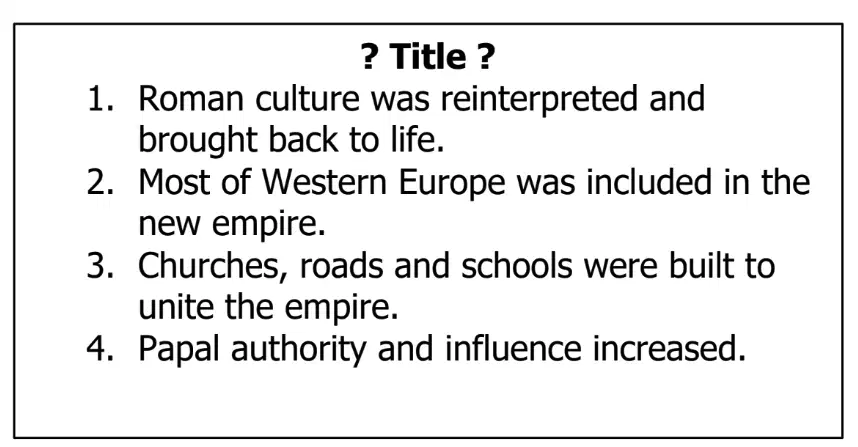
Which would be a correct title for the graphic?

a)

The Great Schism

b)

Age of Charlemagne

c)

Contributions of Justinian

d)

The Manorial System

42.

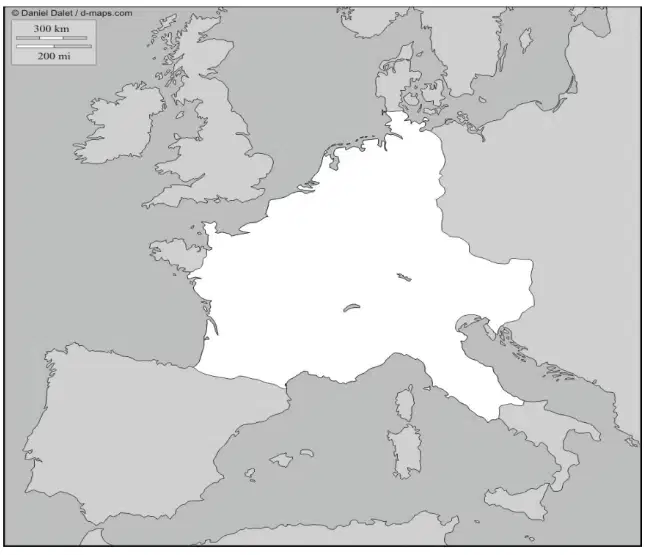
Which Germanic tribe emerged as a force and eventually formed

an empire in Western Europe as shown in white on the map?

a)

Goths

b)

Vandals

c)

Saxons

d)

Franks

43.

Which best replaces the question mark in the graphic?

a)

Scandinavia

b)

Central Europe

c)

China

d)

England

44.

During the Middle Ages, the manorial system – 

a)

had no mutual obligations.

b)

provided little class structure.

c)

was self-sufficient.

d)

was serf controlled.

45.

Which is not an effect from the invasions of the Angles, Saxons,

and Magyars?

a)

Conversion to Christianity

b)

Trade was disrupted

c)

Towns declined

d)

Feudalism weakened

46.

Which group ventured far from their homeland in Scandinavia to

settle in areas today known as Russia, Iceland, and Greenland?

a)

Angles

b)

Vikings

c)

Saxons

d)

Magyars

47.

Tribal units in the Medieval Period were led by – 

a)

chieftains.

b)

serfs.

48.

The Angles and Saxons migrated in the fifth century influencing 

which present-day nation?

a)

1

b)

2

c)

3

d)

4

49.

The Vikings originated closest to which number on the map?

a)

1

b)

2

c)

3

d)

4

50.

Which is a direct factor as to why the Vikings began to explore and invade other regions in the 9th and 10th centuries?

a)

Spread Christianity

b)

Preserve Greco-Roman culture

c)

Lack of arable land

d)

To promote peace

51.
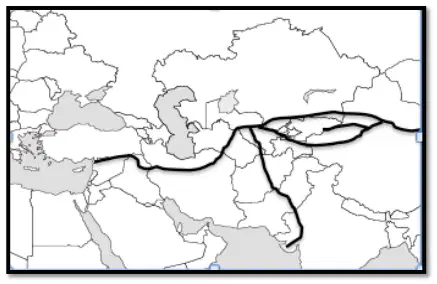
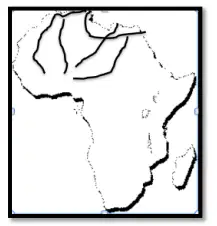
Which trade pattern shown connected Asia to the Mediterranean basin?
a)
Silk Routes
b)
Maritime routes
c)
Western Europe river trade
d)
Trans-Saharan routes
52.
Which trade pattern shown existed around 1000 to 1500 A.D. (C.E.)?
a)
Maritime routes
b)
Trans-Saharan routes
c)
Silk Routes
d)
Black Sea route
53.
New technology such as the windmill and the waterwheel spread mainly from –
a)
South America.
b)
North America.
c)
the Middle East.
d)
Africa.
54.
The most valued items were spices that were used for many purposes. The spice trade mainly revolved lands near the –
a)
Indian Ocean.
b)
Atlantic Ocean.
55.
Religious ideas diffused across trade routes. For example, Buddhism spread from China influencing –
a)
the Middle East.
b)
West Africa.
c)
Korea and Japan.
d)
Latin America.
56.
Originally, the technology of paper was brought to the Muslims from –
a)
India.
b)
China.
c)
West Africa.
d)
Southeast Asia.
57.
India was the origin of –
a)
new crops such as sugarcane.
b)
waterwheels.
c)
the compass.
d)
porcelain products.
58.
The ideas of which religion spread from the Arabian Peninsula to parts of West Africa, and then to Central and Southeast Asia?
a)
Hinduism
b)
Buddhism
c)
Islam
d)
Shinto
59.
All were major trade routes from 1000 to 1500 A.D. except-
a)
Maritime routes across the Indian Ocean
b)
Trans-Saharan routes
c)
Silk Routes
d)
North American canals and rivers
60.
Which Asian archipelago is being described?
a)
Korea
b)
China
c)
Japan
d)
Vietnam
61.
Which religion is indigenous to Japan and has been able to coexist with Buddhism?
a)
Islam
b)
Judaism
c)
Hinduism
d)
Shinto
62.
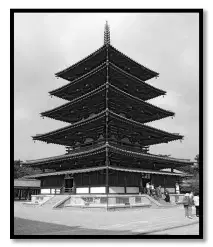
Which mainly influenced the pagoda architecture shown in Japan?
a)
Astronomy practices from Africa
b)
Islam spread by Indian traders
c)
Code of the samurai
d)
Buddhism from China
63.
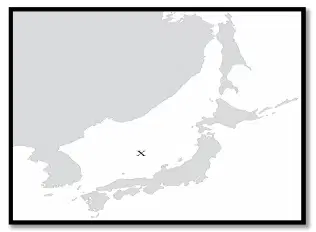
The “X” on the map identifies the location of the Sea of Japan. Another name that identifies this sea is -
a)
the Red Sea.
b)
the East Sea.
c)
the Black Sea.
d)
the East China Sea.
64.
Genghis Khan was the 13th-century warrior in central Asia who founded which great empire?
a)
Incan
b)
Egyptian
c)
Mongol
d)
Mughal
65.
Between 1236 and 1241, which group invaded Russia along with surrounding areas creating a political entity that ruled the region for more than 150 years?
a)
Armies of Alexander the Great
b)
Roman legions
c)
Spartan warriors
d)
The Golden Horde
66.
According to this quotation, explorers relied on technology that originated in –
a)
China.
b)
Arabia.
c)
Italy.
d)
Spain.
67.
Which is not an effect from the invasions of the Angles, Saxons, and Magyars?
a)
Conversion to Christianity
b)
Trade was disrupted
c)
Towns declined
d)
Feudalism weakened
68.
The center of social life during the Middle ages was the
a)
Manor
b)
Church
c)
Vilage
d)
School
69.
Which explains the significance of Caltalhoyuk?
a)
A Paleolithic site where cave art was present
b)
A prehistoric monument located in England
c)
A Neolithic settlement that existed in Anatolia
d)
A site where Europe separates from Asia
70.
Which best replaces the Question mark in the graphic
a)
Qur'an
b)
New testiment
c)
Vedas and the Upanishads
d)
Eightfold Path to Enlightenment
71.
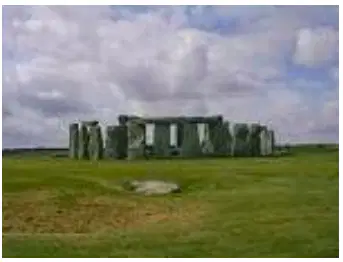
Which archaeological site shown in England was begun during the Neolithic Age and completed during the Bronze Age?
a)
Stonehenge
b)
Catalhoyuk
72.
Which Indicates the importance of Constantinople's location?
a)
Strategic protection of the western frontier
b)
close to Germanic invasions
c)
protected by mountainous terraine
d)
crossroad for trade
73.
During the Middle Ages, Greek and Latin manuscripts and documents were read and discussed paving the way for the Renaissance mainly because – (Unit 7)
a)
the Roman Empire continued to conquer new lands.
b)
monasteries preserved ancient cultural achievements.
c)
warfare from barbarian tribes declined.
d)
the Church played a lesser role in daily lives.
74.
According to the Mandate of Heaven, a Chinese Emperor could remain in power as long as he -
a)
obeyed the priests
b)
controlled the army
c)
governed as a just / fair ruler
d)
conquered many new territories
75.
The darker shaded area shows Islam spread, after Muhammad’s death, across Asia and Africa into –
a)
Scandinavia.
b)
Spain.
c)
England.
d)
Germany.
76.
By 750, the Islamic capital city was moved by the Abbasids from Damascus to which city that eventually exceeded Constantinople in wealth and size?
a)
Jerusalem
b)
Cairo
c)
Medina
d)
Baghdad
77.
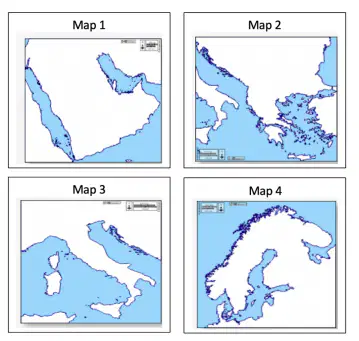
Which map shows the location of the Arabian Peninsula?
a)
Map 1
b)
Map 2
c)
Map 3
d)
Map 4
78.
The alliance between the Frankish kings and the Church led to –
a)
long-distance trade routes being established
b)
the decline of papal power in Western Europe
c)
the Church having more influence in political affairs
d)
more democratic participation in the region
79.
Which Frankish king did the Pope declare to be “Emperor?”
a)
Constantine
b)
Justinian
c)
Charlemagne
d)
St. Cyril
80.
Which best describes a self-sufficient manor?
a)
Produced everything needed including food, clothing, and tools
b)
People became nomadic looking for food and shelter
c)
People led raids on towns and monasteries for survival
d)
Dependent on trade for most items from neighboring villages
81.
Europe mainly became a feudal society because –
a)
unsanitary conditions emerged in towns
b)
overpopulation demanded efficient farming techniques
c)
cities were growing under Roman leadership
d)
protection was needed from raids and invasions
82.
Which achievements are closely associated with ancient Islamic culture?
a)
Paper, silk, and pagodas
b)
Mosques, medical books, and algebra
c)
Aqueducts, roads, and polytheistic temples
d)
Columns, democracy, and dramatic plays
83.
What was significant about the Battle of Tours?
a)
It ended the Frankish domination of Spain
b)
It was a defeat for the Muslim invading forces
c)
It allowed the Roman Army time to retreat
d)
It guaranteed women the right to vote
84.
The photograph best represents a contribution associated with –
a)
architecture
b)
education
c)
language
d)
navigation
85.
The locations in the news headlines most likely describe the migration and settlement of which group?
a)
Saxons
b)
Angles
c)
Celts
d)
Vikings
86.
Muhammad experienced profound spiritual revelations that led him to believe that –
a)
he was the last Buddhist prophet selected to serve
b)
he was chosen by Allah to be a prophet forming a new religion
c)
Allah was one of many gods and goddesses
d)
he should warn the population about Christian and Jewish prophets