
 Worksheets
Micro Sudy
Total questions: 123
Worksheet time: 1hrs 2mins
Approximately what percentage of the world's economies experience scarcity?
10%
40%
85%
100%
The principle that "people face tradeoffs" applies to
individuals.
families.
societies.
All answers are correct.
Mitch has $100 to spend and wants to buy either a new amplifier for his guitar or a new mp3 player to listen to
music while working out. Both the amplifier and the mp3 player cost $100, so he can only buy one. This
illustrates the basic concept that
trade can make everyone better off
people face trade-offs
rational people think at the margin
people respond to incentives
While pollution regulations yield the benefit of a cleaner environment and the improved health that comes
with it, the regulations come at the cost of reducing the incomes of the regulated firms’ owners, workers, and
customers. This statement illustrates the principle that
trade can make everyone better off
rational people think at the margin
people face tradeoffs
people respond to incentives
In economics, the cost of something is
the dollar amount of obtaining it.
always measured in units of time given up to get it.
what you give up to get it.
often impossible to quantify, even in principle.
Ed spends an hour studying instead of watching tv with his friends. The opportunity cost to him of studying is
the improvement in his grades from studying for the hour.
the improvement in his grades from studying minus the enjoyment of watching tv.
the enjoyment he would have received if he had watched tv with his friends.
zero. Since Ed chose to study rather than watch tv, the value of studying must have been greater than the value of watching tv.
A marginal change is a
change that involves little, if anything, that is important.
large, significant adjustment.
change for the worse, and so it is usually a short-term change.
small, incremental adjustment.
Katie is planning to sell her house, and she is considering making two upgrades to the house before listing it for sale. Replacing the carpeting will cost her $2,500 and replacing the roof will cost her $9,000. Katie expects the new carpeting to increase the value of her house by $3,000 and the new roof to increase the value of her house by $7,000.
She should make both improvements to her house.
She should replace the carperting but not replace the roof.
She should replace the roof but not replace the carpeting.
She should not make either improvement to her house.
Economists are particularly adept at understanding that people respond to
laws.
incentives.
punishments more than rewards.
rewards more than punishments.
People are likely to respond to a policy change
only if they think the policy is a good one.
only if the policy change changes the costs of their behavior.
only if the policy change changes the benefits of their behavior.
if the policy changes either the costs or benefits of their behavior.
The principle that trade can make everyone better off applies to
individuals.
families.
countries.
All answers are correct.
Kevin is the CEO of a large firm and a homeowner who pays a landscaper to maintain his lawn rather than do it himself. Kevin has determined that he can earn more in the hour it would take him to work on his lawn than he must pay his landscaper. This scenario is an example of which principle of economics?
Trade can make everyone better off.
Markets are usually a good way to organize economic activity.
Governments can sometimes improve market outcomes.
Prices rise when the government prints too much money
Brenda is an excellent baker and Floyd has a plentiful farm. If Floyd trades eggs and butter to Brenda for some of Brenda’s bread and pastries
only Floyd is made better off by trade.
only Brenda is made better off by trade.
both Floyd and Brenda are made better off by trade.
neither Floyd nor Brenda are made better off by trade.
The invisible hand works to promote general well-being in the economy primarily through
government intervention.
the political process.
people's pursuit of self-interest.
altruism.
The decisions of firms and households are guided by prices and self-interest in a
command economy.
centrally-planned economy.
market economy.
All answers are correct.
For markets to work well, there must be
market power.
a central planner.
property rights.
abundant, not scarce, resources.
For an economist, the idea of making assumptions is regarded generally as a
bad idea, since doing so leads to the omission of important ideas and variables from economic models.
bad idea, since doing so invariably leads to data-collection problems
good idea, since economic analysis without assumptions leads to complicated results that the general public finds hard to understand.
good idea, since doing so helps to simplify the complex world and make it easier to understand.
Economists make assumptions to
provides issues for political discussion.
make a complex world easier to understand.
make it easier to teach economic concepts and analysis.
create policy alternatives that are incomplete or subject to criticism.
A circular-flow diagram is a model that
helps to explain how participants in the economy interact with one another.
helps to explain how the economy is organized.
incorporates all aspects of the real economy.
Both (a) and (b) are correct
The circular-flow diagram
is an economic model.
incorporates two types of decision-makers: households and firms.
represents the flow of inputs, outputs, and dollars.
All answers are correct.
In the circular-flow diagram,
firms are buyers in the markets for goods and services.
households are sellers in the markets for the factors of production.
firms are sellers in the markets for factors of production and in the markets for goods and services.
dollars that are spent on goods and services flow directly from firms to households.
Production is efficient if the economy is producing at a point
on the production possibilities frontier.
outside the production possibilities frontier.
on or inside the production possibilities frontier.
inside the production possibilities frontier.
The production possibilities frontier provides an illustration of the principle that
trade can make everyone better off.
governments can sometimes improve market outcomes.
people face trade-offs.
people respond to incentives.
The production possibilities frontier illustrates
the trade-off between efficiency and equality.
the combination of output that an economy should produce.
the combination of output that each member of society should consume.
none of the answers are correct
Positive statements are
prescriptive.
claims about how the world should be.
claims about how the world is.
made by the economists speaking as policy advisers.
Normative statements are
descriptive.
claims about how the world should be.
claims about how the world is.
made by economists speaking as scientists.
Positive statements are not
descriptive.
prescriptive.
claims about how the world is.
made by economists speaking as scientists.
Normative statements are not
descriptive.
prescriptive.
claims about how the world should be.
made by economists speaking as policy advisers.
The opportunity cost of obtaining more of one good is shown on the production possibilities frontier as the
amount of the other good that must be given up.
market price of the additional amount produced.
amount of resources that must be devoted to its production.
number of dollars that must be spent to produce it.
Which of the following statements is not correct?
Trade allows for specialization.
Trade has the potential to benefit all nations.
Trade allows nations to consume outside of their production possibilities curves.
Absolute advantage is the driving force of specialization.
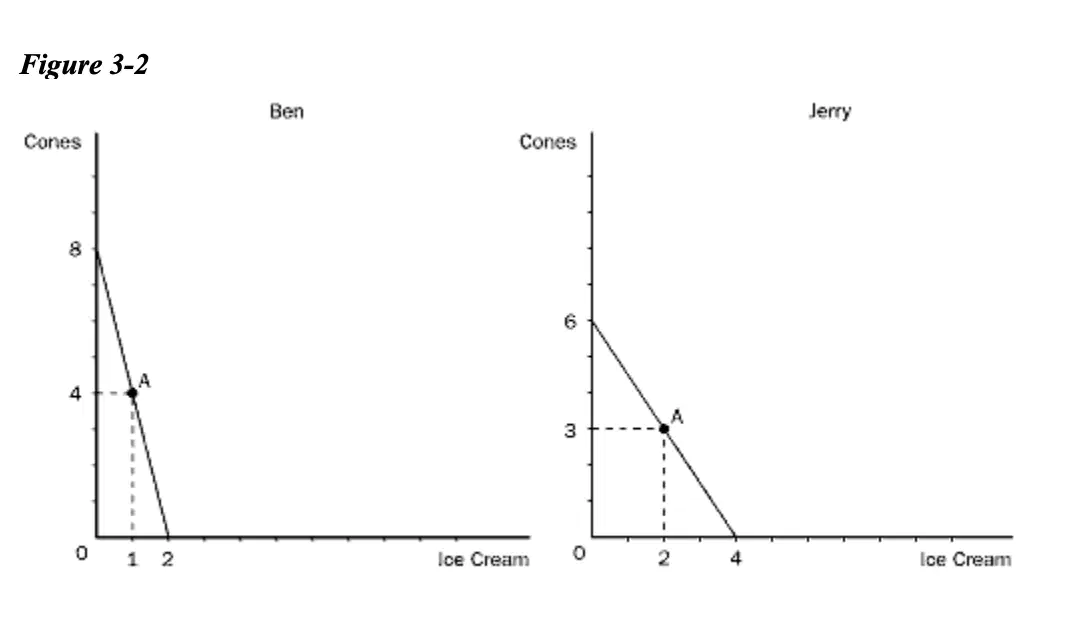
Refer to Figure 3-2. For Jerry, the opportunity cost of 1 pound of ice cream is
1/3 pound of cones
2/3 pound of cones
3/2 pound of cones
2 pounds of cones
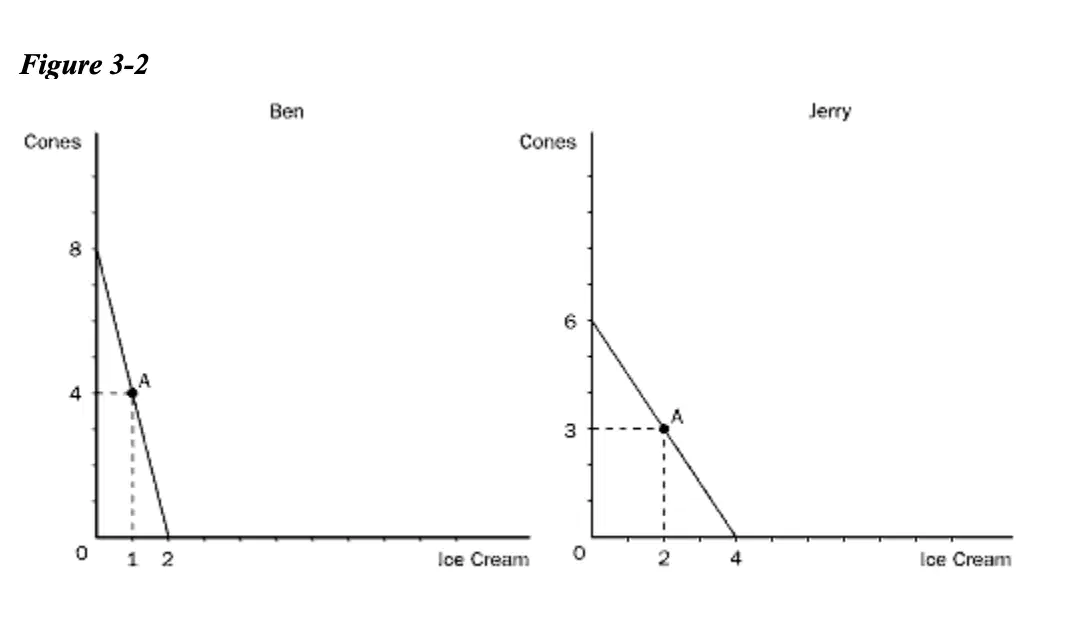
Refer to Figure 3-2. Originally, Ben was producing at his point A and Jerry was producing at his point A. Then, each person decided to specialize in the product in which he has a comparative advantage. Furthermore, they agreed to trade 4 pounds of cones for 2 pounds of ice cream. As a result of these new arrangements, the gains from trade relative to the original situation are as follows:
1 additional pound of cones for Ben and 1 additional pound of ice cream for Jerry.
1 additional pound of ice cream for Ben and 1 additional pound of cones for Jerry.
2 additional pounds of ice cream for Ben and 2 additional pounds of cones fro Jerry.
2 additional pounds of ice cream for Ben and 1 additional pound of cones for Jerry.
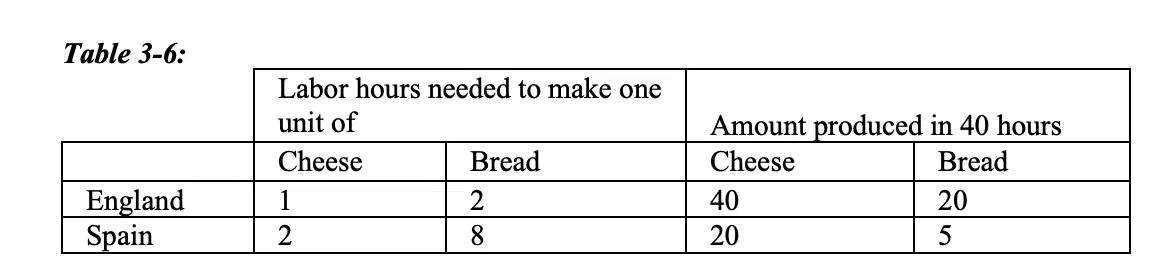
Refer to Table 3-6. The opportunity cost of 1 unit of bread in England is
4 units of cheese.
2 units of cheese.
1 unit of cheese.
1/2 unit of cheese.
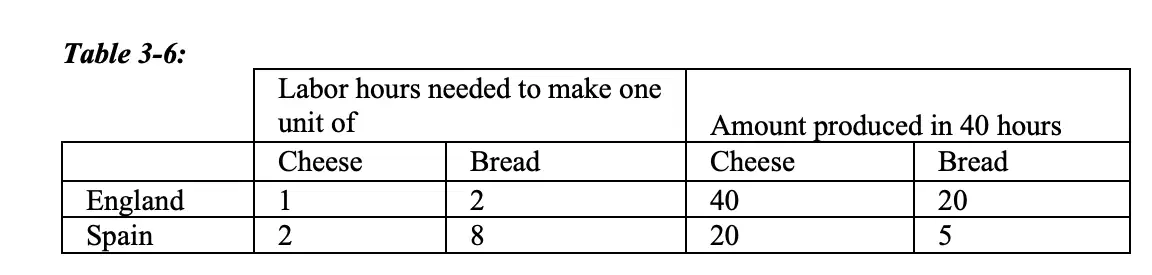
Refer to Table 3-6. England has a comparative advantage in
bread and Spain had absolute advantage in cheese.
bread and Spain has an absolute advantage in neither good.
cheese and Spain has an absolute advantage in both goods.
both goods and Spain has an absolute advantage in cheese.
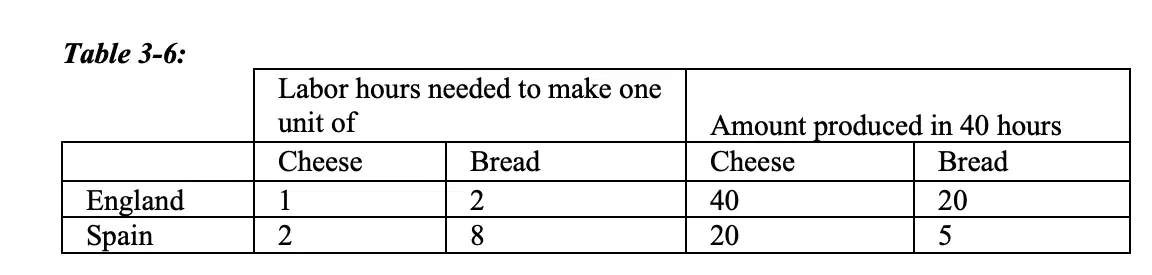
Refer to Table 3-6. If England and Spain specialize and trade based on the principle of comparative advantage, England will export
bread and Spain will export cheese.
bread and Spain will export bread.
cheese and Spain will export cheese.
cheese and Spain will export bread.
If Shawn can produce donuts at a lower opportunity cost than Sue, then
Shawn has a comparative advantage in the production of donuts.
Sue has a comparative advantage in the production of donuts.
Shawn should not produce donuts.
Shawn is capable of producing more donuts than Sue in a given amount of time.
The producer that requires a smaller quantity of inputs to produce a certain amount of a good, relative to the quantities of inputs required by other producers to produce the same amount of that good,
has a loe opportunity cost of producing that good, relative to the opportunity costs of other producers.
has a comparative advantage in the production of that good.
has an absolute advantage in the production of that good.
has an artificial advantage in the production of that good.
Assume that Greece has a comparative advantage in fish and Germany has a comparative advantage in cars. Also assume that Germany has an absolute advantage in both fish and cars. If these two countries specialize and trade so as to maximize the benefits of specialization and trade, then
the two countries' combined output of both goods will be higher than it would be in the absence of trade.
Greece will produce more fish than it would produce in the absence of trade.
Germany will produce more cars than it would produce in the absence of trade.
All answers are correct.
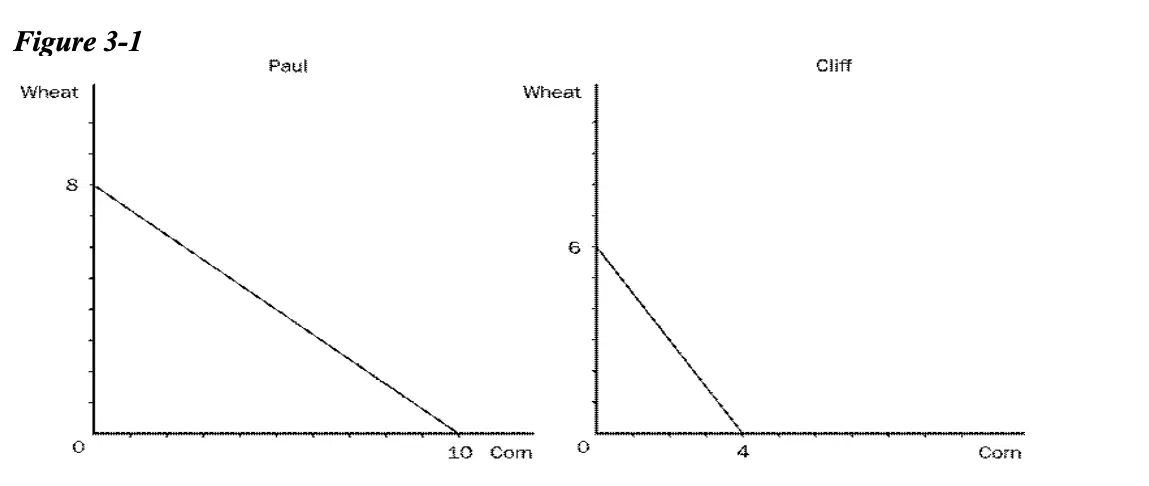
Refer to Figure 3-1. The opportunity cost of 1 bushel of wheat for Cliff is
1/3 bushel of corn.
2/3 bushel of corn.
1 bushel of corn.
3/2 bushel of corn.
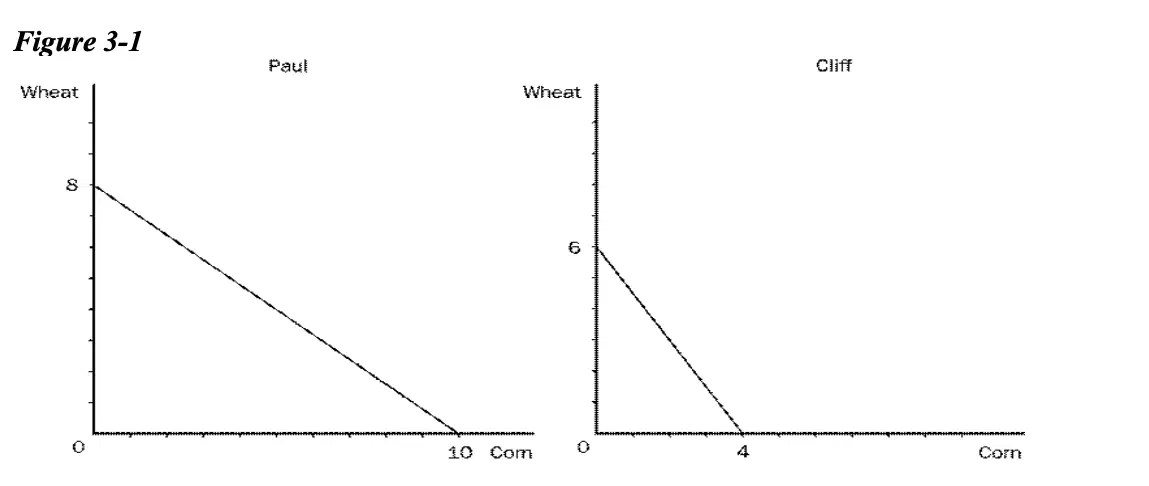
Refer to Figure 3-1. Which of the following statements is correct?
Paul has a comparative advantage in both wheat and corn.
Paul has a comparative advantage in wheat and Cliff has a comparative advantage in corn.
Cliff ha a comparative advantage in wheat and Paul has a comparative advantage in corn.
Cliff has a comparative advantage in both wheat and corn.
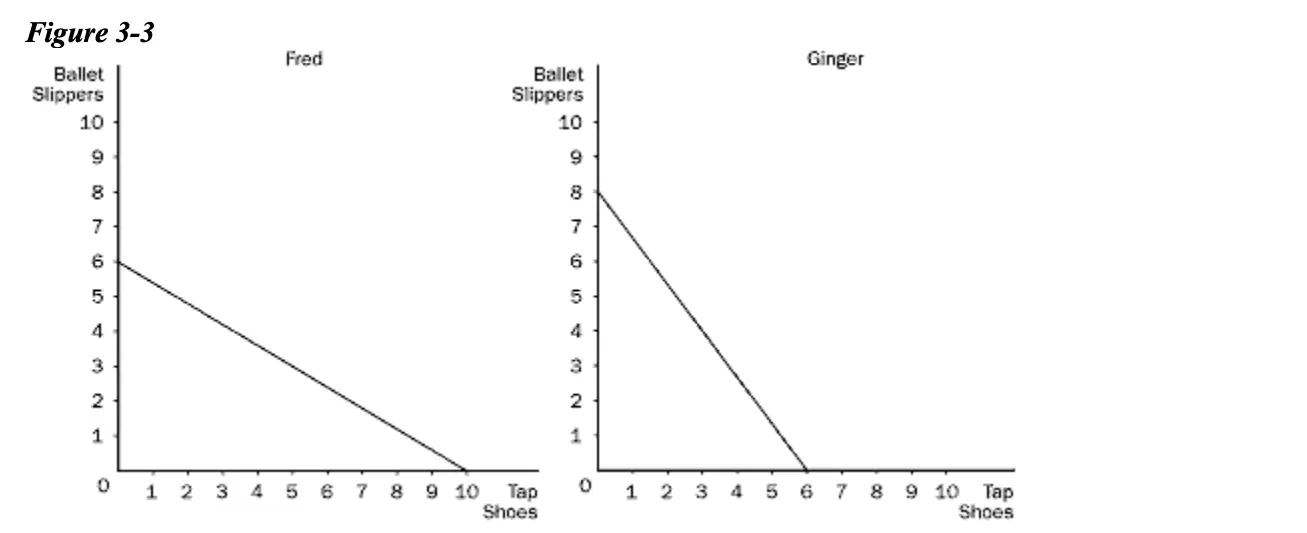
Refer to Figure 3-3. In order to maximize total output
Ginger should specialize in tap shoes and Fred should specialize in ballet slippers.
Ginger should specialize in both goods and Fred should specialize in neither good.
Ginger should specialize in ballet slippers and Fred should specialize in tap shoes.
Ginger should specialize in neither good and Fred should specialize in both goods.
If Shawn can produce more donuts in one day than Sue can produce in one day, then
Shawn has a comparative ad advantage in the production of donuts.
Sue has a comparative advantage in production of donuts.
Shawn has an absolute advantage in the production of donuts.
Shawn should produce donuts and Sue should spend her time on a different activity.
Belarus has a comparative advantage in the production of linen, but Russia has an absolute advantage in the production of linen. If these two countries decide to trade,
Belarus should export linen to Russia
Russia should export linen to Belarus.
Trading linen would provide no net advantage to either contry.
Without additional information about opportunity costs, this question cannot be answered.
What you give up to obtain an item is called your
opportunity cost.
explicit cost.
true cost.
direct cost.
Which of these statements best represents the law of demand?
When buyers' tastes for a good increase, they purchase more of the good.
When income levels increase, buyers purchase more of the most goods.
When the price of a good decreases, buyers purchase more of the good.
When buyers' demands for a good increase, the price of the good increases.
A leftward shift of a demand curve is called a(n)
increase in demand.
decrease in demand.
decrease in quantity demanded.
increase in quantity demanded.
Which of the following would shift the demand curve for gasoline to the right?
a decrease in the price of gasoline.
an increase in consumer income, assuming gasoline is a normal good.
an increase in the price of cars, a complement for gasoline.
a decrease in the expected future price of gasoline.
Suppose that a decrease in the price of good X results in fewer units of good Y being demanded. This implies that X and Y are
complementary goods.
normal goods.
inferior goods.
substitute goods.
Suppose the American Medical Association announces that men who shave their heads are less likely to die of heart failure. We could expect the current demand for
hair gel to increase.
razors to increase.
combs to increase.
shampoo to increase.
An increase in the price of oranges would lead to
an increased supply of oranges.
a reduction in the prices of inputs used in orange production.
an increased demand for oranges.
a movement up and to the right along the supply curve for oranges.
Which of the following demonstrates the law of supply?
When the leather became more expensive, belt producers decreased their supply of belts.
When car production technology improved, car producers increased their supply of cars.
When sweaters producers expected sweater prices to rise in the near future, they decreased their current supply of sweaters.
When ketchup prices rose, ketchup sellers increased their quantity supplied of ketchup.
Lead is an important input in the production of crystal. If the price of lead decreases, then we would expect the supply of
crystal to be unaffected.
crystal to decrease.
crystal to increase.
lead to increase.
Which of the following events must cause equilibrium quantity to rise?
demand increases and supply decreases.
demand and supply both decrease.
demand decreases and supply increases.
demand and supply both increase.
Which of the following events must cause equilibrium price to fall?
demand increase and supply decreases
demand and supply both decrease
demand decreases and supply increases
demand and supply both increase
Equilibrium price must decrease when demand
increases and supply does not change, when demand does not change and supply decreases, and when demand decreases and supply increases simultaneously.
increases and supply does not change, when demand does not change and supply decreases, and when demand increases and supply decreases simultaneously.
decreases and supply does not change, when demand does not change and supply increases, and when demand decreases and supply increases simultaneously.
decreases and supply does not change, when demand does not change and supply increases, and when demand increases and supply decreases simultaneously.
A decrease in input costs to firms in a market will result in a(n)
decrease in equilibrium price and an increase in equilibrium quantity.
decrease in equilibrium price and a decrease in equilibrium quantity.
increase in equilibrium price and a decrease in equilibrium quantity.
increase in equilibrium price and an increase in equilibrium quantity.
If macaroni and cheese is an inferior good, what would happen to the equilibrium price and quantity of macaroni and cheese if consumers’ incomes rise?
Both the equilibrium price and quantity would increase.
Both the equilibrium price and quantity would decrease.
The equilibrium price would increase, and the equilibrium quantity would decrease.
The equilibrium price would decrease, and the equilibrium quantity would increase.
Which of the following sets of events must cause an increase in the price of a new house? (Assume that they are normal goods.)
higher wages for carpenters, higher prices, increases in consumer incomes, higher apartment rent, increase in population, and expectations of higher house prices in the future.
lower wages for carpenters, lower wood prices, increase in consumer incomes, higher apartment rents, increases in population, and expectations of higher house prices in the future.
lower wages for carpenters, higher wood prices, decreases in consumer incomes, higher apartment rents, decreases in population, and expectations of higher house prices in the future.
higher wages for carpenters, lower wood prices, decrease in consumer incomes, lower apartment rents, decreases in population, and expectations of lower house prices in the future.
The price elasticity of demand measures
buyers' responsiveness to a change in the price of a good.
the extent to which demand increases as additional buyers enter the market.
how much more of a good consumers will demand when incomes rise.
the movement along a supply curve when there is a change in demand.
If the price of natural gas rises, when is the price elasticity of demand likely to be the highest?
immediately after the price increase
one month after the price increase
three months after the price increase
one year after the price increase
The greater the price elasticity of demand, the
more likely the product is a necessity.
smaller the responsiveness of quantity demanded to a change in price.
greater the percentage change in price over the percentage change in quantity demanded.
greater the responsiveness of quantity demand to a change in price.
The price elasticity of demand for bread
is computed as the percentage change in quantity demanded of bread divided by the percentage change in the price of bread.
depends, in part, on the availability of close substitutes for bread.
reflects the many economic, social, and psychological forces that influence consumers' tastes for bread.
All answers are correct.
Suppose there is a 6 percent increase in the price of good X and a resulting 6 percent decrease in the quantity of X demanded. Price elasticity of demand for X is
0
1
6
36
If the price elasticity of demand for a good is 4.0, then a 10 percent increase in price results in a
0.4 percent decrease in the quantity demanded.
2.5 percent decrease in the quantity demanded.
4 percent decrease in the quantity demanded.
40 percent decrease in the quantity demanded.
If the price elasticity of demand for a good is 6, then a 3 percent decrease in price results in
a 20 percent increase in the quantity demanded.
an 18 percent increase in quantity demanded.
a 2 percent increase in the quantity demanded.
a 1.8 percent increase in quantity demanded.
Elasticity of demand is closely related to the slope of the demand curve. The more responsive buyers are to a change in price, the
steeper the demand curve will be.
flatter the demand curve will be.
further to the right the demand curve will sit.
closer to the vertical axis the demand curve will sit.
A good will have a more elastic demand, the
greater the availability of close substitutes.
more broad the definition of the market.
shorter the period of time.
more it is regarded as a necessity.
Demand is elastic if the price elasticity of demand is
less than 1.
equal to 1.
equal to 0.
greater than 1.
When the price of used cds is $4, Daphne buys five per month. When the price is $3, she buys nine per month. Daphne's demand for used cds is
elastic, and her demand curve would be relatively flat.
elastic, and her demand curve would be relatively steep.
inelastic, and her demand curve would be relatively flat.
inelastic, and her demand curve would be relatively steep.
If a 15% increase in price for a good results in a 20% decrease in quantity demanded, the price elasticity of demand is
0.75.
1.25.
1.33.
1.60.
Consider luxury weekend hotel packages in Las Vegas. When the price is $250, the quantity demanded is 2,000 packages per week. When the price is $280, the quantity demanded is 1,700 packages per week. Using the midpoint method, the price elasticity of demand is about
1.43, and an increase in the price will cause hotels' total revenue to decrease.
1.43, and an increase in the price will cause hotels' total revenue to increase.
0.70, and an increase in the price will cause hotels' total revenue to decrease.
0.70, and an increase in the price will cause hotels' total revenue to increase.
When the local used bookstore prices economics books at $15 each, it generally sells 70 books per month. If it lowers the price to $7, sales increase to 90 books per month. Given this information, we know that the price elasticity of demand for economics books is about
2.91, and an increase in price from $7 to $15 results in an increase in total revenue.
2.91, and an increase in the price from $7 to $15 results in a decrease in total revenue.
0.34, and an increase in the price from $7 to $15 results in an increase in total revenue.
0.34, and an increase in price from $7 to $15 results in a decrease in total revenue.
When the local used bookstore prices economics books at $15 each, it generally sells 70 books per month. If it lowers the price to $7, sales increase to 90 books per month. Given this information, we know that the price elasticity of demand for economics books is about
income inelastic, so an increase in the price of wheat will increase total revenue of wheat farmers.
income elastic, so an increase in the price of wheat will increase the total revenue of wheat farmers.
price inelastic, so an increase in the price of wheat will increase the total revenue of wheat farmers.
price elastic, so an increase in the price of wheat will increase the total revenue of wheat farmers.
Suppose that when the price of ginger ale is $2 per bottle, firms can sell 4 million bottles. When the price of ginger ale is $3 per bottle, firms can sell 2 million bottles. Which of the following statements is true?
The demand for ginger ale is income inelastic, so an increase in the price of ginger ale will increase the total revenue of ginger producers.
The demand for ginger ale is income elastic, so an increase in the price of ginger ale will increase the total revenue of ginger ale producers.
The demand for ginger ale price inelastic, so an increase in the price of ginger ale will increase the total revenue of ginger ale producers.
The demand for ginger ale is price elastic, so an increase in the price of ginger ale will decrease the total revenue of ginger ale producers.
Price controls
always produce a fair outcome.
always produce an efficient outcome.
can generate inequities of their own.
all of the answers are correct.
In a competitive market free of government regulation,
price adjust until quantity demanded is greater than quantity supplied.
price adjust until quantity demanded is less than quantity supplied.
price adjusts until quantity demanded equals quantity supplied.
supply adjusts to meet demand at every price.
In a free, competitive market, what is the rationing mechanism?
seller bias
buyer bias
government law
price
If a price ceiling is not binding, then
there will be a surplus in the market.
there will be a shortage in the market.
the market will be less efficient than it would be without the price ceiling.
there will be no effect on the market price or quantity sold.
A price ceiling will be binding only if it is set
equal to the equilibrium price.
above the equilibrium price.
below the equilibrium price.
either above or below the equilibrium price.
Suppose the government has imposed a price ceiling on laptop computers. Which of the following events could transform the price ceiling from one that is not binding into one that is binding?
Improvements in production technology reduce the costs of producing laptop computers.
The number of firms selling laptop computers decreases.
Consumers' income decreases, and laptop computers are a normal good.
The number of consumers buying the laptop computers decreases.
Suppose the government has imposed a price ceiling on laptop computers. Which of the following events could transform the price ceiling from one that is not binding into one that is binding?
Farmers use improved, draught-resistant seeds, which lowers the cost of growing soybeans.
The number of farmers selling soybeans decreases.
Consumers' income increases, and soybeans are a normal good.
The number of consumers buying soybean increases.
If the government removes a binding price floor from a market, then the price paid by buyers will
increase, and quantity sold in the market will increase.
increase, and the quantity sold in the market will decrease.
decrease, and quantity sold in the market will increase.
decrease, and the quantity sold in the market will decrease.
When a binding price floor is imposed on a market,
price no longer serves as a rationing device.
the quantity supplied at the price floor exceeds the quantity that would have been supplied without the price floor.
only some sellers benefit.
all answers are correct.
If a binding price floor is imposed on the video game market, then
the demand for video games will decrease.
the supply of video games will increase.
a surplus of video games will develop.
all answers are correct.
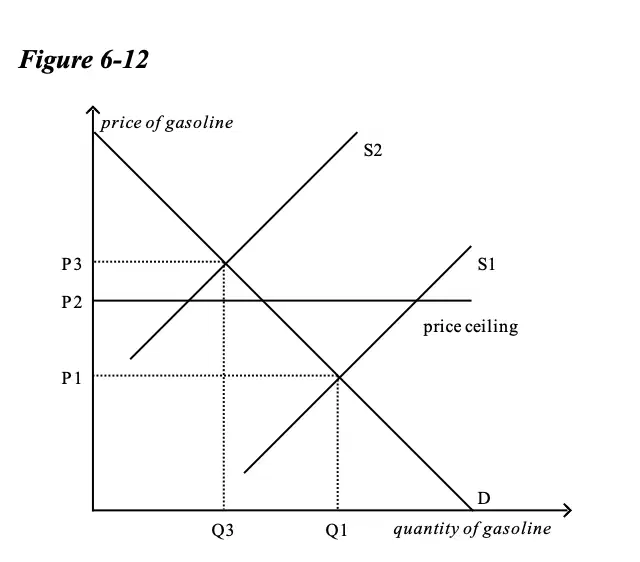
Refer to Figure 6-12. When the price ceiling applies in this market, and the supply curve for gasoline shifts from S1 to S2,
the market price will increase to P3
a surplus will occur at the new market price of P2
the market price will stay at P1
a shortage will occur at the new market price of P2
In the housing market, supply and demand are
more elastic in the short run than in the long run, and so rent control leads to a larger shortage of apartments in the short run than in the long run.
more elastic in the short run than in the long run, and so rent control leads to a larger shortage of apartments in the long run than in the short run.
more elastic in the long run than in the short run, and so rent control leads to a larger shortage of apartments in the short run than in the long run.
more elastic in the long run than in the short run, and so rent control leads to a larger shortage of apartments in the long run than in the short run.
If a tax is levied on the sellers of a product, then there will be a(n)
downward shift of the demand curve.
upward shift of the demand curve.
movement up and to the left along the demand curve.
movement down and to the right along the demand curve.
If a tax is levied on the sellers of a product, then there will be a(n)
upward by exactly $2.00
upward by less than $2.00
downward by exactly $2.00
downward by less than $2.00
When a tax is placed on the buyers of a product, buyers pay
more and sellers receive more than they did before the tax.
more and sellers receive less than they did before the tax.
less and sellers receive more than they did beofre the tax.
less and sellers receive less than they did before the tax.
A tax on the buyers of cereal will increase the price of cereal paid by buyers,
decrease the effective price of cereal received by sellers, and decrease the equilibrium quantity of cereal.
decrease the effective price of cereal received by sellers, and increase the equilibrium quantity of cereal.
increase the effective price of cereal received by sellers, and decrease the equilibrium quantity of cereal.
increase the effective price of cereal received by sellers, and increase the equilibrium quantity of cereal.
When a tax is placed on the buyers of cell phones, the size of the cell phone market
and the effective price received by sellers both decrease.
decrease, but the effective price received by sellers increases.
increases, but the effective price received by sellers decreases.
and the effective price received by sellers both increase.
If a tax is levied on the sellers of flour, then
buyers will bear the entire burden of the tax.
sellers will bear the entire burden if the tax.
buyers and sellers will share the burden of the tax.
the government will bear the entire burden of the tax.
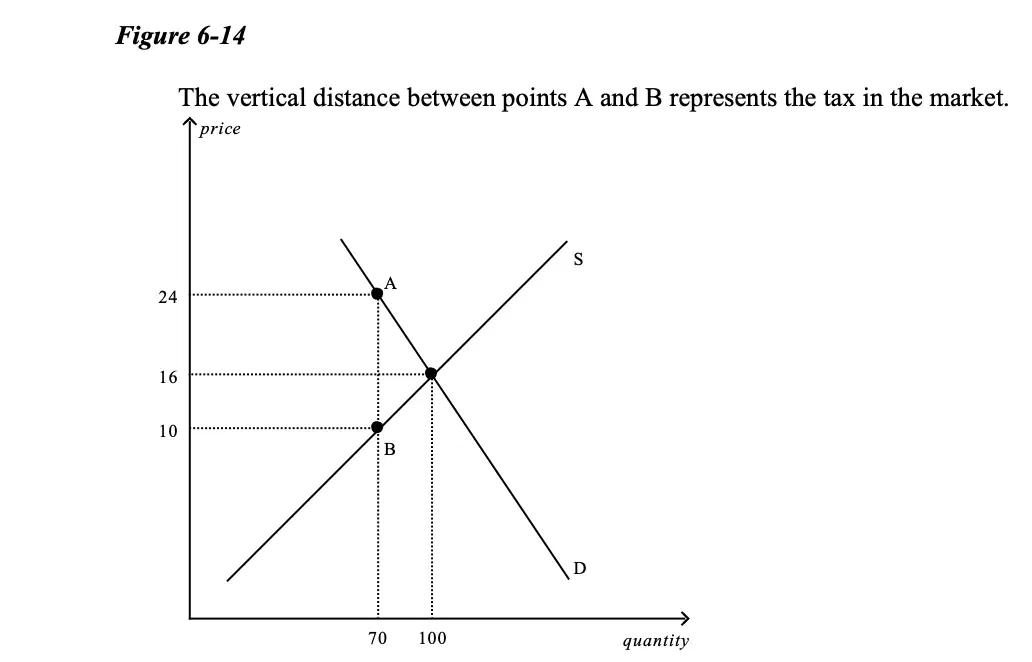
Refer to Figure 6-14. The price that buyers pay after the tax is imposed is
$8.
$10.
$16.
$24.
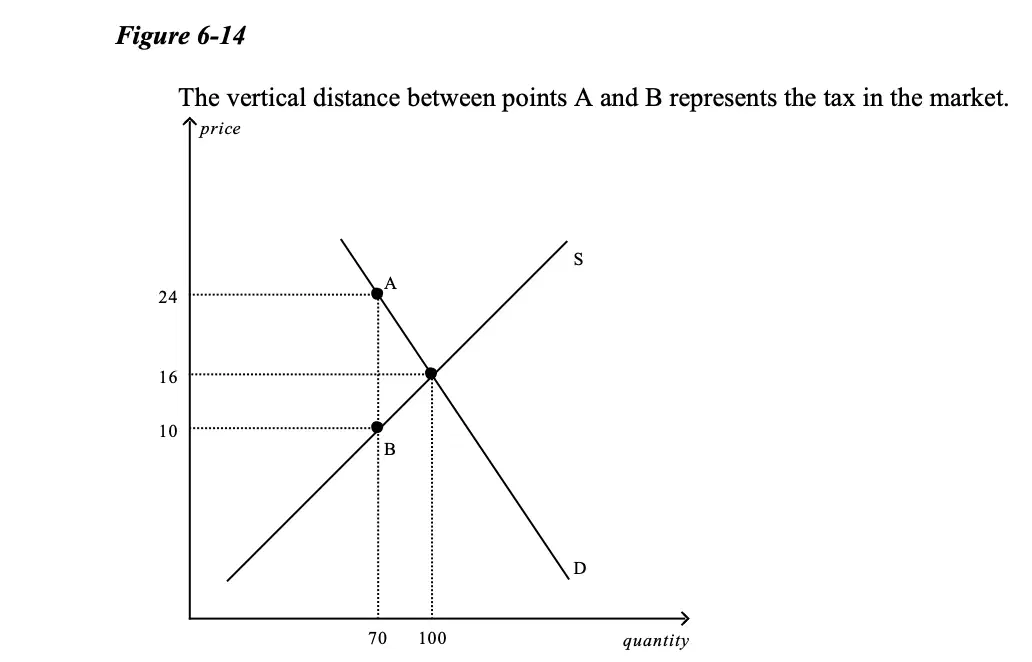
. Refer to Figure 6-14. The effective price that sellers receive after the tax is imposed is
$6.
$10.
$16.
$24.
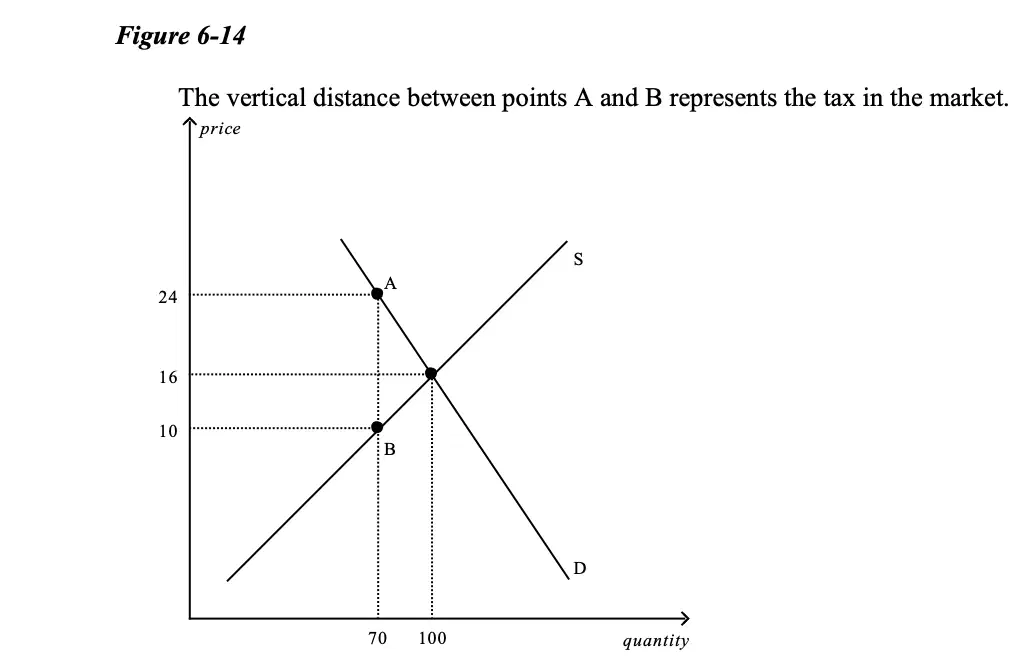
Refer to Figure 6-14. The amount of the tax per unit is
$6.
$8.
$14.
$18.
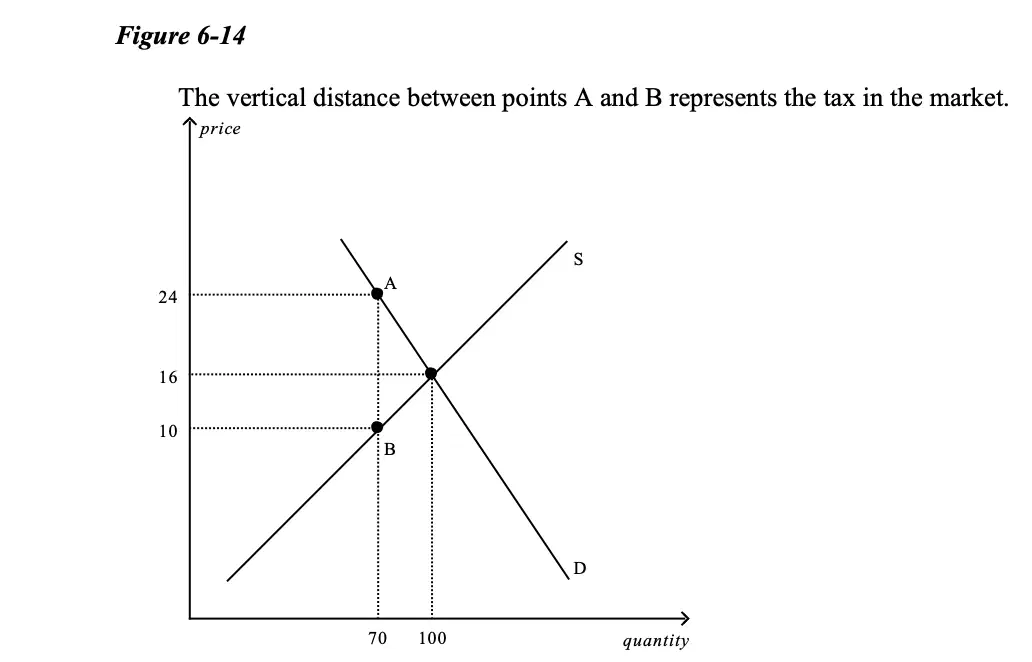
Refer to Figure 6-14. The per-unit burden of the tax on buyers is
$6.
$8.
$14.
$24.
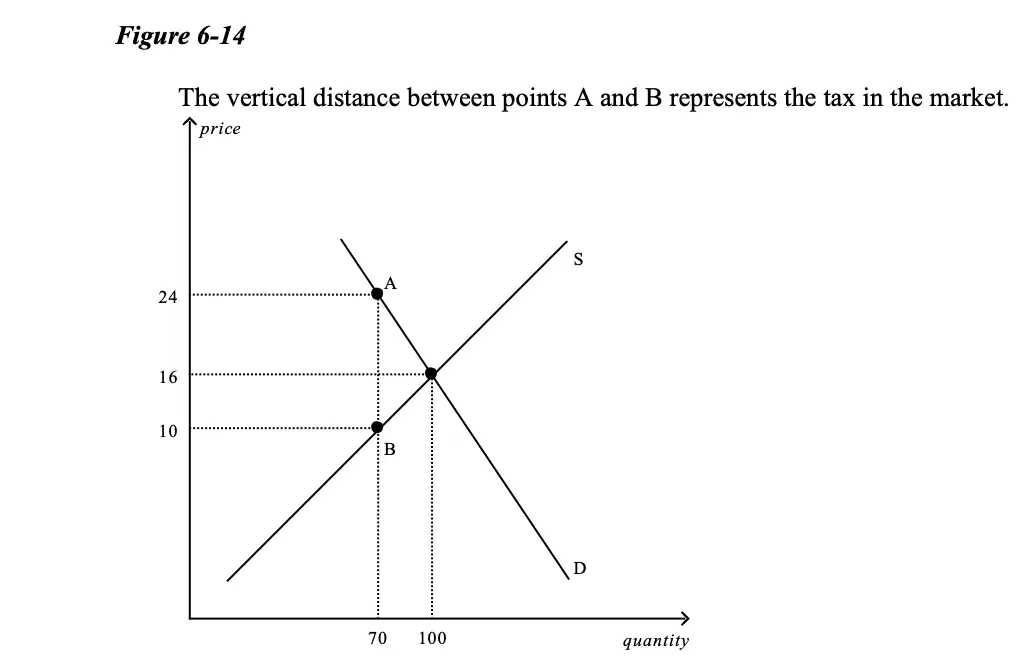
Refer to Figure 6-14. The per-unit burden of the tax on sellers is
$6.
$8.
$10.
$14.
The incidence of a tax falls more heavily on
consumers than producers if demand is more inelastic than supply.
producers than consumers if supply is more inelastic than demand.
consumers than producers if supply is more elastic than demand.
all answers are correct.
Fundamentally, economics deals with
scarcity.
money.
proverty.
banking.
In the simple circular-flow diagram, the participants in the economy are
firms and government.
households and firms.
households and government.
households, firms, and government.
In the simple circular-flow diagram, which of the following is not true.
Households own the factors of production.
Households buy all the goods and services that frirms produce.
Land, labor, and capital flow from households to firms.
Firms own the factors of production.
Which of the following is an example of a normative, as opposed to a positive, statement?
The U.S. income distribution is not fair.
If interest rates increase, then investment spending will decrease.
The minimum wage creates unemployment among young and unskilled workers.
If the price of the a product in a market decreases, then, other things equal, it quantity demanded will increases.
Which of the following is an example of a normative, as opposed to a positive, statement?
Jim has an absolute advantage in production of baseball bats and in the production of hockey sticks.
Jim has an absolute advantage in the production of baseball bats and a comparative advantage in the production of hockey sticks.
Jim has an absolute advantage in the production of hockey sticks and a comparative advantage in the production of baseball bats.
Jim has a comparative advantage in the production of baseball bats and in the production of hockey sticks.

Refer to Table 3-4. Which of the following represents Zimbabwe's and Portugal's production possibilities frontiers when each country has 60 minutes of machine time available?
Zimbabwe can produce at most either 3 toothbrushes or 10 hairbrushes. Portugal can produce at most either 5 toothbrushes or 6 hairbrushes.
Zimbabwe can produce at most either 10 toothbrushes or 3 hairbrushes. Portugal can produce at most either 6 toothbrushes or 5 hairbrushes.
Zimbabwe can produce at most either 180 toothbrushes or 600 hairbrushes. Portugal can produce at most either 300 toothbrushes or 360 hairbrushes.
Zimbabwe can produce at most either 20 toothbrushes or 6 hairbrushes. Portugal can produce at most either 12 toothbrushes or 10 hairbrushes.
If Iowa's opportunity cost of corn is lower than Oklahoma's opportunity cost of corn, then
Iowa has a comparative advantage in the production of corn.
Iowa has an absolute advantage in the production of corn.
Iowa should import corn from Oklahoma.
Oklahoma should produce just enough corn to satisfy its own residents' demands.
Suppose the United States has a comparative advantage over Mexico in producing pork. The principle of comparative advantage asserts that
in order to consume beyond its PPF, the United States should produce more pork than what it requires and export some of it to Mexico.
in order to consume beyond its PPF, the United States should produce a moderate quantity of pork and import the remainder of what it requires from Mexico.
in order to consume beyond its PPF, the United States should refrain altogether from producing pork and import all of what it requires from Mexico.
Mexico has nothing to gain from importing United States pork.
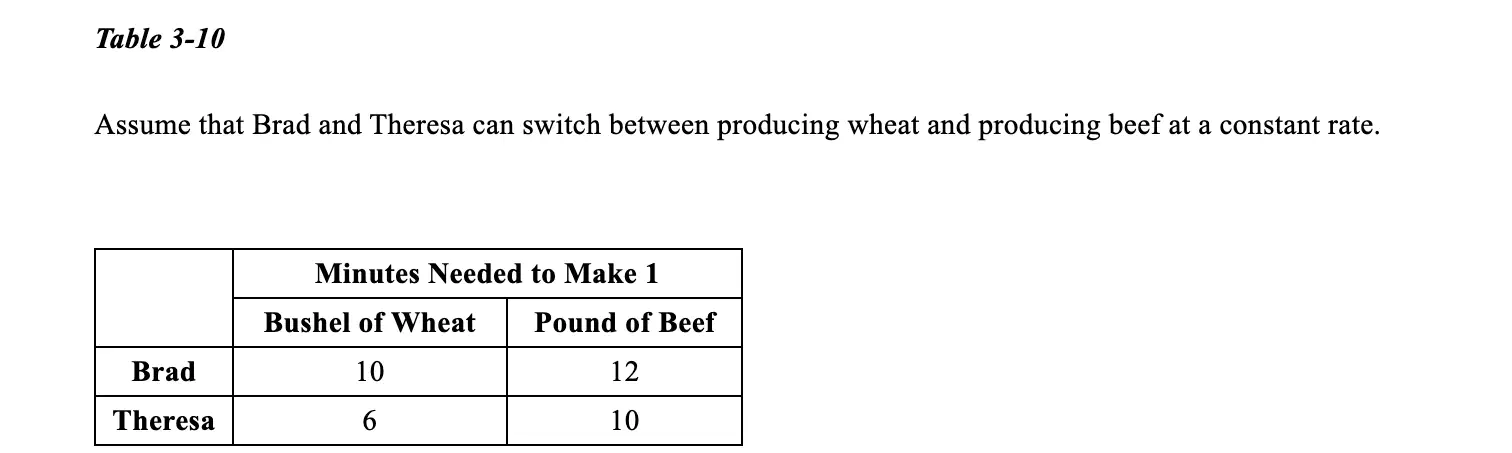
Refer to Table 3-10. What is Brad's opportunity cost of producing one pound of beef? (Hint: Assume each producer has 60 total minutes of production time.)
5/6 bushel of wheat
6/5 bushel of wheat
3/5 bushel of wheat
5/3 bushel of wheat
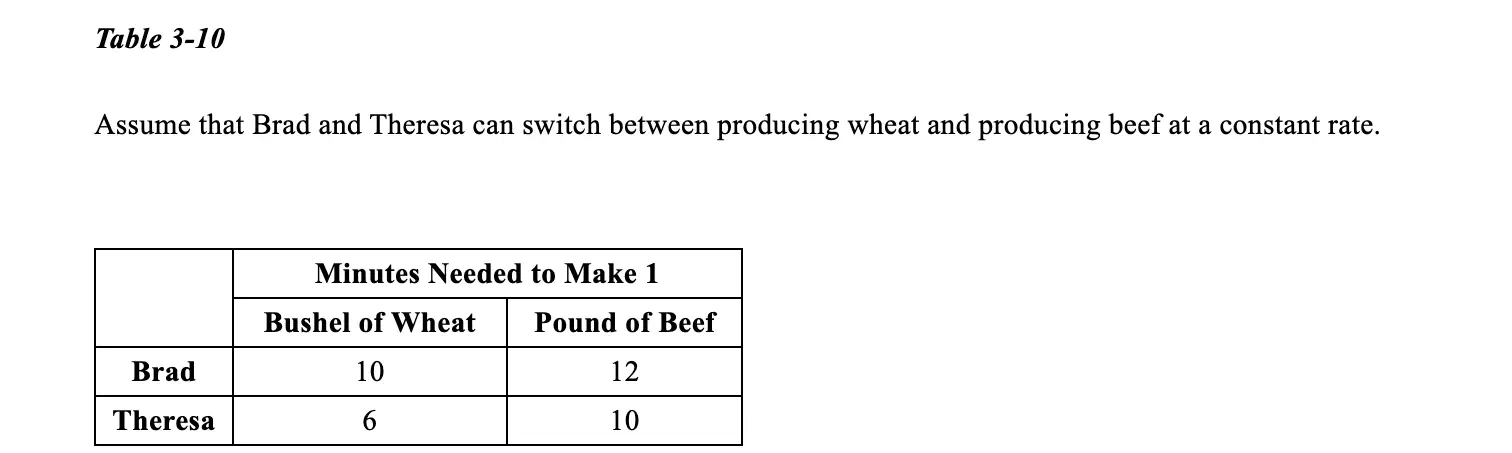
Refer to Table 3-10. Which of the following is true regarding the capabilities of these producers?
Brad has an absolute advantage in the production of both goods.
Brad has a comparative advantage in the production of both goods.
Theresa has a comparative advantage in the production of both goods.
Theresa has an absolute advantage in the production of both goods.
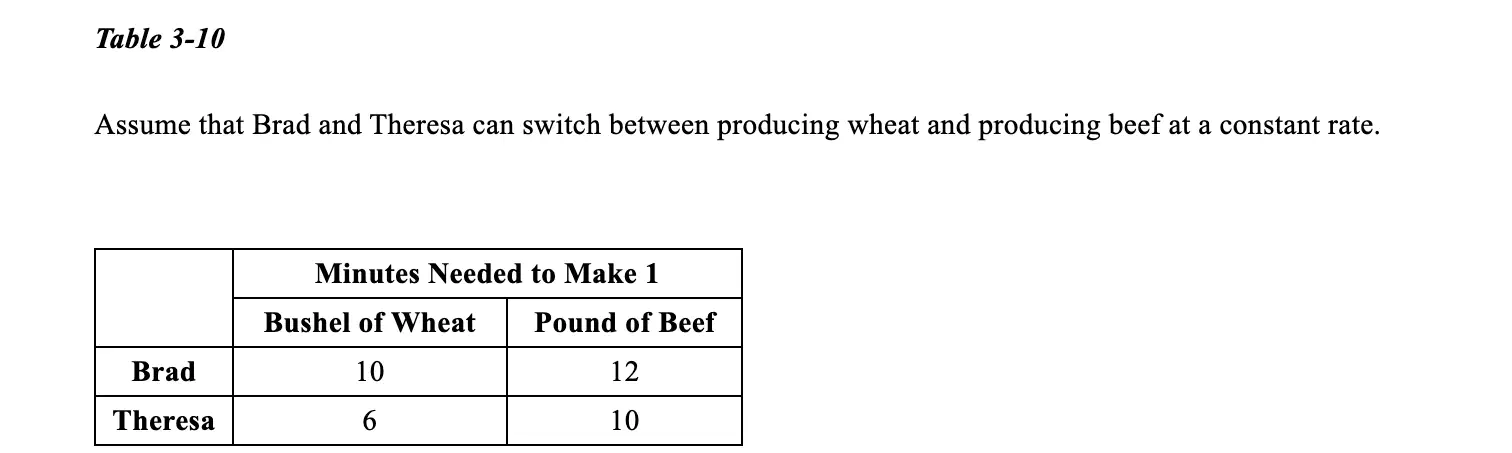
Refer to Table 3-10. Which of the following is true in order for Brad and Theresa to gain from trade with one another?
Brad should specialize in the production of wheat.
Theresa should specialize in the production of beef.
Brad should specialize in the production of beef.
Theresa should specialize in the production of both goods.
Suppose that a worker in Radioland can produce either 4 radios or 1 television per year, and a worker in Teeveeland can produce either 2 radios or 4 televisions per year. Each nation has 100 workers. Also, suppose that each country completely specializes in producing the good in which it has a comparative advantage. If Radioland trades 100 radios to Teeveeland in exchange for 100 televisions each year, then each country's maximum consumption of new radios and televisions per year will be
100 radios, 300 televisions in Radioland and 300 radios, 100 televisions in Teeveeland.
300 radios, 100 televisions in Radioland and 100 radios, 300 televisions in Teeveeland.
200 radios, 100 televisions in Radioland and 100 radios, 200 televisions in Teeveeland.
300 radios, 100 televisions in Radioland and 100 radios, 400 televisions in Teeveeland.

Refer to Figure 3-4. If point A represents Alice's current production and point B represents Betty's current production, under what circumstances can both Alice and Betty benefit from specialization and trade?
Alice produces more pizzas and Betty produces more lemonade.
Alice produces more lemonade and Betty produces more pizzas.
Both Alice and Betty produce only pizzas.
There are no circumstances under which both Alice and Betty can benefit from specialization and trade
If muffins and bagels are substitutes, a higher price for bagels would result in
an increase in the demand for bagels.
a decrease in the demand for bagels.
an increase in the demand for muffins
a decrease in the demand for muffins.
If a surplus exists in a market, then we know that the actual price is
above the equilibrium price, and quantity supplied is greater than quantity demanded.
above the equilibrium price, and quantity demanded is greater than quantity supplied.
below the equilibrium price, and quantity demanded is greater than quantity supplied.
below the equilibrium price, and quantity supplied is greater than quantity demanded.
Suppose the number of buyers in a market increases and a technological advancement occurs also. What would we expect to happen in the market?
Equilibrium price would decrease, but the impact on equilibrium quantity would be ambiguous.
Equilibrium price would increase, but the impact on equilibrium quantity would be ambiguous.
Equilibrium quantity would decrease, but the impact on equilibrium price would be ambiguous.
Equilibrium quantity would increase, but the impact on equilibrium price would be ambiguous.
Which of the following events would cause both the equilibrium price and equilibrium quantity of number two grade potatoes to increase if number two grade potatoes are an inferior good?
An increase in consumer income.
A decrease in consumer income.
Greater government restrictions on agricultural chemicals.
fewer government restrictions on agricultural chemicals.
When the price of candy bars is $1.00, the quantity demanded is 500 per day. When the price falls to $0.80, the quantity demanded increases to 600. Given this information and using the midpoint method, we know that the demand for candy bars is
inelastic.
elastic.
unit elastic.
perfectly inelastic.
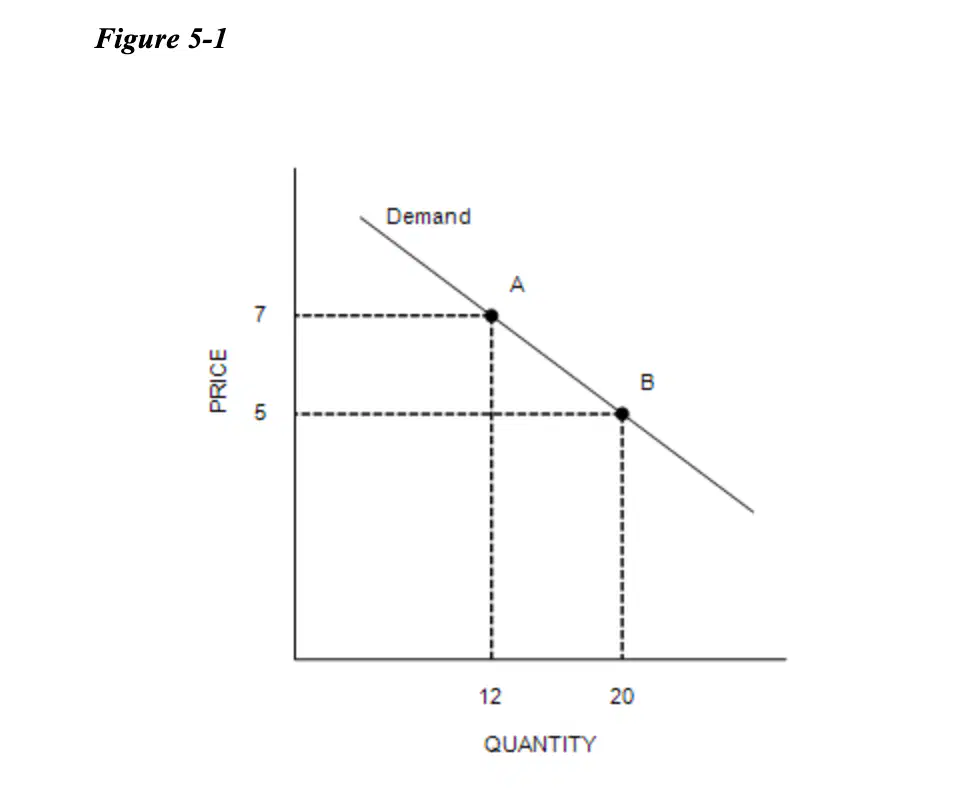
Refer to Figure 5-1. Between point A and point B, price elasticity of demand is equal to
0.33.
0.67.
1.5.
2.67.
Elasticity of demand is closely related to the slope of the demand curve. The more responsive buyers are to a change in price, the
steeper the demand curve will be
flatter the demand curve will be
further to the right the demand curve will sit
closer to the vertical axis the demand curve will sit.
If the demand for donuts is elastic, then a decrease in the price of donuts will
increase total revenue of donuts sellers
decrease total revenue of donut sellers
not change total revenue of donut sellers
There is not enough information to answer this question.
The supply of a good will be more elastic, the
more the good is considered a luxury.
broader is the definition of the market for the good.
larger the number of close substitutes for the good
longer the time period being considered.
The supply of a good will be more elastic, the
nonbinding price floor is imposed on a market.
nonbinding price floor is imposed on a market.
binding price floor is imposed on a market.
binding price floor is removed from a market.
Suppose the government wants to encourage Americans to exercise more, so it imposes a binding price ceiling on the market for in-home treadmills. As a result,
the demand for treadmills will increase.
the supply of treadmills will decrease.
a shortage of treadmills will develop.
a surplus of treadmills will develop.
Suppose the equilibrium price of a physical examination ("physical") by a doctor is $200, and the government imposes a price ceiling of $150 per physical. As a result of the price ceiling, the
demand curve for physicals shifts to the right.
supply curve for physicals shifts to the left.
quantity demanded of physicals increases, and the quantity supplied of physicals decreases.
number of physicals performed stays the same.

