wayground logo

Free Printable Worksheets

Font size

S
M
L
XL
Worksheets

DNA Test Review

Total questions: 85

Worksheet time: 3600secs

Name
Class
Date
1.
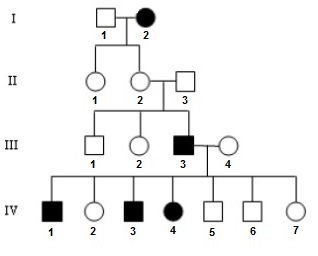
How many generations are shown in this pedigree?
a)
1
b)
2
c)
3
d)
4
2.
This pedigree represents the inheritance of hemophilia in this family. How many of the females have the hemophilia trait?
a)
8
b)
5
c)
2
d)
3
3.
Guanine bonds with ______________.
a)
Adenine
b)
Guanine
c)
Cytosine
d)
Thymine
4.
What are the 4 nitrogen bases?
a)
adenine, thymine, cytoplasm, and guanine
b)
adenine, thymine cytosine, and guanine
c)
adenine, thymine, cytosine, and gylcerol
d)
adenine, thymine, cytosine, and glucose
5.
Which sequence of DNA bases would pair with this partial strand
ATG TGA CAG
a)
ATG TGA CAG
b)
TAC ACT GTC
c)
GTA AGT GAC
d)
CAT TCA CTG
6.
What sugar is found in DNA
a)

Sugar

b)
deoxyribose
c)
Phosphate
d)

Water

7.

DNA is a(n)

a)

atom

b)

molecule

c)

nucleus

d)

cell

8.

A DNA molecule is shaped like a

a)

toilet

b)

cone

c)

ball

d)

spiraled ladder

9.

Most chromosomes are shaped like the letter

a)

Q

b)

W

c)

P

d)

X

10.

DNA acts like a(n )__________________ for our traits.

a)

instruction manual

b)

nucleus

c)

cell

d)

gene

11.

Chromosomes occur in the _______ of a cell.

a)

cell

b)

chromosome

c)

gene

d)

nucleus

12.

An ______________ trait is a trait we get from our parents.

a)

environmental

b)

inherited

13.

An _____________ trait is any trait that is NOT inherited, such as a tattoo, an accent, or a hairstyle.

a)

inherited

b)

environmental

14.

Our eye color is an example of an _______________________.

a)

inherited trait

b)

environmental trait

15.

Our height is usually a result of an _______________________.

a)

inherited trait

b)

environmental trait

16.

A trait such as someone's weight can be affected by both environmental and inherited conditions.

a)

True

b)

False

17.

_______ are features of a living thing that can include height, bone structure, disease risk, and hair, skin, and eye color.

a)

Genes

b)

Cells

c)

Traits

d)

Chromosomes

18.

A chromosome is made of coiled up ___________.

a)

cells

b)

nuclei

c)

DNA

19.

Little pieces of DNA that code for our traits are called

a)

cells

b)

chromosomes

c)

genes

20.

What are the x-shaped objects called inside of the nucleus of a cell?

a)

genes

b)

DNA

c)

chromosomes

d)

cocodrilo peludo que sonríe

21.

DNA stands for

a)

Dioxyribo Nucleic Acid

b)

Dunder Nucleic Acid

c)

Dopamine Nucleic Acid

d)

Deciduous Nucleic Acid

22.

Which is in order from largest to smallest structure?

a)

chromosome, DNA strand, gene, nucleotide

b)

chromosome, gene, DNA strand, nucleotide

c)

gene, DNA strand, chromosome, nucleotide

d)

DNA strand, chromosome, gene, nucleotide

23.

What are the parts of a nucleotide?

a)

phosphate, sugar, base

b)

A, T, G, C

c)

Nucleic Acids

d)

two base pairs connected

24.

One strand of DNA has how many nucleotides

a)

millions

b)

about 20

c)

billions

d)

thousands

25.

What do genes do?

a)

make proteins

b)

store energy

c)

create covalent bonds

d)

create hydrogen bonds

26.

The size and shape of proteins determines:

a)

their function

b)

their bonds

c)

their nucleotides

d)

their chromosomes

27.

The 'backbone' or 'ribbon' of the DNA strand is made of:

a)

phosphate and sugar

b)

phosphate only

c)

phosphate and base

d)

sugar and base

28.

Hydrogen bonds occur:

a)

on the ribbon (between the sugar)

b)

between the bases

c)

only between A & T

d)

only between G & C

29.

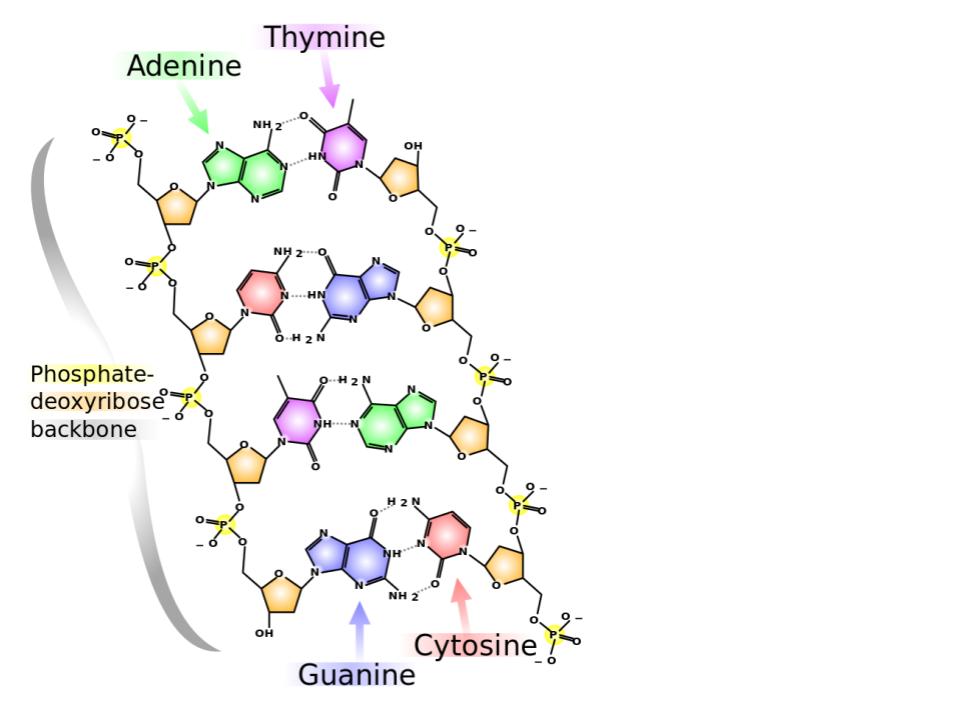
What is this a picture of?

a)

nucleotide

b)

DNA strand

c)

chromosome

d)

gene

30.

Label the picture FROM LEFT TO RIGHT in order:

a)

phosphate ; sugar ; base

b)

phosphate ; base ; sugar

c)

base ; sugar ; phosphate

d)

base ; phosphate ; sugar

31.

In which phase does the DNA copy itself?

a)

interphase

b)

metaphase

c)

anaphase

d)

telophase

32.

In which phase do the chromosomes form?

a)

prophase

b)

metaphase

c)

anaphase

d)

telophase

33.
What type of RNA carries the DNA message out of the nucleus to the ribosomes?
a)
mRNA
b)
tRNA
c)
RNA
d)
DNA
34.
What do we call the process of turning DNA into mRNA?
a)
Translation
b)
Transcription 
c)
Replication
35.
When DNA is transcribed to RNA.... 
a)
A pairs with U
b)
C pairs with U
c)
A pairs with T
d)
C pairs with T
36.
Amino acids are the building blocks of... 
a)
DNA
b)
RNA
c)
Atoms
d)
Proteins
37.
In translation, C pairs with 
a)
U
b)
G
c)
A
d)
T
38.
Where does transcription take place?
a)
nucleus
b)
cytoplasm
c)
ribosome
39.
One difference between DNA and RNA is that....
a)
Only RNA has the base Uracil
b)
only RNA contains the base Thymine
c)
only RNA contains the base Cytocine
d)
only RNA contained the base Guanine
40.
Which of these bases does not exist in RNA?
a)
C
b)
T
c)
U
d)
A
41.
_______ is made during transcription and ________ is made during translation.
a)
mRNA / a protein
b)
a protein / mRNA
c)
Ribosome / Nucleus
d)
mRNA / tRNA
42.
Nucleotides are made up of a sugar, phosphate, and..?
a)
nitrogenous base
b)
nucleic acid
c)
cholesterol
d)
fatty acid
43.
Which of the following is the sugar found in RNA?
a)
Ribose
b)
Maltose
c)
Deoxyribose
d)
Amylose
44.
Codons contain ______ bases
a)
1
b)
3
c)
6
d)
9
45.
Which is the organelle that makes proteins?
a)
Nucleus
b)
Ribosomes
c)
Rough ER
d)
Golgi Apparatus
46.
What is the correct order?
a)
Transcription then Translation
b)
Translation then transcription
c)
Translation then replication
d)
Replication then Translation
47.
DNA codes for...
a)
cholesterol
b)
proteins
c)
fatty acids
d)
a sandwich
48.

In a strand of DNA, if it contains 30% of Thymine, then how much Guanine would be present?

a)
30%
b)
20%
c)
80%
d)
10%
49.
In a molecule of double-stranded DNA, the amount of Adenine present is always equal to the amount of
a)
cytosine
b)
guanine
c)
thymine
d)
uracil
50.
How many nucleotides make a codon?
a)
1
b)
2
c)
3
d)
6
51.
What is the product of translation?
a)
DNA
b)
mRNA
c)
tRNA
d)
proteins
52.
Which type of RNA takes the instructions from the nucleus to the cytoplasm?
a)
mRNA
b)
tRNA
c)
rRNA
d)
RNA polymerase
53.
Which of the following statements is true?
a)
DNA is single-stranded
b)
RNA is single-stranded
c)
DNA contains uracil
d)
RNA contains deoxyribose
54.
RNA contains the sugar
a)
ribose
b)
deoxyribose
c)
glucose
d)
lactose
55.
How does RNA differ from DNA?
a)
RNA contains uracil and deoxyribose
b)

RNA is 1/2 the width of DNA.

c)
RNA contains uracil and ribose
d)
RNA contains adenine and ribose
56.
In messenger RNA, each codon specifies a particular
a)
nucleotide
b)
enzyme
c)
amino acid
d)
promoter
57.

What are the 4 nitrogen bases?

a)

adenine, thymine, cytoplasm, and guanine

b)

adenine, thymine cytosine, and guanine

c)

adenine, thymine, cytosine, and gylcerol

d)

adenine, thymine, cytosine, and glucose

58.
Which sequence of DNA bases would pair with this partial strand
CAT TCA CTG
a)
ATG TGA CAG
b)
TAC ACT GTC
c)
GTA AGT GAC
d)
CAT TCA CTG
59.

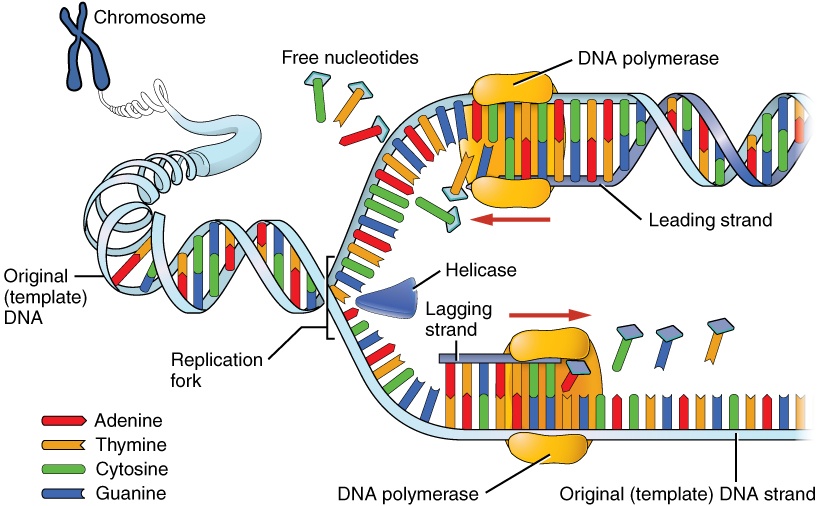
Which is the first step?

a)

DNA Helicase unwinds original DNA strand

b)

RNA Primase lays down RNA primer for new nucleotide bases.

c)

DNA polymerase builds new strands by bring in new nucleotide bases.

d)

Ligase knits together fragments on lagging strand
60.
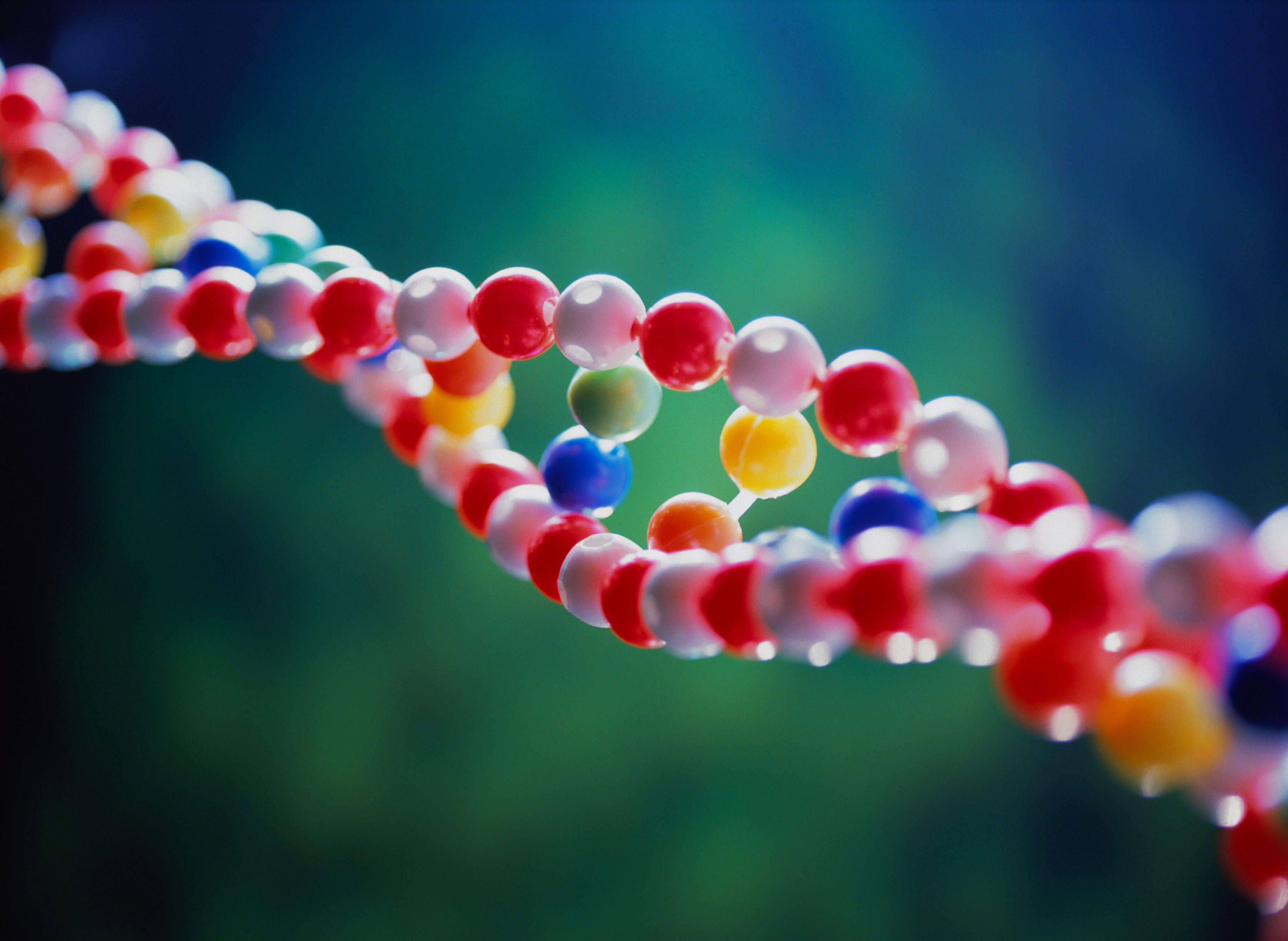
Why is DNA important?
a)
it is very small and very complicated
b)
it's in everything
c)
it serves as the blueprint for traits of all living things
d)
because we eat it every day for energy
61.
Which 2 molecules form the sides (backbone) of the DNA ladder?
a)
deoxyribose sugar and adenine
b)
deoxyribose sugar and a hydrogen bond
c)
deoxyribose sugar and the nucleus
d)
deoxyribose sugar and phosphate
62.
Cytosine always pairs with
a)
Adenine
b)
Thymine
c)
Uracil
d)
Guanine
63.
The two strands of DNA are held together by:
a)
Hydrogen Bonds
b)
Phosphodiester Bonds
c)
Glycolsyl Bonds
d)
Glycosidic Linkages
64.
What is the complement to the DNA strand below:
5'-ATGCCAT-3'
a)
5'-TACGGTA-3'
b)
3'-TACGGTA-5'
c)
3'-ATGGCAT-5'
d)
5'-ATGGCAT-3'
65.
Assume that you have straight hair and your sibling has curly hair. What accounts for this difference?
a)
You have DNA and your sibling does not.
b)
The your sequence of nitrogen bases is different than your sibling.
c)
Your sibling has a weave. 
d)
Your sibling has a genetic mutation. 
66.

Which letter pairs with - A

a)

C

b)

G

c)

T

67.

Which letter pairs with - C

a)

G

b)

A

c)

T

68.

Which letter pairs with - T

a)

C

b)

A

c)

G

69.

Which letter pairs with - G

a)

C

b)

A

c)

T

70.

What is the subunit of DNA?

a)

Polysaachride

b)

Polypeptide

c)

Nucleotide

71.

Which of the following make up a nucleotide? (check all that apply)

a)

Phosphate

b)

Fatty Acid

c)

Deoxyribose Sugar

d)

Nitrogen Base

72.
Translation is the production of ___ from ___.
a)
RNA, protein
b)
DNA, protein
c)
RNA, DNA
d)
protein, RNA
73.
What is the transcribed mRNA strand for CATTAA
a)
GUAAUU
b)
GTAATT
c)
AUGGUU
d)
CATTAA
74.
Transcription takes place in the 
a)
cytoplasm
b)
ribosome
c)
mitochondrion
d)
nucleus
75.
Translation occurs in the
a)
nucleus
b)
mitochondria
c)
cytoplasm
d)
golgi apparatus
76.
The codon (set of 3 nitrogen bases) codes for 1 of 20
a)
endoplasmic reticulum
b)
RNA
c)
genes
d)
amino acids
77.

DNA is made of chemical building blocks called

a)

nucleotides.

b)

bases.

c)

chemicals.

d)

phosphates.

78.

Nucleotides are made of three parts:

a)

a backbone, a step and a base.

b)

a nitrate, a phosphate and a step,

c)

a phosphate group, a sugar group and one of four types of nitrogen bases.

d)

a twizzler, a toothpick and a marshmallow.

79.

The complementary strand to TACG would be

a)

GCAT.

b)

tacg.

c)

CGAT.

d)

ATGC.

80.

The number of thymine bases in a complementary strand will equal the number of _______ bases in the DNA original sequence.

a)

adenine

b)

cytosine

c)

guanine

d)

thymine

81.

What are the two steps involved in reading the DNA to make proteins?

a)

Copying and translation.

b)

Transcription and translation.

c)

Copying and reading.

d)

Reading and transcription.

82.

The process that makes a copy, called mRNA, of the unzipped DNA strand is called

a)

transcription.

b)

transaction.

c)

translation.

d)

typing.

83.
When can a mutation be passed on to offspring?
a)
only when the mutation is present during or occurs during mitosis
b)
only when the mutation is present during or occurs during meiosis
c)
when the mutation occurs during mitosis or meiosis
d)
when the mutation occurs in somatic cells
84.

An example of selective breeding is

a)

a dog breeder mating 2 dogs to make more dogs

b)

a farmer grows bees to pollinate the plants on his farm

c)

a person pollinates 2 white rose plants to only create white roses

85.

Selective breeding is...

a)

a process to create an organism with desired traits from parents with those desired traits

b)

natural method of producing offspring with desired traits

c)

creating a new species

d)

making organisms reproduce during times of stress