
Font size
 Worksheets
Study Guide Unit 1 Lecture
Total questions: 100
Worksheet time: 2hrs 40mins
Blood, the heart, and blood vessels compose the _________ system.
Endocrine
Cardiovascular
Lymphatic
Pulmonary
The plane that separates the body into the front and back, or anterior and posterior portions, is the _________ plane.
median
sagittal
transverse (horizontal)
frontal (coronal)
Which body cavities are almost completely surrounded by bone?
Thoracic and abdominal cavities
Cranial cavity and vertebral canal
Abdominal and pelvic cavities
Thoracic cavity and vertebral canal
The upper and lower limbs compose the _________ portion of the body.
axial
proximal
distal
Appendicular
A(n) _________consists of a group of tissues working together to perform specific functions.
molecule
organelle
tissue
organ
The simplest structures in which the processes of life occur are _________
organs
tissues
molecules
cells
The chin is ________ to the mouth, and the knee is _________ to the ankle.
superior; proximal
anterior; distal
inferior; distal
inferior; proximal
An organ system that protects vital organs, produces blood cells, and stores minerals is the _________system
cardiovascular
integumentary
skeletal
lymphatic
A _________plane is a plane that cut in between the longitudinal and cross-sectional axes.
oblique
sagittal
transverse (horizontal)
median
The gallbladder is located in the ________ quadrant.
right lower
right upper
left upper
left lower
A tissue is _________
organs grouped together
the structural and functional units of the body
an organ with specific functions
a group of cells that perform similar functions
Which quadrant is the stomach located within?
Left upper quadrant
Right upper quadrant
Right lower quadrant
Lower left quadrant
The survival needs of the human body include _________
food, water, and the appropriate atmosphere containing oxygen and adequate pressure.
food, water, oxygen, and the appropriate environmental conditions.
food, water, oxygen, body temperature, and atmospheric pressure.
food, water, and oxygen.
The diaphragm divides the _________
abdominopelvic and thoracic cavities
abdominal and pelvic cavities.
pericardial and pleural cavities
thoracic cavity and mediastinum.
A feedback mechanism that amplifies the stimulus is called _________
positive feedback
hormone feedback
nervous feedback
negative feedback
In anatomical terms, the arm is the _________, and the wrist is the _________ region.
brachium; carpal
brachial; cubital
antebrachium; cubital
antebrachium; carpal
The term used to describe something pertaining to the internal organs is _________
deep
peripheral
visceral
proximal
A feedback mechanism that returns the body to homeostasis is _________
hormone feedback
negative feedback
nervous feedback
positive feedback
The plane that divides the body into superior and inferior portions is the _________
paramedian
frontal (coronal)
sagittal
transverse (horizontal)
The covering of the lungs is the _________, and they are located in the _________ cavities.
parietal pleura; peritoneal
parietal pleura; pleural
visceral pleura; peritoneal
visceral pleura; pleural
All the chemical reactions within a cell or organism are known as _________
metabolism
catabolic reactions
maintenance
anabolic reactions
The thoracic cavity contains which of the following cavities?
Thoracic, pleural, pelvic
Pericardial and pleural
Cranial, abdominal, pelvic
Cranial, spinal, pelvic
The integumentary system is made up of the _________
brain, spinal cord, and nerves
hormone-producing glands
skin, hair, nails, and associated glands
bones, ligaments, and cartilage
The cephalic region includes the _________
the head and neck
the shoulders and arms
the cranial and facial regions
the cranial and cervical regions
The membrane lining the abdominal cavity and covering the surfaces of its organs is the _______
meninges
pericardium
peritoneum
pleura
What type of reaction is shown?
AB + CD → AD + BC
Reversible
Decomposition
Synthesis
Exchange
The monosaccharide that is the major carbohydrate fuel for body cells is _________
glucose
sucrose
galactose
fructose
The valence electrons are those _________
located in the outermost shell
close to the nucleus of the atom
located in the innermost shell
active in chemical bonds
What is the notation that tells the reader the chemical composition of a molecule or compound?
Elemental notation
Atomic structure
Chemical formula
Compound formula
To be considered an organic molecule a substance must contain _________
carbon and oxygen
oxygen and hydrogen
carbon and nitrogen
carbon and hydrogen
About 96% of the body consists of what four elements?
Oxygen, hydrogen, carbon, and nitrogen
Oxygen, hydrogen, carbon, and sodium
Oxygen, hydrogen, carbon, and copper
Oxygen, hydrogen, glucose, and carbon
Steroids are a type of _________
lipid
nucleic acid
protein
sugar
The form of carbohydrate our bodies use to store reserve energy is _________
disaccharides
starches
glycogen
glucose
Where on an enzyme does the substrate bind?
The enzymatic site
The inhibition site
The allosteric site
The active site
Hydrogen bonds occur between _________
ions and nonpolar molecules
polar molecules
multiple ions
nonpolar molecules
A saturated fat will have _________
very few hydrogen atoms
no carbon to carbon double bonds
significant numbers of carbon-carbon double bonds
excessive nutrients
What is the term for a substance that causes a resistance to a change in pH?
Buffer
Electrolyte
Salt
Base
A substance that cannot be broken down into a simpler substance by chemical means is a/an _________
molecule
element
compound
nucleic acid
Anything that has weight and occupies space can be described as _________
a molecule
matter
an atom
a compound
A covalent bond between two amino acids is called a(n) _________
ionic bond
peptide bond
enzyme bond
protein bond
What type of reaction is shown?
A + B + C ↔ ABC ↔ AB + C
Exchange
Decomposition
Synthesis
Reversible
What is released when an ATP splits to produce an ADP?
Energy
Heat
Inorganic phosphate (
P
i
Pi )
All of the choices are correct.
The element that forms the backbone of organic molecules is _________
hydrogen
carbon
oxygen
nitrogen
What type of chemical formula is shown here?
CH
4
Atomic formula
Molecular formula
Elemental formula
Structural formula
Proteins are made up of _________
blank
amino acids
nucleotides
sugars
fats
If there are two forms of atoms for an element that differ only in the number of neutron, the various forms of the element are referred to as _________ of that element.
ions
molecules
isotopes
electrolytes
When placed in water, ionic substances ionize into _________
salts
water molecules
electrolytes
hydrogen ions
The ionization of a/an _________ releases hydrogen ions and increases the concentration of hydrogen ions in a solution.
acid
base
salt
solvent
Lactose, the sugar contained in milk, is an example of a _________
simple sugar
monosaccharide
disaccharide
None of the choices are correct.
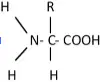
This chemical structure would be the general representation of _________
a fatty acid
glycerol
a nucleic acid
an amino acid
The _________ are the folds of the inner membrane within a mitochondrion that contain the enzymes for aerobic respiration.
mitchondrial reticulum
mitochondrial complexes
mitochondrial cristae
mitochondrial centrioles
The network of membranes that provide channels for the movement of materials throughout the cytoplasm is the _________
Golgi complex
endoplasmic reticulum
lysosomes
mitochondrion
During what phase of mitosis do the chromosomes form a line along the equator of the cell?
Anaphase
Telophase
Prophase
Metaphase
One key difference between mitosis and meiosis is that mitosis occurs in _________ cells while meiosis only occurs in _________ cells.
somatic; nonsex
daughter; parent
somatic; sex
sex; somatic
After being produced, _________ provides the blueprint for assembling proteins.
rRNA
mRNA
mtRNA
tRNA
Substances can enter a cell against the concentration gradient by _________ transport, which is powered by _________
passive; electrolytes
passive; ATP
active; ATP
active; electrolytes
The _________ is the organelle that is sometimes referred to as the powerhouse of the cell due to the fact that it produces ATP most efficiently
Golgi complex
mitochondrion
smooth endoplasmic reticulum
rough endoplasmic reticulum
_________respiration occurs in _________and produces most of the ATP formed by cellular respiration.
Anaerobic; mitochondria
Aerobic; cytoplasm
Aerobic; mitochondria
Anaerobic; cytoplasm
If a blood cell is immersed in a solution that causes water to move out of the cell, the solution is a/an _________solution.
isotonic
hypotonic
hypertonic
None of the choices are correct.
In _________, the sequence of bases in DNA determines the sequence of bases in mRNA. The process occurs in the _________
translation; cytoplasm
cytokinesis; cytoplasm
transcription; nucleus
mitosis; nucleus
In mitosis, the division of the parent cell occurs by _________during _________.
cytokinesis; telophase
cytokinesis; metaphase
cytokinesis; prophase
telekinesis; telophase
The genetic code of _________ is formed by the sequence of nitrogenous _________ in its nucleotides.
RNA; sugars
RNA; acids
DNA; sugars
DNA; bases
The replication of chromosomes occurs during _________
metaphase
anaphase
prophase
interphase
Which organelle is produced with assistance from the nucleolus?
Mitochondrion
Ribosome
Lysosome
Nucleus
The numerous short hair-like projections that move things across the surface of cells are _________
flagella
microtubules
cilia
microvilli
The paired chromosomes separate and migrate toward the poles of a cell during _________
prophase
telophase
anaphase
metaphase
Mitosis produces _________ daughter cells that are genetically _________ the parent cell.
two; identical to
four; different from
two; different from
four; identical to
The _________ acts as the cell's "post office" by sorting, processing, and packaging materials to be transported within the cell or secreted from the cell.
rough endoplasmic reticulum
Golgi complex
mitochondrion
smooth endoplasmic reticulum
How many nucleotides are needed to form a codon?
2
None of the choices are correct.
20
3
The _________ are sites of protein synthesis within cells
nucleoli
lysosomes
vesicles
ribosomes
Facilitated diffusion requires _________ to occur.
a gradient
a gradient and a carrier protein
a carrier protein
energy
How many cells does the human body have?
25 trillion
75 trillion
4 billion
100 million
A nucleotide that RNA uses but DNA does not is _________
adenine
thymine
uracil
cytocine
Sperm are unique amongst human cells because _________
they are produced by mitosis
everyone produces them
they have flagella
they lack nuclei
The structure that controls the movement of materials into and out of cells is the _________
cytoplasm
plasma membrane
endoplasmic reticulum
nucleus
.________ is characterized as striated and involuntary.
Skeletal striated muscle
Cardiac striated muscle
Smooth muscle tissue
Cardiac striated muscle and skeletal striated muscle
________ covers the body surface.
A mucous membrane
A serous membrane
A synovial membrane
The cutaneous membrane
_________ are neuronal processes.
Gliomas
Neurons
Neuroglia
Dendrites
________forms the inner lining lining the urinary bladder and is specialized to stretch and return to its original shape
Transitional epithelium
Pseudostratified columnar epithelium
Stratified squamous epithelium
Simple cuboidal epithelium
The tissue type that covers the body surface, body cavities, and organ surfaces is _________ tissue.
muscle
connective
epithelial
Nerve
Epithelial membranes consist of _________.
epithelial tissue only
epithelial tissue overlying elastic tissue
epithelial tissue overlying loose connective tissue
epithelial tissue overlying reticular tissue
________ is the main tissue in ligaments and tendons.
Dense irregular connective tissue
Loose connective tissue
Dense regular connective tissue
Reticular tissue
________ are the interconnected bony plates in spongy bone.
Canaliculi
Lamellae
Trabeculae
Lacunae
Cells of _________muscle tissue have striations with multiple nuclei, and this tissue is _________ in function.
skeletal striated muscle; involuntary
smooth muscle tissue; voluntary
skeletal striated muscle; voluntary
cardiac striated muscle; involuntary
The bone matrix of compact bone is formed in circular layers called _________
canals
canaliculi
lacunae
lamellae
Blood is classified as _________
an epithelial tissue
a muscle tissue
a connective tissue
a nerve tissue
________forms the inner lining of many respiratory passageways and may include specialized mucus secreting goblet cells.
Simple columnar epithelium
Simple squamous epithelium
Simple cuboidal epithelium
Pseudostratified columnar epithelium
________ contains widely spaced collagen and elastic fibers, and is the most abundant connective tissue in the body.
Areolar connective tissue
Adipose tissue
Dense irregular connective tissue
Reticular tissue
_______ secrete mucus.
Goblet cells
Reticular cells
Adipocytes
Fibroblasts
The tissue type that binds organs together and provides protection and support for the organs is _________tissue.
nerve
muscle
epithelial
connective
The osteocytes of bone tissue reside within fluid-filled spaces called _________
Lacunae
Trabeculae
Lamellae
Canaliculi
_________ contains short rows of chondrocytes between tightly packed collagen fibers.
Elastic cartilage
Hyaline cartilage
Fibrocartilage
Reticular tissue
_________ consists of collagen fibers that are oriented in multiple directions, and is found in the joint capsules and the deep layer of skin.
Reticular tissue
Dense regular connective tissue
Loose connective tissue
Dense irregular connective tissue
In compact bone, bone matrix is arranged in concentric circles around _________, and smaller _________ bring nutrients to osteocytes.
central canals; osteons
central canals; canaliculi
lamellae; central canals
lacunae; canaliculi
The membranes that line the tubes or cavities that have openings to the external environment are referred to as _________.
synovial membranes
cutaneous membranes
serous membranes
mucous membranes
.Glands are formed from _________.
nerve tissue
connective tissue
epithelial tissue
muscle tissue
_________forms the inner lining of the intestines and is important in the secretion and absorption of substances.
Simple cuboidal epithelium
Simple columnar epithelium
Pseudostratified columnar epithelium
Simple squamous epithelium
Dense regular connective tissue consists of tightly packed _________
elastic fibers
reticular fibers
fibroblasts
collagen fibers
Which of the following cover(s) the brain and spinal cord?
Meninges
Perichondrium
Periosteum
Synovial membranes
The connective tissue with a matrix of calcium salts and some collagen fibers is _________.
elastic cartilage
bone tissue
hyaline cartilage
fibrocartilage

