
 Worksheets
Exotics Vet-Reptile/Amph
Total questions: 58
Worksheet time: 29mins
What is the number one reason exotics come to a veterinary clinic?
Nutrition
Husbandry
Vaccinations
Breeding issues
What should be considered regarding the size of the enclosure for housing a snake?
The color of the snake
The length of the snake
The weight of the snake
The age of the snake
What type of species should the enclosure be suitable for?
Aquatic or aerial
Terrestrial or arboreal
Domestic or wild
Nocturnal or diurnal
What is an important feature of the enclosure to prevent the snake from escaping?
Color
Security (escape-proof)
Size
Shape
Why is ventilation important for a snake's enclosure?
To allow the snake to see outside
To provide a place for feeding
To ensure proper air exchange
To make the enclosure easier to clean
What is necessary to maintain hygiene in the snake's enclosure?
Access for necessary cleaning/disinfection
Regular feeding schedule
Natural light
Noise control
What question should be asked regarding the substrate in the snake's enclosure?
What color is the substrate?
What substrate is on the bottom of the cage?
How soft is the substrate?
How much does the substrate cost?
How often should the snake's enclosure be cleaned?
What should be known about the cleaning product used for the snake's enclosure?
What should the housing for a species in captivity reflect?
The species' natural environment and habits
The most convenient size for the owner
The cheapest materials available
The most aesthetically pleasing design
What is the minimum length of an enclosure for a snake?
Twice the length of the snake
The same as the length of the snake
Half the length of the snake
No minimum requirement
What should you avoid placing in a snake's enclosure?
Anything it would eat
A heat source
A water bowl
Substrate for burrowing
What is the minimum recommended tank size for a young snake?
5 gallons
10 gallons
40 gallons
20 gallons
As snakes get older, what might be necessary regarding their tank size?
They may need a smaller tank.
They may need the same size tank.
They may need to upsize their tank.
Tank size is irrelevant as they get older.
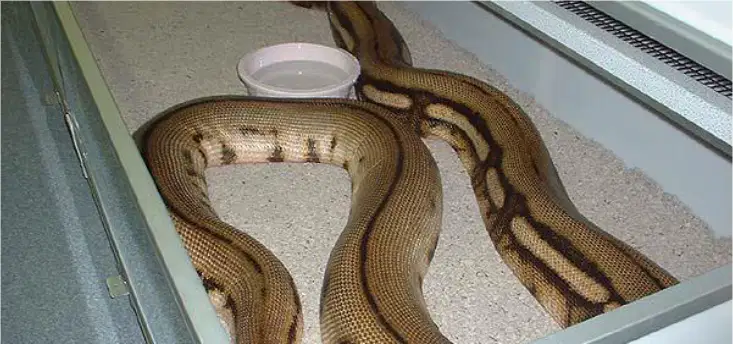
Based on the image, which of the following statements is true?
All snakes can live comfortably in a 10-gallon tank.
Snakes do not need to upsize tanks as they get older.
A 40-gallon tank is too small for a large snake.
A 10-gallon tank is suitable for a large snake.
How large should the dry or docking area be for an aquatic turtle?
Small enough for the turtle to be partially in the water
Large enough for the turtle to be completely out of the water
As large as the turtle's aquarium
Half the size of the turtle's shell
How often should the water in an aquatic turtle's tank be changed?
25% every week
50% every two weeks
50% weekly
100% monthly
What should be the depth of the water in an aquatic turtle's tank?
Twice the width of the turtle's shell
As deep as the turtle's shell
Half the width of the turtle's shell
As deep as the width of the turtle's shell
What must be maintained within the POTZ for the species of aquatic turtle?
Humidity levels
Water salinity
Temperature
Light intensity
What is essential to have in the docking area for an aquatic turtle?
A cooling fan
A heat lamp
A water filter
A UVB light
What does the term "Arboreal" refer to?
Animals that live in the desert
Animals that live in the trees
Animals that live underground
Animals that live in the water
Which of the following is an example of an arboreal animal?
Camel
Jackson's chameleon
Earthworm
Shark
What term describes animals that require warmer and cooler areas in their habitat to regulate their body temperature?
Endothermic
Heterothermic
Ectothermic
Homeothermic
Why should the temperature in warmer and cooler areas of an ectothermic animal's enclosure be monitored?
To ensure they have constant body temperature
To ensure they fall within the POTZ for the species
To make sure they are comfortable at all times
To prevent them from moving too much
What can inappropriate temperatures lead to in ectothermic animals?
Improved health and well-being
Faster growth and development
Poor doing, disease, and death
Increased activity and metabolism
Which of the following should not be used as a heat source for snakes because it can burn them?
Heating tape
Heat lamps
Under-the-tank heaters
Heat rocks
What does POTZ stand for?
Potential Optimal Temperature Zone
Preferred Optimum Temperature Zone
Primary Optimal Thermal Zone
Perfect Optimum Temperature Zone
Why should heat lamps be placed on timers?
To save electricity
To simulate day/night cycles
To increase the heat output
To prevent overheating
Why is a heat source considered vital for the wellbeing of reptiles?
Reptiles need to stay hydrated.
Reptiles are ectothermic and rely on external heat sources.
Reptiles need to stay cool.
Reptiles require darkness to thrive.
What should be done with the heat source to ensure the safety of reptiles?
Place it in direct contact with the reptile.
Keep it at a distance from the reptile.
Remove it from the enclosure entirely.
Use it without any caution.
What can be added to a reptile's enclosure to help retain heat?
Extra bedding or blankets.
Ice packs.
More reptiles.
Cold water bottles.
What is the purpose of covering the tank with a towel or blanket?
To allow more light into the enclosure.
To make the enclosure look nicer.
To trap heat within the enclosure.
To provide a plaything for the reptile.
Why is it important to keep an emergency stock of fresh water for reptiles?
To help them escape the enclosure.
To maintain humidity levels.
To provide a swimming area.
To use as a cleaning agent.
What type of lighting is required for vitamin D synthesis?
UV-A lighting
UV-B lighting
Infrared lighting
LED lighting
What happens if there is a deficiency of vitamin D in terms of calcium absorption?
Calcium absorption is not affected
Calcium can be absorbed more efficiently
Calcium cannot be absorbed from the GI tract
The source of calcium must be changed
Can UV light penetrate glass or plastic?
Yes, it can penetrate both glass and plastic
No, it cannot penetrate either glass or plastic
It can only penetrate glass
It can only penetrate plastic
How often should proper UV light-bulbs be changed?
Once a year
Every six months
Regularly
Only when they burn out
What is important to maintain the health of reptiles and amphibians?
What to feed and how often to feed
Only feeding them once a week
Feeding them the same food every day
Avoiding UV light at all costs
Do all reptiles and amphibians have the same diet?
Yes, all reptiles and amphibians eat the same food
No, all reptiles and amphibians have individual specific diets
Yes, all reptiles and amphibians are carnivores
No, all reptiles and amphibians are herbivores
Are all reptiles carnivores?
Yes, all reptiles are carnivores
No, not all reptiles are carnivores
Yes, and they all require UV light
No, reptiles do not eat meat at all
Do reptiles that are carnivores require UV light?
Yes, they require UV light
No, UV light is harmful to carnivorous reptiles
Yes, but only during the night
No, they only require UV light if they are herbivores
What do some species need in terms of a water source?
A) A small bowl of water
B) A water source large enough to soak in
C) A water source to swim in
D) No water source at all
What is essential regarding the water provided to the species?
A) It can be stagnant and old
B) It should be salty
C) It should be clean fresh water
D) It should be ice-cold
Is misting required for the species?
A) Yes, all species require misting
B) No, misting is harmful to all species
C) It depends on the species
D) Only aquatic species need misting

What may play an important role in proper husbandry according to the image?
Nutrition
Humidity
Exercise
Social interaction
How can high humidity be maintained for the animals?
Using a dehumidifier
Misting the enclosure and the animal
Increasing the temperature
Providing less water
Which type of species must be misted several times a day to maintain the proper humidity?
Desert species
Arctic species
Tropical species
Temperate species
What is available to help maintain humidity automatically?
Heating pads
Automatic misters set on timers
Sun lamps
Ice packs
What can affect humidity in an animal's enclosure?
Substrate choices
Cage size
The color of the enclosure
The age of the animal
Which of the following factors, along with humidity, may play a role in nutritional disease?
UV lighting and temperature
Noise levels and air quality
Cage design and complexity
The number of animals in the enclosure
What is considered the most important aspect of nutrition in insectivorous species according to the text?
The food items themselves
The food of the food
The soil content in the food
The calcium powder on the food
What do wild insects ingest that contributes to the nutrition of an insectivorous lizard?
Plants, feces, and soil
Only plants
Only soil
Only feces
What is done to prey items before feeding them to insectivorous lizards to enhance their nutritional value?
They are refrigerated
They are gut loaded
They are dusted with calcium powder
They are baked
What term is used in the text to describe the process of preparing insects with additional nutrients before they are fed to lizards?
Gut load
Shake and bake
Soil enrichment
Nutrient dusting
What should be the minimum length of a snake terrarium?
Twice the length of the snake
The same as the length of the snake
Half the length of the snake
No less than the length of the snake
Why do some reptiles require UV-B lighting?
For heating their environment
For vitamin D synthesis
To improve their vision
To increase their lifespan
Without vitamin D, which nutrient cannot be absorbed from the GI tract in reptiles?
Protein
Calcium
Carbohydrates
Fats
Which of the following is NOT listed as an important factor in the environment required to maintain a healthy reptile/amphibian?
Housing
UV light
Social interaction
Heat source

