wayground logo

Free Printable Worksheets

Font size

S
M
L
XL
Worksheets

IC2 - Lesson 1-5 Assessment

Total questions: 46

Worksheet time: 49mins

Name
Class
Date
1.
How do you determine the melting point of a substance?
a)
I look at how long it takes for a substance to begin to melt.
b)
I look at the temperature at which a substance starts to melt.
c)
I look at the temperature at which the substance is no longer solid, it has completely turned into a liquid.
d)
I look at the color of a substance. A substance will turn brown when it is starting to melt.
2.
You find a clear gem that is made of one substance. What could you do to identify whether the gem is a diamond?
a)
Determine its shape and compare it to the shape of other gems, including diamonds.
b)
Measure its length and compare it to the length of other gems, including diamonds.
c)
Determine its hardness and compare it to the hardness of other gems, including diamonds.
d)
Measure its mass and compare it to the mass of other gems, including diamonds.
3.
Does every substance have a melting point?
a)
Any substance, even gases, that can be a solid can melt into a liquid and therefore have a melting point.
b)
Only naturally occurring solids will have a melting point.
c)
Only substances with a specific mass and volume can be measured and melted.
d)
Only inorganic substances will have a melting point, even though sometimes the temperature cannot be measured using a classroom thermometer.
4.
How does the size and thickness of metal affect the property of hardness?
a)
The thicker the metal the greater its hardness.
b)
Hardness is not a property.
c)
The amount of a substance does not affect its property of hardness.
d)
The hardness of diamonds will depend on what it is used for i.e. a ring, earrings, or a necklace.
5.
Which of the following characteristics will not help you tell whether two solids are the same or different substances?
a)
color
b)
hardness
c)
shape
d)
melting point
6.
Which piece of gold would have the greatest density?
a)
The gold with a mass of 132 would have the greatest density.
b)
All of the pieces would have the same density.
c)
The gold with a mass of 2 grams would have the greatest density.
d)
The gold with a mass of 13 grams would have the greatest density
7.
Figure out the density of an unknown substance using the data table below.
a)
Density = 36 g/cm³
b)
Density = 0.25 g/cm³
c)
Density = 4.33 g/cm³
d)
Density = 4 g/cm³
8.
A claim has been made that a baseball made by the Rawlings company has the same mass as a baseball made by the Wilson company. What experiment would you design to prove or disprove that claim? Choose the best answer.
a)
Use the water displacement method to determine the volume of each baseball and compare.
b)
Use an electric balance to see if both masses are the same or different.
c)
Slice the baseballs open to determine what they are made of.
d)
Multiply the length x width x height.
9.
Two objects are uncovered in an Egyptian tomb. One of the objects is a sphere and has a mass of 360 grams and a measured volume of 36 cm 3 . The other object is cylindrical with a mass of 50 grams and a measured volume of 5 cm 3 . A scientist just made a claim that both objects are made of the same material. Do you agree with her claim? Select the best explanation.
a)
The two objects have the same density so they must be the same substance.
b)
The two objects are different materials because they have very different masses. One object has a mass of 360 grams while the other object only has a mass of 50 grams.
c)
The two objects may not be the same material.
d)
Although the objects have the same density, the scientist needs to test for other properties. Substances can have common properties but no two substances have all of the same properties.
10.
A student makes some observations about three solids and summarizes the results in the table below.
a)
Only solids 1 and 2
b)
Only solids 2 and 3
c)
Only solids 1 and 3
d)
All of the solids
e)
None of the solids
11.
Jin and Maddie’s class is studying metals. The teacher gives their team 4 metal cubes. Two are 1.5 cm cubes, and two are 1.2cm cubes. They need to determine whether any of the cubes are made of the same element. Which investigation would enable them to determine whether any of the blocks are made up of the same elements?
a)
Jin and Maddie should test hardness on one cube, density on a different cube, solubility in water of another cube, and then melting point on the last cube and then compare.
b)
They should make a data table to record the color, hardness, mass, volume, and the melting point of the small cubes and the larger cubes.
c)
Jin and Maddie should test each cube to determine its properties. They could investigate color, hardness, density, solubility in different liquids, and perhaps their melting point. Each test would need to be repeated for each cube.
d)
Jin and Maddie should test the density of each cube. To do that they would measure the mass and volume to calculate the density. If their densities are all the same they will be the same substance.
12.
How do we know if something is a property or not?
a)
No two substances have the same properties.
b)
All properties are measured with tools.
c)
A property is a characteristic of a substance that is always the same.
d)
Properties depend on the size and shape of the substance.
13.
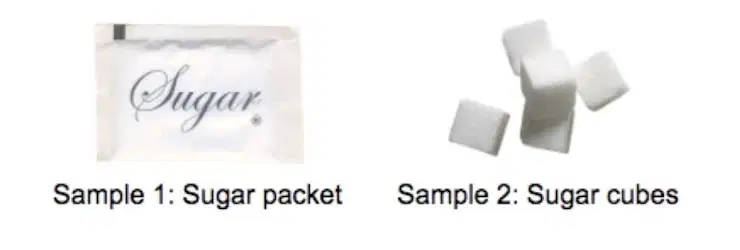
Your lab partner tested the solubility of the sugar in a sugar packet and sugar cubes in order to determine if both sugars are the same substance. Your partner only collected results for the sugar packet. They determined that the sugar from the packet is soluble in water, but is not soluble in oil. If you collected the solubility results for the sugar cubes, what would you predict your results would be if both samples were the same substance?
a)
The sugar cubes would be soluble in water and not soluble in oil.
b)
The sugar cubes would be soluble in both water and oil.
c)
The sugar cubes would not be soluble in water, but soluble in oil.
d)
The sugar cubes would not be soluble in both water and oil.
14.
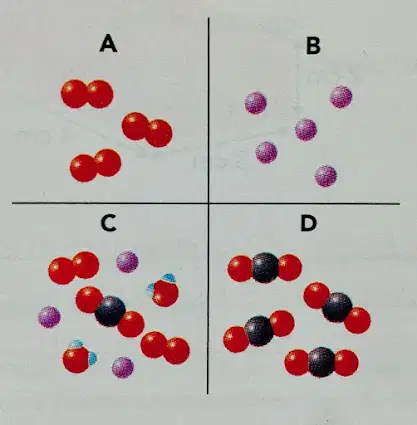
Which of the following shows a mixture?
a)
A
b)
B
c)
C
d)
D
15.
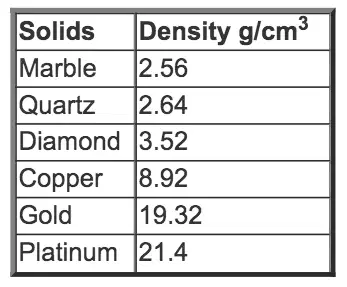
While digging in the backyard, you find an old coin. Its mass is 26.76 g and its volume is 3 cm³. From what is the coin made?
a)
Copper
b)
Marble
c)
Quartz
d)
Diamond
e)
Gold
16.
There is a block on your desk that acts as a paperweight. The block has a mass of 184.32 g. Its measurements are 3 cm by 4 cm by 6 cm. From what is the block made?
a)
Marble
b)
Quartz
c)
Diamond
d)
Copper
e)
Gold
17.
Answer the question below
a)
1
b)
2
c)
3
18.
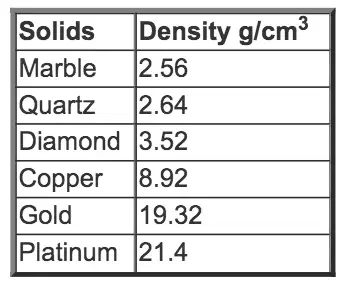
What is the density of the marble?
a)
0.67 g/cm³
b)
13.5 g/cm³
c)
1.5 g/cm³
d)
7.5 g/cm³
19.
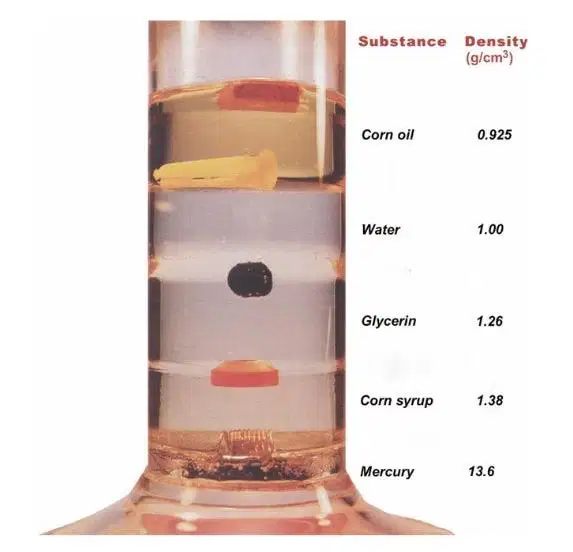
You are given the density column shown in the photo below. You are given an object that has a mass of 21.6 g and a volume of 16 cm³. Between what two layers would this object appear?
a)
corn oil and water
b)
water and glycerin
c)
glycerin and corn syrup
d)
corn syrup and mercury
20.

Which substance is a pure substance? (a)  

Choose from the below words
Tap Water
Ocean Water
24k Gold
Air
21.

The temperature at which a solid substance starts to become a liquid? (a)  

Choose from the below words
Solubility
Melting Point
Density
Hardness
22.

Which of the following would be the capacity of one substance to dissolve in a liquid ? (a)  

Choose from the below words
Solubility
Melting Point
Density
Hardness
23.

The Density of an object is calculated by using this equation: (a)  

Choose from the below words
Volume * Mass
Length * Width * Height
Mass / Volume
Volume / Mass
24.

Which substance is a mixture? (a)  

Choose from the below words
Diamonds
Ocean Water
24k Gold
Distilled Water
25.

The mass per unit volume of a substance is called (a)   ?

Choose from the below words
Hardness
Melting Point
Solubility
Density
26.

You could only use Hardness as a property for (a)  

Choose from the below words
Tap Water
Diamonds
Air
Lemonade
27.

If you cut a loaf of bread in half, each individual half would have (a)  

Choose from the below words
half the volume
double the volume
the same volume
no volume
28.

If you cut a loaf of bread in half, each half would have (a)  

Choose from the below words
half the denisty
double the density
the same density
no density
29.

If the mass of an object is 15 grams and the volume is 3 cm3, what would the density be? (a)  

Choose from the below words
18 g/cm3
12 g/cm3
45 g/cm3
5 g/cm3
30.

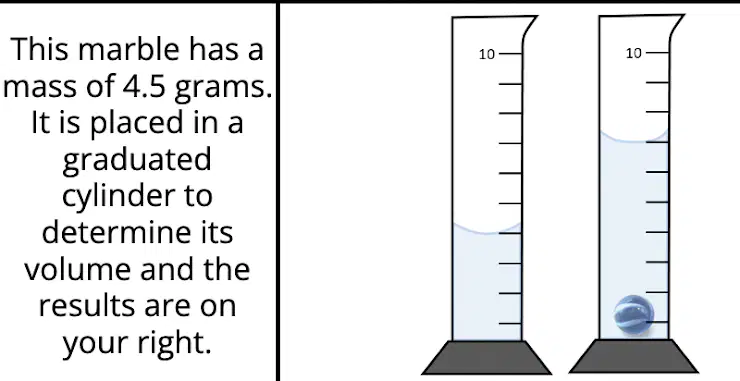
What is the volume of this irregular shape? (a)  

Choose from the below words
6 cm3
8 cm3
14 cm3
22 cm3
31.

the amount of matter an object has is called  (a)  

Choose from the below words
Density
Mass
Volume
Weight
32.

the amount of space an object takes up (a)  

Choose from the below words
Density
Mass
Volume
Weight
33.

Mass is measured in (a)  

Choose from the below words
Newtons
Pounds
milli-Liters
grams
34.

Volume is measured in (a)  

Choose from the below words
Newtons
Pounds
milli-Liters
grams
35.

Is color a property? (a)  

Choose from the below words
Yes, a property
No, not a property
36.

Is mass a property? (a)  

Choose from the below words
Yes, a property
No, not a property
37.

Is volume a property? (a)  

Choose from the below words
Yes, a property
No, not a property
38.

Is shape a property? (eg., round, or tall) (a)  

Choose from the below words
Yes, a property
No, not a property
39.

Is solubility a property? (a)  

Choose from the below words
Yes, a property
No, not a property
40.

Is melting point a property? (a)  

Choose from the below words
Yes, a property
No, not a property
41.

Is density a property? (a)  

Choose from the below words
Yes, a property
No, not a property
42.

If a characteristic changes when I have more or less of a substance, is it a property? (a)  

Choose from the below words
Yes, a property
No, not a property
43.

If a characteristic stays the same when I have more or less of a substance, is it a property? (a)  

Choose from the below words
Yes, a property
No, not a property
44.

What do you need to know to find the density of a substance? (a)  

Choose from the below words
mass and length
length and volume
mass and volume
length and density
45.
What is the evidence?
In our experiment, the blocks had different masses, 20 g., 30 g., 44 g., 123 g and 142 g but the time for all five blocks to fall was about the same. It took between 1.5 and 1.8 seconds for them to fall. No, mass does not affect how quickly an object falls. Since the blocks had different masses but took about the same time, I know that mass does not affect how quickly something falls.

a)
In our experiment, the blocks had different masses, 20 g., 30 g., 44 g., 123 g and 142 g but the time for all five blocks to fall was about the same. It took between 1.5 and 1.8 seconds for them to fall. 
b)
No, mass does not affect how quickly an object falls. 
c)
Since the blocks had different masses but took about the same time, I know that mass does not affect how quickly something falls.
46.
What is the reasoning?
In our experiment, the blocks had different masses, 20 g., 30 g., 44 g., 123 g and 142 g but the time for all five blocks to fall was about the same. It took between 1.5 and 1.8 seconds for them to fall. No, mass does not affect how quickly an object falls. Since the blocks had different masses but took about the same time, I know that mass does not affect how quickly something falls.
a)
In our experiment, the blocks had different masses, 20 g., 30 g., 44 g., 123 g and 142 g but the time for all five blocks to fall was about the same. It took between 1.5 and 1.8 seconds for them to fall. 
b)
No, mass does not affect how quickly an object falls. 
c)
Since the blocks had different masses but took about the same time, I know that mass does not affect how quickly something falls.