
Font size
 Worksheets
Cell Biology Quiz
Total questions: 66
Worksheet time: 46mins
What is one of the difficulties a cell faces as it increases in size due to information overload?
The cell can divide indefinitely without any issues.
DNA grows proportionally with the cell.
The DNA cannot keep up and produce the molecules needed if the cell gets too big.
The cell can easily manage the increased information in the DNA.
Why does the surface area to volume ratio decrease as a cell grows?
Because the volume decreases while the surface area increases.
Because the surface area increases at the same rate as the volume.
Because the volume increases but the surface area does not increase at the same rate.
Because the cell reduces its exchange of materials.
What happens when the surface-area to volume ratio is too small in a cell?
The cell's rate of chemical exchange increases.
The cell becomes more efficient.
The cell's rate of chemical exchange decreases, leading to cell death.
The cell divides into smaller cells.
What must happen for larger organisms to be built?
They must be built from larger cell subunits.
They must be built from a single large cell.
They must be built up from small cell subunits.
They must decrease their surface area to volume ratio.
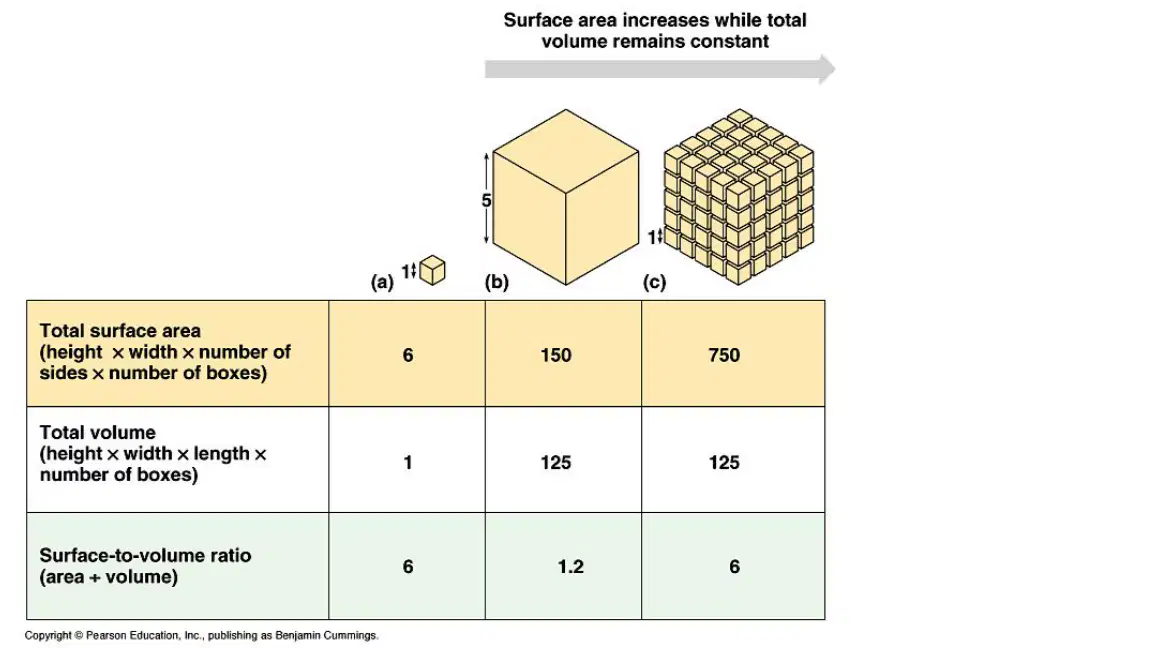
What happens to the surface-to-volume ratio of a cell as it increases in size, based on the diagram provided?
It increases
It decreases
It remains constant
It doubles

According to the diagram, what is the surface-to-volume ratio when the total volume remains constant at 125?
6
1.2
0.6
12
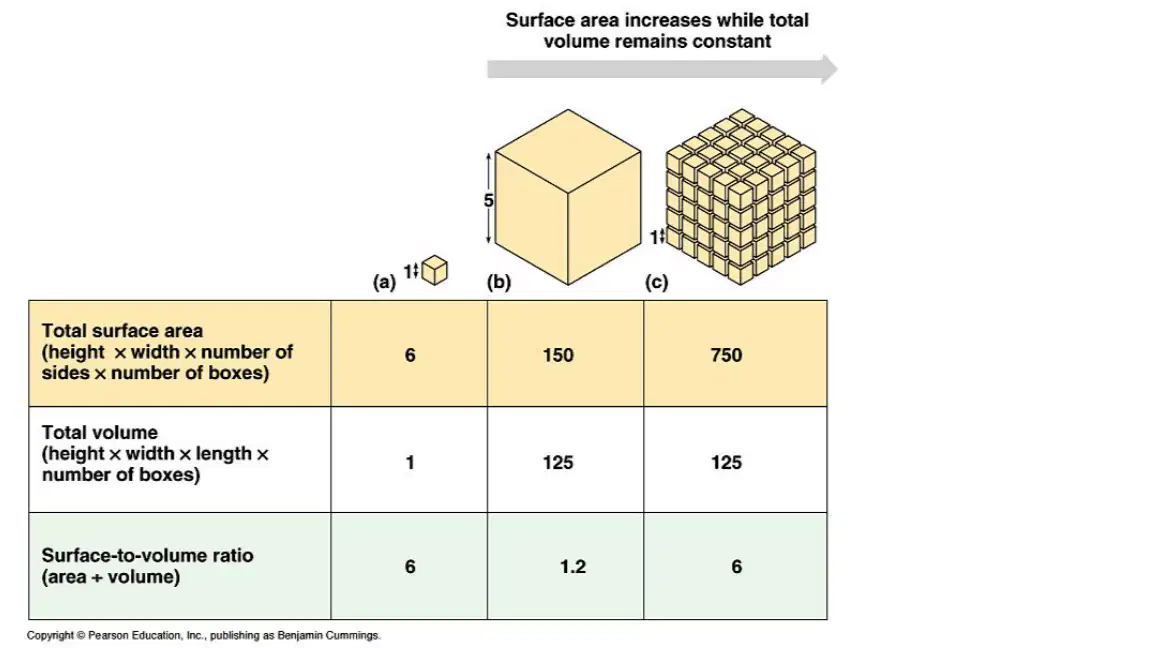
Based on the diagram, what is the total surface area of the largest cell model shown?
6
150
750
125
What is the surface area to volume ratio for a cube with a side length of 0.5 cm?
60:1
12:1
6:1
3:1
As the side length of a cube increases, what happens to the surface area to volume ratio?
It increases.
It decreases.
It stays the same.
It doubles.
What is the volume of a cube with a side length of 2 cm?
1 cm³
8 cm³
24 cm³
54 cm³
Which cube has the smallest surface area to volume ratio?
Cube with side length 0.1 cm
Cube with side length 1 cm
Cube with side length 5 cm
Cube with side length 10 cm
What process does a cell undergo to prevent it from getting too large?
Cell enlargement
Cell division
Cell reduction
Cell multiplication
What is the result of cell division?
The cell grows larger
The cell splits into two new daughter cells
The cell stops functioning
The cell changes its shape
How does cell division help with the issues a cell may face by increasing in size?
It provides more nutrients
It enhances cell mobility
It solves all of the issues
It decreases genetic material
What type of reproduction occurs in both single and multicellular organisms and results in genetically identical offspring from a single parent?
Sexual reproduction
Asexual reproduction
Binary fission
Meiosis
Which of the following is a characteristic of asexual reproduction?
Results in high genetic diversity
Requires two parents
Occurs slowly
Produces genetically identical offspring
What is an example of an organism that reproduces asexually?
Human
Hydra
Rose plant
Dog
What is the result of the fusion of two genetically different parent cells in sexual reproduction?
Offspring genetically identical to the parent
Offspring genetically different from either parent
Offspring with no genetic material
Offspring that are clones of each other
Compared to asexual reproduction, sexual reproduction:
Takes less time and provides less genetic diversity
Takes more time and provides less genetic diversity
Takes less time and provides more genetic diversity
Takes more time and provides more genetic diversity
Which organisms typically reproduce sexually?
Most bacteria and viruses
Most animals and plants
Only single-celled organisms
Only mammals and birds
What are chromosomes made of?
Proteins
RNA
Lipids
DNA
Where are prokaryotic chromosomes found?
In the nucleus
In the mitochondria
In the cytoplasm
On the cell membrane
What is the shape of the DNA in prokaryotic chromosomes?
Linear
Branched
Circular
Helical
How many chromosomes do fruit flies have per cell?
46
8
23
16
How many chromosomes do humans have per cell?
46
8
23
16
Compared to prokaryotic cells, eukaryotic cells have:
Less DNA and fewer chromosomes
More DNA and multiple chromosomes
No DNA and no chromosomes
The same amount of DNA and the same number of chromosomes
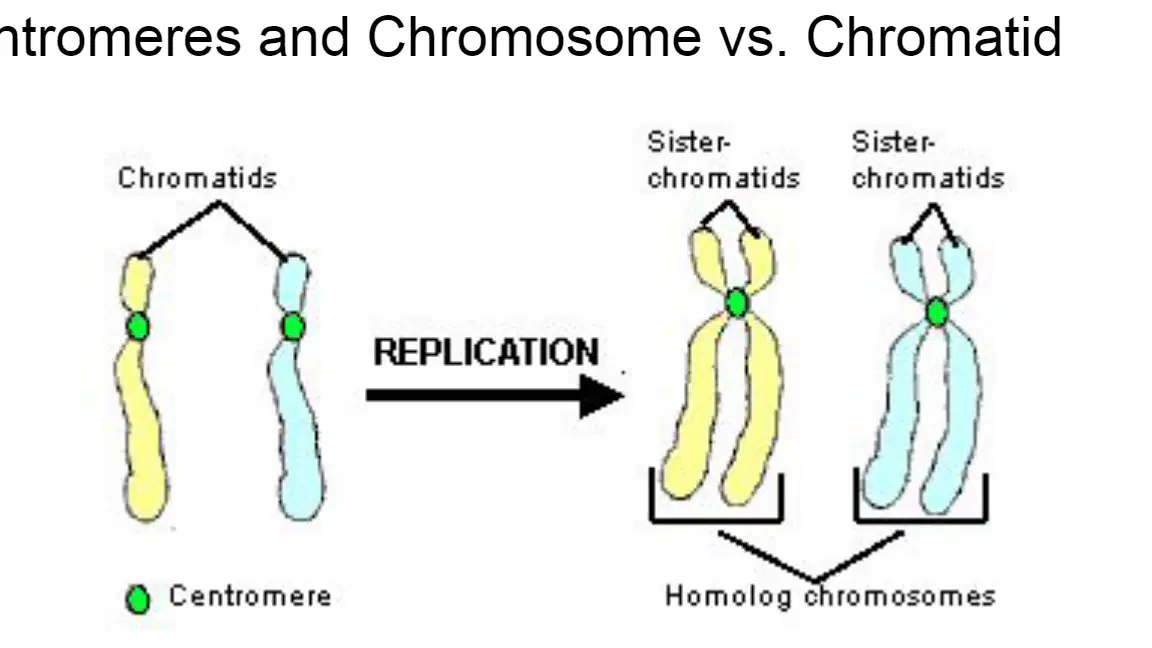
What happens to the chromatids during the process labeled "REPLICATION" in the diagram?
They separate into individual chromosomes.
They replicate to form sister chromatids.
They transfer genetic material to another cell.
They decrease in number.
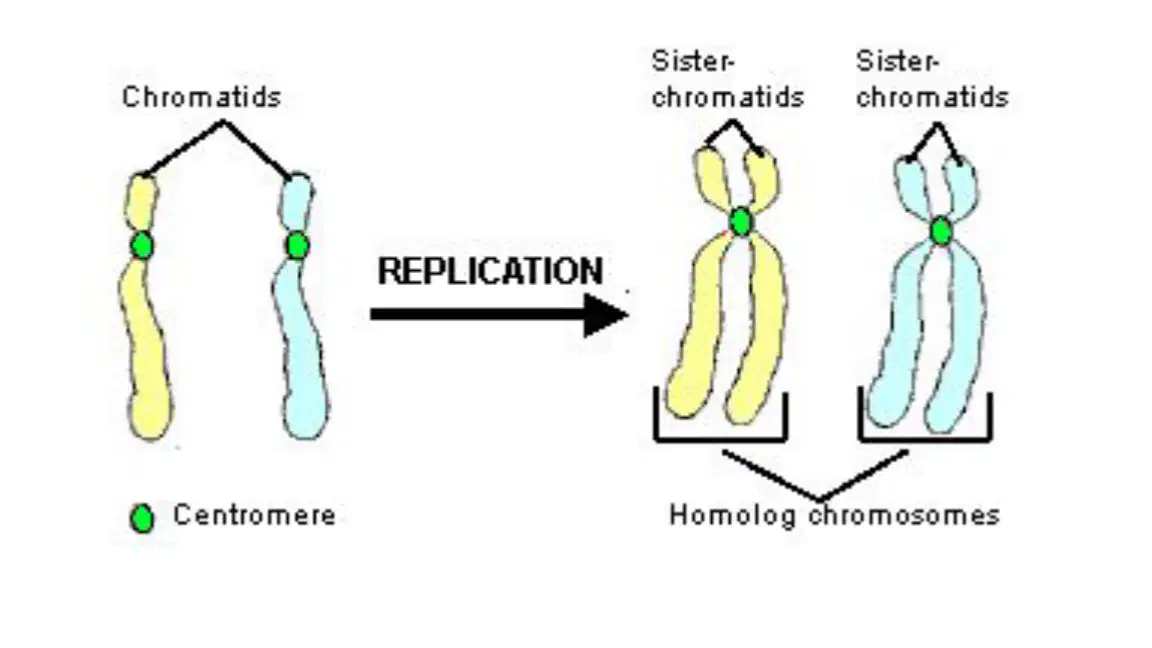
After replication, what are the two identical strands of a chromosome called, as shown in the diagram?
Homolog chromosomes
Sister chromatids
Daughter chromosomes
Parental chromosomes
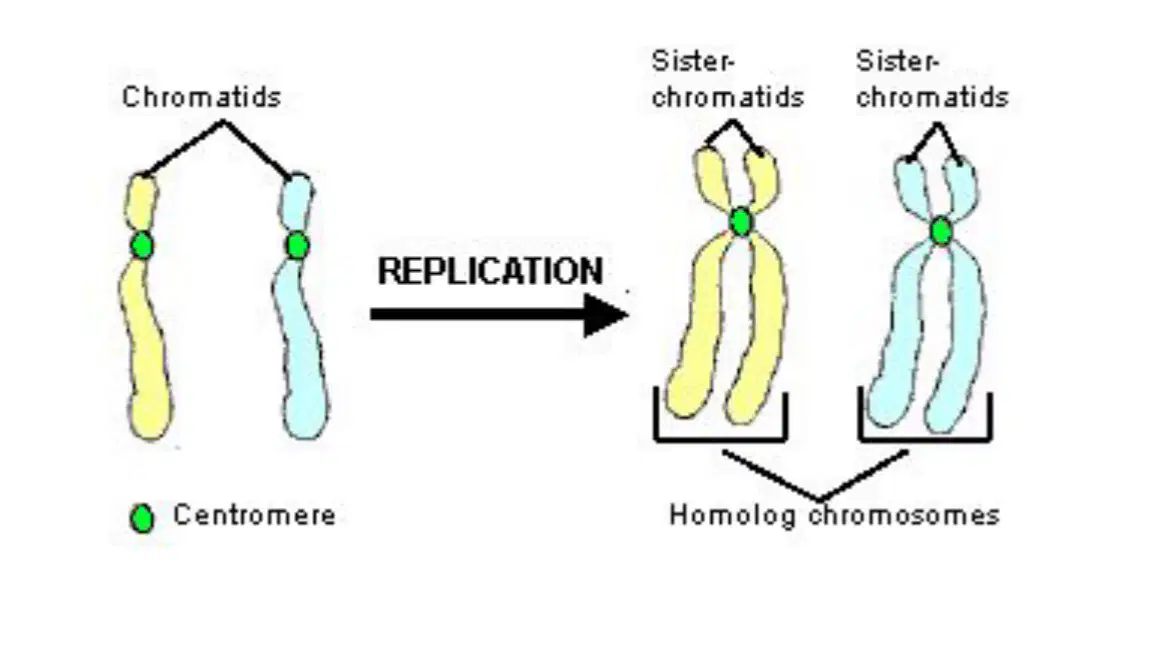
According to the diagram, what are "Homolog chromosomes"?
A pair of chromosomes before replication
A single strand of DNA
A pair of replicated chromosomes
The site of gene expression
What is the series of events that cells go through called?
The Cell Division
The Cell Growth
The Cell Cycle
The Cell Movement
What happens to a cell during the cell cycle?
It grows, prepares for division, and divides to form two daughter cells.
It shrinks and eventually dies.
It merges with another cell to form a larger cell.
It remains static without any changes.
What do the daughter cells do after being formed?
Do prokaryotic and eukaryotic cells go through the same type of cell cycle?
What is the name of the phase where the cell grows before DNA synthesis?
Gap 1 (G1) Phase
Gap 2 (G2) Phase
Synthesis (S) Phase
Mitotic (M) Phase
During which phase do the chromosomes line up along the metaphase plate?
Anaphase
Telophase
Metaphase
Prophase
What happens during anaphase?
Chromosomes break at centromeres, and sister chromatids move to opposite ends of the cell.
Chromatin condenses into chromosomes.
Nuclear membrane breaks down.
Cell grows and prepares for division.
What occurs during telophase and cytokinesis?
How many phases does the eukaryotic cell cycle consist of?
Four
Five
Six
Seven
Which phases of the eukaryotic cell cycle are collectively known as interphase?
G1, S, and M
G1, G0, and G2
G1, S, and G2
S, G2, and M
What is the G0 phase in the eukaryotic cell cycle?
During which period of the cell cycle does the cell grow, DNA replicates, and preparation for cell division occurs?
Mitosis
Cytokinesis
Interphase
G0
Which types of cells are typically in the G0 phase?
What happens during the G1 phase of Interphase?
DNA is synthesized
Chromosomes are replicated
Cells grow in size and make new proteins and organelles
The cell prepares to enter mitosis
During which phase of Interphase is DNA synthesized?
G1 phase
S phase
G2 phase
Mitosis
What is the shortest phase of Interphase?
G1 phase
S phase
G2 phase
Mitosis
By the end of the S phase, how much DNA is there compared to the beginning?
The same amount
Half as much
Twice as much
No DNA is present
What is created during the G2 phase?
New proteins and organelles
DNA
Organelles and molecules needed for cell division
Chromosomes
What is Mitosis?
A type of cellular respiration
Nuclear division, plus cytokinesis
A method of cell transportation
A form of genetic mutation
How many daughter cells are produced as a result of Mitosis?
One
Two
Three
Four
Do the daughter cells produced by Mitosis have the same number of chromosomes as the parent cell?
Yes, they have more chromosomes
No, they have fewer chromosomes
Yes, they have an identical set of chromosomes
No, they have a completely different set of chromosomes
Which of the following is NOT a phase of Mitosis?
Prophase
Metaphase
Interphase
Anaphase
What does prophase mean?
After stage
Before stage
Middle stage
Final stage
What happens to the chromatin during prophase?
It replicates
It condenses into chromosomes
It moves to the cell poles
It disappears
During prophase, what begins to disappear?
Cytoplasm
Nuclear membrane
Cell membrane
Mitochondria
What disappears along with the nuclear membrane during prophase?
Centrioles
Nucleolus
Mitotic spindle
Chromosomes
What separates and helps in forming spindles during prophase?
Chromosomes
Nucleolus
Centrioles
Nuclear envelope
What is the role of spindle fibers during metaphase?
They break down the nuclear membrane.
They move chromosomes to the center of the cell.
They replicate the DNA.
They produce energy for the cell.
During which stage of cell division do chromosomes attach to spindle fibers?
Anaphase
Telophase
Metaphase
Prophase
What is metaphase commonly described as?
The first stage of cell division.
The final stage of cell division.
The second stage of cell division.
The stage where cells rest.
What structure do the chromosomes (sister chromatids) attach to during metaphase?
Nuclear membrane
Centrosome
Spindle fibers
Cell membrane
What happens during anaphase?
Chromosomes duplicate.
Chromatids move toward the opposite poles.
Nuclear membrane reforms.
Spindle fibers begin to form.
Which stage of mitosis is anaphase?
First stage
Second stage
Third stage
Fourth stage
What occurs to the microtubules during anaphase?
They elongate and push apart the poles.
They duplicate along with the chromosomes.
They shorten and separate sister chromatids.
They disassemble and release the chromosomes.
What is telophase?
The first stage of mitosis where chromosomes condense.
The stage of mitosis where the cytoplasm divides.
The fourth stage of mitosis where chromatids arrive at opposite poles.
The stage of meiosis where homologous chromosomes separate.
During telophase, what structure reforms around each group of chromatids?
Cell membrane
Mitotic spindle
Nuclear envelope
Centrioles
What reappears during telophase?
Centrosome
Nucleolus
Spindle fibers
Cell wall

