
NEW
Font size
 Worksheets
DNA, RNA, Protein Synthesis and Mutations Review
Total questions: 75
Worksheet time: 49mins
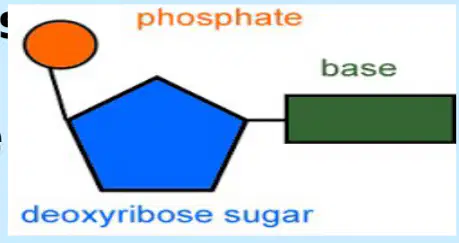
What is a nucleotide composed of?
A phosphate group, a sugar, and a base
A phosphate group and a sugar only
A sugar and a base only
A base and a lipid group
What is the basic shape of DNA described as?
Single strand
Double helix
Triple coil
Quadruple twist
What is the monomer of DNA called?
Amino acid
Nucleotide
Fatty acid
Glucose
What type of molecules are Adenine and Guanine?
Pyrimidines
Amino acids
Purines
Carbohydrates
What type of molecules are Thymine and Cytosine?
Pyrimidines
Amino acids
Purines
Carbohydrates
What type of bonds attach nucleotides together in the center of a double-stranded DNA molecule?
Ionic bonds
Covalent bonds
Hydrogen bonds
Peptide bonds
According to Chargaff's Rule, which of the following is true about the amounts of nucleotide bases in a cell?
Adenine is found in greater amounts than Thymine.
Cytosine and Guanine are found in different amounts per cell.
The amount of Adenine is equal to the amount of Thymine.
The amount of Cytosine is less than the amount of Guanine.
According to Chargaff's Rule, if a strand of DNA has 30% Adenine (A), what percentage of Thymine (T) would it have?
30%
20%
70%
60%
If a DNA strand is composed of 20% Guanine (G), what would be the percentage of Cytosine (C) in the same strand?
10%
20%
30%
40%
In a DNA strand with 40% Cytosine (C), what is the combined percentage of Adenine (A) and Thymine (T)?
20%
40%
60%
80%

What is "A"?
Nucleotide
Deoxyribose Sugar
Nitrogenous base
Phosphate
What is "B"?
Nucleotide
Deoxyribose Sugar
Nitrogenous base
Phosphate
What is "C"?
Nucleotide
Deoxyribose Sugar
Nitrogenous base
Phosphate
What is the complimentary sequence of the following sequence:
GATCAG
TGACAT
GACATG
CTAGTC
CGACTA
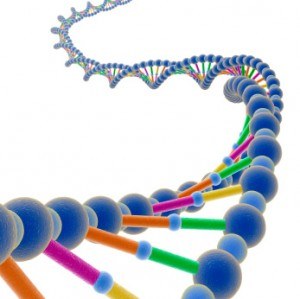
double helix
contains ribose
made of amino acids
is single stranded

Which part of the DNA molecule pictured represents a nucleotide?
A
B
C
D
Which part of the DNA molecule pictured represents the sugar-phosphate backbone?
A
B
C
D
Which part of the DNA molecule pictured represents a base pair?
A
B
C
D
Which part of the DNA molecule pictured represents a hydrogen bond?
A
B
C
D

This picture is illustrating the ____ nature of DNA.
antiparallel
semiconservative
helical
radioactive

What process is happening?
Breakdown of DNA
DNA Replication
Mutations
Which is true of the 2 DNA that have been created?
They are identical copies of each other
They won't work properly
They have new codes - different from the original
They will only work in an offspring
Each piece of DNA created is 1/2 "old" and half "new" DNA. What is this called?
Halfsies
Semiconservative
Split molecules
Supercoiled

Purine or Pyrimidine?
Purine
Pyrimidine

Purine or Pyrimidine?
Purine
Pyrimidine
What enzyme UNZIPS the helix during DNA replication?
Helicase
Zipase
DNA Polymerase
Ligase
What enzyme adds on free nucleotides during DNA replication?
Helicase
Zipase
DNA Polymerase
Ligase
DNA can only be created from
5' to 3'
3' to 5'
side to side
The DNA side that is created during replication CONTINUOUSLY is the
leading strand
lagging strand
old strand
A-T strand
The DNA side that is created during replication using SHORT PIECES called Okazaki fragments is the
leading strand
lagging strand
old strand
A-T strand
Which of the following would be a reason why DNA would need to replicate?
During protein synthesis
When growing or replacing a dead/damaged cell
During transcription
During translation
DNA is along molecule that contains regions called _____________ that code for _________ which are the basis of your ____________
codons, amino acids, proteins
genes, proteins, traits
mRNA, DNA, sugars
DNA and RNA are both ___________ which are primarily composed of the elements ______________
proteins, CHON
carbohydrates, CHO
lipids, CHO
nucleic acids, CHONP

In the model of protein synthesis, letter B represents __________ which takes place in the __________________
translation, ribosome/ cytoplasm
transcription / nucleus
DNA replication / mitochondria
In the model of protein synthesis, letter A represents __________ which takes place in the __________________
translation, ribosome/ cytoplasm
transcription / nucleus
DNA replication / mitochondria
If the DNA template is: TGG CAA GTA
The mRNA strand would be:
ACC GTT CAT
UGG CAA GUA
UCC GUU CUU
ACC GUU CAU

What is the correct amino acid sequence for the mRNA code AUG CCA GUA UGA
Met-Pro-Val-Stop
Tyr-Gly-His-Stop
Which of the codons below codes for Tryptophan?
UGA
UGG
ACC
GUG


In the model pictured, letter A represents___________ and takes place in the ____________
translation, ribosome/ cytoplasm
transcription, nucleus
replication, nucleus

Which statement about protein synthesis is FALSE?
Protein synthesis is the process of making proteins.
Protein synthesis uses amino acids to make DNA
Protein synthesis has two steps: transcription and translation
A mutation is:
a change in the DNA sequence
a change in the amino acid
a change in the ribosome
TRUE or FALSE: All mutations are bad mutations.
True
False
Original DNA strand: TAC GGT CAT
Mutated strand: TAC GGA TCA T
Compare the mutated DNA strand to the original DNA strand. What type of mutation happened?
Point/Substitution
Insertion
Deletion
Original DNA strand: TAC GGT CAT
Mutated DNA strand: TAC GTC AT
Compare the mutated DNA strand to the original DNA strand. What type of mutation happened?
Point/Substitution
Insertion
Deletion
Original DNA strand: TAC GGT CAT
Mutated DNA strand: TAC GAT CAT
Compare the mutated DNA strand to the original DNA strand. What type of mutation happened?
Point/Substitution
Insertion
Deletion
mRNA strand: AUG UUC GUC AAC
Which of the following statements is NOT true about the mRNA strand above?
This mRNA strand contains 4 codons
The mRNA strand codes for 4 different proteins
The mRNA strand codes for 4 amino acids that make up one protein
_____________ are the monomers for proteins and ________ are the monomers for nucleic acids (DNA, RNA)
Carbohydrates / Lipids
Monosaccharides / Fatty Acids
Amino Acids / Nucleotides
In the model pictured, letter B represents ___________ which takes place in the ________________
translation, ribosome/ cytoplasm
transcription, nucleus
replication, nucleus

The codon AUG codes for _________ which also signals the _________ of a protein
stop, end
methionine, start
methionine, end

I include the bases Guanine (G), Cytosine (C), Adenine (A) and Uracil (U) .

I include the bases Guanine (G), Cytosine (C), Adenine (A) and Thymine (T).


______ delivers the codes like a message from the DNA to the ribosome so a protein can be made.
mRNA
tRNA
rRNA
______ is the main component of ribosomes
mRNA
tRNA
rRNA
______ transfers amino acids to the ribosome
mRNA
tRNA
rRNA
In DNA, A pairs with _____ and in RNA, A pairs with _____
C, G
U, T
T, T
T, U

What type of impact?
Silent
Nonsense
Missense
Frameshift

What type of impact does this substitution mutation cause?
Silent
Nonsense
Missense
Frameshift
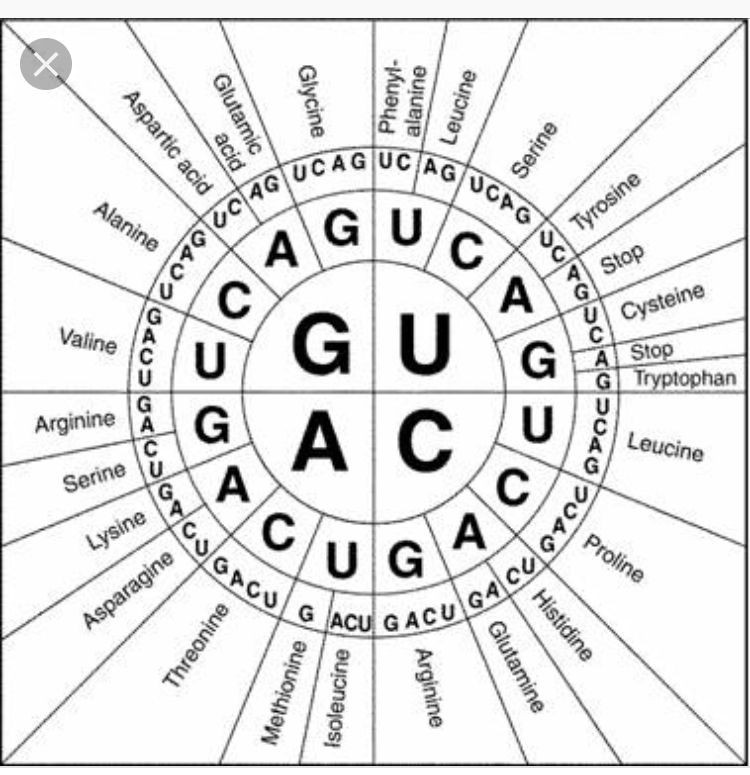
If UCU is changed to UCC, this is a _______________________________.
silent mutation
missense mutation
nonsense mutation
frameshift mutation
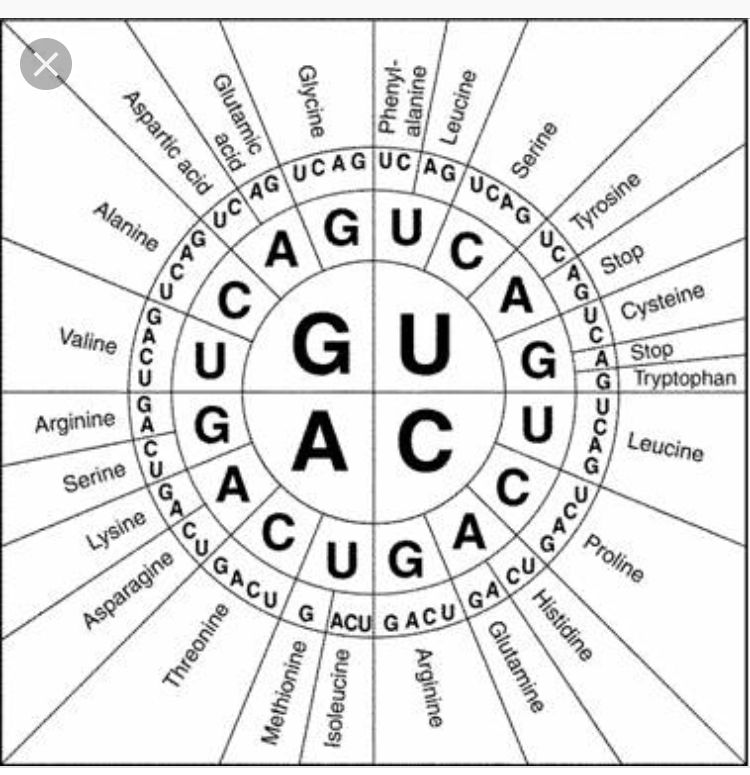
If a mutation codes for and early "stop" in the amino acid chain, this is called a:
nonsense mutation
missense mutation
silent mutation
frameshift mutation
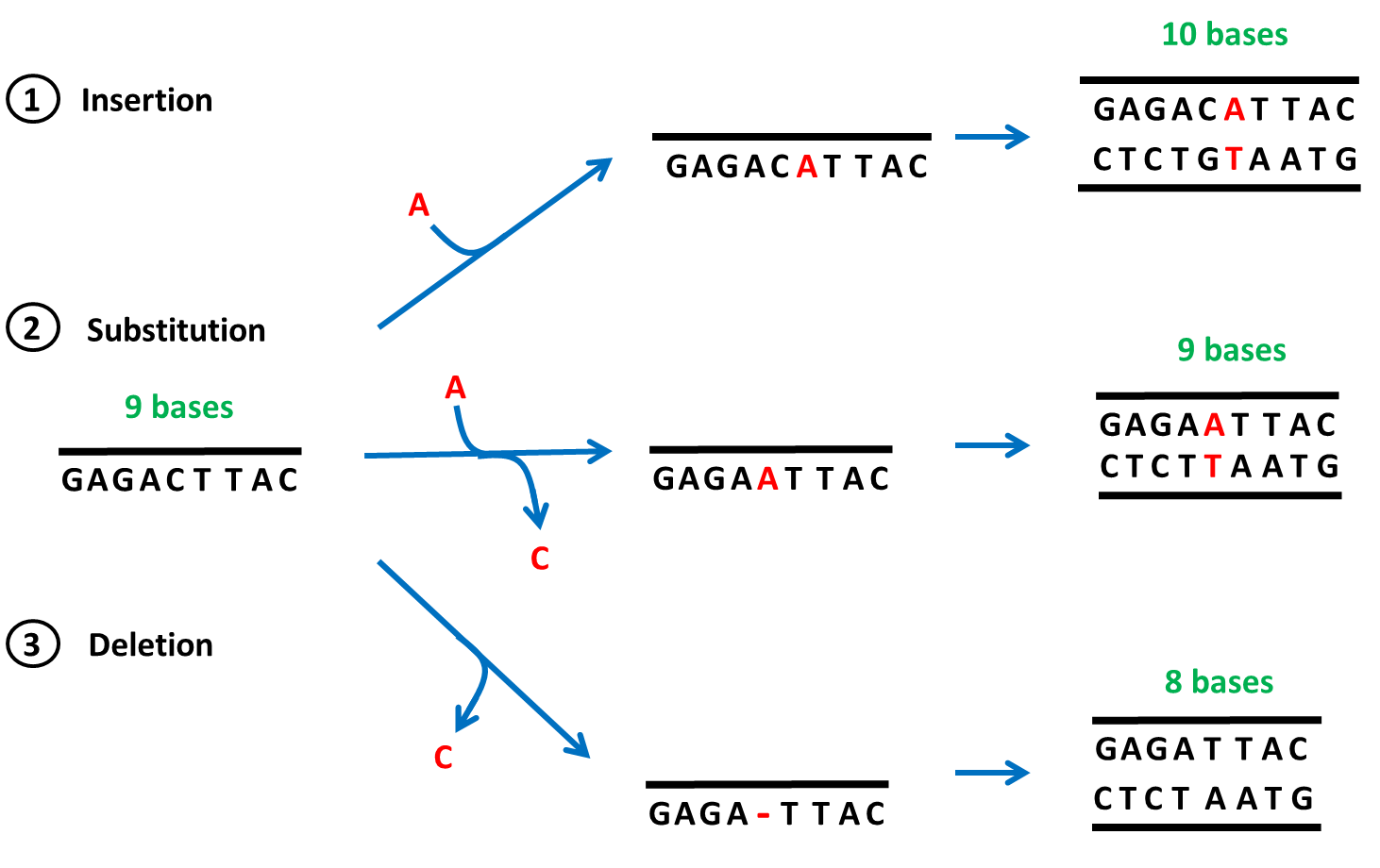
Insertions and deletions are also known as:
frameshift mutations
chromosomal mutations
silent mutations
polyploidy
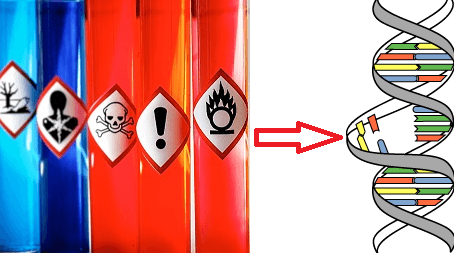
Chemical or physical agents in the environment that may cause mutations are called:
mutants
mutagens
chromosomal mutations
missense mutations
At the bottom of a loop of tRNA is an _____________ that pairs with the mRNA and brings the correct amino acid to the ribosome
supercodon
anticodon
DNA sequence
stop
The enzyme that adds nucleotides to mRNA during transcription is called:
DNA Polymerase
Ligase
RNA Polymerase
Helicase
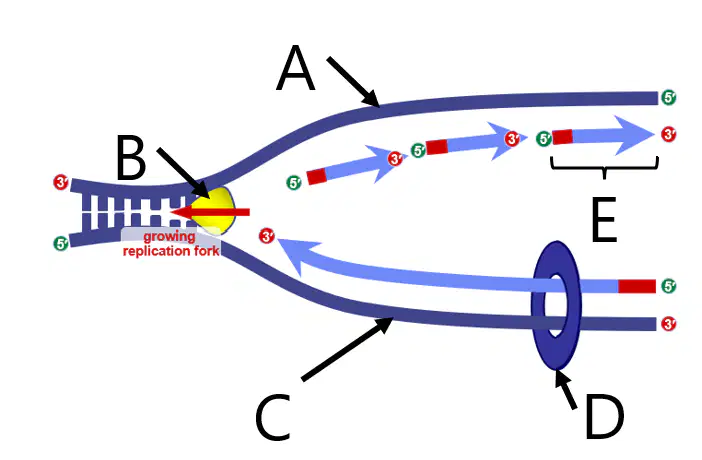
In the model of DNA replication shown, letter A represents
Leading Strand
Lagging Strand
Helicase
DNA Polymerase
Okazaki Fragments
In the model of DNA replication shown, letter B represents
Leading Strand
Lagging Strand
Helicase
DNA Polymerase
Okazaki Fragments
In the model of DNA replication shown, letter C represents
Leading Strand
Lagging Strand
Helicase
DNA Polymerase
Okazaki Fragments
In the model of DNA replication shown, letter D represents
Leading Strand
Lagging Strand
Helicase
DNA Polymerase
Okazaki Fragments
In the model of DNA replication shown, letter E represents
Leading Strand
Lagging Strand
Helicase
DNA Polymerase
Okazaki Fragments

