
 Worksheets
Nervous System
Total questions: 76
Worksheet time: 1hrs 17mins
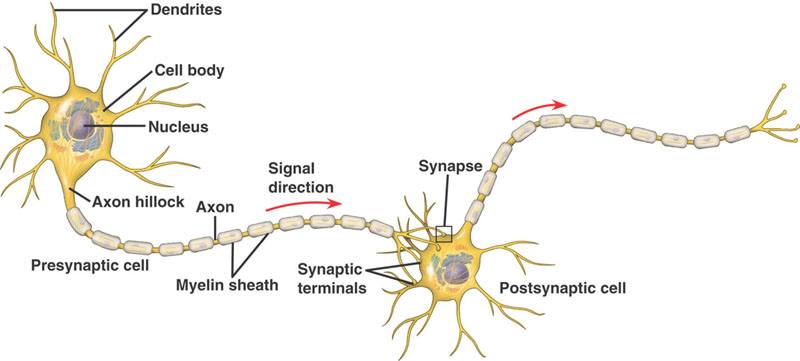
The part of a neuron that receives information from other neurons
A signal molecule that transmits nerve impulses across synapses is a


Cerebrospinal Fluid

Which are part of the central nervous system (CNS)?
Brain
Spinal cord
Spinal nerves
Cranial nerves (that run mostly to the head and neck)
Peripheral nerves (that run to and from skin, muscles, glands, etc.)

What is the term for the chemical released from a nerve cell?
Vesicle
Synapse
Neurotransmitter
Action potential

What is the term for the space that the neurotransmitter has to cross to get to the next nerve cell?
Synapse
Terminal end fiber
Dendrite
Axon

Which is the part of the nervous system that controls unconscious bodily functions?
Autonomic nervous system
Somatic nervous system

The sympathetic nervous system controls unconscious bodily functions involved in our:
Rest and digest functions
Fight or flight response

How many lobes does each side of the brain have?
1
2
3
4

Which is the part of the brain where conscious thought and emotions are produced?
Cerebrum
Cerebellum
Brainstem
The Peripheral Nervous System is entirely made of
Nerves outside of the Central Nervous System
Nerves inside of the Central Nervous System
Muscle Tissues inside of the Central Nervous System
Muscle Tissues outside of the Central Nervous System

Letter C represents the
Cerebrum
Cerebellum
Medulla
Brain stem
Which of the following functions is the nervous system responsible for?
Sensory input
Integration
Motor output
All of the other 3
Which function is responsible for deciding if/what action is needed in response to stimuli?
Sensory input
Integration
Motor output

In the peripheral nervous system, efferent neurons (which carry information out of the center) are called ___
Nonpolar neurons
Interneurons
Motor neurons
Sensory neurons

In the peripheral nervous system, afferent neurons (which carry information to a central point) are called ___
Nonpolar neurons
Interneurons
Motor neurons
Sensory neurons

Which part of the peripheral nervous system is associated with involuntary actions, like breathing and digestion?
The somatic system
The autonomic system
The compulsory system
The reflex loop

Which division of the autonomic system is responsible for the fight-or-flight response?
The somatic division
The sympathetic division
The parasympathetic division
The reflex-loop

Which division of the autonomic system ensures that we rest, digest and "take things nice and easy"?
The somatic division
The sympathetic division
The parasympathetic division
The chill-out division

The axon is covered in fatty material, which acts as insulation, called ___
Myofibra
Monera
Myelin
Mylar

A brief event where the electrical potential of a nerve cell rapidly rises and falls is called ___
An ion trigger
An action potential
A voltage trough
A channel flood
Nerve associated with sense of smell
Facial
Optic
Olfactory
Abducens
This nerve moves the tongue
Hypoglossal
Accessory
Vagus
Glossopharyngeal
This nerve is responsible for balance
Vagus
Accessory
Trochlear
Vestibulocochlear
This nerve is used in swallowing
Trigeminal
Trochlear
Glossopharyngeal
Vagus
Helps focus the lens in the eye and control the amount of light entering the eye.
Oculomotor
Trigeminal
Trochlear
Facial
This nerve is responsible for hearing
Optic
Vestibulocochlear
Olfactory
Trigeminal
This nerve controls heart rate
Vagus
Trigeminal
Abducens
Optic
This nerve is involved in sight
Olfactory
Optic
Trigeminal
Vagus
This nerve has sensory fibers going to the scalp and upper lip
Trigeminal
Trochlear
Vagus
Facial
This nerve has motor fibers to the face, and causes facial expressions
Trigeminal
Facial
Optic
Abducens
There are ______ pairs of cranial nerves
10
12
31
14
Meninges
has 2 layers
line visceral organs
are found in ventral cavity
cover the brain and spinal cord

These are three protective membranes that surround the brain and spinal cord.
Meninges
Pons
Fissures
Cerebellum

These are sections of the brain located behind the parietal lobes; integrate sensory information from the skin, internal organs, muscles, and joints.
Occipital lobes
Parietal lobes
Frontal lobes
Temporal lobes
This is a column of nerve tissue that extends from the brain stem to the beginning of the lumbar region of the spine.
Spinal cord
Cerebrum
Midbrain
Hypothalamus

This is the most inferior portions of the brain; responsible for speech, hearing, vision, memory, and emotion.
Temporal lobes
Frontal lobes
Occipital lobes
Parietal lobes
This is the largest part of the brain, consisting of the left and right hemispheres.
Cerebrum
Cerebellum
Fissures
Diencephalon

These sections of the brain are located behind the forehead.
Frontal lobes
Parietal lobes
Meninges
Primary motor cortex
1.There are….......... meningeal layers that surround the brain.
1
2
3
4
The sub-arachnoid space contains?
CSF
Meningeal arteries
Dural sinuses
Arachnoid
The inner layer of the meninges is called
Pia
Dura
Arachnoid
None
The middle layer of the meninges is called
Dura
Arachnoid
None
Pia
The outer layer of the meninges is known as
Pia
Dura
None
Arachnoid
Dermatomes are areas of skin innervated by specific:
Blood vessels
Muscles
Cranial nerves
Spinal nerves
Deep tendon reflexes are elicited by tapping on a tendon, which stimulates:
Muscle contraction
Skin sensation
Bone growth
Nerve regeneration
What is the difference between a dermatome and a myotome?
Dermatomes innervate the appendicular skeleton and myotomes innervate the axial skeleton
Myotomes innervate the appendicular skeleton and dermatomes innervate the axial skeleton
Dermatome is the skin distribution of a spinal nerve and myotome is the group of muscles innervated by a spinal nerve
Myotome is the skin distribution of a spinal nerve and dermatome is the group of muscles innervated by a spinal nerve
List 3 changes, as a result of aging, to the nervous system

An infection induced inflammation of these tissues surrounding the brain and the spinal cord
Epilepsy
Meningitis
Dementia
Cerebral palsy

A group of nervous system disorders resulting
from brain damage before or during birth, or in
early infancy
Cerebral palsy
Epilepsy
Multiple sclerosis
Stroke

A disorder or injury characterized by loss of function in the
lower trunk and legs
Paraplegia
Meningitis
Quadriplegia
Epilepsy

A mild or severe trauma that can result from a
violent impact to the head
Epilepsy
Traumatic brain injury
Dementia
Multiple sclerosis

A disorder or injury characterized by loss of function below
the neck
Epilepsy
Paraplegia
Quadriplegia
Meningitis

A group of brain disorders characterized by repeated seizures over time
Epilepsy
Dementia
Meningitis
Cerebral palsy

A condition involving a progressive loss of brain
function with major consequences for memory,
thinking, and behavior
Epilepsy
Multiple sclerosis
Dementia
Alzheimer's disease

A chronic nervous system disease characterized
by a slowly spreading tremor, muscular
weakness, and rigidity
Epilepsy
Muscular dystrophy
Parkinson's disease
Meningitis

A chronic, slowly progressive disease of the
central nervous system that destroys the myelin
sheath of nerve cell axons
Multiple sclerosis
Epilepsy
Parkinson's disease
Alzheimer's disease
The very bottom of the spinal cord is a group of nerves and nerve roots called the
(a)
What are some common symptoms of a stroke?
Paralysis of one side of body, slurring speech, facial droop
Headache
Chest pain
Shortness of breath
If the left side is paralyzed, what part of the brain is oxygen-deficient?
Both sides
Left side
Right side
Only a small portion
What is a stroke?
Blocked blood vessel
Bleeding in the brain from a blood vessel
Loss of oxygen to part of the brain
All of the above
What is the major risk factor for stroke?
Obesity
Diabetes
High blood pressure
Family history of storke

