wayground logo

Free Printable Worksheets

Font size

S
M
L
XL
Worksheets

T.9 L.1,2 Electric Force, Magnetic Force

Total questions: 65

Worksheet time: 2hrs 30mins

Name
Class
Date
1.
What types of charges repel?
a)
Positive and Positive
b)
Positive and Neutral
c)
Negative and Neutral
d)
Neutral and Neutral
2.
If a substance has a higher number of electrons than protons on its surface, what type of charge does it have?
a)
A positive charge.
b)
A negative charge.
c)
A neutral charge
d)
No charge at all
3.
The closer the charges, the ___________ the force between them
a)
closer
b)
further
c)
stronger
d)
weaker
4.
Rubbing a balloon on hair is an example of static charge build up created by....
a)
conduction
b)
friction
c)
induction
d)
hairduction
5.

The ___________ _____________ is the force of attraction or repulsion between objects due to their charges.

a)

electric charge

b)

electric force

c)

distance

d)

variable

6.

What happens to the electric force between the objects when you increase the distance between a positively charged object and a negatively charged object? (Everything else remains constant.)

a)

The electric force decreases.

b)

The electric force increases.

c)

The electric force remains constant.

d)

There is not enough information to answer the question.

7.

The closer the charges, the ___________ the force between them

a)
closer
b)
further
c)
stronger
d)
weaker
8.
To demonstrate static electricity, a teacher takes an inflated balloon and rubs it against his hair.  The rubber balloon picks up electrons from his hair, which makes his hair have
a)
a net negative charge
b)
a magnetic force
c)
a net positive charge
9.
What does it mean when the electric field lines are close together?
a)
the field is positive
b)
the field is negative
c)
The field is strong
d)
the field is weak
10.

The invisible region that applies an electric force around a charged object is called an electric (a)   .

11.
A balloon has a negative charge.  The glass rod has a positive charge.  What will happen when the glass rod is brought near the balloon?
a)
The balloon will be attracted to the rod
b)
The balloon will be repelled by the rod
c)
The balloon will remain in place
d)
The balloon will spin in circles
12.
What is the difference between a conductor and an insulator?
a)
An insulator allows electricity to flow through it easily and a conductor does not
b)
A conductor allows electricity to flow through it easily and an insulator does not.
c)
An insulator is magnetic and a conductor is not
d)
A conductor is magnetic and an insulator is not
13.
If two balloons have the same charge, what will happen if you place them close to each other?
a)
Nothing
b)
They will be attracted
c)
They will pop
d)
They will push each other away.
14.

If these magnets were moved further apart their potential energy would

a)

increase

b)

decrease

c)

stay the same

15.

If these magnets were moved closer together their potential energy would

a)

increase

b)

decrease

c)

stay the same

16.

If these magnets were moved closer together their potential energy would

a)

Increase

b)

Decrease

c)

Stay the same

17.

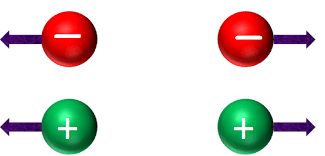
If these electrically charged objects are moved closer together their electric potential energy will

a)

increase

b)

decrease

c)

stay the same

18.

If these two charged objects are moved farther apart their electric potential energy will

a)

increase

b)

decrease

c)

stay the same

19.

If these two charged objects are moved farther apart their electric potential energy will

a)

increase

b)

decrease

c)

stay the same

20.

What happens to the potential energy of these objects when they are moved closer together?


Their electric potential energy will

a)

increase

b)

decrease

c)

stay the same

21.
What is the electrical potential energy like when these same charges are far apart?
a)
high
b)
low
c)
the same as when they are close
22.

The electric field lines for a positive charge is always directed away from the charge. True or False?

a)

True

b)

False

23.
What does it mean when the electric field lines are close together?
a)
the field is positive
b)
the field is negative
c)
The field is strong
d)
the field is weak
24.

If two charges attract to each other, then which of the following is true?

a)

Both charges must be positive.

b)

Both charges must be negative

c)

Both charges must be different.

d)

Both charges must be equal in value.

25.
Electricity is the flow of ______.
a)
electrons
b)
protons
c)
neutrons
d)
atoms
26.
The subatomic particle with a neutral charge is:
a)
protons
b)
electrons
c)
neutrons
d)
cloud
27.

Based on the arrangement of the electric field lines in the diagram, what are the charges?

a)

both charges are the same

b)

the charges are opposite

c)

they are neutral; no charge

28.

Which statement best describes the electric fields in the image?

a)

The charges are neutral.

b)

Both charges are negative, so the field lines are alike.

c)

The field lines move toward a positive charge and away from a negative charge.

d)

The field lines move away from a positive charge and toward a negative charge.

29.
Consider the electric field lines shown in the diagram below. From the diagram, it is apparent that object A is ____ and object B is ____.
a)
+,+
b)
+,-
c)
-,+
d)
-,-
30.
A north pole and a south pole will attract.
a)
True
b)
False
31.
What happens when two north poles of a magnet are placed together?
a)
they repel
b)
they attract
c)
they cancel each other out
d)
the strength of the magnet is doubled
32.
Earth's magnetic poles are in the same place as the geographic poles.
a)
True
b)
False
33.
Magnetic field lines are closet together at the __________.
a)
poles
b)
lines
34.
Magnets can interact without touching.
a)
True
b)
False
35.
The motion of liquid _______ in the Earth's core creates a magnetic field.
a)
Iron
b)
Magnesium
36.

Are the magnetic field lines in the picture correct?

a)

Yes, because they point from north to south.

b)

No, because they point from north to south (they're supposed to go the other way).

c)

Yes, because the North pole is on the left in all pictures.

d)

No, because the North pole is on the left in all pictures (it's supposed to be on the right).

37.

Looking at the field lines in this picture, these two magnets are ________

a)

Attracting

b)

Repelling

c)

Attracting and Repelling

d)

Doing nothing

38.

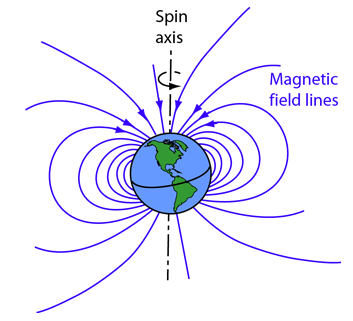
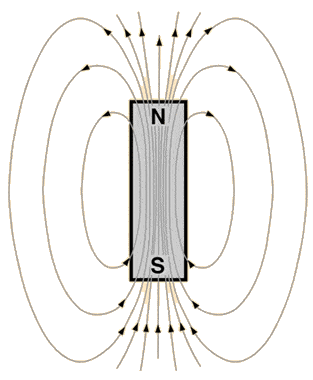
What is the shape of a magnetic field around the Earth?
a)
b)
c)
d)
39.
How are electromagnets different from magnets?
a)
magnets can be turned on/off
b)
you can turn an electromagnet on/off
c)
magnets are more powerful
d)
magnets have a North and South pole
40.

A ________ is a device that has a magnet on a needle that spins freely. It is used for navigation because its needle usually points north.

a)

calculator

b)

ruler

c)

compass

d)

map

41.

Where is the magnetic field the strongest around a bar magnet?

a)

far away from the magnet

b)

at the side of the magnet

c)

at the poles

d)

above the magnet

42.
Magnetic force between two magnets gets weaker the more ________________ between them.
a)
distance
b)
attraction
c)
metal
d)
lightsabers
43.
magnetic field
a)
the space around a magnet in which magnetic forces can act on objects
b)
to separate or set apart
c)
one of the two opposite ends of a magnet
d)
to provide evidence that goes against a claim
44.
When the magnetic fields of two or more magnets overlap, a(n) _________ magnetic field forms.
a)
combined 
b)
single
45.
Earth's magnetic poles are in the same place as the geographic poles.
a)
True
b)
False
46.
If a substance has a higher number of electrons than protons on its surface, what type of charge does it have?
a)
A positive charge.
b)
A negative charge.
c)
A neutral charge
d)
No charge at all
47.

SELECT ALL 4 methods of charging an object:

a)

Conduction

b)

Convection

c)

Friction

d)

Polarization

e)

Induction

48.

Where is the magnetic force weakest on a magnet?

a)

Both poles

b)

The north pole

c)

The south pole

d)

The middle of the magnet

49.

Why do the northern lights/aurora borealis happen?

a)

the solar wind sends particles toward the Earth that pass near Earth's poles and the lights are reflections of the particles

b)

the lunar wind sends particles toward the Earth that pass near Earth's poles and the lights are reflections of the particles

c)

the solar wind sends particles toward the Earth that pass near Earth's equator and the lights are reflections of the particles

d)

the solar wind sends particles away from the Earth and the Earth's gravity brings the particles close to it and the lights are reflections of the particles

50.
The law of conservation of charge states that...
a)
all atoms have more protons than electrons
b)
only protons can be rubbed off of an atom
c)
charge cannot be created or destroyed
d)
charge cannot be transferred 
51.

A repulsive force exists between which two particles?

a)

Two neutrons

b)

An electron and a neutron

c)

An electron and a proton

d)

Two protons

52.
An atom gains an electron.  What type of charge does it have now?
a)
positive
b)
negative
c)
No charge
53.
Insulators are different than conductors in that insulators ____.
a)
do not contain electrons or protons 
b)
 do not contain any charge
c)
have a weaker affinity for electrons 
d)
do not allow charge to freely move 
54.
A glass rod becomes positively charged when it is rubbed with silk. This net positive charge accumulates because the glass rod
a)
gains electrons
b)
loses electrons
c)
gains protons
d)
loses protons
55.

The number of electrons is more than the protons

a)

Positively charged

b)

Negatively charged

c)

Neutral

56.

The number of protons and electrons is equal

a)

Positively charged

b)

Negatively charged

c)

Neutral

57.

Compared to insulators, metals are better conductors of electricity because metals contain more free_______________.

a)

protons

b)

electrons

c)

neutrons

d)

atoms

58.

Charging by ______ is done by rubbing two objects at the same time.

a)

induction

b)

friction

c)

conduction

59.

Charging by _____ is done without actual contact to any other charged object.

a)

Induction

b)

friction

c)

conduction

60.

It is the transfer of electron from a charged object to another by DIRECT CONTACT .

a)

Induction

b)

Conduction

c)

Friction

61.

The loss of static electricity as electric charges transfer from one object to another.

a)

Static Discharge

b)

Negative Charge

c)

Positive Charge

d)

Neutral Charge

62.

Involves touching, contact of the charged objects to a neutral object.

a)

Charging by friction

b)

Charging by conduction

c)

Charging by submission

d)

Charging by induction

63.

A negatively charged material has ___________ electrons.

a)

gained

b)

lost

64.

which is the field for opposite charges

a)
b)
c)
d)
65.

Which diagram correctly shows the electric field around a negative charge?

a)

A

b)

B

c)

they are both positive