
 Worksheets
Metals and Reactions
Total questions: 118
Worksheet time: 1hrs 23mins
Metal + water ---> metal hydroxide + hydrogen
Metal + water ---> metal hydroxide + hydrogen
Metal + acid ---> metal salt + hydrogen
Metal + acid ---> metal salt + hydrogen
Metals are good conductor of
Only heat
Only electricity
Heat and electricity both
None of the above
Which of the following metals is used for making foil to pack foodstuff?
Aluminium
Mercury
Sodium
Copper
Metals react with water to form ______gas.
Nitrogen
Oxygen
Hydrogen
Ozone
Which of the following metals corrodes easily?
Gold
Silver
Nickel
Iron
A sample of gas was found to burn with a pop. Which of the following could have given this result?
Carbon Dioxide
Hydrogen
Nitrogen
Oxygen

By looking at the element illustrated here, how might you classify it by appearance?
Metal
Non-Metal
Metalloid
Iron is a good conductor, malleable and magnetic. What type of element is Iron?
Metal
Non-metal
Metalloid
None of the above
When metal reacts with liquid water the products are...
metal hydroxide and oxygen gas
metal hydroxide and hydrogen gas
metal oxide and oxygen gas
metal oxide and hydrogen gas
The list which contains only metals is .......
aluminium, copper, nitrogen
iron, oxygen, hydrogen
iron, silver, aluminium
iron, sulphur, copper
Metals generally react with dilute acids to produce hydrogen gas. Which one of the following metals does not react with dilute hydrochloric acid?
magnesium
iron
aluminium
copper
Which metal produces MOST vigorous reaction when reacts with oxygen?
Aluminium
Iron
Magnesium
Potassium
Metal + Acid -> ___ + ___
Salt + Hydrogen
Metal Hydroxide + Hydrogen
Metal Oxide + Hydrogen
Metal Carbonate + Hydrogen
Sodium + Hydrochloric acid ->
Sodium chlorine
Sodium chlorine + hydrogen
Sodium chloride + hydrogen
Sodium chloride
Lithium + nitric acid ->
Lithium nitride + hydrogen
Lithium nitric + hydrogen
Lithium nitrogen + hydrogen
Lithium nitrate + hydrogen
How can you test for hydrogen gas?
sniff it
squeaky pop test
add universal indicator
add lemon water
What happens when metals react with water?
Hydrogen gas is formed
Metal hydroxide and hydrogen gas is formed
Metal hydroxide is formed
Metal oxide is formed
What happens when gold reacts with cold water?
the gold will melt
the gold will turn into light yellow
nothing, the gold can't react with cold water
Which group of the periodic table are alkali metals found in?
Group 1
Group 2
Group 7
Group 8
What is formed when sodium reacts with water?
Sodium oxide and hydrogen
Sodium hydroxide and hydrogen
Sodium hydroxide and oxygen
Sodium hydroxide and carbon dioxide
Which of the following is MOST reactive?
Magnesium
Lead
Tin
Copper
Zinc
Which metal is more reactive than calcium?
magnesium
potassium
silver
aluminum
Choose the least reactive metal
calcium
magnesium
iron
copper
Choose the most reactive metal
calcium
magnesium
iron
copper
Which are the signs of chemical change?
Change in size
Colour change
Precipication
Change in state
Effervescence / Gas produced
What does displacement mean?
A chemical reaction where a less reactive metal takes the place of a more reactive metal in a compound.
A chemical reaction where a more reactive metal takes the place of a less reactive metal in a compound.
A more reactive metal is removed from a compound.

Magnesium chloride + Sodium → ?
Sodium chloride + Magnesium
Magnesium chloride + Sodium (No change)
Sodium magnesium + Chlorine

Zinc sulphate + Magnesium → ?
Magnesium + Sulphur + Hydrogen
Zinc sulphate + Magnesium
Magnesium sulphate + Zinc

Lithium chloride + Iron → ?
Lithium chloride + Iron (No change)
Iron chloride + Lithium
Lithium oxide + hydrogen
Which is least reactive?
gold
Calcium
Magnesium
Which can displace Calcium from calcium sulphate?
Sodium
Copper
Iron nails + copper oxide → ?
Iron nails + copper oxide
Iron oxide + copper oxide
Iron oxide + copper
Magic
Metal A is more reactive than Metal B. The following displacement reaction takes place.
Metal A + Metal B in compound ---> Metal B + Metal A in compound.
True or False.
True
False
A more reactive metal will displace a less reactive metal from a metal compound. Which metal is more reactive - copper or iron?
copper
iron
Copper is less reactive than iron. What do you expect to happen when copper is placed inside a solution of iron(II) sulfate?
No reaction takes place.
A reaction takes place. And a colour change is observed.
Copper is less reactive than iron. What do you expect to happen when iron is placed inside a solution of copper(II) sulfate?
No reaction takes place.
A reaction takes place. And a colour change is observed on the iron nail.
Iron + Hydrochloric acid --> ?
iron(II) sulfate + water
iron + hydrogen
iron(II) chloride + hydrogen
iron(II) chloride + water
Which gas gives out a 'squeaky pop' when a lighted splint is placed in it?
hydrogen
oxygen
carbon dioxide
nitrogen
Which equation correctly shows the displacement of copper from copper(II) sulfate by zinc?
copper + zinc sulfate --> copper(II) sulfate + zinc
zinc sulfate + copper --> copper(II) sulfate + zinc
copper(II) sulfate + zinc --> zinc sulfate + copper
copper(II) sulfate + zinc --> zinc sulfate + water
Which equation correctly shows magnesium displacing copper from it copper(II) sulfate?
2Mg + O2 --> 2MgO
Mg + CuSO4 --> MgSO4 + Cu
Mg + MgSO4 --> MgSO4 + Mg

A copper coil is placed inside a solution of silver nitrate. What would you expect to see after 5 minutes? Choose 2 options.
There is no visible change because no displacement reaction took place. Copper, being less reactive than silver, cannot displace silver from silver nitrate.


Silver crystals were formed on copper coil, because copper (being more reactive than silver) displaced silver from silver nitrate.

What is the most likely identity of the metal on the filter paper?
Copper, because it is grey.
Potassium, because it can be cut with a knife showing it is soft.
Iron, because it looks grey and all iron looks grey.

Read the underlined words carefully. Rank the metals according to decreasing reactivity (most reactive to least reactive).
Metal A, B, C, D
Metal A, C, B, D
Metal B, C, D, A
Metal D, B, C, A
What criteria must be met for reactant collisions to result in a successful product?
The reactants must collide with each other
The reactants must collide with enough energy and be in the right positions
The reactants must have enough energy to form the activated complex
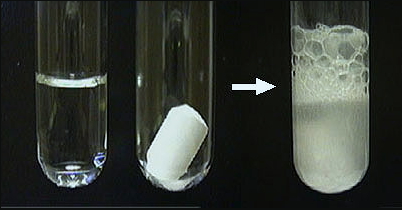
How could we make this reaction happen more quickly?
Decrease the concentration of the acid
crush the chalk to increase the surface area
Put the test tube in an ice bath
When surface area is decreased the rate of reaction...
Decreases, because there are LESS possible sites for correct collisions
Increases, because there are LESS possible sites for correct collisions
Decreases, because there are MORE possible sites for correct collisions
Increases, because there are MORE possible sites for correct collisions
Which has more surface area?
Large chunks of chalk
Cube of sugar
Powdered sugar
Small chunks of sugar
A temperature increase causes the particles ......
to slow down
move faster
collide higher
in the right order
How does a catalyst work in speeding up a reaction?
By lowering the activation energy of reaction
by giving them more energy
by making them more available
What is the rate of reaction?
How much energy is needed for a reaction to occur.
The energy required to break a bond.
The time it takes for a reaction to occur.
Collision Theory
Which of the following increase the reaction rate?
less surface area
lower temperature
increased concentration
Increasing the temperature of a reaction will
Increase the rate
Decrease the rate
Not affect the rate
Decreasing the temperature of a reaction will
Increase the rate
Decrease the rate
Not affect the rate
Decreasing the concentration of a reactant will
Increase the rate
Decrease the rate
Not affect the rate
Increasing the concentration of a reactant will
Increase the rate
Decrease the rate
Not affect the rate
Increasing the quantity of a reactant will
Increase the rate
Decrease the rate
Not affect the rate
Decreasing the quantity of a reactant will
Increase the rate
Decrease the rate
Not affect the rate
Decreasing the particle size of a reactant will
Increase the rate
Decrease the rate
Not affect the rate
Increasing the particle size of a reactant will
Increase the rate
Decrease the rate
Not affect the rate
Adding a catalyst to a reaction will
Increase the rate
Decrease the rate
Not affect the rate
Removing a catalyst from a reaction will
Increase the rate
Decrease the rate
Not affect the rate
Decreasing particle size increases the rate because it increases the (a)
For a collision to be successful, reactants must have the correct ____
Orientation
Energy
Atomic Number
Concentration
Which of the following reactions would produce hydrogen gas most quickly?
1 mol/L HCl & Mg Ribbon
1 mol/L HCl & Mg Powder
3 mol/L HCl & Mg Powder
3 mol/L HCl & Mg Ribbon
Which of the following reactions would produce hydrogen gas most quickly?
1 mol/L HNO3 & Iron Nail
1 mol/L HNO3 & Iron Powder
3 mol/L HNO3 & Iron Powder
3 mol/L HNO3 & Iron Nail
A student investigated the reaction between marble chips and excess dilute hydrochloric acid.
Which of the following would not affect the rate of the reaction?
Increasing the volume of the acid
Decreasing the size of the marble chips
Decreasing the concentration of the acid
Increasing the temperature of the acid
Which of the following pairs of reactants would produce hydrogen most slowly?
Magnesium powder and 4 mol l–1 acid
Magnesium ribbon and 2 mol l–1 acid
Magnesium powder and 2 mol l–1 acid
Magnesium ribbon and 4 mol l–1 acid

Which of the following samples, when reacted with excess 2 mol/L hydrochloric acid, would produce graph Q?
0.5g of magnesium ribbon
0.5g of magnesium powder
1g of magnesium powder
2g of magnesium ribbon
Adding solute to a solvent causes the concentration to...
Increase
Decrease
Stay the same
Adding solvent to a solution causes the concentration to...
Increase
Decrease
Stay the same

