
Font size
 Worksheets
8th Grade Waves Review (QAI)
Total questions: 82
Worksheet time: 41mins
What do light, sound, and ripples in the water have in common?
They are all forms of energy carried in particles.
They are all forms of energy carried in waves.
They are all forms of energy that do not require a medium.
They are all forms of energy that can only travel through air.
Which of the following is NOT an example of a wave?
Dropping a stone in a pond
Hearing a sound
Seeing your mom
Writing a letter
What is a wave?
A) A static object in space
B) A repeating movement, disturbance, or vibration that transfers energy
C) A form of matter
D) A type of chemical reaction
Does a wave transfer matter along with energy?
A) Yes, it transfers both matter and energy
B) No, it only transfers energy, not matter
C) Yes, but only in the form of gases
D) No, it transfers neither energy nor matter
What do all waves carry from place to place?
Matter
Energy
Light
Heat
How do molecules in a wave pass energy?
By moving from one place to another
By passing energy to neighbor molecules
By absorbing energy from the wave
By producing vibrations
What causes waves to be produced?
Absorption of energy by a medium
Energy being carried from place to place
Vibrations
The movement of matter
Under what condition will waves continue to travel?
As long as there is matter to carry
As long as there is light to reflect
As long as there is energy to carry
As long as the medium absorbs the energy
What happens to a wave once the energy is absorbed by a medium?
It changes direction
It increases in speed
It ceases to exist
It transforms into matter
What do waves move?
Matter
Energy
Boats
Air
What happens to the boat when waves pass?
It moves to a different place.
It sinks.
It oscillates up and down.
It speeds up.
What is a medium in the context of wave travel?
A device that measures the frequency of a wave
The matter through which a wave travels
A type of wave that can travel through space
The endpoint of a wave's journey
Do electromagnetic waves require a medium to travel?
Yes, they require a solid medium
Yes, they require a liquid medium
No, they do not require a medium
Yes, they require a gaseous medium
Which states of matter can act as a medium for mechanical waves?
Only solid and liquid
Only solid and gas
Solid, liquid, and gas
Only liquid and gas
Which types of waves do not need a medium to travel?
Sound and seismic waves
Light, gamma, and radio waves
Water and mechanical waves
Ultraviolet and infrared waves
Which of the following is NOT a property of waves?
Amplitude
Frequency
Refraction
Wave speed
What do mechanical waves require that electromagnetic waves do not?
A medium
Frequency
Amplitude
Wavelength
Which type of wave is always transverse?
Mechanical Waves
Electromagnetic Waves
Longitudinal Waves
Sound Waves
Which of the following is an example of a mechanical wave?
Radio waves
Microwaves
Tsunami waves
Gamma rays
What can mechanical waves be that electromagnetic waves cannot?
Transverse
Longitudinal
Always require a medium
Do not need a medium
Which type of wave requires a medium to travel through?
Radio
Sound
Light
X-ray
What type of waves are water waves classified as?
Longitudinal
Transverse
Both Transverse and Longitudinal
Neither Transverse nor Longitudinal
Seismic waves are an example of which types of waves?
Transverse
Longitudinal
Both Transverse and Longitudinal
Neither Transverse nor Longitudinal
Which of the following is not an example of an electromagnetic wave?
Infrared
Ultraviolet
Seismic
Microwave
Gamma rays are classified under which category of waves?
Mechanical
Electromagnetic
Longitudinal
Seismic
Which type of wave is characterized by compressions and rarefactions?
Transverse
Longitudinal
Amplitude
Wavelength
What are the two main properties of a transverse wave?
Compression and Rarefaction
Crest and Trough
Reflection and Refraction
Diffraction and Interference
What behavior of waves is typically observed with smooth and shiny surfaces?
Refraction
Diffraction
Interference
Reflection
Which wave behavior is associated with sound and involves pressure, temperature, or density?
Reflection
Refraction
Diffraction
Interference
What type of wave behavior occurs around obstacles?
Reflection
Refraction
Diffraction
Interference
What are the two types of interference discussed in class?
Compression and Rarefaction
Crest and Trough
Destructive and Constructive
Reflection and Refraction
What are the highest points of a transverse wave called?
Troughs
Amplitude
Crests
Wavelength
What are the lowest points of a transverse wave known as?
Troughs
Crests
Amplitude
Wavelength
What term is used to describe the rest position of a wave?
Trough
Crest
Equilibrium
Amplitude
What is the distance between two consecutive crests or troughs of a wave called?
Amplitude
Frequency
Wavelength
Equilibrium
What is the term for the maximum displacement of a point on a wave from its rest position?
Trough
Wavelength
Frequency
Amplitude
What are the dense regions of a longitudinal wave called?
Rarefactions
Amplitudes
Compressions
Wavelengths
What are the less dense regions of a longitudinal wave called?
Compressions
Amplitudes
Rarefactions
Wavelengths
What is the definition of wavelength?
The maximum height of a wave
The distance between two adjacent crests or troughs
The distance a wave travels in one period
The number of waves that pass a point in a given time frame
What happens to the frequency of a wave as the wavelength increases?
Frequency increases
Frequency remains constant
Frequency decreases
Frequency is not related to wavelength

What is the difference between a longitudinal wave and a transverse wave based on the diagrams?
Longitudinal waves have crests and troughs, while transverse waves have compressions and rarefactions
Longitudinal waves have compressions and rarefactions, while transverse waves have crests and troughs
Longitudinal waves travel faster than transverse waves
Transverse waves cannot travel through air
What is the unit of measurement for frequency?
Meters (m)
Hertz (Hz)
Seconds (s)
Meters per second (m/s)
How is wave speed calculated?
Wave speed = frequency (Hz) + wavelength (m)
Wave speed = frequency (Hz) / wavelength (m)
Wave speed = frequency (Hz) x wavelength (m)
Wave speed = wavelength (m) / frequency (Hz)
What is the unit of wave period?
Hertz (Hz)
Meters (m)
Seconds (s)
Meters per second (m/s)
Which formula represents the relationship between wave period and frequency?
T = f
T = 1/f
T = v/f
T = f/v
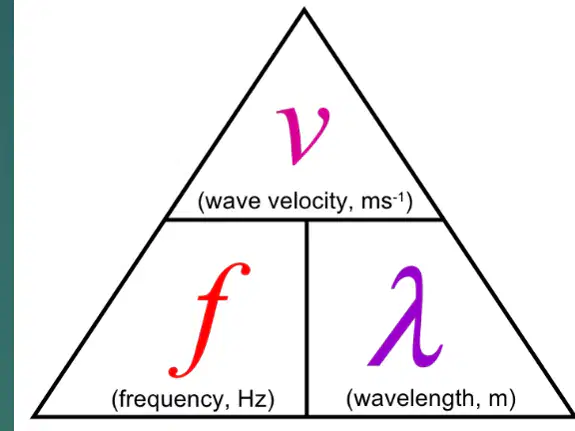
What does the triangle diagram represent?
The Pythagorean theorem
The relationship between force, mass, and acceleration
The relationship between wave velocity, frequency, and wavelength
The relationship between energy, mass, and the speed of light
What is frequency measured in?
Decibels
Watts
Hertz
Joules
What does higher frequency correspond to in terms of pitch?
Lower pitch
Higher pitch
No change in pitch
Variable pitch
Which instrument is likely to produce a sound with a higher frequency?
Tuba
Flute
Drum
Piano
What does lower frequency correspond to in terms of pitch?
Higher pitch
Lower pitch
No change in pitch
The pitch that cannot be heard
What is the equilibrium in a wave?
The highest point of the wave
The lowest point of the wave
The resting point of the wave
The length of one cycle of the wave
What can the equilibrium of a wave be thought of as?
The point of maximum energy
The midpoint of the wave or where the line would be if there was no wave at all
The starting point of the wave
The end point of the wave
What is the crest in a transverse wave?
The resting point of the wave
The lowest point of the wave
The highest point of the wave
The length of one cycle of the wave
What is the trough in a transverse wave?
The resting point of the wave
The highest point of the wave
The midpoint of the wave
The lowest point of the wave
What does the amplitude of a wave represent?
The distance between two crests
The distance between the equilibrium and the crest or trough
The total length of the wave
The distance between two troughs
What is the wavelength in a transverse wave?
The distance between two crests
The distance between the equilibrium and the crest
The distance from the crest to the trough
The distance between two troughs
What does amplitude measure in a wave?
The frequency of the wave
The measure of energy in a wave
The speed of the wave
The duration of the wave
What does greater amplitude indicate about a wave's energy?
Lower energy
Unchanged energy
Greater energy
The energy cannot be determined by amplitude
How is amplitude determined in a transverse wave?
Distance from the crest to the trough
Distance from the crest or the trough to equilibrium
Distance between two crests
Distance between two troughs
What does the density of compression in a wave indicate about its amplitude and energy?
The denser the compression, the smaller the amplitude and lower the energy
The denser the compression, the larger the amplitude and higher the energy
The denser the compression, the faster the wave travels
The density of compression does not affect amplitude or energy
Which of the following is an example of a wave with high amplitude?
Dim light
Quiet sound
Bright light
Slow movement
What is an example of a wave with low amplitude?
Loud sound
Bright light
Quiet sound
Fast movement
What is the definition of 'Period' in the context of wave motion?
The distance a particle travels in the medium during one cycle
The time required for a particle in the medium to make one complete vibrational cycle
The maximum displacement of a particle from its rest position
The number of cycles a particle completes in a given time
How is 'Wavelength' different from 'Period'?
Wavelength is the time it takes to move from one spot to the next 'same' spot, while Period is the distance from one spot to the next 'same' spot
Wavelength is the maximum height of a wave, while Period is the time it takes for a wave to pass a point
Wavelength is the distance from one spot to the next 'same' spot, while Period is the time it takes to move from one spot to the next 'same' spot
Wavelength is the number of waves passing a point per second, while Period is the time it takes for one wave to pass
What is the relationship between frequency and wavelength?
Directly proportional
Inversely proportional
Not related
Equal to each other
What happens to the energy when the frequency increases?
It decreases
It stays the same
It increases
It becomes zero
Which of the following is true about the relationship between wavelength and energy?
They are directly proportional
They are inversely proportional
They are not related
They are equal to each other
What is the relationship between frequency and energy?
As frequency decreases, energy increases
As frequency increases, energy decreases
As frequency increases, energy increases
There is no relationship between frequency and energy
What happens to energy when amplitude increases?
Energy decreases
Energy remains constant
Energy increases
Energy becomes zero
Which of the following describes the relationship between wavelength and energy?
As wavelength increases, energy increases
As wavelength increases, energy remains constant
As wavelength increases, energy decreases
Wavelength and energy are not related
What is the relationship between frequency and wavelength?
As frequency increases, wavelength increases
As frequency decreases, wavelength increases
As frequency increases, wavelength remains constant
Frequency and wavelength are not related
How does pitch relate to frequency?
As frequency increases, pitch decreases
As frequency decreases, pitch increases
As frequency increases, pitch increases
Pitch and frequency are not related
What is the relationship between wavelength and pitch?
As wavelength increases, pitch increases
As wavelength decreases, pitch increases
As wavelength increases, pitch decreases
Wavelength and pitch are not related

What is the relationship between the amplitude of a wave and its kinetic energy?
Higher amplitude results in lower kinetic energy.
Higher amplitude results in higher kinetic energy.
Amplitude and kinetic energy are not related.
Lower amplitude results in higher kinetic energy.
What does a low frequency sound wave indicate about the pitch of the sound?
Higher pitch
Lower pitch
Louder sound
Quieter sound
What does a high amplitude sound wave indicate about the loudness of the sound?
Higher pitch
Lower pitch
Louder sound
Quieter sound
What is required for a mechanical wave to exist?
Electricity
A vacuum
A medium
Light
What are mechanical waves?
Waves that can travel without matter
Waves that can only travel through matter
Waves that are created by machines
Waves that can only travel in a vacuum
What does the term 'medium' refer to in the context of mechanical waves?
A type of wave
A state of matter
Something made of matter
A measurement of wave speed
What are the two basic mechanical wave models to consider?
Transverse and Longitudinal
Circular and Spiral
Linear and Curved
Horizontal and Vertical
What should one pay close attention to while observing mechanical wave models?
The color of the waves
The movement of the particles that make up the medium
The sound produced by the waves
The temperature of the medium
What is another name for longitudinal waves?
Frequency waves
Amplitude waves
Compression waves
Reflection waves

