
 Worksheets
bio G 12
Total questions: 129
Worksheet time: 3hrs 41mins
To sort an organism into a group based on shared traits is called ______.
domains
taxonomy
classification
Cells that have a nucleus are called____.
archea
eukaryotes
bacteria
What two parts of the classification system are used for the naming of organisms?
Domain and Kingdom
Genus and Species
Class and Family
Kingdom and Phylum
Which of the following is the proper way to write a scientific name for a tiger?
Panthera Tigris
Tigris Panthera
Panthera tigris
P. Tigris
What kingdom contains multicellular organisms that use photosynthesis to meet their energy demands?
Plants
Animals
Fungi
Protista
What kingdoms are composed of unicellular organisms that are all microscopic and have no true nucleus?
Fungi and Plants
Plants and Animals
Bacteria and Protists
Archea and Eubacteria
What is the name of the scientist that invented the classification system that we use today?
Aristotle
Bohr
Linnaeus
Hooke
Which of the lists below has all of the levels of classification in the correct order?
Kingdom Class Phylum Genus Order Species Family
Class Phylum Kingdom Species Family Order Genus
Kingdom Family Class Order Phylum Genus Species
Kingdom Phylum Class Order Family Genus Species
What is taxonomy?
What is taxonomy?
A two-word naming system for describing organisms
A classification system based on shared characteristics
A method of observing living organisms in their natural environment
A process for using radioactive elements to date fossils


What is binomial nomenclature?
a name that is used for more than one animal
a two-part scientific name that is unique to every living thing
a name for an organism (ex. polar bear)
the name for all living things
What is the correct scientific name for a lion?
Panthera Leo
Leo Panthera
Panthera leo
P. Leo
Which kingdom includes organisms that are heterotrophic and multicellular?
Plants
Animals
Fungi
Protista
What is the term used for organisms that lack a true nucleus in their cells?
archaea
eukaryotes
bacteria
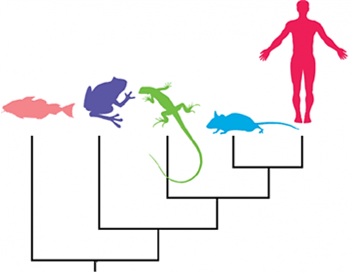
According to this phylogenetic tree, which creature is the least related out of all pictured?
Fish
Frog
Salamander
Human


What number is the common ancestor of C and D
1
2
4
Which kingdoms have photosynthetic organisms?
Plants and Animals
Fungi and Plants
Protists and Plants
Fungi and Protists
A clade contains
all the organisms with similar appearances
organisms living within the same ecosystem
an ancestral species and all the organisms that came before it
an ancestral species and all its descendants
Which of the following is NOT a domain of life?
Prokarya
Eukarya
Eubacteria
Archaebacteria

Which organisms are extinct according to this phylogenetic tree?
sharks
birds
lizards
dinosaurs


Based upon this organism's classification, which of the following is most closely related to it?
Vulpes Vulpes
Canis familiaris
Panthera leo

____ and _____ are MOST closely related.
Gorilla, Birds
Rodents, Amphibians
Gorilla, Amphibians
Rodents, Fish

What animal is B?
Deerus octagis
Deerus pestis
Deerus purplinis
Deerus magnus
Gray Wolf: Canis lupus
Aardwolf: Proteles cristatus
Coyote: Canis latrans
Which of the following technological advances has made the most difference on the study of the evolutionary relationships between organisms?
More precise tools to measure fossilized bones
The ability to compare DNA sequences between organisms
Better techniques to keep animals alive in the lab to study them
Advanced laser scanning techniques to better quantify and compare anatomical traits

What characteristics do all of these animals have in common?
Vertebrate
Endothermic
Lungs
Loss of canine teeth

According to the cladogram, which trait(s) do conifers have? Select all that apply.
Vascular tissue
Seeds
Flowers
Heterotrophic

What is the most recent common ancestor of Mammalia and Non-avian dinosaurs?
Tetrapoda
Amniota
Dinosauria
Diapsida
Which organism is most closely related to the turtles (Testudines)?
Mammalia
Lizards and snakes (Lepidosauria)
Frogs and Salamanders (Lissamphibia)
Crocodylia

Researchers studying populations of Gallotia lizards on the Canary Islands compared the gene for the protein cytochrome b between species. Which two species are most closely related?
G. Atlantica and G. Stehlini
G. Simonyi and G. Bravoana
G. Galloti eisentrauti and G. galloti palmae
G. galloti eisentrauti and G. galloti galloti

Which statement is best supported by the information in this phylogenetic tree?
Lesser pandas are more similar to giant pandas than racoons
Brown bears are more similar to giant pandas than sun bears
Lesser pandas are more similar to racoons than giant pandas
The bear species are more similar to dogs than the giant panda

Based on the cladogram of bats, which two species are the LEAST closely related
Cynopterus sphinx and Ptenochirus jagori
Haplonycteris fischeri and Dyacopterus spadiceus
Ptenochirus jagori and Ptenochirus minor
Cynopterus sphinx and Otopteropus cartilagonodus

Based on the figure, how long ago lived the most recent common ancestor of the European Brown Bear and the Asian Brown Bear?
470,000 years ago
220,000 years ago
330,000 years ago
140,000 years ago

According to the data shown here, which of the following canids is most likely the wild ancestor to the domesticated dog?
Coyote
Red Fox
African Wild Dog
Grey Wolf

What is the most specific taxonomic grouping that the ocean sunfish and triggerfish share?
Phylum
Class
Kingdom
Order

What is the correctly written scientific name of the ocean sunfish?
Mola mola
Molidae Mola
mola Mola
Mola mola

This diagram shows a cladogram of six species based on amino acid similarities. Which two species are most closely related?
I and II
II and IV
I and V
V and VI

Which statement concerning the evolution of species A, B, C, D and E is supported by the diagram?
Species B and C can be found in today's environments.
Species A and D evolved from E.
Species A and C can still interbreed.
Species A, B, and E all evolved from a common ancestor and are all successful today.

Which of the following statements is BEST supported by the cladogram?
The Utah prairie dog was the ancestor of the Gunnison's prairie dog.
The white-tailed prairie dog evolved from the black-tailed prairied dog.
The Mexican prairie dog and the Utah prairie dog share a common ancestor.
The white tailed prairie dog is the closest relative of the white tailed prairie dog.

Which of the following conclusions about bears is BEST supported by the cladogram?
Modern bears evolved from species that are now extinct.
The short faced bear was the ancestor of the Asiatic black bear.
Present day bear species are more closely related than their ancestors were.
Natural selection favored brown bears over American black bears.

Of the choices listed, which species is the oldest?
H
D
C
A
What is the most recent common ancestor of species G and H?
B
C
D
E

Which two species are most different?
H and B
F and J
F and H
B and J

Which group of animals on this tree are most closely related to birds?
Saurischian dinosaurs
Ornithischian dinosaurs
Crocodiles
None of these are related to birds

Where is the alligator and T. rex's common ancestor?
Point A
Point B
Point C
Point D

According to this tree, which of these animal phyla are most closely related?
Arthropoda & Mollusca
Arthropoda & Chordata
Chordata & Mollusca

The diagram below represents possible genetic relationships between groups of organisms.
Which statement is a valid conclusion that can be drawn from the diagram?
Insects are more complex than mammals.
Earthworms and sea stars have a common ancestor.
Snails appeared on Earth before corals.
Sponges were the last new species to appear on Earth.
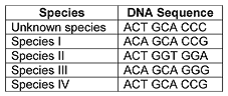

Which organism is the most distantly related to all the others?
Raccoon
Dog
Giant Panda
Sun Bear
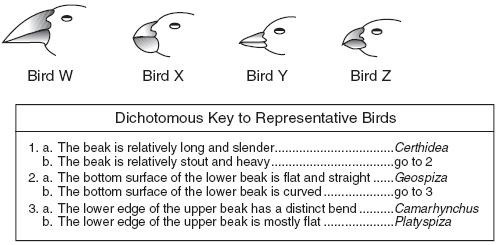


Biologist group living things based on ____.
Habitat
Size
Colors
Shared Characteristics


Unicellular, prokaryotic, autotroph
bacteria
protist
animal
plant
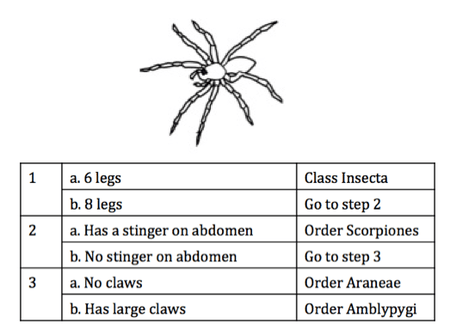

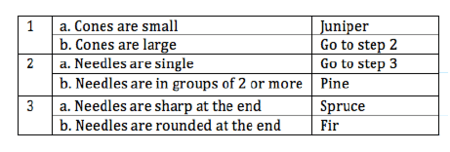
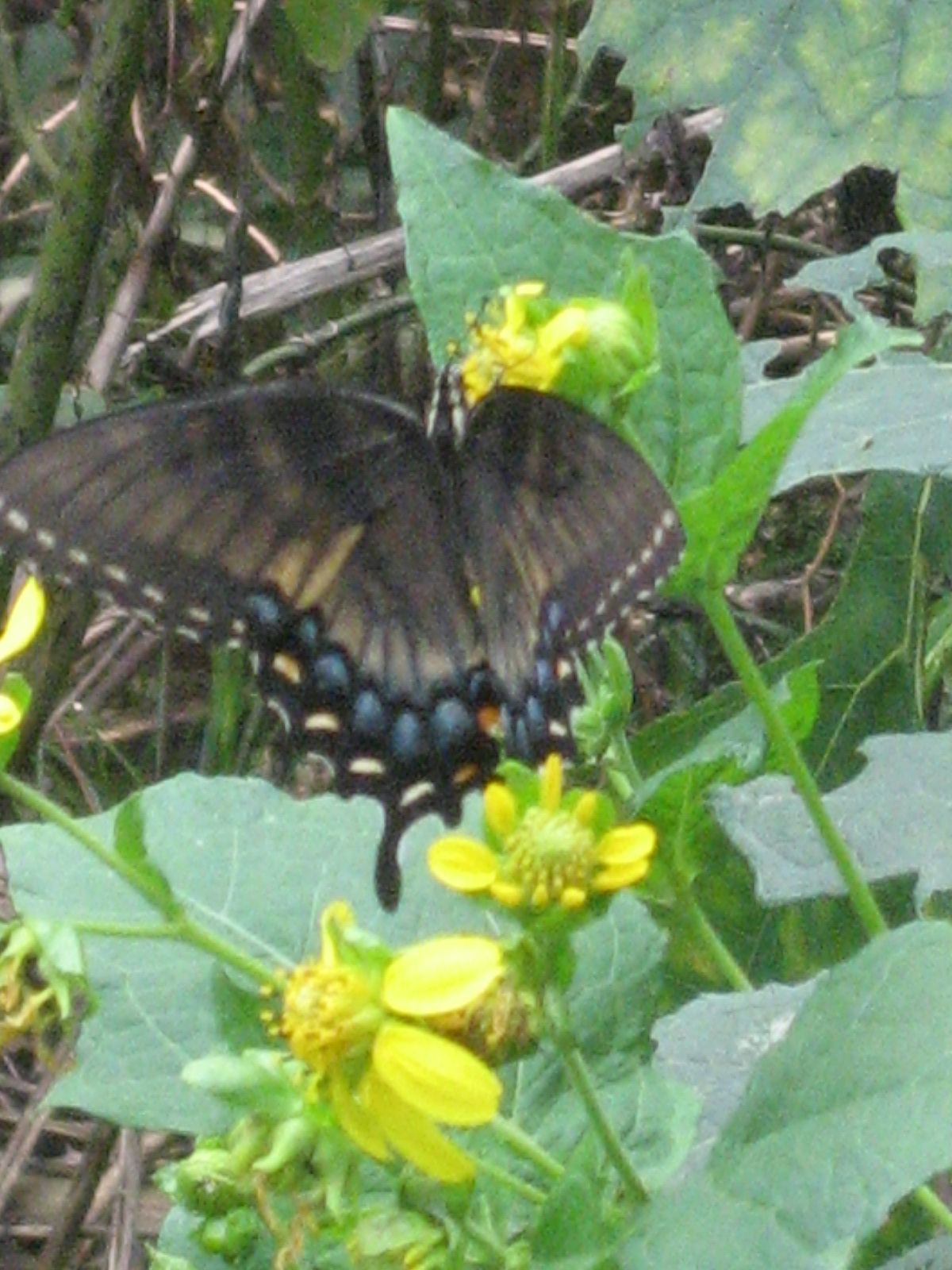
What is the genus name here:
Canis lupus
Canis
lupus
The science of describing, classifying and naming living things is known as _______.
Biology
Taxonomy
Sortology
Phylogeny
Biologist group living things based on ____.
Habitat
Size
Colors
Shared Characteristics
Unicellular, prokaryotic, autotroph
bacteria
protist
animal
plant
According to this phylogenetic tree, which creature is the least related out of all pictured?
Fish
Frog
Salamander
Human

Which two groups of organisms have the MOST genetic DIFFERENCES?
rotifers and nematodes
mollusks and annelids
mollusks and arthropods
echinoderms and chordates

The diagram shows a cladogram of six species based on amino acid similarities. Which two species are MOST CLOSELY related.
I and II
II and IV
I and V
V and VI

How many options should every branch in a dichotomous key have?
1
2
3
4


What number is the common ancestor of C and D
1
2
3
4
Which characteristics best describe the Kingdom Protista?
unicellular and multicellular, eukaryote, heterotroph and autotroph
unicellular, prokaryote, heterotroph
multicellular, eukaryote, autotroph
multicellular, prokaryote, heterotroph
Which one is not a Domain of life?
Bacteria
Archaea
Eukarya
Animalia


Phloem transports...
Sap
Nutrients and sugars
Water
H2O
What plant cells are responsible for maintaining flexible support?
Collenchyma
Parenchyma
Sclerenchyma
Momenchyma
Plants that grow extremely quickly likely have a high number of which cell type?
Perenchyma
Sclerenchyma
Dermal
Meristem
Which of the following is NOT included in ground tissue?
Parenchyma
Sclerenchyma
Collenchyma
Xylem
Guard cells belong to which type of tissue?
Ground Tissue
Vascular Tissue
Epidermal Tissue
Muscular Tissue
What are the components that make up the phloem?
Guard cells and root hair cells
Guard cells and sieve tubes
Companion cells and sieve tubes
Companion cells and root hair cells
Phloem and Xylem together make up the...
Ground Tissue
Vascular Tissue
Dermal Tissue
Cardiac Tissue

Which of the following is NOT a function of the roots?
Store sugars
Absorb water and minerals
Anchor plant to the ground
Photosynthesis
What would happen to a plant that did not have proper phloem?
The plant would not have structural support
The plant would die due to lack of nutrients
The plant would not grow due to lack of rapid cell division
The plant would die due to lack of photosynthesis in cells
Which one is a function of Meristematic Tissue ?
Growth Of Plant
Photosynthesis
No Kaam
Guarding the Cell wall
Shyamak observed that coconut has a stiff and hard covering . Wondering, he asked about the husk from his teacher. His teacher told him that coconut husk is hard due to __________________
Collenchyma
Stiffenchyma
Sclerenchyma
Parenchyma
Movement toward a stimulus
hydrotropism
positive tropism
dormancy
stimulus
A plant's response to touch
thigmotropism
geotropism
hydrotropism
dormancy
The movement of roots toward the ground or the movement of stems away from the ground
hydrotropism
geotropism
thigmotropism
phototropism
The movement of a plant's roots toward water in the soil
thigmotropism
geotropism
phototropism
hydrotropism
What causes plants to bend toward the sunlight?
positive thigmotropism
positive thigmotropism
negative phototropism
positive phototropism
phloem : food transport
Which plant hormone is responsible for phototropism?
cytokinin
auxin
gibberellin
ethylene

