
Font size
 Worksheets
Plate tectonics sample questions
Total questions: 111
Worksheet time: 3hrs 35mins
Rocky or rigid outer part of Earth consisting of the brittle crust and the top part of the upper mantle
Lithosphere
Oceanic Crust
Continental Crust
Asthenosphere
Mantle convection is the very slow creeping motion of Earth’s solid silicate mantle caused by convection currents carrying heat from the interior to the planet's surface.
Lithosphere
Earthquake
Convection Currents
Core
Solid, outer layer and is made of both the oceanic and continental crust.
Hydrosphere
Core
Mantle
Crust
Hot fluid or semi-fluid material below or within the earth's crust from which lava and other igneous rock is formed on cooling.
Convection Current
Lithosphere
Core
Magma
The thick part of the earth's crust that forms the large landmasses. It is generally older and more complex than the oceanic crust.
Oceanic Crust
Continental Crust
Magma
Inner Core
In the region where two continental plates collide, what geological feature MOST often forms?
an ocean
a volcano
a river valley
a mountain chain
Crustal plates that pull apart from one another MOST likely form
volcanic island arcs
strike-slip faults
oceanic trenches
rift zones
Which two plates collided with each other to form the Himalayan Mountains?
Nazca and Eurasia
Indo-Australian and Eurasian
North America and Antarctic
South American and Indo-Australian
Which of these tectonic plate boundaries is most likely to form a volcano.
a continental plate colliding with a continental plate
an oceanic plate sliding past a continental plate
a continental plate sliding past a continental plate
an oceanic plate colliding into a continental plate
What causes the tectonic plates to continually to move?
Convection currents
Volcanic and seismic activity
Strong winds and storms
Rotation of the solid core
Which statement best describes why fossils of the same land-dwelling species have been discovered in both South America and Africa?
The organism migrated to two continents
The organisms were separated by the formation of new mountain ranges
The organisms became extinct due to climate change on these continents
These organisms once lived on one large landmass that later split into two continents
A satellite image can help scientist locate the area where two plates have diverged by showing the existence of
Plateaus
Mountains
Rift Valleys
Grassy Plains
This single landmass that broke apart 200 million years ago and gave rise to today's continents is called
Pangrea
Pangaea
Continental Drift
Plate Tectonics
The tectonic plate boundary where two plates collide, come together, or crash into each other
Divergent
Convergent
Transform
Subduction
The formation of new areas of oceanic crust which occurs through the upwelling of magma at midocean ridges and its subsequent outward movement on either side
Subduction
Transform
Convergent
Sea-Floor Spreading

This is when one plate goes under another
Transform
Sea-floor Spreading
Subduction
Divergent

Look at this image. What type of plate boundary is this?
Divergent
Complex or Uncertain
Transform
Convergent
The theory that pieces of Earth's lithosphere are in constant motion, driven by convection currents in the mantle is called
Continental Drift
Plate Tectonics
Pangaea
Earthquake
A volcanically active area of the Earth's surface far from a tectonic plate boundary
Fault
Crust
Core
Hot Spot
A break in the earth's crust
Earthquake
Fault
Tectonic plates
Boundary
The shaking that results from the movement of rock beneath Earth's surface
Fault
Boundary
Continental Drift
Earthquake
The layer of the earth that is the only liquid layer is
Outer Core
Mantle
Inner Core
Crust
He is the German scientist who theorized that Pangaea split apart and drifted into different locations
Alfred Wagner
Harry Hess
Alfred Wegener
Alfred Wagoner
The place where two plates meet is called a
Fault
Boundary
Convergent
Divergent

The type of plate boundary between South American Plate and Nazca plate is
convergent
divergent
transform
uncertain/complex
The gradual movement of the continents across the Earth's surface through geological time
Plate tectonics
Continental Drift
Earthquake
Sea-floor Spreading
This earth's layer is made up of the crust and a tiny bit of the upper mantle
astenosphere
inner core
lithosphere
geosphere

Oceanic and continental convergent plate boundaries form
mountains and mountain ranges
volcanoes and mountains
deep-oceanic trenches and volcanoes
island arcs, trenches, and mountains

Mountains and Mountain ranges are created by what kind of plate boundaries?
Continental and Continental Divergent
Oceanic and Continental Convergent
Oceanic and Continental Divergent
Continental and Continental Convergent
A subduction zone is formed...
when one tectonic plate sinks below another
at every type of divergent plate boundary
at every type of convergent plate boundary
at transform boundaries

The Galapagos Hot Spot is located closest to what type of tectonic plate boundary?
Transform
Divergent
Convergent
Uncertain or Complex
What geologic feature/event you be most likely to find at a transform boundary?
Rifts
Mountains
Valleys
Earthquakes

Early scientist studies the continents an dobserved that South America and Africa fit together like puzzle pieces. Which of the following ideas does this observation support?
The continental shelves of these two continents are made of the same type of rock.
The material that makes up the continental shelves is eroded from the continents.
These continents were joined in the past and have moved apart since that time.
The tectonic plates beneath these continents are roughly the same age.
Which of the following models best describes the scientific theory of plate tectonics?
Building a rocket model and launching it.
Counting the number of pennies that land heads up after each toss
Using a basketball to block the light from a lamp on a ping pong ball
Mixing vinegar and baking soda together in a flask and watching the reaction.
Placing two pieces of cardboard over a layer of shaving cream and pushing them together.

Which features are commonly formed at the plate boundaries where continental crust converges with oceanic crust?
long chains of mid-ocean volcanic islands perpendicular to the coast
large volcanic mountain ranges parallel to the coast at the center of the continents
a deep ocean trench and a continental volcanic mountain range near the coast
an underwater volcanic mountain range and rift valley on the ocean ridge near the
coast
What are the processes that have been claimed to explain the movements of Earth’s tectonic plates?
mantle convection and continental drift
sea-floor spreading and continental drift
mantle convection, ridge push and slab pull
slab pull, and sea floor spreading

Divergent plates move away from each other. What feature is most likely found at a divergent plate boundary?
Mountain range
Mid-Ocean Ridge
Plateau
sand bars
Examining rocks that form on either side of the Mid-Atlantic Ridge provides evidence that supports the theory of plate tectonics. These rocks provide evidence of plate movement. What is happening to the rocks as they get farther and farther from the ridge?
They are made up of smaller particles.
They have higher iron content.
They become increasingly older.
They become thinner and thinner.

Which geologic events occur most often at a mid-oceanic ridge plate boundary?
Magnetic pole reversals and cooling of ocean water
Earthquakes and volcanic eruptions
Meteorite impacts and tilting of shorelines
Water pollution and water heating

The map below shows dark bands that indicate long mountain ranges on the west coasts of North America and South America. What caused the formation of these mountain ranges?
deposition of river sediments entering the ocean
collision of lithospheric tectonic plates
erosion of continental coastlines by ocean waves
uneven heating of Earth’s surface

The Ring of Fire is an area along the edge of the Pacific Ocean with many volcanoes. Which of these geologic areas is where rock is recycled by one tectonic plate sliding underneath another tectonic plate?
a strike-slip fault
a subduction zone
a rift valley
a divergent boundary
Earthquakes are experienced in many areas on the planet. What is occurring that results in earthquakes
two tectonic plates sliding past each other
two tectonic plates pulling away from each other
tectonic plates being weathered over time
tectonic plates melting as they slide into the mantle
Currently, there are 44 active volcanoes in the Andes Mountains in South America. Why are volcanoes so common in mountain ranges such as the Andes?
The Andes absorb more solar radiation and create the heat necessary to form lava
The Andes are located largely in rainforests where the hot climate supports volcano formation
The Andes are at a high elevation, which is necessary for volcano cone formation.
The Andes are in a region where a crustal plate is moving under another plate, which causes volcano formation.

The diagram below shows the collision of an oceanic plate and a continental plate. At which location would a natural disaster least likely to occur?
1
2
3
4
Molten magma rises, cools and falls in the mantle of the Earth’s interior. What type of heat transfer does this describe?
Conduction
Radiation
Convection
Absorption
There have not been any earthquakes reported in the interior of the content of Africa. Why?
The mountains in Africa do not cause pressure to build up in the lithosphere.
The entire continent of Africa is located on a single continental tectonic plate.
The landmass of Africa is too small to form earthquakes.
The plate boundary inside Africa is too small to form earthquakes.
Which of the following statements best explains why earthquakes occur more frequently in California than in Florida?
California is located on the boundary of two crustal plates, but Florida is not.
The rock under California is soft, but the rock under Florida is hard.
Rock found in California is sedimentary, but rock found in Florida is igneous.
California is located on a continental plate, but Florida is not.
Which of the following statements best describes the relationship between continental drift and plate tectonics?
The theory of plate tectonics was developed before the theory of continental drift.
Plate tectonics disproved the theory of continental drift.
Plate tectonics helped explain how continental drift occurred.
The theory of plate tectonics developed independently from the theory of continental drift.

The Philippine Islands formed when crustal plates move over a hot spot in Earth's mantle. When the hot spot erupts in a volcano, magma becomes lava and is deposited, which forms a new island. Over time, which of the following happens?
The plate is lifted up and the newly formed island is raised from the hot spot.
The plate is pulled under and the newly formed island is separated from the hot spot.
The plate becomes stable and the newly formed island is detached from the hot spot.
The plate continues to move and the newly formed island moves away from the hot spot.
Tectonic plates move due to convection currents in the mantle. What causes those convection currents in the mantle?
the transfer of energy as electromagnetic waves
the transfer of energy from a region of lower temperature to a region of higher temperature
the transfer of energy through material in direct contact
the transfer of energy due to the movement of matter
Alfred Wegner hypothesized that when the edges of separate continents are very similar; it suggests that these rocks were formed in the same way, implying that they were joined initially. To prove his hypothesis, Wegner collected fossil evidence from the east coast of South America and the west coast of Africa. Analysis of the fossils showed that they are similar, not only in structure, but in age. His conclusion was that these two continents were once joined. How would you best describe the results of Wegner’s experiment?
No conclusion can be drawn from the results
The results fail to support the hypothesis
The results are inaccurate
The results support the hypothesis

The movement of the tectonic plates is caused by
the rotation of the Earth.
convection currents in the Asthenosphere
the gravity of the iron-nickel core.
the Moho discontinuity.
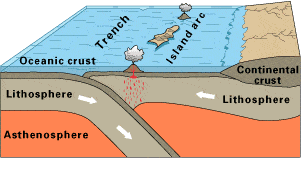
Observe this diagram of a plate boundary. One statement BEST describes what is happening. It is that
the oceanic crust is melting.
the denser ceanic crust is subducting under the less dense oceanic crust
volcanic islands are forming.
the tectonic plates are moving away from each other.

Most geologists think that the movement of Earth’s plates is caused by _______
convection.
continental drift.
subduction.
conduction.
A place where two plates slip past each other, moving in opposite directions, is known as a _______
transform boundary
divergent boundary.
convergent boundary.
rift valley.

The place where two plates come together is known as a _______
transform boundary.
divergent boundary.
convergent boundary.
rift valley.

Below is a picture of sea-floor spreading. How are the ocean crusts moving?
Converging
Diverging
Sliding
No movement
The San Andreas Fault in California is known as an active earthquake area. What type of
boundary is it?
Converging
Diverging
Transform
Sea Floor Spreading

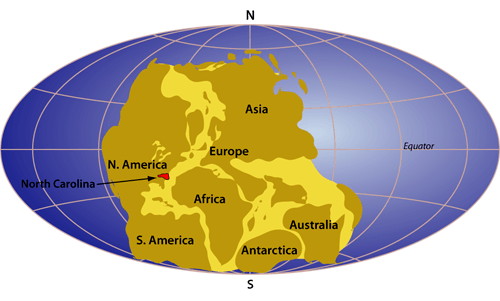
What type of plate boundary lies on the west coast of South America?
Convergent
Divergent
Transform
Uncertain
What plate does New York lie on?
(a)
Which two mantle hot spots are located at midocean ridges?
Iceland and Yellowstone
Galapagos and Tasman
St. Helena and Hawaii
Easter Island and Bouvet
Which type of tectonic plate boundary is found between the South American Plate and the Scotia Plate?
transform
convergent
divergent
complex or uncertain
Crustal formation, which may cause the widening of an ocean, is most likely occurring at the boundary between the
African Plate and the Eurasian Plate
Pacific Plate and the Philippine Plate
Indian-Australian Plate and the Antarctic Plate
South American Plate and the North American Plate
Trenches can be produced at contact zones between tectonic plates. The boundary between the following plates is an example of that:
South American and African
Indian-Australian and Pacific
Eurasian and North American
Pacific and Antarctic
Associated with transform boundaries.
Volcanoes
mountains
trenches
earthquakes-faults


Other evidence include __________________ that plate tectonics does occurr in the crust of the Earth.
Rock formation, weather, fossils
Mountain formation, fossils
Geologic features, fossils
Valleys, Ocean trenches
At which of these boundaries would you find a deep sea trench?
transform
divergent
oceanic-oceanic convergent
Observe this diagram of a plate boundary. One statement BEST describes what is happening. It is that
the oceanic crust is melting.
the denser ceanic crust is subducting under the less dense oceanic crust
volcanic islands are forming.
the tectonic plates are moving away from each other.

Which of the following is the name of the ancient supercontinent formed 280 Million Years ago.
Pangea
Gondwanda
Laurasia
Neverland
Scientists recently discovered that rocks collected from the Franklin Mountains in West Tests and rocks collected from mountains in eastern Antarctica were exactly the same age. Further research showed that the rocks were chemically and geologically the same and came from the same magma source. This discovery provides evidence of--
coastal erosion
plate tectonics
ocean currents
glacial melting
Which statement best describes the geologic process that is most likely responsible for the formation of mountains?
They are along a transform plate boundary that is no longer active, so erosion is creating deep valleys.
They are along a transform plate boundary in which plates are currently moving side by side, causing earthquakes and faults
They are along a plate boundary in which plates are currently converging, causing uplift and steep slopes.
They are along a plate boundary in which plates diverged in the distance past, allowing new rock to build up.
A mid-ocean RIDGE is located at the boundary of two tectonic plates. Which diagram correctly models the relative plate motion on each side of a mid ocean ridge?


Rift valleys can from when fractures in Earth's crust widen. The valley walls slowly move at a rate of only a few millimeters a year. Which of these best describes the type of tectonic activity that forms rift valleys?
Rift valleys from where a continental plate moves under an oceanic plate
Rift valleys form where a plate slides horizontally past another plate
Rift valleys from where two plates move away from each other.
Rift valleys form where an oceanic plate moves under another oceanic plate.

The San Andreas fault is a transform fault. The map below shows a student's approximation of where the fault line crosses through the United States. Students were asked to make maps predicting which way land would most likely move over thousands of years.


A mid- ocean ridge separates the Pacific plate and the Nazca plate off the western coast of South America. Which statement best describes the relative motions of the Pacific and Nazca plates?
The Pacific and Nazca plates are moth moving to the east.
The Pacific and Nazca plates are both moving to the west
The Pacific plate is moving to the west, and the Nazca plate is moving to the east.
The Pacific plate is moving to the east, and the Nazca plate is moving to the west.

The image shows a plate boundary. Arrows have been added to indicate the movement of the plates.What plate boundary feature is also shown?
A ridge formed by an inactive convergent boundary
A valley forming at an active divergent boundary
A fault forming at an active transform boundary
A volcano formed by an active transform boundary

The map shows the locations of four active volcanoes in the Caribbean Sea. What do these volcanoes indicate about plate tectonics in the region?
The volcanoes form an island arc, indicating a converging plate boundary
The volcanoes form a line, indicating a diverging plate boundary.
Two plates are moving past each other, causing faulting and magma formation.
Two plates are moving apart, creating new seafloor

The diagram shows a model of the movement of two tectonic plates. When the plates collide, on plate often moves below the other plate. The rising magma that can result from this type of plate movement may produce-
fossil layers
volcanic islands
deep-sea sediment
seafloor spreading

The model below shows two continental plates. The folded mountains in this model form at which type of plate boundary?
Transform boundary
Divergent boundary
Subduction boundary
Convergent boundary

What is the name of plate #5?
Cocos
Indo-Australian
Juan de Fuca
Pacific

What is the name of plate #1?
Cocos
Indo-Australian
Juan de Fuca
Pacific

What is the name of plate #6?
Antarctic
Arabian
North American
Pacific

What is the name of plate #2?
Antarctic
Arabian
North American
South American
What is the name of plate #4?
Antarctic
Arabian
North American
South American
What is the name of plate #11?
Antarctic
Arabian
Caribbean
South American
What is the name of plate #9?
Okhotsk
African
Philippine Sea
Scotia
What is the name of plate #7?
Eurasian
African
Philippine Sea
Scotia
What is the name of plate #3?
Eurasian
Nazca
Philippine Sea
Scotia
What is the name of plate #3?
Eurasian
Nazca
Philippine Sea
Scotia
What is the name of plate #8?
Eurasian
Nazca
Philippine Sea
Scotia
Match the following images with vocabulary.

Continental Drift

Divergent Boundary

Transform Boundary

Convergent Boundary

