
 Worksheets
Unit 7: Biodiversity, Sustainability, Ecological Succession
Total questions: 146
Worksheet time: 4hrs 41mins
Which experiences the least change over time?
Pioneer Species
Primary Succession
Aquatic Succession
Climax Community
What is a common characteristic among pioneer species?
roots that break apart rocks
long thick roots
exposed surface roots
soak up water quickly
Which of the following best describes primary succession?
Volcano wipes out ecosystem that gradually grows back from ash covered soil
Volcano creates a new island of rock that must break down to form an ecosystem
Forest fire burns down forest that must bounce back over time
Tornado destroys a crop that must slowly grow back over time.
What term best relates to equilibrium?
pioneer species
primary succession
secondary succession
climax community
If farmers use a controlled burn to prevent forest fires, what would most likely be the first plants to return?
trees
shrubs
mosses
grasses
Breaking News! A new island has formed off of Hawaii! What must occur for it to become an ecosystem?
Secondary Succession
Aquatic succession
Primary Succession
Ferns must grow
Which would most likely result in primary succession?
old forest growing
undisturbed prairie
pollution kills mountain lake species
a Newly formed volcanic island
Which progression best explains secondary succession?
lichens>grass>shrubs>small trees> big trees
mosses>creates soil>grasses>small trees> big trees
Volcano destroys ecosystem>grasses>shrubs>small trees>big trees
Volcano forms new island> lichens>grasses>shrubs>small trees>big trees
Which best describes eutriphication?
pond slowly filling with sediment over time; becoming a forest
growth of an ecosystem following a disturbance
forest burning down
humans causing succession
Which would result in primary succession?
volcano destroying habitat leaving only soil and ash
Tornado destroying a crop leaving very little soil
Glacier retreating exposing bare rock
limiting factors
If you visited a forest in 2015 and there was only small plants there when revisited in 2019, what likely happened?
passing of a glacier
preservation of a habitat
occurrence of a forest fire
development of a parking lot
Which of the following is the correct aquatic succession stages?
Full ecosystem>trees>shrubs>fish and aquatic animals>plants> water only
Water only>small plants and animals>sediment builds> pond fills with soil
fire>grass>shrubs>trees
bare rock>lichens>grasses>shrubs>trees
Both primary and secondary succession start with...
modify an area to allow more complex organisms to appear
lichens and moss
never reach climax community
start from a volcano always
How do pioneer species compare in primary and secondary succession?
primary starts with grass and weeds, secondary starts with mosses
primary starts with forest fire, secondary starts with volcano
primary starts with a volcano, secondary starts with a forest fire
Lichens and moss in primary, and grasses/ ferns in secondary
An example of typical pioneer species, that is one that appears in the earliest stages of ecological succession is:
Oak Trees
Spiders
Weeds
Small Conifer Trees
Primary succession occurs in areas with:
very little soil
lots of soil
no soil
soil that has been disturbed
What best describes the term succession?
rapid changes that create an ecosystem overnight
gradual changes over time to fully create or restore and ecosystem
forest with the tallest trees
the rate species produce offspring
Why do grasses appear before shrubs in ecological succession?
loosen the dirt for new trees to take roots?
provide food for animals returning to the area
require plenty of sunlight to make their own food
can grow even in areas with shallow soil


Primary succession occurs in an area that has:
soil
no soil
some soil
none of these
___ are the first organisms to colonize an area and begin the process of ecological succession.
foundational organisms
introductory organisms
primary organisms
pioneer species
What is the main difference between primary and secondary ecological succession?
Primary begins WITHOUT soil; Secondary begins WITH soil
Primary is the first state and secondary is the second stage
Primary builds plant community; secondary builds animal community
Primary begins WITH soil; Secondary begins WITHOUT soil
What is an example of a disturbance that could bring about secondary succession?
Humans cut down many trees in a small region
A volcanic eruption covers a village in lava.

During a forest fire most vegetation (plants) burn. Which ecological succession will take place after a forest fire?
Primary
Secondary

As ecological succession progresses, a pioneer community gradually changes into a climax community. What typically happens during this process?
The number of species increases
The number of species decreases
The organisms in an area decrease in size
The organisms in an area can no longer find food
Which of the following types of organisms would be present during the pioneer community stage of ecological succession?
Lichens and mosses
Grasses and shrubs
Small trees and wildflowers
Tall trees and thick brush
Which
As an ecosystem transitions from a grassland to a forest, grasses will begin to -
adapt to life in the forest.
be replaced by other plants.
multiply to establish dominance.
relocate to a nearby grassland.
What are the two types of ecological succession?
Primary and Secondary
Environmental and Natural
Habitat and Community
Population and Community
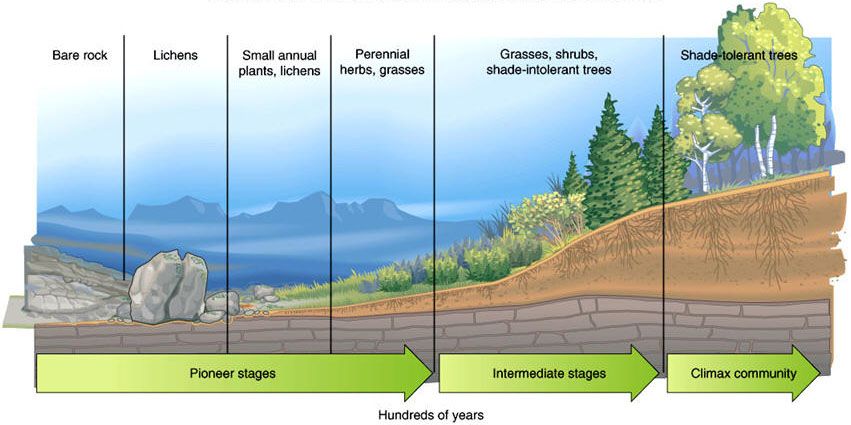
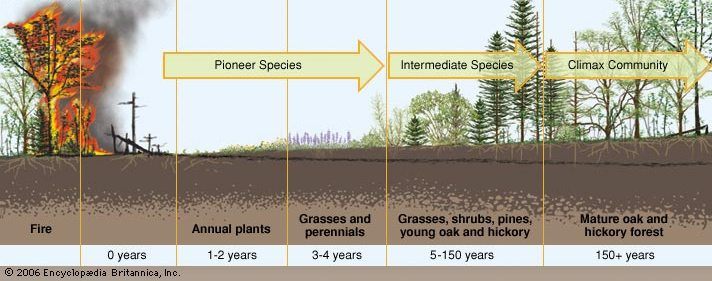

Ecological succession can be described as
A change in weather
The dominant species in one particular area
A gradual change in plant and animal life in an ecosystem over time
Species that survive best when there is little or no competition in an area
What is one way secondary succession differs from primary succession?
Secondary succession is typically quicker than primary succession
Secondary succession is typically slower than primary succession
Secondary succession only occurs in mountains, primary succession only occurs in wetlands
Secondary succession is the gradual change in plant species, while primary succession is the gradual change in animal species
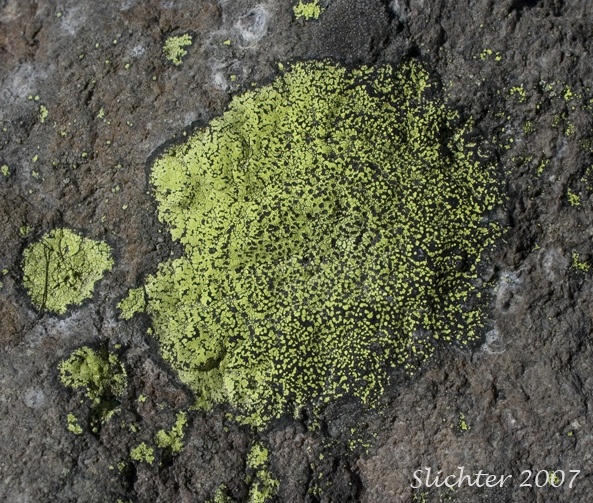
A community of moss and lichens growing on an outcrop of a rock is an example of
A behavioral adaptation
A climax community
Primary succession
Secondary succession

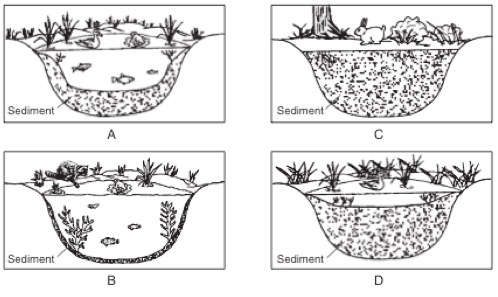
Which diagram best represents a climax community?
Picture A
Picture B
Picture C
Picture D
Which of the following represents secondary succession?
Moss growing on top of rocks
Plants growing in a forest that was destroyed by fire
Plants growing on sand dunes
Plants growing on a new volcanic island that formed in the ocean

The graph below shows how the number of species in a particular ecosystem changed over a 200 year period. What is one conclusion you can make based on the information in the graph?
The number of species increased the most during the first 50 years
The number of species decreased by 25,0000 over a period of 200 years
The number of species decresed the most durin gthe last 80 years
The number of species increased by 25,000 over a period of 200 years.
Which statement about pioneer species is TRUE?
Pioneer species require soil to grow
Pioneer species are organisms made up of only one cell
Pioneer species thrive during the early stages of ecological succession
Pioneer species, such as hardwood trees, thrive during the final stages of ecological succession
As ecological succession progresses, a pioneer community gradually changes into a climax community. What typically happens during this process?
The number of species increases
The number of species decreases
The organisms in an area decrease in size
The organisms in an area can no longer find food
The process of ecological succession usually begins after all of the following EXCEPT:
Flooding
Forest Fire
Rain Showers
Volcanic eruptions
An empty lot that was only covered in dirt ten years ago is now home to many different species of plants and animals. Based on your knowledge about ecological succession, what can you infer?
People must have planted all the plants in the empty lot
There are more rocks in the soil compared to 10 years ago
There are more nutrients in the soil compared to ten years ago
The animals will not survive because there is not enough plants.
Select two pioneer species
Lichen
Moss
Deciduous tree
Deer
What is needed for more complex plants to grow?
Water depth
Tacos
Soil depth
The gradual process in which ecosystems change or develop over time is called
Ecological Succession
Peanut Butter and Jelly
Volcano
Glacier

Which series of pictures BEST represents ecological succession?
A
B
C
D



Biodiversity, aka biological diversity, usually refers to
the same species in a general location
the number of different species in a given area
the number of animal species in a given area
the number of plant species in a given area
A population is
a group of similar species in different areas
a group of the same species in the same geographic area.
a group of several species in the same geographic area
a group of several species along with their abiotic factors in a small area.
A stable ecosystem typically has high biodiversity.
True
False
High biodiversity is a sign of a healthy ecosystem.
True
False
What does the root "bio" mean...
living
nonliving
toxic
variety
What does the root "diversity" mean...
living
nonliving
toxic
variety

How do biodiversity and stability work together?
The lower the biodiversity the greater the stability of an ecosystem.
The higher the biodiversity, the less stable the ecosystem
The higher the biodiversity, the greater the stability of the ecosystem.
Biodiversity has nothing to do with ecosystem stability.


Which ecosystem is more likely to survive a change in the environment?
One with High biodiversity
One with Low biodiversity

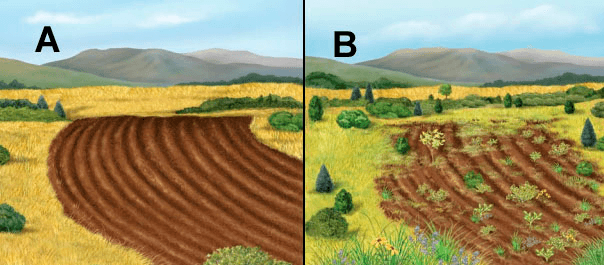
Which shows more biodiversity Image A or Image B. Why?
Image B is more biodiverse, because shows more different species than image A.
Image A is more biodiverse, because shows a greater number of organisms that image B
Both images show the same biodiversity
The level of biodiversity that involves a variety of habitats is _____ diversity.
ecosystem
population
genetic
species
Which ecosystem below has the HIGHEST biodiversity?


What are the 3 types of biodiversity (SELECT 3)
Genetic
Species
Ecosystem
Size
Biotic
The more different types of organisms and the more relationships that can occur between organisms the greater the...
Species Diversity
Genetic Diversity
Ecosystem Diversity
Greater ____________________ means there are more habitats to support different types of organisms.
Ecosystem Diversity
Species Diversity
Genetic Diversity
The greater the ____________________, the more likely a species is to survive changes to their environment
Genetic Diversity
Species Diversity
Ecosystem Diversity
Which biome is more biodiverse?
Desert
Grassland
Tundra
Rainforest

A farmer digs a small pond in a pasture. The farmer adds young individuals from two species of algae-eating fish to the pond and plants some reeds around the edge of the pond. The farmer wants the pond to be a sustainable ecosystem.
Which of the following would be most helpful in increasing the pond ecosystem’s sustainability?
Decreasing the number of pond species around the edges of the pond
Introducing older fish of the same species into the population of algae-eating fish
Having a greater diversity of living organisms in the pond
Adding water between the water and where the reeds are planted
What does biodiversity indicate about an ecosystem?
the location of the ecosystem
the overall size of the ecosystem
the ability of the ecosystem to survive change
the identity of the organisms that began ecological succession in the ecosystem
The warmer the environment is and the closer an environment is to the equator, the higher the biodiversity of the environment. Based on these observations, which of these environments has the greatest biodiversity?
Tundra
Desert
Tropical rainforest
Grasslands
Which term best describes the number and variety of organisms in a given area during a specific period of time?
limiting factor
biodiversity
succession
sustainability

The following table lists the number and variety of organisms in four different ecosystems.
Based on the table, which ecosystem is likely the most sustainable?
Ecosystem 1
Ecosystem 2
Ecosystem 3
Ecosystem 4
In which biome would you expect to find many coniferous trees?
taiga
Tundra
Savanna
Tropical rainforest
What is one way that a temperate rainforest is different from a temperate deciduous forest?
A temperate rainforest has large populations of grasses rather than tall trees.
A temperate rainforest is made up of palm trees rather than coniferous trees.
A temperate rainforest has a long rainy season rather than moderate, year-round rainfall.
A temperate rain forest has trees that lose their leaves in winter rather than keeping them year-round.
You observe a garden in a schoolyard. Corn, tomatoes, pumpkins, and other crops thrive in the garden. What is most likely true of the soil in this microhabitat?
It is dry and frozen.
It is rocky, sandy, and dry.
It is deep, dark, and nutrient rich.
It is thin, acidic, and nutrient poor.
What important role does fire play in a grassland biome?
It helps seeds germinate.
It spreads seeds to distant locations.
It causes flowers on plants to bloom.
It prevents animals from eating plant populations.
How are tropical plants such as bromeliads adapted to the biome in which they live?
They grow from tree branches rather than the forest floor, which helps them to absorb more sunlight.
They have long, thick roots, which helps them to gather the nutrients that are found deep within the soil.
They have hollow leaves and stems for storing water, which helps them to survive long periods with little rainfall.
They lose their leaves during the winter, which helps them to save energy when the temperature falls and prevents the buildup of snow.


Anastayjia visited 3 different ecosystems to collect specimens. She visited a grassy area in a tundra and woody area in a Temperate deciduous forest. She collected 20 different types of species from the tundra and 98 different types of species from the forest. Which ecosystem is the MOST sustainable?
Tundra
Desert
Temperate deciduous forest
Rainforest
What two factors would make biodiversity increase?
Tornadoes and hurricanes
Large amount of producers and water
More predators and competition
The water cycle and ocean warming

What is true about sustainability?
Having a small number of species increases biodiversity
Sustainability is how organisms change over time
Sustainability is how much rainfall and sunlight an ecosystem receives
The more different types of species you have (biodiversity) the better an ecosystem can sustain itself
Biodiversity means..
The variety of life in an ecosystem
How an ecosystem changes over time
Differences among humans
Diversity of a select few species in a deserted area
A certain area of the Indian ocean is expected to dry up and become a desert over thousands of years. What will happen to the sustainability of this ocean?
Sustainability would increase because the number of species would increase
Sustainability would remain the same
Sustainability would decrease because the number of species would decrease
Not enough information is given

Which of the following would cause biodiversity to DECREASE?
Water
Forest Fires
Sunlight
Producers
What is the most important biotic factor in supporting an ecosystem?
water
sunlight
herbivores
producers
What is false about biodiversity
More biodiversity makes it least likely for a species to survive a disturbance such as a Tsunami
More biodiversity allows species to survive a disturbance such as a hurricane
As biodiversity increases sustainability increases
Genetic biodiversity is what makes us look and act different
A hurricane hit a tundra and a forest. A tundra is less biodiverse than the forest. Which biome would be impacted the most?
The forest because it has more species and it wouldn't be able to sustain itself as well as the tundra
They would be impacted the same
The forest because it has more producers
The tundra because it has less species and it wouldn't be able to sustain itself as well as the forest

When biodiversity increases
Sustainability decreases
Sustainability remains the same
Sustainability also increases
Sustainability becomes greater by 2

When biodiversity decreases
Sustainability also decreases
Sustainability remains the same
Sustainability increases
Sustainability is not impacted
Biodiversity occurs in all except..
Genes
Abiotic factors
Species
Ecosystem
The greater a habitat’s biodiversity, the greater will be that habitat’s
sustainability over time
consumption of energy in the form of sunlight
temperature ranges across the seasons
distance to the nearest water source.
Which of the following most likely supports the most sustainable ecosystem?
The habitat with the greatest number of predators
The habitat with the greatest variety of living things
The habitat with the warmest average temperature
The habitat with the greatest number of consumers
The ocean ecosystem has a high sustainability because of -
strong, persistent currents
predator/prey relationships
the large variety of different organisms, producers, and water
None of the above

