
Font size
 Worksheets
Y11 Physics
Total questions: 168
Worksheet time: 2hrs 56mins
Which of these options would give a total resistance of 10 Ω (ohms)?
A 2 ohm resistor and a 5 ohm resistor in series
A 2 ohm resistor and a 5 ohm resistor in parallel
Two 5 ohm resistors in series
Two 5 ohm resistors in parallel
What equipment do you need to measure the resistance of a component?
Choose from an ammeter, a voltmeter and a power supply.
Just an ammeter
Just a voltmeter
Just a power supply
All three
In what unit is charge measured?
Volts
Amps
Quarks
Coulombs

Look at this circuit.
What can you say about the total resistance of this combination of resistors?
This parallel arrangement has less resistance than either R1 or R2
This parallel arrangement has a resistance between that of R1 and R2
This parallel arrangement has more resistance than R1 or R2
This parallel arrangement has more resistance than R1 and R2 added together
What unit is used to measure voltage (or potential difference)?
Amps (A)
Volts (V)
Coulombs (C)
Joules (J)
How does an earth wire act as a safety feature?
It provides more current
It stops the appliance becoming live
It stops the appliance from being dropped
It slows the current if there is a fault
Which is the most common type of wasted energy in the home?
Kinetic
Gravitational
Thermal
Chemical
As a filament bulb gets brighter, what happens to its resistance?
The resistance decreases
The resistance stays the same
The resistance increases
The resistance becomes zero
When does the resistance of a light-dependent resistor increase?
When it gets darker
When it gets lighter
When it gets hotter
When it gets colder
How does friction cause static charge?
By removing positive electrons
By adding positive electrons
By transferring negative electrons
By a squeaky noise
Which of these factors does NOT affect the resistance of a wire?
The material the wire is made from
The length of the wire
The diameter of the wire
The shape of the wire
A car headlamp is rated as 12 V, 2 A.
What is its power rating?
12 W
14 W
24 W
122 W
The correct form of Ohm's Law, linking potential difference V, current I and resistance R is…
V = I × R
V = I + R
V = I/R
V = R/I
How can you describe a.c, or alternating current?
A current with the same strength and direction all the time
A current that varies in strength and swaps direction smoothly and regularly
A current that has the same strength but changes direction regularly
A current that changes strength regularly but always in the same direction
A current of 0.5 A flows for 2 minutes in a circuit.
The charge flow is…
1 C
2 C
60 C
120 C

What does this graph show?
Resistance and length of wire are proportional
Resistance and length of wire are directly proportional
Resistance and length of wire are inversely proportional
Resistance and length of wire are unrelated
Why is distributing the same power through the National Grid more efficient at a lower current?
Low voltages are safer
High currents heat up the cables, wasting energy
High currents get more electricity through to the consumer
High voltages are safer
Which statement describes a series circuit?
A single loop with the same current passing through all components
More than one loop with the same current passing through all components
A single loop with different currents passing through various components
More than one loop with different currents passing through various components
What colour is the neutral wire in a plug?
Blue
Brown
Yellow
Green & Yellow
A residual current device (RCD) switches off the electricity supply if…
the live and neutral currents are equal
the live current is greater than the neutral current
the live current is less than the neutral current
the live and neutral currents are zero
Which statement is true if you increase the resistance of a variable resistor?
A larger current flows through the resistor
The better the resistor conducts
The lower the current flows through the resistor
The easier it is for electrons to pass through the resistor
Which of the following pairs of objects would undergo repulsion?
A positively charged object next to a negatively charged object
A positively charged object next to a neutral object
A negatively charged object next to a neutral object
A negatively charged object next to a negatively charged object
What could a light-dependent resistor be used to control?
The temperature of a fridge
The temperature of the hot water in a water boiler
The blood flow
The timing for a streetlight
Which statement describes a parallel circuit?
A single loop with the same current passing through all components
More than one loop with the same current passing through all components
A single loop with different currents passing through each component
More than one loop with different currents passing through each loop
Which of these values is a power rating for a domestic lightbulb?
230 V
2000 W
0.5 A
11 W
What colour is the earth wire in a plug?
Blue
Brown
Yellow
Green & Yellow
Which of these materials would NOT act as an electrical insulator?
Rubber
Glass
Copper
Wood
A student is attempting to measure the resistance of a component.
What should the student do to obtain a range of results?
Adjust the variable resistor
Swap the cells
Reverse the ammeter
Swap the ammeter and voltmeter
A resistance of 33 Ω (ohms) has a current of 0.2 A passing through it.
What is the potential difference across the resistor?
0.2 V
0.66 V
6.6 V
33 V
Which of these resistances conducts best?
0.1 kilo-ohms
1 mega-ohm
10 ohms
100 ohms
The equation linking charge flow, Q, and current, I, is…
Q = I/t
Q = I × t
Q = t/I
Q = I + t
The resistance of a thermistor is affected by…
temperature
moisture
light levels
pressure
What type of fuse should be fitted to a kettle rated as 230 V, 2300 W?
3 A
5 A
7 A
13 A

Look at this circuit.
What is the total resistance of this combination of resistors?
2 Ohms
8 Ohms
15 Ohms
35 Ohms
Before being distributed through the National Grid, the output of a power station passes through a…
step-out transformer
step-in transformer
step-down transformer
step-up transformer
An LED is an electrical device. What does 'LED' stand for?
Low-energy device
Light-efficient dimmer
Low-efficiency diode
Light-emitting diode
Three cells, each of potential difference 4 V, are arranged in series.
They provide a potential difference of…
1.3 V
4 V
7 V
12 V
Which colour wire connects to the fuse in a plug?
Blue
Brown
Yellow
Yellow & Green
A 10 cm length of wire has a reistance of 25 Ω (ohms).
A 30 cm length of the same wire will have a resistance of…
50 ohms
100 ohms
8 ohms
75 ohms
In the UK, the live wire is at an alternating potential difference of…
0 V
120 V
230 V
390 V
What type of current do cells and batteries provide?
a.c. only
d.c. only
a.c. and d.c.
neither a.c. nor d.c.
Which of these statements about a diode is true?
A diode lets current through in only one direction
A diode lets current through in both directions
A diode has low resistance in all arrangements
A diode has zero resistance
Transformers in the National Grid are essential to distribute electricity…
efficiently
safely
fairly
quickly
What is the frequency of a wave?
# of oscillations produced in a certain amount of time
The distance the wave oscillates from it's resting position
The lowest point of a transverse wave
Resting point of a wave - no wave movement
What is the amplitude of a wave?
Where there is no wave movement
The distance the wave oscillates from it's resting position
A disturbance that transfers energy from one place to another
The distance between two corresponding parts of a wave
If the wavelength of a wave increased, what would happen to the frequency?
decrease
increase
stay the same
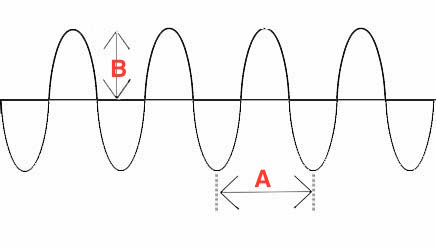
What property of this wave is represented by the letter "A"
amplitude
crest
trough
wavelength
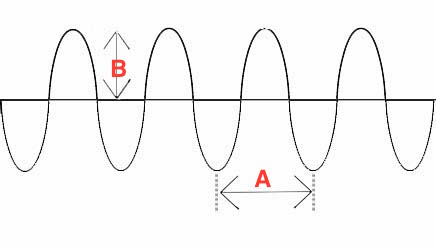

The units of frequency are...
metres
seconds
Hertz
degrees
Light is an example of a transverse wave
True
False
Sound is an example of a transverse wave
True
False
Which of the following statements describes the period of a wave?
Number of waves per second
Distance from crest to crest
Distance from resting position to top of the wave
Time taken to produce one wave
One use of radio waves is...
Broadcasting and communications
Heating
Observing internal structure of objects
Sterilising food and medical equipment
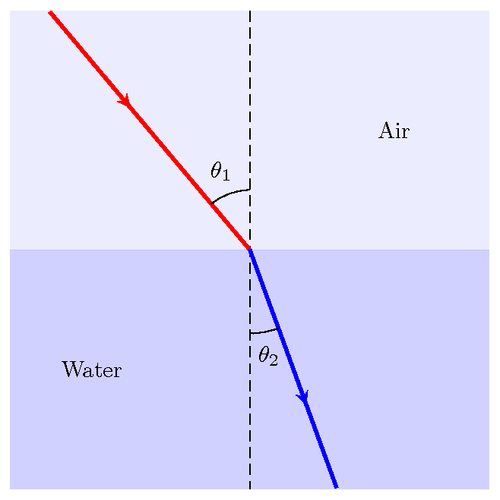
The following image demonstrates...
Reflection
Refraction
Interference
Diffraction
Which type of wave as oscillations that are parallel to the direction of energy transfer?
Transverse
Light
Longitudinal
S-Wave
A material has a high optical density. What will this do to the speed of light when it enters?
Speed it up
Slow it down
Stays the same
Electromagnetic waves are made up of oscillating..
particles.
protons.
electric and magnetic fields.
electric fields.
Which type of radio waves is reflected off the ionosphere?
Long-wave
Short-wave
Which type of radio wave can diffract (bend) around curved surfaces such as hills?
Long-wave
Short-wave
How are Electromagnetic waves different from Mechanical waves?
EM waves have very short wavelengths
EM waves transmit energy instead of matter
EM waves can travel through the vacuum of space (without particles)
EM waves can change direction by reflection

Which is true about the speed of radio waves compared to light waves? They are...
less energy & frequency, but still the SAME speed as the speed of light (300,000,000 m/s)
less energy & frequency, so LESS than the speed of light (300,000,000 m/s)
smaller wavelength, so LESS than the speed of light (300,000,000 m/s)
more energy & frequency, so MORE than the speed of light (300,000,000 m/s)
To calculate the frequency of an electromagnetic wave, you need to know the speed of the wave and its
wavelength.
intensity.
refraction.
amplitude.
A radio wave has a frequency of 12.0 x 10⁶ Hz. Find its wavelength. (the speed of radtio waves in air is 3.0 x 10⁸ m/s).
(a)

What happens to particles as they heat up?
Kinetic energy decreases
Energy stays the same
They don't move
Kinetic energy increases
Which state of matter has molecules that vibrate the least?
solid
water
gas

Who is this?
Black Panther
Iron man
Thanos
Thor

How many days does a moon cycle last?
22
24
28
32

Marie Curie was the first woman to win the Nobel Prize for her work in radioactivity but what elements did she discover?
Radium & Polonium
Radion & Argon
Manganese & Polodium
Radon & Radium
Which reactor of the Chernobyl Power Plant caused the Chernobyl disaster?
1
2
3
4
How is alpha radiation used non-medically?
In smoke alarms
In thickness gauges
In medical tracers
In detecting leaks in pipes
How is beta radiation used medically?
In smoke alarms
In thickness gauges
In medical tracers
In detecting leaks in pipes
How is gamma radiation used?
Smoke alarms
Medical tracers
Sterilising equipment
Communication

What does c represent?
Mass
Specific heat
Temperature
What does m represent?
Mass
Specific heat
Temperature
the symbol for specific latent heat is
c
L
Q
m
What is the formula to calculate specific latent heat of vaporisation?
L = Q/m
c = Q/(mΔƟ)
Q = mcΔƟ
Q = mL

What are particles X, Y and Z?
X: electron, Y: proton, Z: neutron
X: proton, Y: electron, Z: neutron
X: proton, Y: neutron, Z: electron
X: electron, Y: neutron, Z: proton

Which of the following accurately describe isotopes?
Isotopes are elements that are beside each other in the periodic table.
Isotopes are atoms that has the same number of protons but different number of electrons.
Isotopes have similar physical properties but different chemical properties.
Isotopes are atoms that has the same number of protons but different number of neutrons.
Who won the Best Pop Vocal Album at the Grammys this year (2019)?
Kelly Clarkson
Taylor Swift
Shawn Mendes
Ariana Grande
What are the four houses at Hogwarts?
Ravenclaw, Slytherin, Hufflepuff & Gryffindor
Ravenclaw, Slytherin, Muggle & Gryffindor
Ravenclaw, Slytherin, Death Eaters & Gryffindor
Ravenclaw, Slytherin, Nargles & Gryffindor
What is special about a snake's vision?
They can see in colour
They have no pupils
They can see infrared
They are blind
An electric motor transfers 24 J of energy usefully, but wastes 16 J of energy in doing so. What is the efficiency of the motor?
16 J ÷ 24 J = 0.67
24 J ÷ 16 J = 1.5
16 J ÷ 40 J = 0.4
24 J ÷ 40 J = 0.6
If the speed of an object is increasing, its (a) energy store is increasing.
As an object falls it gains kinetic energy as its _______________ ___________ energy store decreases.
(a)
Which of the following is not a use of ultrasound?
Cleaning machinery
Sterilising medical apparatus
Scanning in hospitals
Range-finding
The three types of fossil fuel are natural gas, coal and ...
methane
oil
uranium
wood
Nuclear power is...
renewable
non-renewable
One disadvantage of geothermal energy is that ________________________________.
a plant cannot be built ANYWHERE
it doesn't cost a lot of money to build
it can provide power 24 hours a day
it doesn't harm ecosystems where it's built

What is the half life of this radioactive element
100s
40s
50s
10s

The correct notation to complete this nuclear equation for beta decay is


I am a fast moving electron stopped by aluminium - what am I?
alpha
beta
gamma
I am a high frequency electromagnetic wave stopped by thick lead - what am I?
alpha
beta
gamma
I am two neutrons and two protons, and stopped by paper - what am I?
alpha
beta
gamma

What is this symbol?
Thermistor
Resistor
LED
Diode
The law of conservation of energy states that …
energy is always constant
energy cannot be transferred or created, only destroyed
energy cannot be created or destroyed, only transferred
energy cannot be transferred, only created and destroyed
Select the non-magnetic element
Iron
Cobalt
Nickel
Copper
Which rule applies the direction of a magnetic field created from an electrical current flowing through a wire?
Right hand rule
Left hand rule
Neither
Which of these factors can increase the strength of an electromagnet?
Number of coils of wire
Strength of electrical current flowing through wire
Having an iron core
Potential difference
All of the above
What is magnetic flux density measured in?
Teslas
Amps
Musks
Pascals
What are the units of power?
Joules
Newtons
Amps
Watts
Kilowatt-hours
Which of these is not a force?
Kinetic
Thrust
Tension
Drag
Friction
Which of these are measured in Joules? Tick all that apply (two answers).
Kinetic energy
Weight
Thrust
Power
Work done

Describe the motion in the graph:
Constant Speed (positive slope)
Stopped (at rest)
Acceleration (increasing speed)
Return Home (negative slope)

Describe the motion in the graph:
Constant Speed (positive slope)
Stopped (at rest)
Acceleration (increasing speed)
Return Home (negative slope)

Select the description of motion from A - B.
Slowing down away from the origin
Speeding up away from the origin
Constant velocity away from the origin
Constant velocity towards the origin

Use the picture above to choose the most accurate description of the object's motion
object is at rest
object is slowing down
object is moving at a constant speed
object is speeding up

At what time does the object switch directions?
15 minutes
40 minutes
10 minutes
30 minutes


What happens when the ball goes from the highest position to the lowest position
PE and KE increases and decreases together
Impossible to know without knowing the mass of the object
the PE decreases while KE increases
The thermal energy of a substance is called the........
Maternal energy
External energy
Paternal energy
Internal energy

What is the melting point of iron?
0 oC
1500 oC
2800 oC
3300 oC

At what point do the particles have the most kinetic energy?
A
C
D
F

What state is iron in between C and D?
solid
liquid
gas
plasma

During which two sections of the graph does the temperature stay constant? (You must choose two answers)
A to B
B to C
C to D
D to E
E to F

Between which two points is iron a solid?
A to B
B to C
C to D
D to E
E to F
Example of a transverse wave?
Electromagnetic wave
Sound
P-Waves
Example of a longitudinal wave?
P-waves
S-waves
Radio waves
Ultraviolet light
In a transverse wave, oscillations are ____ to direction of energy transfer
Parallel
Perpendicular
What device would you use for viewing oscillations in waves?
Oscilloscope
Stroboscope
Frequency generator
Wave detector
Which type of electromagnetic wave has the second highest frequency?
X-Ray
Gamma Rays
Ultra Violet
Micro waves
Look at the following equation E = m c Δθ What does the c stand for?
Mass
change in temperature
Latent heat
specific heat capacity
Look at the equation: E=mL What does the L stand for?
Latent Heat
Mass
Energy
Specific Heat Capacity
A gas is kept at a constant volume, but it is heated up. What happens to the pressure of the gas?
Pressure increases because particles hit the sides of the container more frequently (they have more KE)
Pressure increases because particles hit the sides each other more frequently (they have more KE)
Pressure decreases because particles have more room to move so don't hit the sides of the containers as often.
Pressure decreases because particles have more room to move so don't hit each other as often.
What is the unit for pressure?
Pa
J
kg/m3
N

Which letter(s) represents the wavelength of the wave?
a
b
c
d
e

What is the amplitude of this wave?
0.20 m
0.40 m
2.0 s
4.0 s
What is the time period of this wave?
0.20 m
0.40 m
2.0 s
4.0 s


Which of the following do all regions of the electromagnetic spectrum have in common?
Travel at the speed of light (3.0 x 10 8 m/s)
Cannot travel in a vacuum
Can be reflected, refracted and polarised
Need a medium to travel in

