
 Worksheets
Nuclear General Review
Total questions: 88
Worksheet time: 2hrs 57mins
What are the two types of forces inside the nucleus that cause an atom to be radioactive?
Strong Nuclear Force
Protonic Force
Repulsive Electrical Force
Neutron Attraction Force
What subatomic particle interactions give you the Strong Nuclear Force?
Protons touching Protons
Electrons touching Protons
Neutrons touching Neutrons
Protons touching Neutrons
Electrons touching Electrons
This subatomic is the only one that affects the Repulsive Electrical Force
(a)
Of the following examples of radiation, which ones WILL cause ionization?
Alpha
Gamma
Ultraviolet
Released Neutron from Fission or Fusion
Infrared
Of the following examples of radiation, which ones WILL cause ionization?
Beta
Radiowaves
Microwaves
X-Rays
Yes or No
The Gamma Radiation released from DECAY already existed within the atom?
Yes
No
Yes or No
The Gamma Radiation released by FISSION already existed in the atom.
Yes
No
This type of background radiation includes:
- radiation from the Sun/stars
- radiation from blackholes
- radiation from pulsars
- radiation from exploding stars
(a)
True or False
In order for an atom to be radioactive, the Strong Nuclear Force and Repulsive Electrical Force must be equal.
True
False

Yes or No
After the Uranium-235 atom splits from fission, are the two new elements useful for additional fission?
Yes
No
This is the name given to the process of fission spreading to additional atoms.
(a)
This is the amount of material needed to sustain a chain reaction.
(a)
The process in which radiation randomly strips away electrons from atoms.
(a)
This type of radiation is equal to a released Helium atom
(a)
This type of radiation is an electron that forms within the nucleus and is released.
(a)
Which isotope is useful for Fission in a nuclear power plant?
Uranium-238
Uranium-200
Plutonium-280
Uranium-235
The process of mining Uranium out of the Earth and concentrating the rare yet useful Uranium isotope into fuel pellets.
(a)
Which Uranium enrichment is ncecessary to create the fuel used in a nuclear submarine?
Low-Enrichment
High-Enrichment
Where does the energy come from after after an atom splits from Fission?
A large amount of matter changes into a large amount of energy.
A small amount of matter changes into a larger amount of energy.
A small amount of matter changes into a small amount of energy.
A large amount of matter changes into a small amount of energy.
How does a nuclear power plant create usable electricity?
Radiation from fission heats water which turns turbines that turn a generator that makes usable electricity.
Radiation from fission is plugged into charging batteries.
Radiation from fission travels through wires to houses and businesses.
Radiation from fission heats up turbines that turn a generator that makes usable electricity.
What are the problems with nuclear power plants? Mark all that apply
The power plants create radioactive steam that is released into the environment.
The power plants create nuclear waste that does not have a permanent storage solution.
The power plants create smoke and other air pollutants.
The power plants have the possibility of having an accident that would affect a large area.
Which radiation can be blocked by a thin piece of paper your skin?
alpha
beta
gamma
Which radiation can make it through a sheet of paper but can be blocked by a sheet of metal?
alpha
beta
gamma
Which radiation can only be blocked by lead or thick concrete?
alpha
beta
gamma
These devices are used to separate the fuel rods in a nuclear assembly in order to increase or decrease the rate of fission in the nuclear reactor.
(a)
Why is Radon so dangerous? Choose all that apply
Radon is a radioactive metal that can be absorbed through the skin.
When inhaled, Radon changes into Uranium which is radioactive
When inhaled, Radon changes into Polonium which then changes into Lead.
When inhaled, Radon releases dangerous alpha particles.
What type of energy is stored in the nucleus of an atom?
Nuclear energy
Chemical potential energy
Elastic potential energy
Gravitational potential energy
Has no electric charge
protons
neutrons
electrons
Which of the following is a benefit of using nuclear energy over fossil fuels?
Lower initial setup costs
No greenhouse gas emissions during operation
Less radioactive waste produced
Easier to find fuel sources
Which of the following particles is commonly involved in CAUSING nuclear fission reactions?
Protons
Electrons
Neutrons
Positrons
Which is not a method of radioactive decay?
Alpha decay
Beta decay
Gamma decay
Sigma decay
How is nuclear waste typically managed?
Released into the atmosphere
Stored at the site where it is produced
Immediately recycled into new fuel
Dumped into the ocean
Parent Bromine-85 goes through alpha decay. What is the daughter atom produced?
Bromine-81
Arsenic-85
Arsenic-81
Krypton-85
Potassium-52 undergoes beta decay. What is the daughter atom created?
Calcium-52
Calcium-48
Chlorine-52
Chlorine-53
Europium-170 undergoes gamma decay. What is the daughter atom created?
Europium-166
Europium-171
Europium-170
Europium-169
Radium-235 undergoes alpha decay. What is the daughter atom created?
Rutherfordium-231
Radium-231
Radon-231
Actinium-235
A daughter Americium-247 atom is created from alpha decay. What was the parent atom?
Curium-247
Berkelium-243
Berkelium-251
Plutonium-251
A daughter Terbium-170 atom is created from beta decay. What was the parent atom?
Dysprosium-1771
Gadolinium-170
Holmium-174
Holmium-170
A daughter Osmium-195 atom is created from alpha decay. What was the parent atom?
Tungsten-191
Platinum-199
Iridium-194
Osmium-195
A daughter Iodine-138 is created from beta decay. What was the parent atom?
Iodine-134
Iodine-138
Cesium-142
Tellurium-138

What is likely to happen to unstable nuclei with too many, or too few, neutrons?
They will decay by emitting radiation.
They will loose all their electrons.
They will bond with other atoms.
What is the change in the atomic number when an atom undergoes alpha decay?
Increases by 1
Decreases by 1
No change
Decreases by 2
What is the change in the atomic number when an atom undergoes beta-minus decay?
Increases by 1
Decreases by 1
No change
Decreases by 2
The Radioactive decay is completely
Spontaneous
Programed
Controlled
Beta radiation is ____________________
an electron from an electron shell.
an electron from the nucleus.
two protons and two neutrons.
a high frequency electromagnetic wave.
What is an isotope?
An atom with the same number of neutrons and electrons, but a different number of protons.
An atom with the same number of protons and electrons, but a different number of neutrons.
An atom with the same number of neutrons and protons, but a different number of electrons.
Which of the following is not a type of radioactive decay?
Alpha decay
Beta decay
Gamma decay
Delta decay


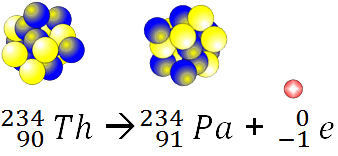

Which symbol(s) represent gamma radiation?
yellow
blue
red
614C = ___ + -10e
radioactivity is
The energy that is released from the nucleus of the atom
the energy that is released from the outer shell of the atom
The energy that released from the electrons in the energy levels.
85209At = ___ + 24He
which type of decay is also referred to as a helium nuclei?
alpha
beta
gamma

If the nucleus has too few neutrons, it will emit two protons and two neutrons called ___________.
an alpha particle
a beta particle
a neutron
gamma radiation
What is the product of the alpha decay of Thorium-232 ( 90232Th )?
88228Ra
91232Pa
89228Ac
92232U
What is the phenomenon of splitting a nucleus into two or more smaller nuclei called?
Fusion
Fission
Radioactivity
_____ is the energy due to the splitting of atoms.
Has no electric charge
protons
neutrons
electrons
Which of the following is a benefit of using nuclear energy over fossil fuels?
Lower initial setup costs
No greenhouse gas emissions during operation
Less radioactive waste produced
Easier to find fuel sources
In a nuclear reactor, what is the purpose of the control rods?
To generate electricity
To absorb neutrons and control the reaction rate
To cool down the reactor core
To initiate the nuclear reaction
What is considered nuclear waste?
Any material that emits alpha particles
Only spent nuclear fuel rods
Any by-products from nuclear reactions that are radioactive and not useful
Excess water used in cooling the reactor
Which of the following is a common isotope used in nuclear reactors?
Uranium-235
Carbon-12
Hydrogen-1
Oxygen-16
Which of the following is not a use of nuclear energy?
Generating electricity
Propelling ships
Fueling vehicles
Medical imaging
What is the main environmental concern associated with nuclear power plants?
Air pollution
Noise pollution
Thermal pollution
Radioactive waste disposal
What is a chain reaction in the context of nuclear fission?
A series of chemical reactions that produce a stable element.
A reaction where the product of one reaction initiates further reactions.
A process where atoms are linked together to form a long chain.
A reaction that can only occur in a linear sequence.
What is the main reason for the difficulty in disposing of nuclear waste?
It is invisible and hard to detect.
It requires special containers that are expensive to produce.
It remains dangerously radioactive for long periods.
It can spontaneously combust if not handled properly.

In a correctly written symbol what would be located in the "Z" position?
number of neutrons
atomic number
number of electrons
mass number
Positively charged; in the nucleus
protons
neutrons
electrons
What type of energy is stored in the nucleus of an atom?
Nuclear energy
Chemical potential energy
Elastic potential energy
Gravitational potential energy
What is the primary advantage of nuclear energy?
It produces high amounts of carbon dioxide.
It requires large amounts of water for cooling.
It generates a large amount of energy from a small amount of fuel.
It is cheaper than solar energy.
In a nuclear reactor, what is the purpose of the control rods?
To generate electricity
To absorb neutrons and control the reaction rate
To cool down the reactor core
To initiate the nuclear reaction
A 50 gram chunk of radioactive material goes through 2 half lives of decay. How many grams of the parent material are left over?
50 grams
25 grams
12.5 grams
6.25 grams
A 200 gram chunk of radioactive Iondine-195 cools out of a lava. After 3 half lives, how much of the original chunk is now the daughter Xenon-195?
200 grams
175 grams
150 grams
25 grams
What is needed in order to have fission?
An electron must hit an unstable Uranium atom.
A proton must hit an unstable Uranium atom.
An electron must hit an unstable Uranium atom
Temperatures must reach 10 to 15 million degrees Celsius.
What is likely to happen to unstable nuclei with too many, or too few, neutrons?
They will decay by emitting radiation.
They will loose all their electrons.
They will bond with other atoms.

In a star, mark all the stages that involve FUSION.
Nebula
Protostar
Main Sequence Star
Supernova
Elements up to what atomic number can be formed in Giants/Supergiants?
Helium (Element #2)
Uranium (Element #92)
Iron (Element #26)
Oganesson (Element #118)
When an Giant star "dies", what is the likely end result?
Neutron Star
Pulsar
Black Hole
White Dwarf
What element is being fused together in a Main Sequence star and where is it happening?
Helium + Helium to form elements up to Iron. Happens in the nucleus
Helium + Helium to form elements up to Iron. Happens outside the nucleus.
Hyderogen + Hydrogen to form Helium. Happens inside the nucleus.
Hydrogen + Hydrogen to form Helium. Happens outside the nucleus.
This is the name for the process that marks the end of a Supergiant and can create elements up to and including Uranium.
planetary nebula
white dwarf
neutron star
supernova
What two things do you need in order to have fusion?
High Temperatures
Large Volume
Large Mass
High Pressure

