
 Worksheets
ESS Standards
Total questions: 86
Worksheet time: 11hrs 10mins
Salinity refers to the amount of ___________________ dissolved in a given amount of liquid.
oxygen
salt
Thermal energy
Density
Which 2 answers are true statements?
As salinity levels increase density increases
As density increases water will rise
As temperature decreases water will rise
As temperature increases density decreases
Which answer below does NOT describe a cause of surface ocean currents?
Continental deflection is when a current meets land and changes direction
Global winds cause currents to flow in different directions
Density causes cold water to rise to the surface in the ocean
Coriolis effect causes the ocean currents to curve due to Earth’s rotation
Which answer choice correctly describes global heat convection?
Cold air rises from the equator towards the poles, because warm air rises and cold air sinks
Warm air rises from the equator towards the poles, because warm air rises and cold air sinks
Cold air rises from the equator towards the poles, because cold air rises and warm air sinks
Warm air rises from the equator towards the poles, because cold air rises and warm air sinks

Which best describes the movement of the Gulf Stream?
cold currents carry cold water from the polar zones toward the equator.
Warm currents carry warm water from the tropics toward the poles.
Warm currents carry cold water from the tropics toward the poles.
Cold currents carry warm water from the polar zones toward the equator.
Due the rotation of the earth, currents flow in circular motion instead of straight paths. This is due to the …
Continental deflection
Coriolis Effect
Global wind
Deep ocean current
Which of the following images best illustrates continental deflection?


This is why ocean currents are not in straight lines.
Coriolis Effect
greenhouse effect
continental deflection
Salinity
What affects deep ocean currents (multiple response-3 answers)
salinity level
density
winds
Temperature differences

Which argument supports the evidence from Step 3 of the investigation?
Freshwater is rising because it has a higher albedo.
Freshwater is rising because it is colder.
Saltwater is sinking because its volume is increasing.
Saltwater is sinking because it is more dense.

Based on the investigation, which effect does the salt concentration of seawater have on ocean currents?
Ocean currents are the strongest when the salt concentration difference between freshwater and saltwater is greatest.
Ocean currents are the strongest when the salt concentration of seawater is lowest.
Ocean currents are the strongest when freshwater meets another body of freshwater.
Ocean currents are the strongest when the difference in albedo of saltwater and freshwater is greatest.
Which answer below gives correct information about heat transfer? (multiple select – 2 answers)
Conduction is touching a hot pan
Radiation is the ground burning your feet
Convection is feel a breeze in the evening
Conduction is a hot air balloon rising in the air

Which answer explains the picture to the left?
cold air sinks because it is less dense
warm air sinks because it is less dense
cold air sinks because there are less molecules tightly packed together
warm air rises because there are less molecules tightly packed together

Which statement is true regarding the following image? (2 answers)
The liquid in container A is more dense than the liquid in container B.
The liquid in container A is less dense than the liquid in container B.
The liquid in container B is warmer than container A.
The liquid in container A is warmer than container B.

Which heat transfer is A?
conduction
convection
radiation

Which heat transfer is B?
conduction
convection
radiation

Which heat transfer is C?
Conduction
Convection
Radiation
Which is the best example of an object having kinetic energy?
a car parked on a steep hill
a tennis ball rolling across the court
a picture hanging on the wall
a piece of coal before it's burned

When a pendulum swings, at which point is gravitational potential energy at its highest?
1
2
3
4

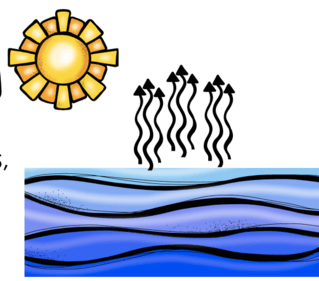
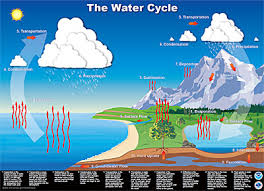
Which stage does water try to return to the ocean or soak into the ground but sometimes can't ?
condensation
evaporation
precipitation
run off
What is the result of sulfur dioxide and nitrogen oxides from fossil fuels being burned then emitted into the atmosphere combining with water droplets?
Erosion
Acid rain
Ocean acidification
Global Warming
The water cycle is the earth's way of
Getting rid of water
Recycling water
Using up all of our water
None of the above
Most of the earth's fresh water is beyond our reach because it is
Buried deep within the earth.
frozen into glaciers and polar caps.
Taking up most of the ocean
In the sky in the form of clouds

How could pesticides get into lakes and streams?
too much pesticide could be sprayed and it runs off
it could be sprayed too close to a stream
rain could wash pesticides into a lake
all of the above
Which practice could humans do to save or manage water usage?
restrict irrigation (watering lawns & crops)
redirect the flow of a river
drain the wetlands
build a hydroelectric dam
What are the three main factors that determine the climate of an area?
precipitation, wind speed, and humidity
temperature, latitude, and air pressure
wind speed, latitude, and humidity
latitude, temperature and precipitation
What are the 3 major climate zones in order from equator to the poles?
polar, temperate, tropical
tropical, temperate, polar
temperate, polar, tropical
What landform causes the rain shadow effect?
mountains
lakes
plains
valley
Which side of the mountain usually gets deserts and why?
windward, because of rising, moist air
leeward, because of rising, dry air
windward, because of sinking, moist air
leeward, because of sinking, dry air
Which side of a mountain range is closer to the ocean?
leeward side
rain shadow side
windward side
downwind side

Why would places near the north with the same latitude have very different climates?
One place is near a warm ocean current.
It is not possible
Because of La Nina
Because of El Nino

After the rain falls down onto Earth's natural surfaces, what most likely happens next?
There is infiltration or runoff of the rain water.
Groundwater starts to evaporate
Transpiration happens to the plants.
The liquid turns into an gas or an water vapor
97% of the Earth's water is accumulated and located in....
ground wat
the ocean
lakes, rivers, and streams
glaciers
What is a layer of rock or sediment that pools and stores water underground?
glacier
well
aquifer
natural spring
Where in a tropical climate are you most likely to find cooler weather and snow?
at the top of a tall mountain
at sea level near a cold ocean current
in cloudy places near the center of the continent
at the base of a mountain range that blocks air flow
Tara is studying the water cycle. She knows that in order for evaporation to happen, there needs to be a source of energy that generates heat. What is the main source of energy that powers the water cycle?
sun
oceans
clouds
water vapor
Why do cities that are inland have a wide range of temperatures compared to a city by the ocean?
water heats up and cools down faster than land
water heats up and cools down slower than land
water heats up faster but cools down slower than land
water heats up slower but cools down faster than land

Why is the surface of the earth unevenly heated?
When the sun’s energy is transferred to the earth’s surface, it hits the area around the north and south poles most directly, while hitting the area around the equator at an angle.
When the sun’s energy is transferred to the earth’s surface, it hits the area around the equator most directly, while hitting the areas around the north and south poles at an angle.
The earth’s surface is evenly heated.
None of the above
All weather occurs in which layer of the Earth’s atmosphere…
(Choose troposphere- We will learn this later ;)
Exosphere
Thermosphere
Stratosphere
Troposphere
Which answer choice correctly describes the movement of air on Earth?
Warm air rises from the equator and moves toward the poles because it is less dense.
Warm air rises from the equator and moves toward the poles because it is more dense.
Warm air rises from the north and south poles, then sinks toward the equator because it is less dense.
Warm air rises from the north and south poles, then sinks toward the equator because it is more dense.
Which answer choice correctly describes a convection cell? ( 2 answers)
Warm air rises, then cools and sinks.
Cool air rises, then warms up and sinks.
Warm air rises because its molecules are spread out (less dense).
Warm air rises because its molecules are packed tightly together (more dense).

Which answer choice correctly describes convection cells?
There are 2 major convection cells, one in the northern hemisphere and one in the southern hemisphere.
There are 4 major convection cells due to the Coriolis effect.
There are 5 major convection cells due to the Coriolis effect.
There are 6 major convection cells, three above the equator, and three below the equator.
How do convection cells function?
Warm air rises from the earth’s surface, cools in the atmosphere, and then sinks back to the earth’s surface.
Cool air rises from the earth’s surface, warms up in the atmosphere, and then sinks back to the earth’s surface.
Convection cells only occur above the equator
Convection cells only occur below the equator.

Students are demonstrating the movement of wind. In Step 1, they blow up a balloon, trying to make it as round as possible. In Step 2, they draw a line around the middle of the balloon to represent the equator. In step 3, one student spins the balloon. While the balloon spins, another student draws a line from the middle of the balloon to the top.
In which two ways can this model represent the Coriolis effect? ( 2 answers)
Warm air rising causes cooler air to sink to the surface.
Rotation of Earth causes the wind to appear to curve.
Wind at the equator is denser than wind at the poles.
Cool air flows faster than warmer air as it moves across Earth.
The amount the wind appears to curve depends on the speed of Earth’s rotation.
Salinity refers to the amount of ___________________ dissolved in a given amount of liquid.
Oxygen
Thermal energy
salt
Nitrogen

The Western Australian Current brings cool water to the western coast of Australia. It flows in a curved path instead of a straight north to south movement. This is an example of...
Coriolis Effect
Global Winds
Continental deflection
Change in salinity

The Western Australian Current delivers cool water from the Indian Ocean. The speed of current is greater in summer months compared to winter months. What can you infer about the climate of Western Australia due to the Western Australian Current?
It will cause the climate in Western Australia to be warmer.
The current will cause the climate in Western Australia to be cooler.
The current will have no impact on the climate of Western Australia.
It will cause cold winters and warm summers.
Two objects at different temperatures are in contact. Which of the following happens to their thermal energy?
Their thermal energies remain the same.
Thermal energy passes from the cooler object to the warmer object
Thermal energy passes from the warmer object to the cooler object.
Thermal energy passes back and forth equally between the two objects.
___________________ is the type of heat transfer that occurs in fluids, such as warm air rising and cold air sinking; creating wind.
convection
conduction
radiation
insulation
The type of heat transfer that happens through direct contact of molecules or particles with each other is ___________________.
convection
conduction
radiation
insulation

A group of friends gather around a fire to stay warm. This is an example of…
conduction
convection
radiation
insulation

The way the heat is moving from the hot coffee is called...
convection
radiation
insulation
conduction
Hot coffee is stirred with a spoon; the spoon gets hot due to…
conduction
convection
radiation
insulation

As the sun’s energy is transferred to Earth’s surface, it travels through waves. Which method of heat transfer is used?
conduction
convection
radiation
insulation
As air molecules come in contact with the earth’s surface, thermal energy is transferred from the earth’s surface to the air molecules. This is heat transfer through…
conduction
convection
radiation
insulation
The air molecules, warmed by earth’s surface, rise because they are ____________________. After the air molecules cool, they sink. This is an example of _____________________.
more dense, conduction
less dense, convection
less dense, radiation
more dense, insulation
Which heat transfer is caused by uneven heating of the Earth?
conduction
convection
radiation
insulation

Which type of potential energy does the person in the swing possess?
Electric
Elastic
Chemical
Gravitational
Which type of potential energy is unused gasoline?
Electrical
Elastic
Chemical
Gravitational

What potential energy is this graph representing?
Electrical
Elastic
Chemical
Gravitational

How would you describe the relationship between the mass of a car and its kinetic energy?
As the mass of a car increases, its kinetic energy increases.
As the mass of a car increases, its kinetic energy decreases.
As the mass of a car decreases, its kinetic energy increases.
There is no clear relationship between mass and kinetic energy

What weather event is illustrated in this image?
Hurricane
Tornado
Thunderstorm
Flood
What two words describe the temperature and humidity of a maritime polar air mass?
Wet and Warm
Wet and Cold
Dry and Warm
Dry and Cold
Which two locations are you most likely to experience a marine climate?
Western North America
Western Europe
Africa
Eastern South America
What is the name for large pellets of ice that form inside of cumulonimbus clouds during thunderstorms?
Rain
Snow
Hail
Sleet
What are the two most important things that people should do to reduce the danger of storms to themselves?
Stay Weather Aware
Seek Appropriate Shelter
Have emergency supplies easily available.
Know the phone number and/or address of a neighbor, relative, or close friend.
What general direction does weather in the United States travel?
South to North
East to West
West to East
North to South
What two words describe the temperature and humidity of a continental tropical air mass?
Wet and Warm
Wet and Cold
Dry and Warm
Dry and Cold

What weather front is illustrated in this image?
Warm Front
Cold Front
Occluded Front
Stationary Front
Isobars differ from isotherms. Which of the following is NOT true about isobars?
Isobars are lines joining places on the map that have the same air pressure.
Isobars are lines joining places on the map that have the same temperature.
Isobars that are close together indicate windy conditions.
Isobars are referenced to the number 1013.


Stormy Weather
Stormy Weather
The fact that it's less dense than cold air.
The fact that it weighs more than cold air.
The fact that it has higher pressure than cold air.
The fact that it's more dense than cold air.
What type of air mass is over land at the equator?
Maritime Tropical
Maritime Polar
Continental Tropical
Continental Polar
What type of air mass is over the Artic Ocean?
Maritime Tropical
Maritime Polar
Continental Tropical
Continental Polar

