
 Worksheets
Electromagnetism Review HP
Total questions: 61
Worksheet time: 2hrs 8mins
When is an object magnetic?
when it only has a north pole
when it only has a south pole
when it is free to rotate
when it attracts iron
Chris rubs an iron nail in one direction with the south pole of a magnet. Which of the following is TRUE of the magnetized nail?
it will only be attracted to the north pole of a magnet
it has a strong north pole and a much weaker south pole
its domains have become rearranged so that they are lined up in one direction
the bar magnet has caused a random arrangement of the nail's domains
Magnetism comes from
static charged particles
neutrons
generators
electron motion
Where are the strongest magnetic effects on magnets?
in the middle of the magnet
at both poles of the magnet
at only the magnet's north pole
at only the magnet's south pole
What do you end up with if you cut a magnet in half?
one north-pole piece
two unmagnetized poles
two pieces, each with a north pole and a south pole
two north pole pieces
As electrons move in a current, they make
a broken circuit
a magnetic field
a gravitational force
a bar magnet
A coil of wire that has an iron core and that acts as a magnet when an electric current is in the coil is called a(n)
magnetic pole
electromagnet
permanent magnet
horseshoe magnet
Which of the following actions will decrease the strength of the magnetic field of an electromagnet?
adding fewer loops of wire per meter in the coil
decreasing the current in the wire
removing the wire
all of the above
Which of the following solenoids has the strongest magnetic fields?
a solenoid without an iron core and 2 amps of current
a solenoid with an iron core and 2 amps of current
a solenoid with an iron core and 4 amps of current
a solenoid without an iron core and 4 amps of current
Which of the following statements describing magnets is the most correct?
All magnets have two poles, either both south or both north.
Magnets only have one pole. It is either a south pole or a north pole.
All magnets have two poles, one north pole and one south pole.
Magnets can have any number of poles as long as the number is odd.
A magnetic field will always travel away from the ________ and into the _______ pole.
north, north
south, south
north, south
south, north
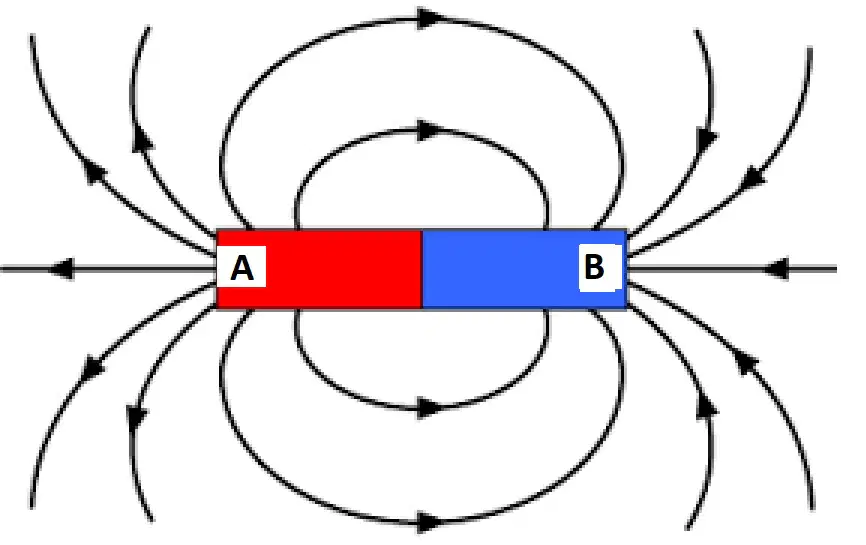
Based on the image of the magnetic field shown, which magnetic poles most likly represent spot A and spot B.
Spot A is a North pole and Spot B is a South pole.
Spot A and Spot B are both North poles.
Spot A and Spot B are both South poles,
Spot A is a South pole and Spot B is a North pole.

Based on the magnetic field created by the two magnets shown in the image, what are the magnetic poles most likely at spot A and spot B?
Spot A is a North pole and Spot B is a South pole.
Spot A is a South pole and Spot B is a North pole.
Spot A and Spot B are both South Poles.
Spot A and Spot B are both North Poles.
Why does the Earth's inner core a strong magnetic field?
There is solid iron in the Earth's inner core.
There is molten (liquid) iron spinning in Earth's inner core.
There is a core of iron running east and west along the equator.
There metals such as aluminum and copper in the earth core spinning around.

Which of the following would decrease the strength of an electromagnet?
Increasing the loop or coils of electric wire.
Increasing the electric current by using a stronger battery,
Adding more iron into the middle of the loops of wires.
Using a wire with a greater resistance.
Electromagnetic induction occurs when a ______________ is moved in a ____________ direction through a coils of wire.
iron nail, parallel
iron nail, perpendicular
magnet, parallel
magnet, perpendicular
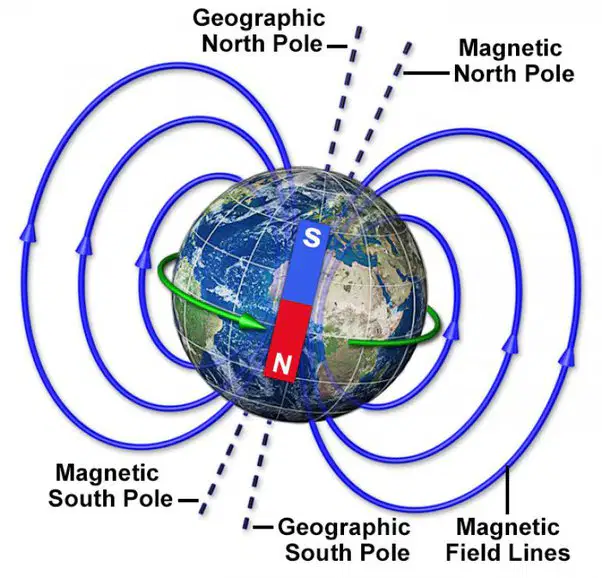
The Earth's magnetic
South pole is located near Earth's geographic ____________ pole.
North
South
East
West
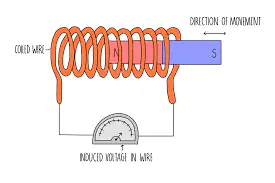
Electromagnetic induction is the creation of _______________ using ________________.
magnetism, electric current
electric current, the motion of a magnet
magnetism, the motion of a magnet
electric current, a difference in voltage.

When electric current runs through a circular loop of wire, where is the magnetic field the strongest?
Outside of the loop of wire.
In the center of the loop of wire.
Around the edge of the wire.
The magnetic field is the same all around the wire.
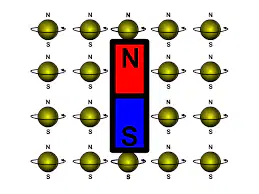
What part of the atom creates magnetic areas, called domains, within certain materials?
Stationary electrons inside the atom.
Spinning electrons inside the atom.
Spinning protons inside the atom.
Stationary protons inside the atom.

What two properties does a material need to make it magnetic?
Areas of domains all aligned in the same direction.
Extra electrons that are all spinning in the same direction.
Areas of domain all pointed in different directions.
Extra electrons spinning in opposite directions.
A student breaks a bar magnet in half. What is created after the student breaks the bar magnet in half?
Two magnets with only north poles.
Two magnets with only south poles.
Two magnets with both north and south poles.
The pieces that are no longer magnetic.
Which of the following would give the most amount of electric current (electricity) through the process of electromagnetic induction?
Placing a magnet inside a coil of wires.
Placing a magnet next to a wire.
Moving a magnet in a parallel direction along the coils of wire.
Moving a magnet in a perpendicular direction across the coils of a wire.
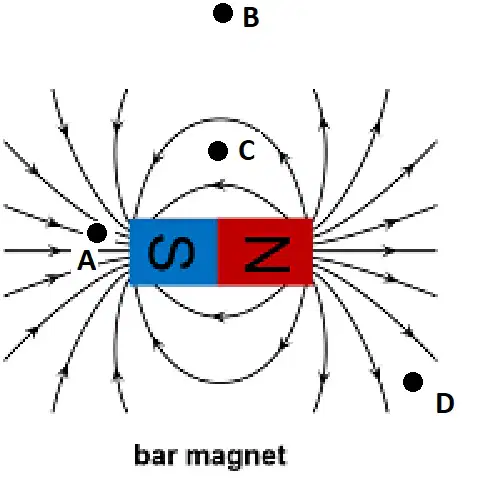
Based on the image of the magnetic field created, which location would a magentic object experience the greatest magnetic force?
A
B
C
D

How does a motor work?
Current generates an electric field around the loop of wire. The electric force causes the loop of wire to rotate.
Current generates a magnetic field in the loop of wire that is then attracted and repelled by the magnet(s) in the motor.
The magnets in the motor attract and repel the metal in the copper wire that makes up the loop. This causes the loop to rotate.

How can you increase the magnetic field strength in an electromagnet?
Increase the number of coils.
increase the voltage
increase the current by reducing the resistance of the coil
all of the above
How can you decrease the magnetic field strength in an electromagnet?
Increase the number of coils.
increase the voltage
decrease the current by increasing the resistance of the coil
all of the above

What did Faraday discover about Induction?
That a changing magnetic field induces a current in a conductor.
That electricity and magnetism were related when he noticed a current carrying conductor deflected the compass of a needle.
That the Earth's magnetosphere deflected charged particles from the sun known as solar winds.
That alternating current could be manipulated with transformers.

What did Oersted discover about Induction?
That a changing magnetic field induces a current in a conductor.
That electricity and magnetism were related when he noticed a current carrying conductor deflected the compass of a needle.
That the Earth's magnetosphere deflected charged particles from the sun known as solar winds.
That alternating current could be manipulated with transformers.

Which one represents the magnetic field lines of magnets repelling?
A
B
Which one represents the magnetic field lines of magnets attracting?
A
B

When running a current through a wire, what do the blue lines represent?
The wire spinning
A magnetic field that was created
Electrons leaving
Electricity


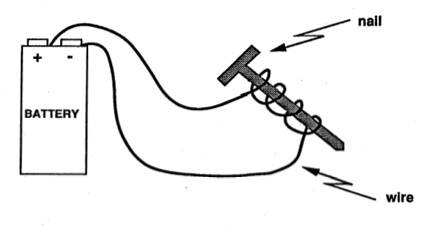
To make this electromagnet stronger you could:
use less wire
have fewer wire coils around the nail
have more wire coils around the nail
use a plastic core

These magnetic domains are:
strongly magnetized
slightly magnetized
unmagnetized

Every magnet has a:
East and West pole
North and South pole
East and South pole
North and West pole
Chicago and Saint pole

Why does the compass needle move at different locations?
Because the needle is attracted to the magnetic field produced by the magnet
Because north is up
Because it is being attracted to the Magnetic North Pole
Because north is down

The area around a magnet is called the .....
attraction zone
work area
magnetic field
hot zone
Probably the most useful thing about electromagnets is that they can be turned ________ and ________.
on, off
positive, negative
north, south
on, negative

How can a wire become magnetic?
point it north
add a resistor
heat it up
run a current through it
Can you produce current in a wire with a magnet that is sitting still?
Yes; having a magnet near a wire is enough to excite the electrons
No; the magnetic field has to be changing to excite the electrons
No; magnets cannot create electricity


What conclusion can you draw from this graph?
As current increases, magnetic strength decreases.
As current increases, magnetic strength increases.
As current decreases, magnetic strength increases.
There is no relationship between current and magnetic strength.
Electromagnetic Induction (pHet simulation) is...
the use of the movement of magnets around a coil of wire to create an electrical current through the wire
the use of the movement of electricity around a coil of wire to create an electrical current through the wire

Which of these is a way to make an electromagnet stronger? (a)
Label the parts of the electromagnet.

