
Font size
S
M
L
XL
 Worksheets
3pr 2nd Sci U2L1:The Physical Properties of the Electric Current
Total questions: 120
Worksheet time: 2hrs 0mins
Name
Class
Date
1.
Electrons are …........ charged particles.
a)
positively
b)
neutral
c)
negatively
d)
variable
2.
The flow of electric charges through a metal wire represents …...........
a)
resistance.
b)
electric current intensity.
c)
electric current.
d)
potential difference.
3.
The ….............. is the measuring unit of the electric charges.
a)
coulomb
b)
ampere
c)
volt
d)
ohm
4.
The measuring unit of the electric current intensity is …...........
a)
ampere.
b)
volt.
c)
ohm.
d)
coulomb.
5.
The ampere = …...........
a)
joule/coulomb
b)
coulomb/sec.
c)
joule/sec.
d)
sec./coulomb
6.
If a quantity of electricity 30 coulomb passes in a time 10 second through a conductor so the current intensity equals …..... ampere.
a)
300
b)
3
c)
40
d)
30
7.
The quantity of electricity flow in a conductor on passing electric current of intensit (2 ampere) through a cross-section of a conductor within a time (20 minute) equal …..... coulomb.
a)
10
b)
20
c)
4
d)
2400
8.
The …....... is known as the quantity of electric charges flowing through a cross-sectio of the conductor in one second.
a)
ampere
b)
coulomb
c)
electric resistance
d)
current intensity
9.
The charges which transmitted by a current of one ampere in one second, is known as …..........
a)
coulomb.
b)
volt.
c)
ampere.
d)
ohm.
10.
The ammeter is used to measure the ….......... in the electric circuit.
a)
potential difference
b)
current intensity
c)
resistance
d)
e.m.f
11.
The measuring unit of the amount of electricity is the coulomb. It doesn’t equal with ….....
a)
amp. x sec.
b)
joule/volt
c)
joule x volt
d)
amp. x sec. and joule/volt
12.
All of the following are used to measure the electric current intensity, except …..........
a)
ampere.
b)
coulomb/second.
c)
(joulxohm)/coulomb
d)
joul/(ohmxcoulomb)
13.
For measuring the potential difference by direct method the …........ apparatus is used.
a)
ammeter
b)
voltmeter
c)
ohmmeter
d)
voltammeter
14.
To transfer electric charge of 10 coulomb between two points the potential difference between them is 20 volts, …..... joules are needed.
a)
0.5
b)
2
c)
20
d)
200
15.
If the work done to transfer an electric charge of 300 coulomb between two points is 33000 joule, the potential difference between these two points will be volt
a)
105
b)
110
c)
220
d)
120
16.
The unit that is used in measuring work is
a)
ampere.
b)
joule.
c)
coulomb.
d)
ohm.
17.
The …........ is used to measure the e.m.f of a battery.
a)
voltmeter
b)
ammeter
c)
rheostat
d)
ohmmeter
18.
The measuring unit of e.m.f is …............
a)
coulomb.
b)
ampere.
c)
ohm.
d)
volt.
19.
Which of the following figures represents the right connection of the ammeter and voltmeter in a circuit ?
a)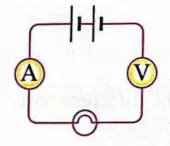
b)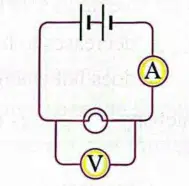
c)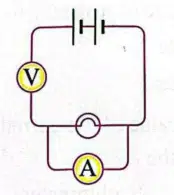
d)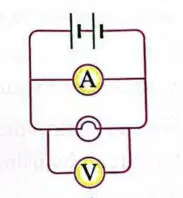
20.
Which one of the following figures represents a part of an electric circuit that contains an ammeter and voltmeter connected in right way ?
a)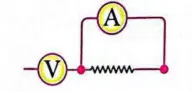
b)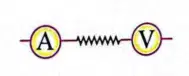
c)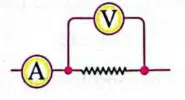
d)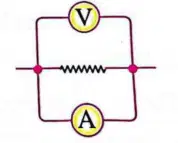
21.
The value of the work done to transfer a quantity of electric charges of one coulomb between the two poles of this conductor is the
a)
ohm.
b)
potential difference.
c)
current intensity.
d)
electric resistance.
22.
The joule equals
a)
volt/coulomb.
b)
volt x coulomb.
c)
coulomb/sec.
d)
volt/sec.
23.
The physical quantity which its measuring unit equivalent (joule/volt.second) is
a)
current intensity.
b)
potential difference.
c)
work done.
d)
quantity of electricity.
24.
When 1.5 V is written on an electric cell, this means that its …... equals 1.5 volt.
a)
electric intensity
b)
e.m.f
c)
stored energy
d)
resistance
25.
If the quantity of charge which passes in an electric wire is doubled and the time of its passing decreases to its half, the current intensity will …..
a)
increase four times.
b)
decrease to quarter.
c)
doubled.
d)
does not change.
26.
If an electric current of 0.2 ampere flows through an electric heater and the potential difference between its two ends is 220 volt, whose resistance is equal to …... ohm.
a)
1100
b)
11
c)
110
d)
11000
27.
In an electric resistance of 20 ohms, if the current intensity passing through it is doubled, its value becomes …... ohms.
a)
10
b)
20
c)
30
d)
40
28.
An electric current, whose intensity is one ampere passes through a resistance of 20 ohm, then the intensity of the electric current increases to 2 ampere in the same resistance, so the value of resistance ….
a)
increases to double.
b)
decreases to half.
c)
decreases to quarter.
d)
does not change.
29.
We can control the value of the current intensity that passes in the different parts of the circuit by using the …...
a)
ammeter.
b)
ohmmeter.
c)
rheostat.
d)
voltmeter.
30.
We can control the value of the electric resistance by using …......
a)
ammeter.
b)
ohmmeter.
c)
rheostat.
d)
voltmeter.
31.
The unit that is used in measuring the electric resistance is …...
a)
ohm.
b)
ampere.
c)
volt.
d)
coulomb.
32.
The ….......... is used to measure the electric resistance.
a)
ammeter
b)
voltmeter
c)
ohmmeter
d)
rheostat
33.
The ratio between the potential difference across two ends of a conductor and the electric current intensity passing through it, is equal to …....
a)
electromotive force.
b)
work done.
c)
quantity of electricity.
d)
electric resistance.
34.
The resistance of the conductor which carries a current of 1 ampere when the potential difference between its two ends is 1 volt equals …...
a)
1 ampere.
b)
1 volt.
c)
1 ohm.
d)
1 coulomb.
35.
In the electric circuit, the sliding rheostat is used to ….......
a)
measure the electric current intensity.
b)
measure the potential difference.
c)
change the resistance value.
d)
open and close the circuit.
36.
The apparatus used to control the value of electric resistance in the circuit is the …........
a)
ohmmeter.
b)
ammeter.
c)
rheostat.
d)
voltmeter.
37.
The symbol that indicates the variable resistance is …........
a)
b)
c)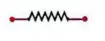
38.
In rheostat, slider is moved on ….... Bar
a)
aluminium
b)
copper
c)
carbon
d)
iron
39.
Insulated material used in manufacture of electric devices is …..........
a)
titanium.
b)
aluminium.
c)
tin.
d)
porcelain.
40.
According to Ohm’s law at constant temperature, if the potential difference between terminals of a conductor is doubled so the resistance of this conductor is …....
a)
doubled.
b)
remain constant.
c)
decreases to half.
d)
increases 4 time.
41.
The value of the resistance of an electric conductor in an electric circuit is changed on changing …...
a)
dimensions of the conductor.
b)
electric current intensity passing through it.
c)
quantity of electric charges pass through it.
d)
time of connection.
42.
As the length of the wire of rheostat increases, the current intensity …...........
a)
increases and no change in the resistances.
b)
decreases as the resistance increased.
c)
doesn’t change and the resistance increases.
d)
increases as the resistance decreased.
43.
We can control the illumination of bulb (X) in circuit ….......
a)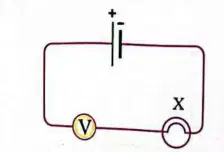
b)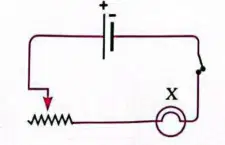
c)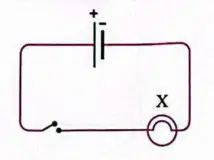
d)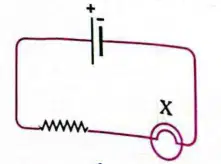
44.
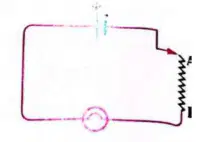
In the electric circuit in front of you, when the slider of the rheostat moves from point (A) to point (B), the intensity of light in the electric lamp ….........
a)
increases.
b)
decreases.
c)
doesn’t change.
d)
becomes zero.
45.
During the connection of an electric circuit to verify Ohm’s law, the teacher advised his students to connect a rheostat to the circuit to ….............
a)
measure the current intensity.
b)
measure the potential difference.
c)
control the current intensity.
d)
switch on and off the electric circuit.
46.
Electric current intensity = …...........
a)
q x t
b)
q / t
c)
V x R
d)
R / V
47.
…............ is the mathematical relation of Ohm’s law.
a)
R = V / I
b)
I = RV
c)
R = V x I
d)
V = R/I
48.
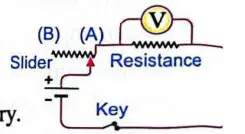
In the opposite figure, if the slider of the rheostat moves from (A) to (B) then the voltmeter reading …........
a)
increases.
b)
decreases.
c)
no change.
d)
equal to the value of e.m.f of the battery.
49.
The ratio between the potential difference between the two ends of a conductor and the electric current intensity passing through it, is equal to the …...........
a)
e.m.f
b)
electric current.
c)
quantity of electricity.
d)
electric resistance.
50.
One volt equals ….......
a)
ampere x ohm.
b)
joule/coulomb.
c)
coulomb/sec.
d)
ampere x ohm. & joule/coulomb.
51.
Figure …...... shows the relation between current intensity passing through a conductor and its resistance when the temperature is constant.
a)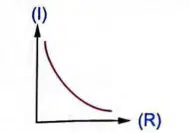
b)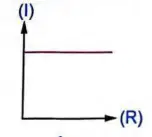
c)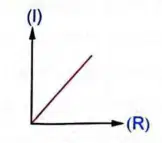
d)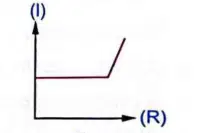
52.
The diagram ….... verifies Ohm's law.
a)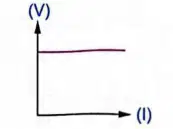
b)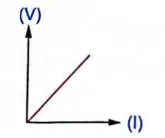
c)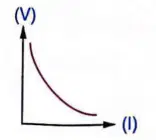
d)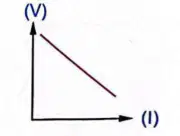
53.
Which electric circuit is used to verify Ohm’s law ?
a)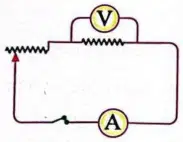
b)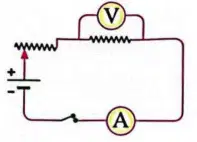
c)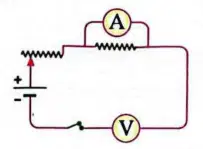
d)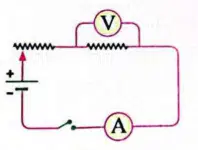
54.
When a current of 3 ampere passes through a closed electric circuit containing a resistance of 2 ohm, the reading of the voltmeter connected in parallel to the resistance is …... volt.
a)
1.5
b)
6
c)
2/3
d)
1/6
55.
…...... is the charge transferred by a constant current of one ampere in one second.
a)
The ampere
b)
Coulomb
c)
Ohm
d)
Volt
56.
Joule = ….......... x Volt.
a)
Ampere
b)
Coulomb
c)
Ohm
d)
Volt
57.
The unit of measuring the electric charges is …........
a)
joule.
b)
coulomb.
c)
ohm
d)
volt
58.
The unit of measuring the electromotive force (e.m.f) is the …......
a)
ampere.
b)
volt.
c)
coulomb.
d)
ohm
59.
Volt is the potential difference across the terminals of a conductor when the work done to transfer a quantity of charge of one coulomb between the two points is one …......
a)
second.
b)
joule.
c)
coulomb.
d)
ohm
60.
If the work done to transfer an electric charge of 300 coulombs between two points is 33300 joules, the potential difference between the two points is …...... volts.
a)
222
b)
111
c)
333
d)
444
61.
The voltmeter is connected in …..... in the electric circuits.
a)
series
b)
parallel
c)
zero
d)
directly
62.
The …........ measures the potential difference between the two ends of a conductor.
a)
ammeter
b)
voltmeter
c)
ohmmeter
d)
rheostat.
63.
The …........... is used to measure the electric resistance.
a)
voltmeter
b)
ohmmeter
c)
ammeter
d)
rheostat.
64.
The …........ is used in changing the resistance.
a)
ammeter
b)
sliding rheostat
c)
voltmeter
d)
ohmmeter
65.
The ammeter is connected …....... in an electric circuit.
a)
parallel
b)
series
c)
zero
d)
directly
66.
The e.m.f of an electric source is the between its two poles when the circuit is open.
a)
electric potential
b)
electric potential difference
c)
electric resistance
d)
current intensity
67.
…...... equals (joule / ampere.second).
a)
Ohm
b)
Volt
c)
Ampere
d)
Coulomb
68.
The electric current intensity passing through a conductor is directly proportional to the ….......... between its ends at a constant temperature.
a)
resistance
b)
potential difference
c)
The electric current.
d)
The electric resistance
69.
…........ is the ratio between the potential difference across the conductor to the current intensity flowing through it.
a)
The e.m.f
b)
The electric resistance
c)
resistance
d)
potential difference
70.
Electromotive force can be defined as the potential difference between the two poles of the battery when …..........
a)
current intensity of one ampere passes in the circuit.
b)
no current passes in the circuit (the circuit is open)
c)
The electric resistance
d)
directly
71.
…............ is the state of an electric conductor that shows the transfer of the electricity to and from it when it is connected to another conductor.
a)
The electric current intensity
b)
Electric potential
c)
electric potential difference
d)
electric resistance
72.
The resistance of a conductor that 1 ampere is passed through it when the potential difference between its terminals is 1 volt equals ….......
a)
10 ohm.
b)
1 ohm.
c)
20 ohm.
d)
5 ohm.
73.
If the fixed resistance is spoiled in the circuit used to prove Ohm’s law, the ammeter reading is ….........
a)
infinite
b)
zero
c)
10
d)
20
74.
The mathematical relation of Ohm’s law is …..........
a)
R = I x V
b)
R=V/I
c)
I = V x R
75.
If the potential difference between the two ends of a conductor is 3 volt, and an electric current intensity of one ampere passes in it, the resistance of the conductor is …...........
a)
one ohm.
b)
3 Ohm
c)
10 ohm.
d)
1 ohm.
76.
If the length of the wire increase, the resistance increases and the current intensity ….......
a)
increases.
b)
decreases.
c)
same
77.
Positively charged particles found in the nucleus of an atom.
a)
Protons.
b)
Electrons.
c)
The coulomb.
d)
The ampere.
78.
Negatively charged particles that rotate around the nucleus.
a)
Electrons.
b)
Protons.
c)
The coulomb.
d)
The ampere.
79.
The flow of electric negative charges in a conducting material (metal wire).
a)
The electric current.
b)
Electric potential
c)
electric potential difference
d)
electric resistance
80.
The quantity of charge which transferred by a current intensity of one ampere in one second.
a)
The coulomb.
b)
The ampere.
c)
The volt.
d)
The ohm.
81.
The electric current intensity passing through a circuit when a charge of one coulom passes through a given cross-section in one second.
a)
The ampere.
b)
The coulomb.
c)
The volt.
d)
The ohm.
82.
The current intensity produced by flowing one coulomb of electric charges in one second through a conductor.
a)
The ampere.
b)
The coulomb.
c)
The volt.
d)
The ohm.
83.
The quantity (amount) of electric charges that flow through a conductor in a time of one second.
a)
The electric current intensity.
b)
potential difference.
c)
work done.
d)
quantity of electricity.
84.
The quantity of electricity (electric charges) in coulomb flowing through a cross-section of a conductor in one second.
a)
The electric current intensity.
b)
potential difference.
c)
work done.
d)
quantity of electricity.
85.
A device used to measure the electric current intensity passing in a conductor.
a)
Ammeter.
b)
ohmmeter.
c)
rheostat.
d)
voltmeter.
86.
A device used to control the electric current intensity passing in the electric circuit.
a)
Sliding rheostat.
b)
Ammeter.
c)
Ohmmeter.
d)
Voltmeter.
87.
A device used to raise or reduce voltage of the home electric equipment,
a)
Electric transformer.
b)
The electric current.
c)
Electric potential
d)
electric resistance
88.
The electric state of a conductor that shows the transference of electricity from or to it, when it is connected to another conductor.
a)
The electric potential of a conductor.
b)
electric resistance
c)
Electric transformer.
d)
The electric current.
89.
The value of the work done to transfer a quantity of charge (one coulomb) between two ends of this conductor.
a)
The potential difference across two terminals of a conductor.
b)
electric resistance
c)
Electric transformer.
d)
The electric current.
90.
The potential difference between two terminals of a conductor on doing a work of one joule to transfer a quantity of charge of one coulomb.
a)
The volt.
b)
The ampere.
c)
The coulomb.
d)
The ohm
91.
The potential difference between two poles of an electric source when the electric circuit is open.
a)
The electromotive force.
b)
electric resistance
c)
Electric transformer.
d)
The electric current.
92.
The measuring unit of the electromotive force of the electric cell.
a)
The volt.
b)
The ampere.
c)
The coulomb.
d)
The ohm
93.
A physical quantity which is measured by (volt x coulomb).
a)
The Joule.
b)
The ampere.
c)
The coulomb.
d)
The ohm
94.
The device that is used to measure the electromotive force of an electric cell.
a)
Voltmeter.
b)
Ammeter.
c)
Ohmmeter.
d)
Rheostat.
95.
Used in some electric circuits to control current intensity as the resistance is directly proportional with the length of the wire.
a)
Rheostat.
b)
Ammeter.
c)
Ohmmeter.
d)
Voltmeter.
96.
The obstruction (opposition) that the electric current faces during its flow in the conductor.
a)
The electric resistance.
b)
The electromotive force.
c)
Electric transformer.
d)
The electric current.
97.
The resistance of a conductor that allows the passing of an electric current of 1 ampere through it when the potential difference across its ends is 1 volt.
a)
The ohm.
b)
The ampere.
c)
The coulomb.
d)
The volt.
98.
The resistance that you can change its value in order to adjust the value of the current intensity and the potential difference in the different parts of the circuit.
a)
The variable resistance (Sliding rheostat).
b)
Voltmeter.
c)
Ammeter.
d)
Ohmmeter.
99.
A device used to measure the electric resistance.
a)
Ohmmeter.
b)
Rheostat.
c)
Ammeter.
d)
Voltmeter.
100.
The electric current intensity is directly proportional to the potential difference between two terminals of a conductor at a constant temperature.
a)
Ohm's law.
b)
The volt's law
c)
The ampere's law
d)
The coulomb's law
101.
The ratio between the potential difference across the two ends of a conductor and the electric current intensity passing through it.
a)
The resistance of a conductor.
b)
The potential difference
c)
the electromotive force.
102.
The ratio between the work done and the quantity of electric charge which passing between two points.
a)
The potential difference
b)
The resistance of a conductor.
c)
the electromotive force.
103.
The potential difference across the terminals of a conductor when its resistance is one ohm and the current intensity flowing through it is one ampere.
a)
The volt.
b)
The ohm.
c)
The ampere.
d)
The coulomb.
104.
The current intensity passing through a conductor when its resistance is one ohm and the potential difference across its terminals is one volt.
a)
The ampere.
b)
The volt.
c)
The ohm.
d)
The coulomb.
105.
The electric current is the flow of …........ through conducting material.
a)
electric negative charges (electrons)
b)
Protons.
c)
The coulomb.
d)
The ampere.
106.
The measuring unit of the quantity of electricity (charge) is ….......
a)
coulomb.
b)
joule.
c)
ohm
d)
volt
107.
The current flows through the circuit only when the circuit is ….......
a)
closed.
b)
opened.
c)
remain the same
108.
The current intensity due to the flow of 2700 coulomb in 300 second through a cross-section of a conductor equals …...
a)
9 ampere
b)
10 ampere
c)
3 ampere
d)
1 ampere
109.
Electric current doesn’t flow between two conductors, their electric potential are …....
a)
equal
b)
more than
c)
less than
110.
The instrument which is used to measure the electric potential difference is …........
a)
The Voltmeter.
b)
The Ohmmeter.
c)
The Rheostat.
d)
The Ammeter.
111.
The ….... apparatus is used to measure the electormotive force.
a)
Voltmeter
b)
Ohmmeter.
c)
Rheostat.
d)
Ammeter.
112.
When no current passes through a circuit, then the reading of the voltmeter connected to a battery indicates …...........
a)
the electromotive force.
b)
The potential difference
c)
The resistance of a conductor.
113.
The resistance that faces the flow of electric current in a conductor is known as the …........
a)
electric resistance.
b)
The potential difference
c)
the electromotive force.
114.
The …....... apparatus is used to measure the electric resistance in the circuit.
a)
ohmmeter
b)
Rheostat.
c)
Ammeter.
d)
Voltmeter.
115.
The measuring unit of the resistance in the circuit is …..........
a)
ohm
b)
ampere
c)
volt
d)
coulomb
116.
…........ is used to change the electric resistance in an electric circuit.
a)
Sliding rheostat
b)
Voltmeter
c)
Ohmmeter.
d)
Ammeter.
117.
The resistance of a conductor that 1 ampere is passed through it when the potential difference between its terminals is 1 volt = …........
a)
1 ohm.
b)
2 ohm.
c)
4 ohm.
d)
8 ohm.
118.
The ohmeter is used to measure ….......... in the electric circuit.
a)
The resistance
b)
The Voltmeter.
c)
The Ohmmeter.
d)
The Rheostat.
119.
The potential difference between the two terminals of a conductor is …...... proportional to the intensity of the current passing through it at a constant temperature.
a)
directly
b)
zero
c)
less than
d)
more than
120.
When a current of intensity 5 ampere passes through a conductor of resistance 2 ohm, so the potential difference across its terminals equals …...........
a)
10 volt.
b)
20 volt.
c)
1 volt.
d)
5 volt.
Reset

