
 Worksheets
Earth and Rock
Total questions: 108
Worksheet time: 4hrs 53mins


Any rock that forms from another rock as a result of changes in heat or pressure (or both) is a:
chemical rock
igneous rock
sedimentary rock
metamorphic rock
This is the continuous process of rock changing from one type to another.
Igneous rocks
Sedimentary rocks
Metamorphic rocks
Rock Cycle
What type of rock might contain evidence of past life?
Sedimentary Rock
Igneous Rock
Metamorphic Rock
Which of the following lists the steps a rock undergoes in order to become sedimentary rock, in the correct order?
Deposition, erosion, melting, cooling
Erosion, weathering, eruption, cooling
Dissolving, deposition, cooling, fracture
Weathering, erosion, deposition, compaction
Limestone is a sedimentary rock. During the rock cycle, limestone is changed into marble, a metamorphic rock. The processes that act on limestone and change it into marble are
weather and erosion
heat and pressure
compacting and cementing
melting, cooling, and hardening
The process by which igneous rocks are formed
weathering and erosion
melting and cooling
heat and pressure
compaction and cementation

You found a rock that seems to have ribbon-like bands across it, and it is multicolored. What type of rock is this?
Sedimentary
Igneous
Metamorphic

This rock formed when lava cooled very quickly on Earth's Surface. What type of rock is this?
Sedimentary
Extrusive Igneous
Intrusive Igneous
Metamorphic

Using your understanding of the Rock Cycle, what would the label A represent?
Metamorphic
Igneous
Sedimentary
Using your understanding of the Rock Cycle, what would the label B represent?
Metamorphic
Igneous
Sedimentary
Using your understanding of the Rock Cycle, what would the label C?
Metamorphic
Igneous
Sedimentary
The _______________ , which is semi-liquid, can be found beneath the lithosphere. This layer can flow and is thought to play a role in the movement of the lithosphere (plate tectonics).
Asthenosphere
Mesosphere
Outer Core
Inner Core
What is the name of the layer of the Earth that has convection currents?
Core
Crust
Mantle
Lithosphere
What are the 4 main layers of the Earth?
Temperature and pressure ___ as you move towards the center of the Earth.
decrease
increase
neither answer is correct.
Which of the following is the correct order of the Earth's layers moving inward to the center.
Crust
Mantle
Outer Core
Inner Core
Mantle
Outer Core
Inner Core
Crust
Inner Core
Outer Core
Crust
Mantle
Outer Core
Inner Core
Mantle
Crust
What are the two types of crust?

The mantle makes up nearly ___ of Earth's mass.
31
41
21
32
The outer core is (a) not solid.
The crust and upper portion of the mantle are called the
asthenosphere.
lithosphere.
This is the portion of the Earth's mantle where convection occurs.
Asthenosphere
Lithosphere

What layer of the Earth is labeled A?
inner core
outer core
mantle
crust
Which layer is liquid?
crust
mantle
outer core
inner core
Which layer is the HOTTEST?
Crust
Mantle
Outer Core
Inner Core
What state of matter is the inner core?
Solid
Solid but flexible
Liquid
What layer has convection currents?
Crust
Mantle
Inner Core
Outer Core
What layer is liquid and makes a magnetic field?
Outer Core
Mantle
Inner Core
Crust
How many major earth layers are there?
3
4
5
3.5
What layer of the Earth is labeled B?
inner core
outer core
mantle
crust
What layer of the Earth is labeled C?
inner core
outer core
mantle
crust
What layer of the Earth is labeled D?
inner core
outer core
mantle
crust

What layer of the Earth is represented by the letter D?
Crust
Mantle
Outer Core
Inner Core

What layer of the Earth is represented by the letter C?
Crust
Mantle
Outer Core
Inner Core

What layer of the Earth is represented by the letter B?
Crust
Mantle
Outer Core
Inner Core

What layer of the Earth is represented by the letter A?
Crust
Mantle
Outer Core
Inner Core

The rigid rocky layer of the crust and upper mantle is called the:
Asthenosphere
Lithosphere
Core

The soft part of the Mantle below the Lithosphere is called the:
Crust
Lithosphere
Asthenosphere
Core

Which layer of the Earth is a dense solid ball of Iron and Nickle?
Crust
Mantle
Outer Core
Inner Core

What is the thickest layer of the Earth?
Crust
Mantle
Outer Core
Inner Core

What is the thinnest layer of the Earth?
Crust
Mantle
Outer Core
Inner Core
What layer of the Earth is represented by the letter A?
Crust
Mantle
Outer Core
Inner Core
What layer of the Earth is represented by the letter B?
Crust
Mantle
Outer Core
Inner Core
What layer of the Earth is represented by the letter C?
Crust
Mantle
Outer Core
Inner Core
What layer of the Earth is represented by the letter D?
Crust
Mantle
Outer Core
Inner Core
The layers of Earth are in the order they are in because:
It keeps us safe
It holds the Earth together
Its pretty
The different layers have different densities

The most dense layer of the Earth is:
Crust
Mantle
Core
The least dense layer of the Earth is the:
Crust
Mantle
Core
In which layer of the atmosphere is the most water vapor found?
thermosphere
mesosphere
troposphere
stratosphere
Which layer of the atmosphere would jets fly in to avoid a thunderstorm?
troposphere
thermosphere
mesosphere
stratosphere
As you ascend (go up) in the troposphere what happens to the temperature?
It increases steadily
It decreases steadily
How many layers of the atmosphere are there?
3
4
5
6
What is the outermost layer of the atmosphere that contains almost no air molecules?
troposphere
mesosphere
exosphere
thermosphere
What is the hottest layer of the atmosphere due to the absorption of the sun's rays?
Mesosphere
exosphere
thermosphere
stratosphere
What is found in the troposphere?
meteoroids
space station
weather
satellites
Which of the following can be found in the exosphere?
meteoroids
treetops
weather
satellites
Which layer burns up meteoroids?
mesosphere
thermosphere
stratosphere
exosphere
Which layer is closest to the earth? All weather occurs here.
troposphere
mesosphere
thermosphere
stratosphere
The ionosphere is located at the bottom of which layer of the atmosphere?
thermosphere
mesosphere
exosphere
troposphere
What is the important gas in the atmosphere that absorbs the ultraviolet radiation from the sun?
oxygen
ozone
nitrogen
carbon dioxide
Which layer has the aurora borealis (The Northern and Southern Lights)
troposphere
stratosphere
mesosphere
thermosphere
Put the layers of the atmosphere in order. (1 being closest to the earth)
troposphere
stratosphere
mesosphere
thermosphere
exosphere




What is another name or synonym for the water cycle?
Geologic cycle
Hydrologic cycle
Geosphere
Carbon cycle
The major source of energy and the driving energy source of the water cycle. __________________
moon
ocaen
Sun
atmosphere
The draining away of water from the surface of an area of land.
weathering
transpiration
run-off
precipitation
As a part of the water cycle, water from Earth's surface enters the clouds and finally falls back to the ground in the form of rain. What is the correct sequence of processes water undergoes?
Evaporation, Condensation, Precipitation
Precipitation, Condensation, Evaporation
Condensation, Evaporation, Precipitation
Evaporation, Precipitation, Condensation

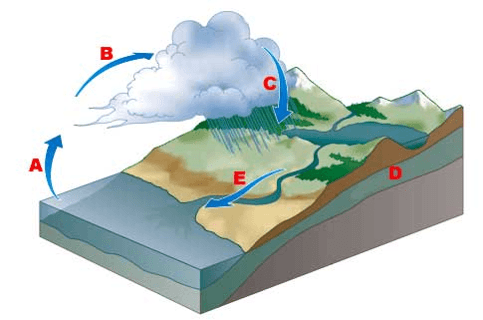
The image shows various stages in the water cycle. During which stage does water flow back towards the sea as runoff?
W
X
Y
Z

What is it called when WATER is FORMED from an LIQUID to a WATER VAPOR or an [GAS]?
EVAPORATION
PRECIPITATION
TRANSPIRATION


What is the process of matter changing from a solid to a liquid?
Crystallization
Evaporation
Melting
Condensation

What is the process of matter changing from a gas to a liquid?
Crystallization
Evaporation
Melting
Condensation

What is the process of matter changing from a liquid to a gas?
Crystallization
Evaporation
Melting
Condensation

What is the process of water falling out of the atmosphere?
Groundwater flow
Precipitation
Water collection
Cloud formation

What is the process of water flowing under the Earth's surface?
Groundwater flow
Precipitation
Water collection
Cloud formation

What is the process by which plants release water vapor into the atmosphere?
Precipitation
Condensation
Transpiration
Evaporation

________ is water vapor condensing around dust particles into liquid water in the atmosphere.
Groundwater flow
Precipitation
Water collection
Cloud formation

Which of the following is driven by energy from the sun?
Precipitation
Evaporation
Groundwater flow
Water collection

Which of the following is driven by gravity?
Precipitation
Evaporation
Condensation
Crystallization

Which of Earth's reservoirs holds the most water?
Atmosphere
Living organisms
Oceans
Glaciers

Water is changing from a gas to a solid.

