wayground logo

Free Printable Worksheets

Font size

S
M
L
XL
Worksheets

Chemistry Exam

Total questions: 90

Worksheet time: 2hrs 43mins

Name
Class
Date
1.

Matter is anything that.....

a)

Has mass and takes up space

b)

Has mass and is visible

c)

Takes up space and has energy

d)

Has energy and is visible

2.

What particle view below is a mixture?

a)

b)

c)

d)

3.

What is the best classification for this substance?

a)

An element

b)

A compound

c)

A mixture

4.

Is this a pure substance?

a)

Yes

b)

No

5.

What is the best classification of this substance?

a)

An element

b)

A compound

c)

A mixture of 2 elements

d)

A mixture of 2 compounds

6.

What is an example of a physical property?

a)

Silver is shiny

b)

Alcohols are flammable

c)

Alkali metals are reactive with water

d)

Acids are sometimes corrosive

7.

What is an example of a chemical change?

a)

Tearing paper

b)

Dissolving salt in water

c)

Melting ice

d)

Burning wood

8.
When experimenting with the growth of a plant, a scientist uses three (of the same type of) plants, two different fertilizers, equal light, and equal water. What type of variable is the fertilizer?
a)
Dependent
b)
Independent
c)
Control
9.
Which variable is affected by what is being tested?
a)
Dependent
b)
Independent
c)
Control
10.
What does the 6 represent above the C
a)
Symbol 
b)
Name 
c)
Mass Number 
d)
Atomic Number 
11.
How many electrons can be held in the first energy level ?
a)
1
b)
2
c)
8
d)
16
12.
How many electrons can the 2nd energy level hold ?
a)
2
b)
4
c)
8
d)
16
13.
____________ can move from one energy level to another when they gain or lose energy.
a)
electrons
b)
protons
c)
neutrons
d)
atoms
14.
The __________ of an atom is the sum of the protons and neutrons in the nucleus of that atom.
a)
mass number
b)
atomic number 
c)
atomic weuight
d)
isotope weight
15.
Cations are _______ that form ____________ ions and __________ electrons.
a)
nonmetals, positive, lose
b)
nonmetals, negative, gain
c)
metals, positive, gain
d)
metals, positive, lose
16.
Anions are _______ that form ____________ ions and __________ electrons.
a)
nonmetals, positive, lose
b)
nonmetals, negative, gain
c)
metals, positive, gain
d)
metals, positive, lose
17.
If an atom gains 3 electrons, what charge will it have as an ion?
a)
+3
b)
-3
c)
+5
d)
-5
18.
What's a valence electron?
a)
electrons in the second energy level
b)
electrons in the outermost energy level
c)
the atomic number
d)
electrons in the first level
19.
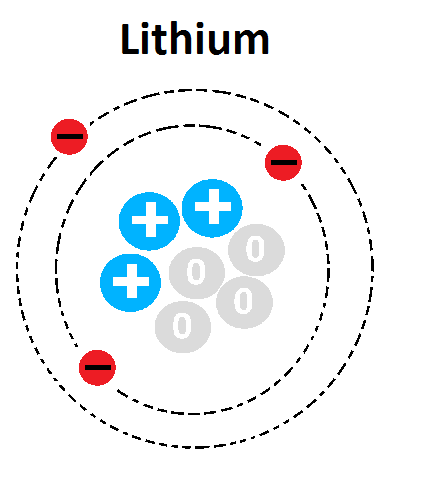
What element is represented in this Bohr Model? 
a)
Carbon
b)
Hydrogen
c)
Aluminum
d)
Lithium
20.
Find the density of a 2 cm x 2 cm x 2 cm cube with a mass of 64 g.
a)
6 cm3
b)
12 g/cm3
c)
128 g/cm3
d)
8  g/cm3
21.
Chemical equations ___.
a)
describe chemical reactions
b)
show how to write chemical formulas
c)
give directions for naming chemical compounds
d)
describe only biological changes
22.
In the chemical equation H2O2 → H2O + O2, H2O is a ___.
a)
catalyst
b)
solid
c)
product
d)
reactant
23.
If you rewrite the following word equation as a balanced chemical equation, what will the coefficient and symbol for nitrogen be?
nitrogen trifluoride → nitrogen + fluorine
a)
2N
b)
2N2
c)
N2
d)
4N
24.
What are the coefficients that will balance the skeleton equation below?
N2 + H2 → NH3
a)
1,1,2
b)
1,3,3
c)
3,1,2
d)
1,3,2
25.
When the equation KClO3 → KCl + O2 is balanced, the coefficient of KClO3 is ___.
a)
1
b)
2
c)
3
d)
4
26.
What are the missing coefficients for the skeleton equation below?
Cr + Fe(NO3)2 → Fe + Cr(NO3)3
a)
4,6,6,2
b)
2,3,2,3
c)
2,3,3,2
d)
1,3,3,1
27.

The product of a synthesis reaction is BaCl2.  If one of the reactants is Ba, what is the other reactant?

a)
Cl
b)
Cl2
c)
BaCl2
d)
Ba
28.
What are the correct formulas and coefficients for the products of the following double-replacement reaction?
RbOH + H3PO4 →
a)
Rb(PO4)3 + H2O
b)
RbPO4 + 2H2O
c)
Rb3PO4 + 3H2O
d)
H3Rb + PO4OH
29.
Which of the following is the correctly balanced equation for the complete combustion of heptene, C7H14?
a)
C7H14 + 14O → 7CO + 7H2O
b)
C7H14 + 7O2 → 7CO + 7H2O
c)
2C7H14 + 21O2 → 14CO2 + 14H2O
d)
C7H14 + O2 → C7O2 + 7H2
30.
The equation Mg + 2HCl → MgCl2 + H2 is an example of which type of reaction?
a)

synthesis reaction

b)
single-replacement reaction
c)
double-replacement reaction
d)
decomposition reaction
31.
The equation 2C3H7OH + 9O2 → 6CO2 + 8H2O is an example of which type of reaction?
a)
combustion reaction
b)
single-replacement reaction
c)
double-replacement reaction
d)
decomposition reaction
32.
What is the balanced chemical equation for the reaction that takes place between bromine and sodium iodide?
a)
Br2 + NaI → NaBr2 + I
b)
Br2 + 2NaI → 2NaBr + I2
c)
Br + NaI2 → NaBrI2
d)
Br + NaI2 → NaBr + I2
33.

The first letter in a properly written chemical symbol is always...

a)
boldfaced
b)
capitalized
c)
underlined
d)
italicized
34.
How many significant figures are in the measurement 0.0034 kg?
a)
two
b)
four
c)
five
d)
three
35.
If an element is a poor conductor of electricity, in which category does it belong?
a)
metals
b)
nonmetals
c)
metalloids
d)
transition elements
36.
Density is found by....
a)
dividing volume by mass
b)
multiplying mass and volume
c)
dividing mass by volume
d)
multiplying mass by moles
37.
The smallest particle of an element that retains that element's properties is...
a)
atom
b)
electron
c)
compound
d)
molecule
38.
In which of the following are correct?
a)
Cs: 55 protons, 133 electrons
b)
Zn: 30 protons, 60 electrons
c)
In: 49 protons, 49 electrons
d)
F: 26 protons, 26 electrons
39.
Which of the following IS NOT a diatomic element?
a)
fluorine
b)
carbon
c)
nitrogen
d)
bromine
40.
When the equation 
Fe + Cl2 --> FeCl3
is balanced, what is the coefficient for Cl2?
a)
1
b)
2
c)
3
d)
4
41.
One mole of ANYTHING is...
a)
12
b)
22.4
c)
6.02 x 1032
d)
6.02 x 10²³
42.
The mass of one mole of a substance is...
a)
molar mass
b)
atomic mass
c)
molecular mass
d)
avogadro mass
43.
In the reaction
2H2 + O2 --> 2H2O
which of the following is a product?
a)
O2
b)
H2
c)
H2O
d)
OH
44.
The opposite phase of melting is 
a)
freezing 
b)
sublimation
c)
condensation 
d)
deposition 
45.
What is a characteristic of matter that can be measured or observed without changing matter into something new?
a)
matter
b)
molecule
c)
physical property
d)
states of matter
46.
Which of the following is a sign that a chemical reaction has occurred?
a)
change in shape
b)
melting
c)
formation of a gas
d)
dissolving
47.
an atom with atomic number 6 would have how many protons 
a)
6
b)
12
c)
3
d)
cannot be determined 
48.
Who atomic model said electrons orbit the atom like planets orbit the sun 
a)
Einstein
b)
Thomson 
c)
Bohr 
d)
Dalton 
49.
Which of the following is a negatively charged subatomic particle?
a)
Electron
b)
Proton
c)
Neutron
d)
Quark
50.
What are the horizontal rows on the periodic table called?
a)
Groups
b)
Periods
c)
Rows
d)
Classifications
51.
elements in the middle of the periodic table, groups 4 through 7 are called the ___________
a)
middle elements
b)
transition elements
c)
nonmetals
52.
How many valence electrons are in the atom "Mg"?
a)
1
b)
5
c)
3
d)

2

53.
Elements that have properties of both metals and nonmetals are _____
a)
metals
b)
metalloids
c)
nonmetals
54.
What kind of bond forms between two nonmetals?
a)
Covalent bond
b)
Ionic bond
c)
Can be either covalent or ionic
d)
Hydrogen bond
55.
What kind of bond forms when one kind of atom gives electrons to another kind of atom?
a)
Chemical bon
b)
Ionic bond
c)
Covalent bond
d)
Electron bond
56.
What type of chemical reaction is this one?
CUO + CO2 --> CuCO3
a)
Decomposition
b)
Combustion
c)
Synthesis
d)
Single Replacement 
57.
What type of chemical reaction is this one?
Ca + MgCl2 --> CaCl2 + Mg
a)
Decomposition
b)
Combustion
c)
Synthesis
d)
Single Replacement 
58.
What coefficients are needed to correctly balance the equation?
_Bi   +   _O2   >   _Bi2O3
a)
3,2,3
b)
2,3,2
c)
4,3,2
d)
none of these
59.
Determine the molar mass for CCl4
a)
158.8 g/mol
b)
47.54 g/mol
c)
189.35 g/mol
d)
82.9 g/mol
60.

How many significant figures are in the following number?

100

(a)  

61.

How many significant figures are in the following number?

0.00034030

(a)  

62.

144 + 12.221 = ?

(a)  

63.

How many significant figures does the following number have?1.2500 x 10310^3  

a)
5
b)
3
c)

Ambiguous: 3 or 5

d)

7

64.
What is 98.907 rounded to 1 significant figure?
a)
98.9
b)
90
c)
100
d)

1.x102

65.
Solve and give your answer with the correct number of significant figures
24.28 + 12.5
a)
3.687 x 101
b)
36.8
c)
37
d)
3.70x101
66.

What is 0.658 rounded to 1 significant figure?

a)

0

b)

0.66

c)

0.7

d)

0.658

67.

What is 7.555 rounded to two significant figures?

a)

7.6

b)

7.5

c)

70

d)

76

e)

7.60

68.
What is the name of this element?
a)
Helium
b)
Hydrogen
c)
Argon
d)
Silver
69.
What is the mass number of this atom?
a)
1
b)
3
c)
4
d)
7
70.
What is the atomic number of this atom?
a)
2
b)
4
c)
6
d)
none of the above
71.
What group does this element belong to?
a)
Group 1: Alkali metals
b)
Group 18: Noble Gases
c)
Group 2: Alkaline-Earth Metals
d)
Group 17: Halogens
72.
How many valence electrons?
a)
2
b)
3
c)
5
d)
10
73.

On the periodic table, Groups are

a)

Horizontal rows

b)

Vertical columns

74.

On the periodic table, Periods are

a)

Horizontal rows

b)

Vertical columns

75.

What is this element?

a)

Beryllium (atomic #4)

b)

Boron (atomic #5)

c)

Carbon (atomic #6)

d)

Nitrogen (atomic #7)

76.

What group does this element belong to?

a)

1

b)

2

c)

17

d)

18

77.
Which of the following is the atomic number of an alkali metal?
a)
31
b)
20
c)
18
d)
19
78.
What group on the Periodic Table contains the elements of the alkaline earth family?
a)
1
b)
2
c)
17
d)
18
79.
Gold (Au)
a)
Transition Metal
b)
Alkali Metal
c)
Alkaline Earth Metal
d)
Heavy Metal
80.
Which element is not in the Alkali metal family?
a)
Li
b)
H
c)
Fr
d)
Cs 
81.
Argon (Ar)
a)
alkali metal
b)
alkaline earth metal
c)
halogen
d)
noble gas
82.
An atom that has the electron configuration of 1s22s22p63s23p64s23d5 is classified as
a)
A transition element
b)
a noble gas
c)
an alkali metal
d)
an alkaline earth metal
83.

Sulfur is a...

a)

metal

b)

nonmetal

c)

metalloid

84.
Which is a metal?
a)
Rhodium (Rh)
b)
Arsenic (As)
c)
Hydrogen
d)
Argon (Ar)
85.

What element has this orbital notation?

a)

lithium

b)

beryllium

c)

boron

d)

carbon

86.

What element has this electron configuration?

a)

boron

b)

carbon

c)

nitrogen

d)

oxygen

87.

Which element is represented by this orbital notation?

a)

carbon

b)

nitrogen

c)

oxygen

d)

fluorine

88.

Which of the following is the electron configuration for Fluorine

a)
b)
c)
d)
89.

Which of the following is the electron configuration for silicon?

a)
b)
c)
d)
90.

Which of the following is the orbital notation for oxygen?

a)
b)
c)
d)