
 Worksheets
15 Regents: Oxidation/Reduction Reactions
Total questions: 55
Worksheet time: 3hrs 30mins



What are the coefficients when the equation is balanced for mass and charge?


H
S
O
2Ca(s) + O2(g) --> 2CaO(s), calcium is __________
which element, if any, is oxidized?
4Fe + 3O2 --> 2Fe2O3
2CaO--> 2Ca + O2
Al (s) + FeSO4 (aq) → Al2(SO4)3 (aq) + Fe (s)
Which statements are true about this reaction?
I. Al (s) reduces Fe2+ (aq)
II. Al (s) is the oxidizing agent.
III. FeSO4 is the oxidizing agent.
I and II only
I and III only
II and III only
I, II and III
Consider the following reaction.
NO3− (aq) + Cu (s) → NO (g) + Cu2+ (aq)
Which statement is correct?
Cu (s) is the reducing agent because it loses electrons.
Cu (s) is the reducing agent because it gains electrons.
Cu (s) is the oxidizing agent because it loses electrons.
Cu (s) is the oxidizing agent because it gains electrons.
The following chemical equation represents the extraction of silicon from quartz using coke.
SiO2 + C → Si + CO2
What is the change in oxidation number of silicon?
+2 to 0
+4 to 0
0 to +2
0 to +4
What is the oxidation number of X in XO4-?
+4
+5
+7
+8
Which equation represents a redox reaction?
NaOH + HNO3 → NaNO3 +H2O
2AgNO3 + Zn → Zn(NO3)2 + 2Ag
2NaCl + Pb(NO3)2 → PbCl2 + 2NaNO3
CaCO3 + 2HCl → CaCl2 + H2O + CO2
Substance that oxidizes another substance by accepting its electrons.
reducing agent
oxidation number
disproportionation
oxidizing agent
What is the oxidation number of C in SrCO3?
-4
+2
-6
+4
Reduction is the ___________ of electrons.
loss
gain
sharing
transfer
What is the oxidation number of chlorine in HClO?
0
-1
+1
+5
2 CaO--> 2 Ca + O2
A decrease in oxidation number.
concentrated
reduction
oxidation
dilute
An increase in oxidation number.
more acidic
reduction
less basic
oxidation
These keep track of the movement of electrons.
(+) and (-) signs
oxidation numbers
coefficients
subscripts
Cl2 + 2e- --> 2Cl - is an example of:
a chemical reaction
redox
oxidation
reduction
Defined as the gain of electrons.
oxidation
redox
reduction
LEO GER
Defined as the loss of electrons.
oxidation
reduction
redox
OIL RIG

Combustion and single-replacement reactions are __________ redox reactions.
always
never
sometimes
mostly

_____________ synthesis and decomposition reactions involve the transfer of electrons.
All
Most
No
Some

An increase in oxidation number.
more acidic
reduction
less basic
oxidation

A decrease in oxidation number.
concentrated
reduction
oxidation
dilute

What is a half-reaction of this equation, Na + Cl --> NaCl ?
Cl + e- --> Cl-
Cl - e- --> Cl-
Na --> Na + e-
Na° + Cl°--> Na+1Cl-1

What is the reducing agent here: N2 + 3H2 --> 2NH3
N2
H2
NH3
2NH3
What does the mnemonic phrase does LEO GER represent?
Let Ewoks Operate and Get Essential Rats
Loss of Electrons is Oxidation and Gain of Electrons is Reduction
Loss of Energy is Onerous and Gain of Energy is Rad
Less Electrons are Only Gain for Eventual Reacting
What does the mnemonic phrase OIL RIG mean?
Ox Is Losing Re Is Galloping
Oxidation Is Lustrous, Reduction is Grating
Oxidation Is Longer, Reduction is Great
Oxidation Is Loss, Reduction Is Gain
What do the mnemonic phrases OIL RIG and LEO GER help with?
Knowing that Lions and Oil are directly connected to atoms and molecules
Knowing that oil is an integral part of redox reactions
Knowing that losing electrons is oxidation and gaining electrons is reduction
Knowing that Oxidation is loss and reduction is gain of electrons
Charge of the anode
Positive
Negative
Charge of the cathode
Positive
Negative
Flow of electrons
From cathode to anode
From anode to cathode
Oxidation occurs at the
anode
cathode
Reduction occurs at the
anode
cathode


What type of electrochemical cell is shown?
oxidation cell
electrolytic cell
reduction cell
voltaic cell

Write the balanced half-reaction for the reduction that occurs in this electrolytic cell.
Cl2 + 2e⁻ → 2Cl⁻
Cl2 → 2Cl⁻ + 2e⁻
2Na⁺ + 2e⁻ → 2Na
2Na⁺ → 2Na + 2e⁻

Which type of cell does the diagram represent?
electrolytic, with the anode at A
electrolytic, with the cathode at A
voltaic, with the anode at A
voltaic, with the cathode at A
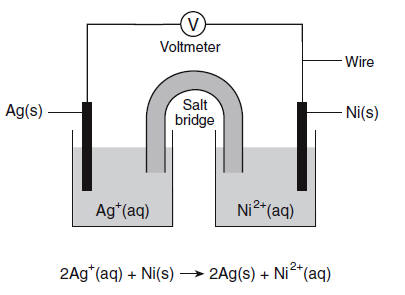

The part of the electrolytic cell at which electrons are produced is the _____.
anode
cathode
external circuit
salt bridge

