wayground logo

Free Printable Worksheets

Font size

S
M
L
XL
Worksheets

Biology review

Total questions: 57

Worksheet time: 37mins

Name
Class
Date
1.

Which kingdome does Bacteria Belong to?

a)

Protista

b)

Animalia

c)

Plantae

d)

Monera

2.
Most protists are unicellular. This means they
a)
are made of one type of cell
b)
are made of one cell
c)
are made of many cells
3.
This domain contains organisms that have a true nucleus in each of their cells. 
a)
Eukarya
b)
Archaea
c)
Bacteria
4.

Arthropods are invertebrates with

a)

a soft body

b)

an exoskeleton

c)

many eyes

d)

bones

5.
These all belong to the phylum _________.
a)
porifera
b)
annelida
c)
arthropoda
d)
cnidaria
6.
A sea star is a member of the group called
a)
amphibians
b)
echinoderms
c)
sponges
7.
Which two groups listed are both endotherms?
a)
fish and birds
b)
birds and mammals
c)
reptiles and mammals
8.
Which is the correct order of The Levels of Taxonomy?
a)
Kingdom, Phylum, Class, Order, Family, Genus, Species
b)
Kingdom, Phylum, Order, Class, Family, Genus, Species
c)
Kingdom, Phylum, Family, Class, Order, Genus, Species
d)
Species, Genus, Family, Class, Order, Phylum, Kingdom
9.
What is one of the most important differences between plants and animals?
a)
Plants do not move but animals can.
b)
Plants consume their food but animals can use the sun to produce their food.
c)
Plants can produce their own food while animals must consume their food.
d)
Plants do not need water but animals do.
10.

How do you define 'biodiversity'?

a)

Biology

b)

Living Organisms

c)

Variety of living organism

d)

Interaction between living and non-living organism

11.
Amoeba and paramecia are eukaryotic, single cellular, heterotrophic, and reproduces asexually. Which kingdom would best these organisms best be classified into?
a)
Plant
b)
Animal
c)
Protist
d)
Fungi
12.
Which of the following organisms would be considered unicellular?
a)
Humans
b)
Dogs
c)
Mushrooms
d)
Amoebas
13.
What is the meaning of Mollusks?
a)
Soft-bodied
b)
filter feeder
c)
porus
d)
stomach foot
14.

___________ make food by photosynthesis and pass it back to the stem.

a)

stems

b)

roots

c)

leaves

d)

buds

15.
Vascular tissue that transports water and minerals UPWARDS from a plant's roots is know as ______.
a)
Chlorophyll
b)
Phloem
c)
Stomata
d)
Xylem
16.
The plant tissue that carries food materials DOWNWARD from the leaves to the rest of the pant is the ______.
a)
Phloem
b)
Stomata
c)
Chlorophyll
d)
Xylem
17.

a clear odorless gas which plants use as a raw material in photosynthesis

a)

Oxygen

b)

Reactants

c)

Chlorophyll

d)

Carbon Dioxide

18.

A chemical reaction during which plants convert energy from the Sun to chemical energy; the reaction converts carbon dioxide and water to sugar and oxygen

a)

products

b)

Carbon Dioxide

c)

Photosynthesis

d)

Chemical Reaction

19.

This is a...

a)

moss

b)

liverwort

c)

hornwort

d)

club moss

e)

horsetail

20.

Select all plant groups that are nonvascular.

a)

mosses

b)

horsetails

c)

hornworts

d)

club mosses

e)

liverworts

21.

The father of modern taxonomy was ____________.

a)

organisms

b)

Carolus Linnaeus

c)

Kingdom

d)

Taxonomy

e)

species

22.
The science of genes, heredity, and variation.
a)
Genetics
b)
Paleontology
c)
Anatomy
d)
Ecology
23.

What is the study of the structure of living things

a)

Anatomy

b)

Embryology

c)

Zoology

d)

Physiology

24.

Physiology is the study of:

a)

Cells

b)

Internal structure of the body

c)

Functioning of the body

d)

External structure of the body

25.

Organisms in this smallest taxonomic group share many characteristics.

a)

domain

b)

kingdom

c)

species

d)

class

26.
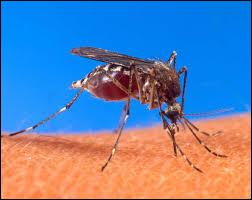
Mosquito  belongs to what kingdom?
a)
Animal Kingdom
b)
Plant Kingdom
c)
Fungi Kingdom
d)
Protista Kingdom
27.

Which of the following shows the correct sequence for the scientific method inquiry?

a)

Conclusion, Experimentation, Hypothesis, Observation

b)

Observation, Experimentation, Hypothesis, Conclusion

c)

Observation, Hypothesis, Experimentation, Conclusion

d)

Experimentation, Conclusion, Observation, Hypothesis

28.

Is Chloroplast found in animal cell?

a)

No

b)

Yes

29.
This type of cell needs a cell wall and chloroplasts
a)
Plant cell
b)
Animal Cell
c)
Bacteria
30.
Robert Hooke, Anton van Leeuwenhoek, Theodor Schwann, Rudolf Virchow, and Matthias Schliden were all responsible for what theory?
a)
The Theory of Gravity
b)
The Theory of Relativity
c)
The Cell Theory
d)
The Theory of Continental Drift
31.
Robert Hooke, Anton van Leeuwenhoek, Theodor Schwann, Rudolf Virchow, and Matthias Schliden were all responsible for what theory?
a)
The Theory of Gravity
b)
The Theory of Relativity
c)
The Cell Theory
d)
The Theory of Continental Drift
32.
Robert Hooke, Anton van Leeuwenhoek, Theodor Schwann, Rudolf Virchow, and Matthias Schliden were all responsible for what theory?
a)
The Theory of Gravity
b)
The Theory of Relativity
c)
The Cell Theory
d)
The Theory of Continental Drift
33.
Which of the following is the correct order of the direction of a message?
a)
Dendrite-Cell Body-Axon-Synapse
b)
Synapse-Cell Body-Axon-Dendrite
c)
Dendrite-Synapse-Cell Body-Axon
d)
Axon-Cell Body-Dendrite-Synapse
34.
A nerve cell that is the basic working unit of the brain and nervous system which processes and transmits information
a)
axon
b)
neuron
c)
dendrite
d)
neurotransmitter
35.

The nerve cells in your body are called neurons. From the picture which part of the neuron is most likely responsible for carrying signals between the dendrite and axon terminal?

a)

soma

b)

axon

c)

Node of Ranvier

d)

Schwann cell

36.

A _____ is a blood vessel that carries blood to the heart

a)

blood vessel

b)

artery

c)

vein

d)

capillary

37.

a HABITAT is:

a)

a type of animal.

b)

a place where plants and animals live.

c)

a big house for humans.

38.

Which is an example of an abiotic factor in an ecosystem?

a)

animals

b)

decomposers

c)

plants

d)

temperature

39.

It describe the variety of life forms in an ecosystem

a)

Biodiversity

b)

Stability

c)

Adaptations

d)

Survival

40.

The Greenhouse Effect is .... process.

a)

a man-made

b)

an artificial

c)

a natural

d)

an industrial

41.
The scientific name for skull is______________.
a)
cranium
b)
brain
c)
head
d)
noggin
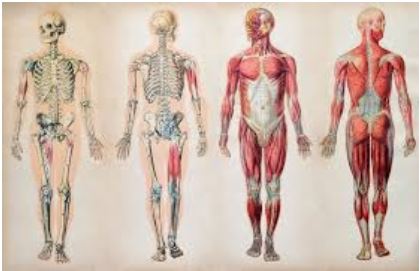
42.
a)
metacarpals
b)
metatarsals
c)
carpals
d)
tarsals
43.
a)
Humerus
b)
Ulna
c)
Radius
d)
Clavicle
44.
What is the name of the collar bone?
a)
Clavicle
b)
Scapular
c)
Sternum
d)
Xiphoid
45.
Name the bones.
a)
Tarsals
b)
Carpals
c)
Phalanges
d)
Mandible
46.

The bones in your legs are called _________. They are the largest and the longest bones in the body.

a)

Femur or Thigh Bones

b)

Skull

c)

Bones or Skeleton

d)

Pelvic bones

47.

___________ muscles are found only in the heart.

a)

skeletal

b)

smooth

c)

cardiac

48.
Where is the smallest bone in your body?
a)
hand
b)
spine
c)
ear
d)
pinky toe
49.
What is the biggest bone in your body?
a)
fibula
b)
humerus
c)
pelvis
d)
femur
50.

About how many bones are there in a human body?

a)

208

b)

306

c)

206

d)

100

51.

Gas exchange in the lungs occurs between which two structures?

a)

capillaries and bronchioles

b)

alveoli and capillaries

c)

alveoli and veins

d)

bronchi and alveoli

52.

The part of the respiratory system labelled E is the _____________.

a)

trachea

b)

alveoli

c)

pharynx

d)

diaphragm

53.

Where are the vocal cords located?

a)

Sinuses

b)

Oropharynx

c)

Pharynx

d)

Larynx

54.

Name the structure labeled 8

a)

lungs

b)

trachea

c)

diaphragm

d)

alveoli

55.
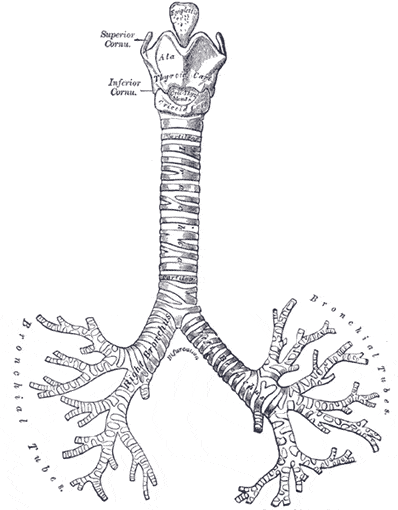
The two main branches from the trachea (one to each lung)
a)
bronchi
b)
alveoli
c)
capillaries
d)
bronchioles
56.
Tiny tubes that branch off of bronchi
a)
capillaries
b)
alveoli
c)
bronchioles
d)
pluera
57.
A chamber behind the nose and mouth that leads to the trachea
a)
pharynx
b)
trachea
c)
epiglottis
d)
larynx