
 Worksheets
Chemistry Semester TEST
Total questions: 98
Worksheet time: 2hrs 22mins
The vertical (up and down) columns in the Periodic Table are called
groups
towers
periods
atomic numbers
Elements in a .................. have similar chemical properties.
period
group
row
Which group of the periodic table is composed of inert (not reactive) gases?
answer choices
alkali metals
alkaline earth metals
halogens
noble gases
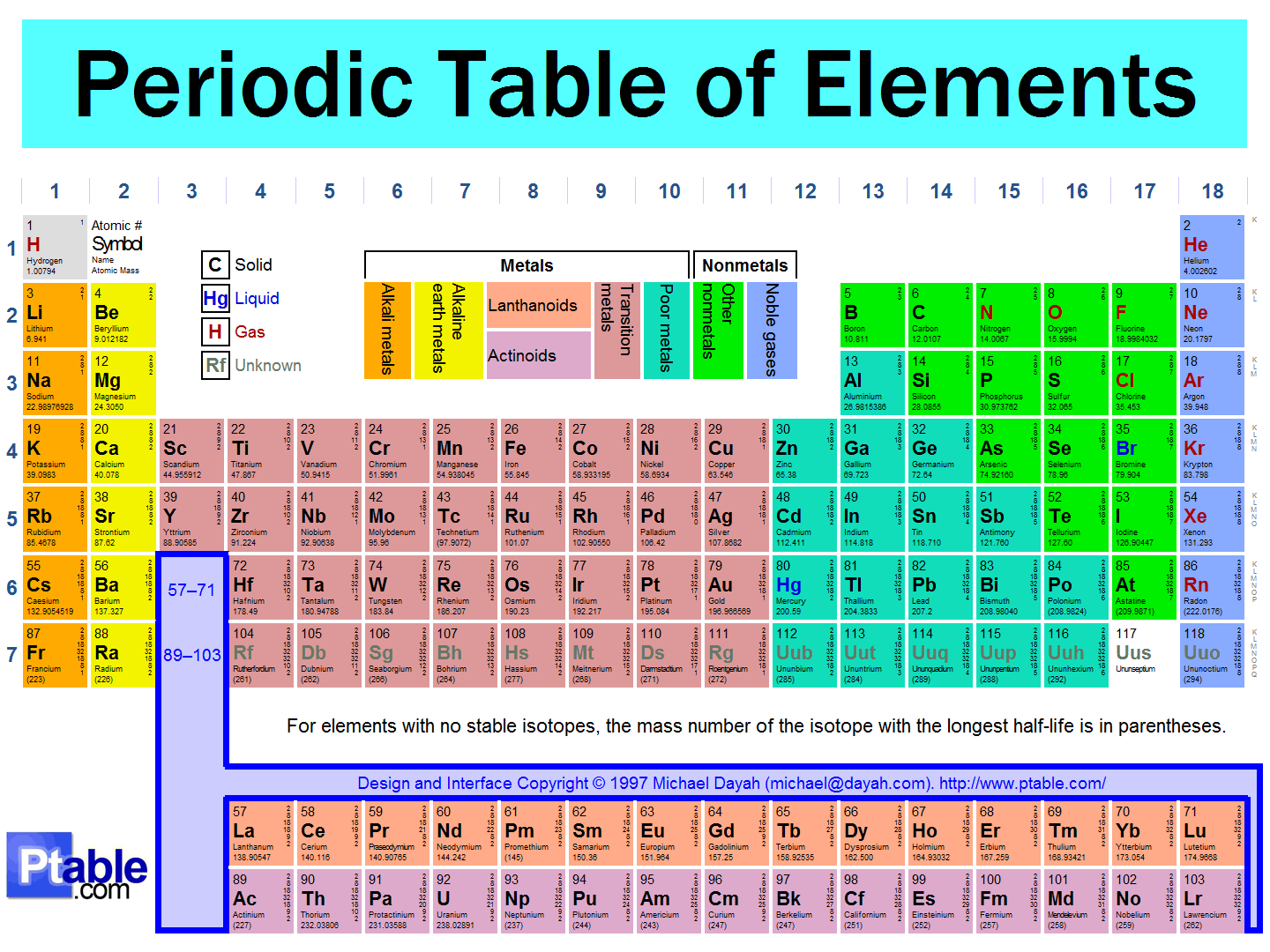

Which element is similar to F?
Ne
Cl
Which element is similar to He?
H
Ar
Which element is the least reactive?
Li
Ne
B
C
This group of elements sit along a stair step line on the periodic table and have properties of both metals and nonmetals. _________________________
luster
metals
nonmetals
metalloids
You try it. What is the mass of one mole of Carbon atoms?
6 grams
6.02 x 10²³
12.01 grams
You try it. One mole of NaF, sodium fluoride, will have a mass of
41.99g
20g
41.99 amu's
20amu's
What is the mass of one mole of sodium oxide Na2O?
about 62 grams
30g
30amu
60amu
What is the gram formula mass for Mg(OH)2?
41.3g
58.32g
65.6g

What is the mass of K?
39
19
+1
40

What is the mass of Cl?
-1
17
35
12

Based on the answers to the first two questions, K has a mass of 39 and Cl has a mass of 35, predict the mass of KCl?

How many Ba atoms are present in the compound Ba3(PO4)2
2
3
4
8

What is the metric base unit for mass?
gram
pound
ounce
liter
Which of the following would be an example of a physical change?
condensation forming on a mirror while showering
an old iron gate rusting
baking a cake
frying an egg
H2SO4
What is the formula (molar) mass of AuCl3?
96 g/mol
130 g/mol
232.5 g/mol
303.5 g/mol
What is the gram formula mass of sodium?
11
23
16
32
H2SO4
What does the Law of Conservation of Mass say? It says,
"During a chemical reaction, mass is neither _______ or destroyed."
burned
created
melted
The substances that go into a reaction are called the _______.
products
reactants
So, the Law of Conservation of Mass would tell us that the mass of all the REACTANTS must __________ the mass of all PRODUCTS in a chemical reaction.
equal
be greater than
be less than
What is the left part of a chemical equation called?
2H2 + O2 ---> 2H2O
Reactants
Yields
Products
Chemical equation
What is the right part of a chemical equation called?
2H2 + O2 ---> 2H2O
Reactants
Yields
Products
Chemical Equation
What is the number before a chemical formula called?
Example: 2H2 + O2 ---> 2H2O
Coefficient
Atom
Subscript
Equation
What is the little number after an element in a chemical equation called?
Example: H2
Coefficient
Atom
Subscript
Equation
(OH)2
What is the total number of atoms present in 5Na3PO4?
5
55
40
8
Mg + __HCl ---> MgCl2 + H2
Is the following equation balanced?
Al + O2 ---> 2Al2O3
YES
NO
What coefficients are needed to balance the equation?
___Al + ___ O2 ---> 2Al2O3
3,2
3,4
4 , 3
4,2
What coefficients are needed to balance the following chemical equation?
__Zn + __HCl → __ZnCl2 + __H2
1,1,1,1
1,2,1,1
2,1,2,2
2,1,2,1

Which of the following chemical formulas are the reactants?
CH4
CH4 and 2O2
CO2
CO2 and 2H2O

Which of the following chemical formulas are the products?
2O2
CH4 and 2O2
CO2
CO2 and 2H2O
How many hydrogen atoms are in the formula for glucose, C6H12O6 ?
6
12
18
24
How many atoms of oxygen are in the chemical formula for sulfuric acid, H2SO4 ?
1
2
3
4
How many atoms of oxygen are in the chemical formula for potassium carbonate?
2K2CO3
2
3
4
6
How many atoms of hydrogen are on the reactant side of the balanced chemical listed below?
2H2O → 2H2 + O2
1
2
3
4
How many atoms of oxygen are in the product side of the balanced chemical equation below?
H2SO4 + 2NaOH → 2H2O + Na2SO4
2
4
6
8

1s22s22p63s23p64s23d10


1s22s22p63s2

1s2 2s2 2p6 3s2


This is a correct dot diagram for neon (Ne)
true
false

This could be the dot diagram of
Si
Br
B
S
Which Lewis Dot Diagram would represent Chlorine?


What element does this Lewis Dot Digram represent?
Li
Al
C
Be

This is a correct dot diagram for oxygen (O)?
true
false
Boron has 3 valence electrons but it wants a full shell, what charge does it like to form?
3-
3+
5-
5+
Nitrogen has 5 valence electrons but wants a full shell. What charge does nitrogen tend to form?
5+
5-
3+
3-
Oxygen has 6 valence electrons but wants a full shell. What charge does nitrogen tend to form?
6+
2-
6-
2+

What is the atomic mass of Neon?
10
20.18
10.18
20


What is the atomic mass of Copper?
63.546
29
29.546
92


How many electrons does a Copper atom have?
63
29
92
34

What is the atomic mass of Gold?
79
196.97
79.97
275

What is the atomic mass of Helium
4.0026
2.0026
4
1

How many electrons does an Iodine atom have?
53
126
73
179

How many electrons are in a gold atom?
79
196
117
275

What is the atomic weight of Iron?
26
55.845
56
30

How many electrons does an atom of Krypton have?
36
83.798
47.798
119.798

What does the topmost number (3) represent?
Mass Number
Atomic Number
Atomic Mass
Number of Neutrons

How many neutrons does an Oxygen atom have?
8
16
24
7.999
Is the following equation balanced?
Al + O2 ---> 2Al2O3
YES
NO
Which type of chemical reaction has two or more reactants to make one product?
combustion
single displacement
double displacement
synthesis
decomposition
Identify the following chemical reaction.
2 NaBr + 1 Ca(OH)2 ----> 1 CaBr2 + 2 NaOH
Synthesis (or combination)
Decomposition
Single displacement
Double displacement
Identify the following chemical reaction.
3 HBr + 1 Al(OH)3 ----> 3 H2O + 1 AlBr3
Synthesis (or combination)
Decomposition
Single displacement
Double displacement
Identify the following chemical reaction.
Pb + FeSO4 ----> PbSO4 + Fe
Synthesis (or combination)
Decomposition
Single displacement
Double displacement
What reaction has the following general formula:
A + CD --> C + AD
Synthesis
Decomposition
Single Replacement
Double Replacement
Combustion

