
 Worksheets
Life Science CFE Review 2024
Total questions: 126
Worksheet time: 3hrs 51mins

A student wants to perform a science experiment about plants. He wants to know if a certain type of soil will make plants grow taller. Each pot will receive a different type of soil, but will get the same type of seed, water amount, and sunlight amount.What is the Independent Variable in this story?
Amount of sunlight
How tall the plant will grow
Amount of water
Type of material the plant is growing in

What do you measure for results (outcome)?
Dependent variable
Hypothesis
Experimental Group
Constants

Why is it important to have constants in an experiment?
To make sure the experiment is fair
Constants are not needed for experiments.
To measure the dependent variables all at once
To test many variables at a time

This bar graph shows the number of cheeseburgers sold at McYummies drive thru last week. Study the graph and answer the following question.
What was the maximum number of burgers sold, and on which day was this?
30 burgers on Tuesday
60 Burgers on Thursday
20 Burgers on Thursday
25 Burgers on Monday

Why do many experiments include several trials instead of a single trial?
Repetition of trials increases the accuracy of the results
Repetition of trials decreases the sample size of the experiment.
Repetition of trials makes data easier to analyze.
It is not necessary to repeat trials

1. Aside from repeating a scientific experiment, what else must a scientist do to increase the accuracy of the results?
Change the hypothesis
Share data with other scientists for them to repeat or replicate
Analyze the data faster
Keep the data for themselves

Anna is in charge of studying how the amount of plant food (fertilizer) affects the height of a plant at a local garden. Which testable statement does she investigate?
There is no way to test this hypothesis.
If a plant receives two cups of food per day, then the height of the plant will increase
If a plant gets different amounts of water and two cups of food per day, the height of the plant will increase
If a plant receives more sunlight, the height of the plant will decrease

How is a hypothesis different from a theory?
A theory has evidence to back it up and a hypothesis is an educated guess as to what is going to happen.
They are both the same. They both are guesses as to what happens in the natural world.
A theory is an opinion about how something works but a hypothesis has scientific evidence to support it.
A hypothesis is used in science and a theory is used in society.
A statement that describes what scientists expect to happen every time under a particular set of conditions is a
scientific inquiry
scientific hypothesis
scientific theory
scientific law

How many variables should be changed in an experiment?
measuring the temperatures and humidity in a greenhouse that has both short and tall plants growing in it
making a model to observe whether water collects on the walls of a greenhouse with increasing humidity
A set of principles that explains and predicts a phenomena is called a (a) .
Someone is cold and shivers. Which systems are at work together?
Respiratory and Skeletal
Nervous and Muscular
Nervous and Circulatory
What is the smallest unit of life?
atom
organ
tissue
cell
Drag the images to match the labels

Cell

Tissue

Organ

Organ System

Organism
Which system takes in information through the 5 senses?
Nervous
Respiratory
Circulatory
Digestive
Which system is responsible for the absorption of nutrition?
Circulatory
Integumentary
Digestive
Respiratory
Receives stimuli and transports impulses, coordinates actions and reactions in the body
Integumentary
Nervous
Circulatory
Respiratory
Supports and provides structure for the body
Skeletal
Muscular
Circulatory
Respiratory
Supplies blood with oxygen and rids the body of carbon dioxide
Integumentary
Nervous
Circulatory
Respiratory
The _____ system is a transport system, carrying oxygen, carbon dioxide, and wastes to and away from cells using the heart and blood.
endocrine
circulatory
respiratory
excretory
The ______ system removes the body's wastes through the kidneys (cell wastes), digestive (feces), respiratory (CO2), and integumentary (salts/sweat)
excretory
digestive
respiratory
circulatory
In what way are the digestive and circulatory systems alike?
Both protect organs in the body.
Both control movement of the body.
Both absorb gases or nutrients into the body.
Both provide structural support for the body.
What is the function of the digestive system?
It transports blood and oxygen to your cells
It breaks down food so the nutrients can be absorbed by your body
It helps you breathe by taking in oxygen and transporting carbon dioxide out of your body
It helps you move
Which body system protects the organs of the body?
digestive
respiratory
skeletal
muscular
How is a theory in science different from a theory in everyday life?
A theory in science is less accurate
A theory in science and in real life are the same
A theory in science is more accurate
What most likely caused the finches on the Galapagos Islands to have beaks that were different from the finches on the mainland?
There were different types of predators on the island.
There were different types of food available on the island.
The finches had no water to drink.
The finches on the mainland could not fly high enough.
True or False? In Natural selection an animal chooses to adapt in a single generation, and survives.
true
false
When looking at two tree frogs of the same species, a slight difference was observed within members of the same species. This is called _____________.
replicating
variations
fossils
clone
What most likely happened to species that are found in the fossil record but have no living members?
They had offspring of a different species.
They became extinct.
They never really existed.
They mutated to other species.
The preserved remains or physical evidence of an organism that lived in the past are called ______________.
variations
fossils
homologous structures
evolutionary features

The correct order of classification from the BROADEST group to the most narrow is:
Species, Genus, Family, Order, Class, Phylum, Kingdom
Kingdom, Phylum, Class, Family, Order, Genus, Species
Domain, Kingdom, Family, Order, Phylum, Class, Genus, Species
Domain, Kingdom, Phylum, Class, Order, Family, Genus, Species

An organism that LACK a NUCLEUS (NO NUCLEUS)
Eukaryote
Prokaryote
Heterotroph
Autotroph
Which Domain/Kingdom is capable of living in EXTREME ENVIRONMENTS like hot springs, geysers, or very salty waters?
Bacteria
Eukarya
Archaea
Which statement was NOT included in cell theory?
All living things are composed of cells.
Living cells come only from other living cells.
Each cell contains a cell membrane, cytoplasm, nucleus, mitochondria, and endoplasmic reticulum.
Cells are the smallest structure of living things that can perform the functions necessary for life.

Which statement describes the ability of the cell membrane to allow various substance to move through it?
The cell membrane is selectively permeable.
The cell membrane is NOT selectively permeable.
Cells must be able to perform certain functions in order to survive. Which of the following must all cells do to survive?
obtain energy
absorb wastes
utilize oxygen
continue growing
Cell membranes are semi-permeable because they allow only certain particles to cross into or out of the cell.
True
False
___ is the maintenance of an internal balance of conditions in a changing external environment.
Diffusion
Endocytosis
Passive transport
Homeostasis
What is the function of the cell membrane in maintaining homeostasis?
Regulates movement of substances
Transports oxygen in the blood
Produces energy for the cell
Stores genetic information
Which organelle is known as the powerhouse of the cell?
endoplasmic reticulum
mitochondria
chloroplast
nucleus
What is the function of the nucleus in maintaining homeostasis?
Store and transmit genetic information
Produce energy for the cell
Maintain cell shape and structure
Control and regulate cell's activities
Which organelle is responsible for producing energy in the form of ATP?
mitochondria
nucleus
chloroplast
endoplasmic reticulum
How do organelles help in maintaining homeostasis in a cell?
Organelles have no role in maintaining homeostasis in a cell.
Organelles perform specific functions to regulate the cell's internal environment and ensure its proper functioning.
Organelles hinder the cell's ability to maintain homeostasis.
Organelles only maintain homeostasis in certain types of cells.
What happens to a cell if it fails to maintain homeostasis?
The cell can experience dysfunction and potentially cell death.
The cell will become stronger and more resilient.
The cell will divide and multiply rapidly.
The cell will become resistant to external stimuli.
Rigid layer that surrounds the cell of plants and some other organisms such as fungi
Cell Wall
Golgi Apparatus
Chloroplast
Cell Membrane
Which is a characteristic of living things?
They breathe.
They have skin.
They can move.
They respond to their environments.
Which cell parts are not present in animal cells?
cell membrane & cytoplasm
nucleus & chloroplasts
cell wall & chloroplasts
ribosomes & mitochondria
Which organelle is the site of photosynthesis?
Cell Wall
Chloroplasts
Cytoplasm
Cell Membrane


Which of the following statements about chromosomes is correct?
Chromosomes are long, thread-like structures
Chromosomes are found in the nucleus of all cells in the human body
Chromosomes contain DNA
All of the above
What is a short segment of a DNA strand that codes for our characteristics?
chromosome
DNA
RNA
gene
Where is DNA found in a human cell?
ribosome
nucleus
cell membrane
cytoplasm
How many alleles (letters) does a child get from each parent?
1
2
3
4

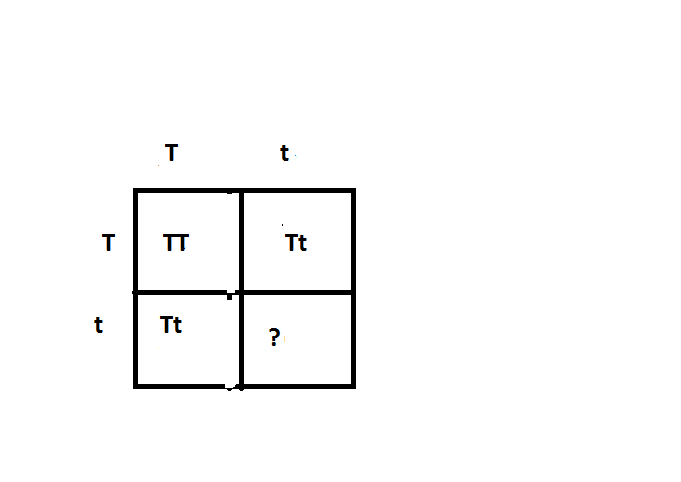
In the punnett square below, what belongs in the missing square


After mitosis is complete, the new cells:

The process on the right is:
Right: meiosis
Right: cloning
Right: meiosis
Right: mitosis
In eukaryotes, which organelle is DNA usually found in?
cell membrane
vacuole
chloroplast
nucleus
Which of the following requires only ONE parent creating a clone of themselves-no diversity, large amounts of offspring?
Asexual reproduction
Meiosis
Sexual reproduction
DNA Replication

Which of these combinations identifies the appropriate labels in the order as shown in the diagram (1,2,3)?
Chromosome, Gene, DNA
Chromosome, DNA, Gene
DNA, Chromosome, Gene
DNA, Gene, Chromosome
What is the compound that plants use to absorb the energy from light?
Chlorophyll
H2O
DNA
Nitrogen
How can the law of conservation of energy be expressed in the case of a chemical reaction?
total energy before the reaction is always less than the total energy after the reaction
total energy before the reaction is always greater than the total energy after the reaction
total energy before the reaction is always equal to the total energy after the reaction
energy cannot be measured in a chemical reaction
How does Carbon in the grass become part of a Tertiary consumer?
The lion eats the grass
The carbon ends up in the lion's food chain
Carbon from grass does not end up in the lion's food chain
The lion breathes in carbon dioxide given out by the plants
There is a cypress trees in Florida with a tree trunk diameter of about 3.5 m. What is the source of most of the carbon in the cypress tree?
The carbon created by the tree during photosynthesis.
The carbon stored in tree seeds.
The carbon dioxide molecules the tree absorbed from the atmosphere.
The nutrients containing carbon that the tree absorbed from the soil.
Which of the following best explains how plants follow the Law of Conservation of Mass during photosynthesis?
The reaction uses energy to produce a product without energy.
A gas (carbon dioxide) and a liquid (water) use energy to produce a solid (carbohydrates).
The amount of each element that begins photosynthesis equals the amount of each element that is produced.
The amount of carbohydrates at the beginning of photosynthesis equals the amount of oxygen that is produced.
The atmosphere and the ocean are the two main carbon reservoirs.
True
False
Carbon is not created nor destroyed in the carbon cycle.
True
False
What is NOT an example of limiting factors?
Predation
Food Source
Space
Migration
If humans destroys all of the Sea Turtles nesting sites, what is going to happen to the Sea Turtles?
Increase
Decrease
Stay the same
Sea Turtles don't need to nest

What would happen to the hedgehog population if more foxes were introduced to the population?
Increase
Decrease
Stay the same
What are hedgehogs?

What would happen to the bird population if mouse population increased?
Increase
Decrease
Stay the same
What is a mouse?

Which of the following is a tertiary consumer in this food web?
Rabbit
Hedgehog
Fox
Bacteria
A relationship between two organisms in which one organism benefits and the other is unharmed...
Mutualism
Commensalism
Parasitism
A relationship between two organisms in which both organisms benefit.
Mutualism
Commensalism
Parasitism
A relationship between two organisms in which one is benefited and the other is harmed.
Mutualism
Commensalism
Parasitism


Which animal has the least amount of energy?
Eagle
Lizard
Gradd
Rabbit
What is the role on decomposers?
Eat plants
Break down dead animals and material
Produce their own food
Eat every animal under it
Shrubs in a meadow use sunlight to produce their own food. What role is the organism performing in this ecosystem?
consumer
producer
decomposer
in a prairie ecosystem, nitrogen and other matter build up in animal wastes. Which organisms return this matter to the ecosystem by breaking down wastes?
producers
decomposers
primary consumers
secondary consumers

What is a lion?
autotroph
heterotroph

What is asparagus?
autotroph
heterotroph

