wayground logo

Free Printable Worksheets

Font size

S
M
L
XL
Worksheets

Ecology Review

Total questions: 83

Worksheet time: 1hrs 23mins
Name
Class
Date
1.

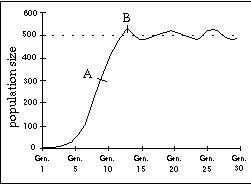
What is the carrying capacity of the graph?

a)

around 500

b)

more than 800

c)

less than 300

d)

around 700

2.
Which of the following would INCREASE the carrying capacity of an ecosystem?
a)
increase in predators
b)
disease
c)
increase in available food
d)
drought
3.

When death rate is equal to birth rate...

a)

population increases

b)

population decreases

c)

population stays the same.

d)

population rapidly increases then becomes stable

4.

When birth rate is high and death rate is low...

a)

population increases

b)

population decreases

c)

population stays the same

d)

all of these

5.

Match the following

a)
1.

Predation

b)
2.

Symbiosis

c)
3.

Commensalism

d)
4.

Parasitism

6.

What will happen if all of the frogs in a population die?

a)

The frogs' predators will decrease and the frogs' prey will increase

b)

The frogs' predators will increase and the frogs' prey will decrease

c)

We better all pray because there isn't anymore frogs.

7.

A scientist was studying a population of fish in a pond over a period of 10 years. He observed that

the population increased each year for 3 years, and then remained nearly constant for the rest of

the study. The best explanation for this observation is that the population had

a)

stopped reproducing

b)

reached carrying capacity

c)

mutated into a different species

d)

run out of food and all died

8.
Excessive amounts of rain caused a flood in the southwest United States that resulted in substantial amounts of deaths in the rabbit population? This situation is an example of a density _____________ limiting factor.
a)
density-independent
b)
density-dependent
c)
density- too high
d)
density- too low
9.

A lion and a cheetah attempt to occupy the same niche. The more aggressive lion survives; the cheetah does not.

a)

Density-Dependent: Competition

b)

Density-Independent: Competition

c)

Density-Dependent: Predator-Prey

d)

Density-Independent: Predator-Prey

10.

Which graph depicts exponential growth in a population?

a)
b)
c)
d)
11.

Which example describes or illustrates how a density-dependent limiting factor can affect a forest ecosystem?

a)

A forest fire forces many animals to move to new habitats

b)

A heat wave causes the death of many animals in the forest

c)

An earthquake causes the death of many animals in the forest

d)

A disease causes death of many animals in the forest

12.
One of the main causes of biodiversity loss is?
a)
Habitat fragmentation
b)
Invasive species
c)
Climate change
d)
All of the Above
13.
Which of the following is another word for a plant?
a)
autotroph
b)
heterotroph
c)
consumer
14.
All living things get their energy from which of the following sources?
a)
food
b)
water
c)
sun
15.
In which type of relationship do both species benefit?
a)
parasitism
b)
mutualism
c)
commensalism
16.
Barnacles grow on whales.  Whales give the barnacles a place to live but the barnacles do not help or harm the whale.  Which type of relationship is this?
a)
commensalism
b)
mutualism
c)
parasitiesm
17.
Which is an example of a parasitic relationship?
a)
a bee pollinates a flower
b)
a tapeworm takes nutrients from a dog
c)
an orchid lives in a tree but does not harm the tree
18.
An oxpecker bird eats ticks off of a zebra.  The bird gets food from eating the ticks and the zebra has harmful parasites removed.  Which type of symbiosis is this?
a)
mutualism
b)
parasitism
c)
commensalism
19.

A lichen is a combination of fungus and algae that lives on the sides of trees, rocks, and other materials. The fungus provides the algae with water and minerals and the algae uses the water and minerals to make food for both organisms. What type of relationship does the lichen represent?
a)
mutualism
b)
parasitism
c)
commensalism
20.
Biodiversity is 
a)
the variety of species within an ecosystem
b)
a large number of the same species in an ecosystem
c)
an abundant amount of the same primary consumers 
d)
the ability to have an abundant source from the same species
21.
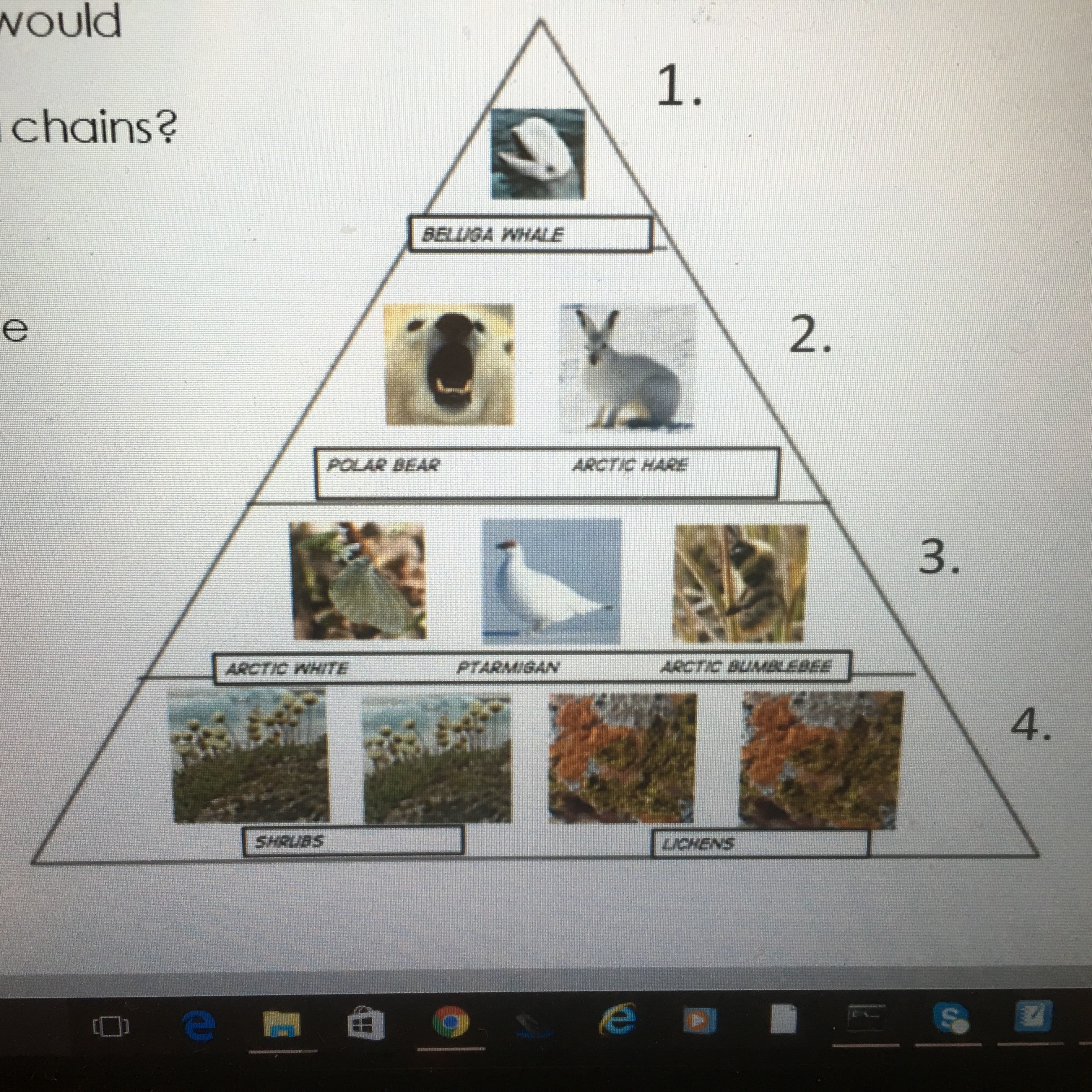
Level 1 is called the _____________ trophic level. 
a)
Tertiary consumer
b)
Tertiary producer
c)
Primary consumer
d)
Primary producer
22.
A food pyramid represent the relative amount of energy in trophic levels. Which of the following correctly shows a food pyramid?
a)
A
b)
B
c)
C
d)
D
23.
Which organism recieves the least amount of energy from the producer?
a)
Owl
b)
Grasshopper
c)
Lilypad
d)
Mouse
24.
If these organisms were arranged in a food pyramid, which organism would have the least amount of total energy available?
a)
coyote
b)
insect
c)
lizard
d)
shrub
25.

What amount of percentage does the energy decrease as it goes up the pyramid?

a)

100%

b)

1000%

c)

10%

d)

1%

26.

If a toxin was introduced to the water of an aquatic ecosystem. Which organism would have the highest accumulation of the toxin in their tissues?

27.

Identify this populations carrying capacity

28.
Which of the following best explains why nitrogen fixation must take place?
a)
Atmospheric nitrogen is unusable to plants and animals
b)
Nitrogen must be returned to the atmosphere
c)
Animals must breathe in nitrogen
d)
Nitrogen gets "stuck" in the soil and must be untrapped
29.
Which of the following is true about phosphorus?
a)
Phosphorus is found primarily in the atmosphere.
b)
Phosphorus is an important component of RNA and DNA.
c)
Phosphorus can be “fixed” by lightning.
d)
Phosphorus is released into the air when animals exhale carbon dioxide.
30.
The ____________ is the portion of the Earth which contains all life.
a)
Ecosystem
b)
Population
c)
Community
d)
Biosphere
31.
What is a limiting factor?
a)
Any biotic or abiotic factor that restricts the size of a population.
b)
The maximum number of a population an ecosystem can hold.
c)
A geologic event which controls living space.
d)
The role an organism plays in its environment.
32.
Fungi, such as mushrooms, can be classified as 
a)
Autotrophs
b)
Carnivores
c)
Producers
d)
Decomposers
33.
Using the food web image, which of the following statements is correct?
a)
An increase in rabbits would lead to a decrease in mountain lions.
b)
A decrease in snakes would lead to a decrease in hawks.
c)
Rabbits are omnivores. 
d)
Snakes are primary consumers.
34.
In the food chain image, to what trophic level does the frog belong?
a)
Quaternary Consumer
b)
Primary Consumer
c)
Secondary Consumer
d)
Tertiary Consumer
35.
Nitrogen fixation is carried out primarily by
a)
humans.
b)
plants.
c)
bacteria.
d)
consumers.
36.
What process returns nitrogen back to the atmosphere?
a)
Nitrogen fixation
b)
Elimination
c)
Denitrification
d)
Digestion
37.
Phosphorous is passed from plants to ____ who eat them
a)
plants
b)
animals
c)
scavengers
38.
How have humans affected the phosphorus cycle?
a)
By burning too many fossil fuels
b)
By cutting down too many trees
c)
By using fertilizers on plants
d)
By eliminating decomposers
39.

Too much phosphorus in waterways (rivers, lakes) can lead to___________.

a)

eutrophication

b)

Nothing

c)

Death

d)

diseases

40.

How does carbon enter the biotic environment from the abiotic?

a)
Cellular Respiration
b)
Photosynthesis
c)
Decomposition
d)
Combustion of fossil fuels
41.

What process illustrates a transfer of nutrients or material from the biotic environment to the abiotic environment? (SELECT ALL THAT APPLY)

a)

Cellular Respiration

b)
Photosynthesis
c)

Nitrogen fixation

d)

Denitrofication

e)

Transpiration

42.

How does nitrogen enter the biotic environment from the abiotic?

a)
Cellular Respiration
b)
Photosynthesis
c)

Nitrogen fixation

d)

Denitrofication

43.
Which of the following involves a situation in which a density-dependent factor influences a  population?
a)
Several seasons passed during which rainfall was ample, winters were not severe and food for snow hares was in good supply.
b)
A hurricane severely disrupted a salt marsh and uprooted most of the marsh grass in an estuary.
c)
A forest fire on the north side of a mountain forced the white-tailed deer from the north side to move into the range of the white-tailed deer on the south side of the mountain, making food more scarce.
d)
After a heavy rain, pesticides that were applied to a cotton crop to control weevils ran off into a waterway that flows next to a field.
44.
A previously rapidly growing population of green tree frogs in the city park has suddenly leveled off, and is presently neither increasing or decreasing in numbers. You can probably infer that the tree frog population has reached its ____________________ _________________________.
a)
Limiting Factor
b)
Carrying Capacity
c)
Population Total
d)
Nap Time
45.

During a field trip, William observed a volcano erupting and asked, 'This would be an example of what type of succession?'

a)

Primary

b)

Secondary

c)

Tertiary

46.
Yucca flowers are pollinated by yucca moths. The moths lay their eggs in the flowers where the larvae hatch and eat some of the developing seeds. Both species benefit. 
a)
parasitism
b)
commensalism
c)
mutualism
47.
The picture shows what type of succession?
a)
primary
b)
secondary
c)
tertiary
d)
quadanary
48.

DDT in pesticides traveled up the food chain to Bald Eagles in a process called:

a)

Biomagnification

b)

Poisoning

c)

Acclimation

d)

Adaptation

49.

Which would most likely happen if too many nutrients entered an estuary?

a)

Nutrients would be used up by the fish and plants, keeping the estuary in balance.

b)

Algal blooms would lower dissolved oxygen levels, causing fish to suffocate.

c)

Algal blooms would decrease, leaving few food resources for fish.

d)

Nutrients would sink to the bottom, increasing soil deposition.

50.

Which organism in the food web shown to the right would

contain the lowest concentration of chemical pollutants?

a)

producers

b)

primary consumers

c)

secondary consumers

d)

tertiary consumers

51.

Chemical pesticides tend to be used in terrestrial ecosystems, but they are commonly found in the tissues of aquatic organisms. Because of this, birds and other animals with a diet high in fish commonly suffer the effects of biological magnification. How do these pesticides end up in these aquatic ecosystems?

a)

Pesticides evaporate and are delivered to water sources by rainfall

b)

Land animals containing pollutants die and decompose in waterways

c)

Pesticides are carried to water sources by freshwater runoff.

52.

Which type of succession reaches the climax community faster?

a)

primary succession

b)

secondary succession

53.
What would most likely happen if the rabbit population was removed from the food chain grass —› rabbit —› fox?
a)
their would be more grass
b)
there would be less rabbits
c)
there would be more fox
54.
Plants and animals that have migrated to areas where they did not originate and often displace native species by out-competing them for resources are called...
a)
habitat fragmentation
b)
endangered species
c)
invasive species
d)
extinct species
55.

Which process takes Carbon Dioxide from the air and water from the ground and converts it into a form of sugar used by living things?

a)

Precipitation

b)

Photosynthesis

c)

Cellular Respiration

d)

Fermentation

56.
Why is burning fossil fuels harmful? 
a)
then we won't have any fossil fuels if we burn them all
b)
They can get extremely hot
c)
Increases the amount of greenhouse gases in the air
d)
this would destroy fossils
57.
In which organelle does photosynthesis occur?
a)
mitochondria
b)
ribosome
c)
xylem
d)
chloroplast
58.
Where does cellular respiration take place in the cell?
a)
Cell Membrane
b)
Nucleus
c)
Mitochondria
d)
Vacuole
59.
What is the pioneer species during primary succession?
a)
lichen and moss
b)
weeds and flowers
c)
shrubs and bushes
d)
trees and large animals
60.
Land conservation is a worldwide priority. There are several methods to prevent the loss of land due to a variety of reasons. Which method is not a way to conserve land?
a)
sea walls
b)
rain water harvesting
c)
limits on clear cuts of forests
d)
cut and burn methods of clearing land
61.
Carbon dioxide is added to the atmosphere by
a)
Burning fossil fuels 
b)
Cellular respiration
c)
Decomposing organic matter
d)
All answers are correct
62.
_______ happens when fertilizers, animal waste, sewage or other substances rich in nitrogen and phosphorus are lost into waterways causing excessive algae growth.
a)
Eutrophication
b)
Introduced species
c)
Biological Augmentation
d)
Nonrenewable Resource
63.
What is deforestation?
a)
Clearing Earth's forests on a massive scale
b)
Eating too much vegetables
c)
Going to a forest and pulling weeds
d)
Clearing the five trees in my backyard
64.
Concentration of toxins in an organism as a result of ingesting other plants/animals in which the toxins are widely distributed
a)
biomagnification
b)
point-source pollution
c)
artificial eutrofication
d)
consumable pollution
65.

90% of the energy that gets lost as you move up a food pyramid or chain gets lost as

a)

pollution to the environment

b)

heat to the environment

c)

energy for decomposers

d)

gets recycled

66.

High biodiversity is a sign of a healthy ecosystem.

a)

True

b)

False

67.

Jenn is studying a population of fish found in a pond that has a decreasing carrying capacity. Which of the following factors would not decrease the carrying capacity of her fish?

a)

•drought

b)

•flooding

c)

•food shortages

d)

•The number of species competing with the animal for food decreased.

68.

Carrying capacity is the ​ (a)   number of organisms that can survive in an area based on the available ​ (b)   , such as food and water.

Choose from the below words
maximum
resources
minimum
predators
69.

Which of the following is an example of a keystone species?

a)

Cattle

b)

Sea otter

c)

Grass

d)

Mosquito

70.

What is a keystone species?

a)

A species that is most abundant in an ecosystem.

b)

A species that plays a critical role in maintaining the structure of an ecological community.

c)

A species that has no predators in its ecosystem.

d)

A species that can live in a variety of ecosystems.

71.

How can the removal of a keystone species affect an ecosystem?

a)

It can increase biodiversity.

b)

It can lead to a more stable ecosystem.

c)

It can cause a trophic cascade and disrupt the ecosystem balance.

d)

It has no significant effect.

72.
What is transpiration?
a)
Excess water being released from the leave
b)
Excess sugar being released from the leave
c)
The way a plant makes its food
d)
When the plant uses sugar for energy
73.

Depletion of the ozone layer is caused by:

a)

Methane

b)

Carbon Dioxide

c)

UV rays

d)

Chlorofluorocarbons

74.

The role of the Ozone layer:

a)

Protect Earth from infrared radiation.

b)

Protect Earth from electromagnetic radiation.

c)

Protect Earth from UV radiation.

75.
The main human activity that releases greenhouse gases is
a)
using bottled water
b)
burning fossil fuels
c)
texting on cellphones
d)
eating meat
76.
Increase in which gas is primarily responsible for increased global warming?
a)
Carbon dioxide
b)
Water vapor
c)
Methane
d)
Nitric oxides
77.

The water cycle would not occur if which of the following were missing?

a)

bacteria

b)

autotrophs

c)

carbon dioxide

d)

solar energy

78.

The ozone layer protects us from

a)

Increased atmospheric heat

b)

CFCs

c)

UV rays

d)

Decreased atmospheric heat

79.

All of the following are causes for biodiversity loss, EXCEPT:

a)

Habitat Loss

b)

Invasive Species

c)

Replanting trees

d)

Pollution

80.
What are the effects of deforestation ?
a)
loss of habitat
b)
increased green house gasses 
c)
soil erosion and flooding
d)
all of the above
81.

Which is a MAJOR cause of acid rain?

a)

spraying pesticides on crops

b)

burning fossil fuels for energy

c)

dumping sewage in rivers

d)

using Nuclear power stations

82.
Kudzu has overgrown many parts of southern Missouri and native ground plants have disappeared from the area. This is an example of:
a)
Parasitism between kudzu and the native plants
b)
A predator prey relationship between ground plants and kudzu
c)
Competition occurring between the native and invasive species
d)
Commesalism occurring between the kudzo and native plants
83.

What human activity results in CFCs being added to the atmosphere?

a)

Burning fossil fuels

b)

Deforestation

c)

Aerosol cans