wayground logo

Free Printable Worksheets

Font size

S
M
L
XL
Worksheets

1st Year End of Year Revision Quiz

Total questions: 110

Worksheet time: 1hrs 12mins

Name
Class
Date
1.

What is this piece of equipment?

a)

graduated cylinder

b)

beaker

c)

erlenmeyer flask

d)

florence flask

2.

What is this piece of equipment?

a)

florence flask

b)

test tube

c)

beaker

d)

graduated cylinder

3.

What is this piece of equipment?

a)

googles

b)

goggles

c)

test tube

d)

beaker

4.

What is this piece of equipment?

a)

test tube

b)

tweezers

c)

thermometer

d)

florence flask

5.

What is this piece of equipment?

a)

mortar and pestle

b)

evaporating dish

c)

erlenmeyer flask

d)

beaker

6.

What is this piece of equipment?

a)

thermometer

b)

tweezers

c)

spatula

d)

goggles

7.

What is this piece of equipment?

a)

petri dish

b)

glass stirring rod

c)

thermometer

d)

goggles

8.

_____________ is an instrument that uses a lens to make tiny things look larger.

a)

A telescope

b)

A hand lens

c)

Safety goggles

d)

A microscope

9.

Which piece of equipment should you use to measure out liquids?

a)
b)
c)
d)
10.

What is the name of this piece of equipment?

a)

Beaker

b)

Conical flask

c)

Measuring cylinder

d)

Evaporating Basin

11.

Green part of plant where photosynthesis occurs

a)

Glucose

b)

Carbon dioxide

c)

Chloroplast

d)

Product

12.

Small openings on a leaf, through which oxygen and carbon dioxide can move.

a)

product

b)

stomata

c)

roota

d)

glucose

13.

Select all that are products of Photosynthesis.

a)

Water

b)

Carbon Dioxide

c)

Oxygen

d)

Sunlight (Light Energy)

e)

Glucose (Sugar/food)

14.

Is Glucose (C6H12O6) a Reactant (Ingredient) or Product of Photosynthesis?

a)

Product

b)

Raw Material

c)

Neither

15.

How does most of the water needed by the plant get into its leaves?

a)

It enters through the stomata

b)

The roots absorb it and then it travels up the stem

c)

It's made during a chemical reaction in the leaf

d)

The flowers capture water and deliver it to the leaves

16.
Why do plants conduct photosynthesis?
a)
To make light
b)
To make mitochondria
c)
To make glucose
d)
To release carbon dioxide
17.
Which of these conditions would decrease the rate of photosynthesis in a plant?
a)
Above average precipitation
b)
Changing the daylight hours from 14 hrs to 10 hrs
c)
Changing the CO2 concentration from 380 ppm to 410 ppm
d)
All of these choices
18.
Which choice correctly shows the gases that enter and exit plants during photosynthesis?
a)
Enter: Oxygen
Exit: Carbon dioxide
b)
Enter: Water vapor
Exit: Glucose
c)
Enter: Carbon dioxide
Exit: Oxygen
d)
Enter: Light
Exit: Water vapor
19.

Where do plants get the energy for photosynthesis to take place?

a)

nutrients in the soil

b)

the sun

c)

chlorophyll

d)

bee pollination

20.

What part of a plant is adapted for photosynthesis?

a)

Flowers

b)

Roots

c)

Stem

d)

Leaves

21.

Carbon dioxide + water → _ _ _ _ _ _ _ + oxygen

(a)  

22.

What is the process by which plants make their own food using sunlight?

a)

Respiration

b)

Photosynthesis

c)

Transpiration

d)

Germination

23.

Which pigment in plants is responsible for absorbing light energy during photosynthesis?

a)

Carotene

b)

Chlorophyll

c)

Anthocyanin

d)

Xanthophyll

24.

Which gas is released by plants as a byproduct of photosynthesis?

a)

Oxygen

b)

Carbon dioxide

c)

Nitrogen

d)

Hydrogen

25.
What are the main organs of gas exchange in the respiratory system?
a)
diapragm
b)
lungs
c)
trachea
d)
bronchi
26.

When you breathe, your lungs take in ___ and remove ___.

a)

air/oxygen

b)

oxygen/carbon dioxide

c)

carbon dioxide/waste

d)

waste/air

27.
The two main branches from the trachea (one to each lung)
a)
bronchi
b)
alveoli
c)
capillaries
d)
bronchioles
28.
The air sacs that are covered with capillaries that separate gases we need from gases we don't need.
a)
bronchi
b)
lungs
c)
oxygen
d)
alveoli
29.
What is the function of the bronchi (bronchial tubes)?
a)
Transport air from nose to lungs
b)
Transport air from trachea to lungs
c)
Transport air from lungs to alveoli
d)
Transport air from alveoli to blood
30.

Within the lungs, the exchange of oxygen and carbon dioxide occurs between the ___ and the capillaries.

a)

trachea

b)

bronchi

c)

alveoli

d)

diaphragm

31.
A disorder of the lungs called ____ causes the bronchi to become restricted (get smaller) so air can't get to the lungs.
a)
asthma 
b)
cold
c)
influenza 
d)
bronchitis 
32.
What is tube that is also known as your wind pipe?
a)
esophogus
b)
bronchi
c)
trachea
d)
alveoli
33.
What is the name of the muscle below the lungs that helps with breathing?
a)
trachea
b)
alveoli
c)
diaphragm
d)
bronchi
34.
The beginning of the respiratory system that warms and moistens the air.
a)
trachea
b)
nose
c)
bronchi
d)
diaphragm
35.
What is the small flap of tissue called that covers the air-only passage when we swallow?
a)
Bronchioles
b)
Larynx
c)
Alveoli
d)
Epiglottis
36.
Cellular respiration needs two reactants. 
They are....
a)
Carbon dioxide and water 
b)
energy and food
c)
glucose and oxygen 
d)
nitrogen and fluid 
37.

Respiration is a vital function that all living things carry out.

a)

True

b)

False

38.

Respiration takes place in

a)

the cells

b)

the lungs

c)

the heart

d)

the brain

39.

When respiration takes place, energy is produced along with another two substances B and C. Select substances B and C.

a)

Carbon dioxide

b)

Water

c)

Oxygen

d)

Hydrogen

40.

During exercise our body needs to produce more energy by respiration thus it needs more oxygen. Our breathing rate

a)

increases

b)

decreases

41.

What is aerobic respiration?

a)

The release of energy from food using oxygen

b)

The release of energy from food without oxygen

c)

The process of converting glucose into ATP

d)

The process of breaking down carbon dioxide

42.

What is anaerobic respiration?

a)

The release of energy from food using oxygen

b)

The release of energy from food without oxygen

c)

The process of converting glucose into ATP

d)

The process of breaking down carbon dioxide

43.

What is the equation for aerobic respiration?

a)

Glucose + Oxygen → Carbon dioxide + Water

b)

Carbon dioxide + Water → Glucose + Oxygen

c)

Glucose + Water → Carbon dioxide + Oxygen

d)

Carbon dioxide + Oxygen → Glucose + Water

44.

How does the body obtain glucose?

a)

By inhaling it through the lungs

b)

By eating plants or other animals

c)

By converting oxygen into glucose

d)

By producing it through photosynthesis

45.

What happens if there is not enough glucose for respiration?

a)

Respiration will slow down or stop

b)

Anaerobic respiration will occur

c)

More oxygen will be needed

d)

Energy production will increase

46.

What cell part is NOT found in all cells?

a)

Chloroplasts

b)

Cell Membrane

c)

Cytoplasm

d)

Nucleus

47.

True or False:

Plant cells have a more rigid structure than animal cells.

a)

True

b)

False

48.

This type of cell needs a cell wall and chloroplasts

a)

Animal Cell

b)

Plant Cell

49.

This cell part is in ALL cells. It is the gel-like substance that provides cell shape.

a)

Chloroplasts

b)

Cell membrane

c)

Cytoplasm

d)

Nucleus

50.

What type of cell is pictured above?

a)

Plant Cell

b)

Animal Cell

51.

What type of cell is pictured above?

a)

Plant Cell

b)

Animal Cell

52.

controls movement of materials in and out of the cell, maintains homeostasis

a)

cell membrane

b)

cell wall

c)

chloroplast

d)

cytoplasm

53.

fluid-filled sacs that store food

a)

cytoplasm

b)

mitochondrion

c)

nucleus

d)

vacuoles

54.
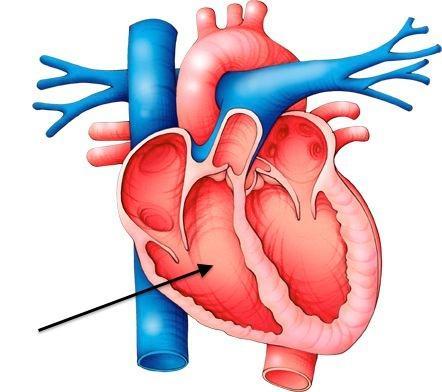
Identify
a)
Left atrium
b)
Right atrium
c)
Left ventricle
d)
Right ventricle
55.
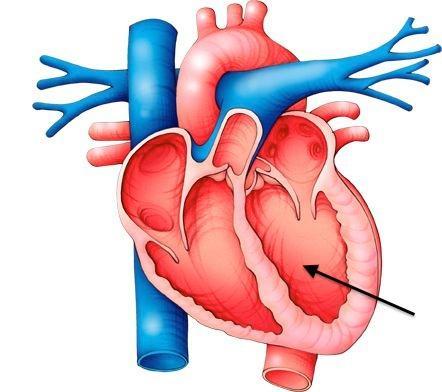
Identify
a)
Left atrium
b)
Right atrium
c)
Left ventricle
d)
Right ventricle
56.
The heart has ___ chambers.
a)
1
b)
2
c)
3
d)
4
57.
Which chambers of the heart are the thickest and strongest?
a)
Atria
b)
Ventricles
c)
Valves
d)
Aorta
58.
Carry blood away from heart; mostly oxygen-rich
a)
Arteries
b)
Veins
c)
Capillaries
59.
Which type of blood vessel has the thickest layer of smooth muscle in its walls?
a)
Arteries
b)
Veins
c)
Capillaries
d)
Ventricles
60.
What function does the heart do?
a)
Protects organs and produces red blood cells.
b)
Generates heat.
c)
Breaks down food into nutrients.
d)
The heart is a pump, which moves the blood. The arteries and veins are the pipes where the blood flows.
61.
Which is NOT a function of the circulatory system?
a)
deliver O2 and nutrients to cells
b)
remove CO2 and wastes from cells
c)
break down carbohydrates into glucose
d)
transport other materials through body
62.
Structure(s) that keep the blood flowing in one direction.
a)
Valve(s)
b)
Septum(s)
c)
Neuron(s)
d)
Bronchiole(s)
63.
arteries, veins, and capillaries are three types of __________
a)
heart valves
b)
blood vessels
c)
cells
d)
veins
64.
Where does the digestion of starch begin?
a)
esophagus
b)
small intestine
c)
stomach
d)
mouth
65.
The muscular tube that moves food from the mouth to the stomach?
a)
esophagus
b)
small intestine
c)
stomach
d)
mouth
66.
Where are nutrients absorbed into the blood?
a)
esophagus
b)
small intestine
c)
stomach
d)
mouth
67.
Food broken down by physical processes is called
a)
mechanical digestion
b)
chemical digestion
68.
Enzymes and acids are examples of 
a)
mechanical digestion
b)
chemical digestion
69.

What enzyme is found in saliva that starts digesting carbohydrates?

a)

amylase

b)

chyme

c)

pepsin

d)

bile

70.

What are the rhythmic muscular contractions of your esophagus called to help food move along?

a)

swallowing

b)

peristalsis

c)

inertia contractions

d)

paralysis

71.
What organ is this?
a)
stomach
b)
small intestine
c)
large intestine
d)
esophagus
72.

What nutrient is present in food like pasta, bread and rice?

a)

Vitamins

b)

Minerals

c)

Carbohydrates

d)

Fats

73.

Lack of vitamin C can cause ....

a)

dry skin

b)

anemia

c)

scurvy

d)

rickets

74.
Nutrients that build and repair tissues and cells e.g. meat, milk, eggs.
a)
Fat
b)
Minerals
c)
Vitamins
d)
Protein
75.
Elements essential for good health. e.g. Calcium, Iron, Potassium 
a)
Protein
b)
Fat
c)
Minerals
d)
Carbohydrates
76.
The body uses this to carry nutrients and waste. It also helps joints move smoothly.
a)
Fat
b)
Water
c)
Minerals
d)
Vitamin 
77.
The amount of energy the body gets from food is measured in.
a)
Metabolism
b)
Diet
c)
Calories
d)
Protein
78.
What is the main reason for eating a wide variety of foods? 
a)
to learn the food label
b)
to provide all the nutrients you need 
c)
to keep from getting bored with your diet 
d)
to help improve physical fitness 
79.
WHAT ARE THE 6 NUTRIENTS?
a)
Carbs, Meats, Fibers, Water, Protein, and Dairy
b)
Fruits, Milk, Fibers, Water, Pork, and Vitamins
c)
Carbs, Fats, Minerals, Water, Proteins, and Vitamins
d)
Carbs, Fats, Fibers, Cheese, Protein, and Vegtables
80.

Which food group are on the top shelf of food pyramid?

a)

Meat and fish

b)

Fruit and vegetables

c)

Grains

d)

Oil, salt and sugar

81.

Specific amount of each food you should eat.

a)

food group

b)

balanced diet

c)

Food Pyramid

d)

serving size

82.

What is this

a)

Food Pyramid

b)

Pyramid of Danger

c)

Pyramid of Doom

83.
What is the formula for density?
a)
density = mass x volume
b)
density = mass / volume
c)
density = mass + volume
d)
density = mass - volume
84.
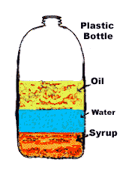
Which liquid is the least dense?
a)
oil
b)
water
c)
syrup 
d)
plastic bottle
85.
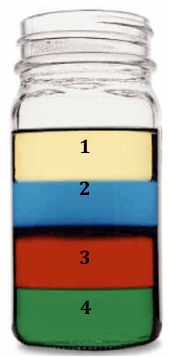
Put the liquids in order from most dense to least dense?
a)
4, 3, 2, 1
b)
1, 2, 3, 4
c)
3, 4, 2, 1, 
d)
4, 3, 1, 2
86.
What is the volume of Object X?
a)
10.0 cm3
b)
15.0 cm3
c)
20.0 cm3
d)
25.0 cm3
87.
If an object has a density of 3.6 g/mL and you put it into water, will it sink or float?  
a)
sink
b)
float
88.
Jack has a rock. The rock has a mass of 14g and a volume of 2cm3. What is the density of the rock?
a)
7 mL
b)
7 g/cm3
c)
28 g/cm3
d)
1/7 g/cm3
89.

How many states of matter are there?

a)

2

b)

4

c)

100

d)

10000000000

90.

What is a liquid?

a)

matter than has a definite shape and definite volume

b)

matter that has an indefinite shape and indefinite volume

c)

matter that has a indefinite shape and definite volume

d)

matter that has definite shape and indefinite volume

91.

What shape to liquids have?

a)

definite shape

b)

takes the shape of the container they are in

c)

Spread out all over the place

d)

a table

92.

What is a gas?

a)

matter that has an indefinite volume but definite shape

b)

matter that has a definite shape but no definite volume

c)

matter that doesn't have a definite shape or definite volume

d)

matter that does not exist

93.
Particles (molecules) in a ______________________ have more energy than the other states of matter.
a)
gas
b)
solid
c)
liquid
94.
What is condensation?
a)
gas to solid
b)
gas to liquid
c)
liquid to solid 
d)
solid to liquid 
95.
A chemical change
a)
doesn't really change much.
b)
creates a new substance
c)
is a change in the state of matter
96.

Is ice melting a physical or chemical change?

a)

Chemical

b)

Physical

97.
Which of the following is a chemical property?
a)
water boils when heated
b)
the volume of a brick
c)
sodium is explosive when placed in water
d)
the flexibility of rubber
98.
Physical or Chemical change?
recycling used aluminum cans to make new aluminum cans
a)
Physical 
b)
Chemical
99.
Physical or Chemical change?
cooking an egg
a)
Physical 
b)
Chemical
100.

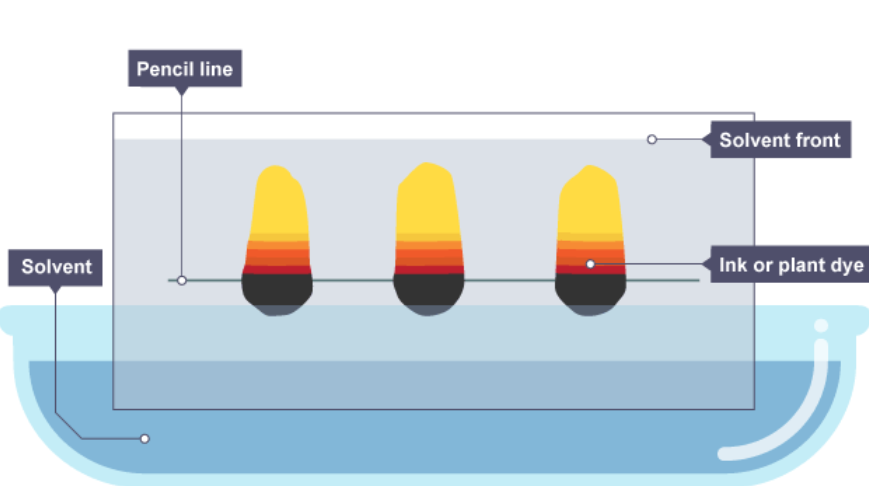
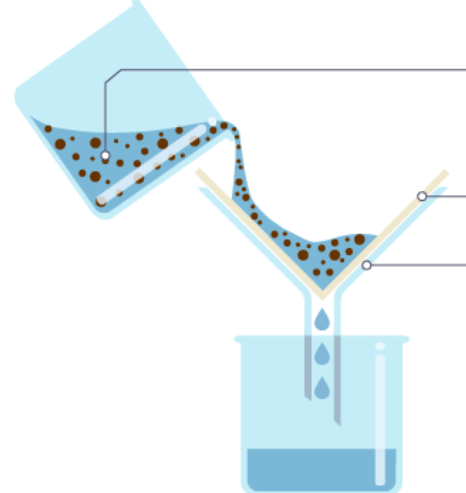
This method separates substances due to differences in the sizes of their particles.

a)

Filtration

b)

Evaporation

c)

Distillation

d)

Chromatography

101.

If a substance is insoluble in water, it ___________.

a)

dissolves in water

b)

cannot dissolve in water

c)

forms a solution when mixed with water

d)

cannot be separated from water

102.

Which method is this a picture of?

a)

Filtration

b)

Evaporation

c)

Distillation

d)

Chromatography

103.

Which method is this a picture of?

a)

Filtration

b)

Evaporation

c)

Distillation

d)

Chromatography

104.

Which method has a solid and a gas as the final products?

a)

Filtration

b)

Evaporation

c)

Distillation

d)

Chromatography

105.

Filtration can be used to separate salt from water.

a)

True

b)

False

106.
Two or more substances mingled together, but not chemically combined are known as a
a)
residue
b)
solution
c)
distillate
d)
mixture
107.

How could you separate iron filings from a mixture of iron and sulfur?

a)

Using a magnet

b)

By adding water and filtering

c)

By distillation

108.
A solution is a kind of ________. 
a)
mixture 
b)
compound 
c)
element 
d)
stuff 
109.
The _____is the part that gets dissolved. 
a)
solute 
b)
solvent 
c)
solution 
d)

soluble

110.
This is the part of the solution that does the dissolving. 
a)
solute
b)
solvent 
c)
salt water 
d)

residue