Wayground logo

Free Printable Worksheets

Font size

S
M
L
XL
Worksheets

Chemistry Final Review

Total questions: 78

Worksheet time: 2hrs 39mins

Name
Class
Date
1.

Which of the following are mole ratios for a reaction obtained from?

a)

a. coefficients from a balanced equation

b)

b. periodic table

c)

c. total mass of products

d)

d. molar mass

2.

What scientific law requires equal numbers of atoms on both sides of a chemical equation?

a)

a. the law of gravity

b)

b. the law of conservation of matter

c)

c. the law of definite proportions

d)

d. conversation of energy

3.

In the unbalanced equation NI3 ⟶ l2 + N2, how many moles of I2 are produced when 5.0 mol of Nl3 decompose completely? Balance the equation first.

a)

a. 3.3 mol

b)

b. 7.5 mol

c)

c. 1.67mol

d)

d. 5.0 mol

4.

For the balanced equation: 2 SO2(g)+O2(g)→2 SO3(g)

Which reactant is the limiting reagent if you start with 2.0 moles SO2 and 1.5 moles of O2?

a)

a. SO2

b)

b. O2

c)

c. SO3

5.

What coefficients are needed to balance the following equation?

___ NaOH + ___FeCl2 → ___ Fe(OH)2 + ___ NaCl

a)

a. 1, 3, 2, 3

b)

b. 2, 1, 1, 2

c)

c. 4, 2, 2, 4

d)

d. 2, 1, 2, 1

6.

If 20.0 g of NaNO₃ are produced according to the following BALANCED equation, how many moles of AgNO3 reacted?

AgNO₃ + NaCl → AgCl + NaNO₃

a)

a. 20.0 mol

b)

b. 0.235 mol

c)

c. 4.25 mol

7.

Use the equation M = n (moles of solute) / V (volume in liters).

What is the molarity of a solution made from dissolving 100g of NaCl in 500 mL of solution?

a)

a. 3.4 M

b)

b. 50 M

c)

c. 1.2 M

d)

d. 2.0 M

8.

What does the concentration of moles of solute per liter of solution measure?

a)

a. molarity

b)

b. % composition

c)

c. solubility

d)

d. molar mass

9.

Use the equation M = n (moles of solute) / V (volume in liters).

A solution having a volume of 5.0 L contains 1.5 moles of solute. What is the molarity of the solution?

a)

a. 7.5 M

b)

b. 3 M

c)

c. 0.3 M

d)

d. 3.3 M

10.

If a solution has a pH of 2.5, how would the solution be classified?

a)

a. neutral solution

b)

b. acid

c)

c. base

11.

If a solution has a pH of 10, how would the solution be classified?

a)

a. neutral solution

b)

b. acid

c)

c. base

12.

Referring to the provided graph, which concentration had the fastest reaction rate?

a)

A

b)

B

c)

C

13.

Low concentration has what effect on reaction rate?

a)

increases reaction rate

b)

decreases reaction rate

c)

has no effect on reaction rate

14.

Low temperature has what effect on reaction rate?

a)

increases reaction rate

b)

decreases reaction rate

c)

has no effect on reaction rate

15.

Increased surface area has what effect on reaction rate?

a)

increases reaction rate

b)

decreases reaction rate

c)

has no effect on reaction rate

16.

Which of the following is NOT a stress to an equilibrium system?

a)

concentration

b)

catalyst

c)

temperature

d)

surface area

17.

If chemical equilibrium has been established then...

a)

forward and reverse reactions are equal

b)

the amount of products and reactants are equal

c)

no reactants will remain

18.

What is the reactant in the following equation?

Pb(NO3) + 2 KI → 2 KNO3 + PbI2

a)

KNO3 and PbI2

b)

Pb(NO3) and PbI2

c)

Pb(NO3) and KI

d)

Ki and PbI2

19.

If the temperature of an experiment changes from 25°C to 32°C.

Is this exothermic or endothermic?

a)

endothermic

b)

exothermic

c)

neither

20.

Balance the following chemical equation: ___ Al + ___ O 2_2 → ___ Al 2_2 O 3_3

a)

2, 1, 2

b)

4, 3, 2

c)

1, 1, 1

d)

2, 3, 1

21.
2SO2(g)+O2(g)⇌2SO3(g)
Removing O2(g) will
a)
shift equilibrium right
b)
shift equilibrium left
c)
decrease temperature
d)
have no change
22.
2SO2(g)+O2(g)⇌2SO3(g)
Adding SO2(g) will
a)
shift equilibrium right
b)
shift equilibrium left
c)
increase rate of reaction
d)
have no change
23.

I use molar mass when the problem gives me grams?

a)

False

b)

True

24.

Which letter represents the potential energy of the products?

a)

A

b)

B

c)

C

d)

D

e)

E

25.

What does 'Z' represent in the energy profile shown here?

a)

Reactants Energy of Formation

b)

Kinetic Energy

c)

Activation Energy

d)

Products Energy of Formation

26.
An energy profile for a reversible chemical reaction is shown. According to this profile, the activation energy of the reverse reaction is equal to
a)
D
b)
C - B
c)
A - B
d)
C- D
27.
Which solute is the most soluble at 10 ⁰C?
a)
KI
b)
KClO3
c)
NH4Cl
d)
NH3
28.
How many grams of SO2 can dissolve at 50 ⁰C?
a)
5 g
b)
10 g
c)
20 g
d)
39 g
29.

Using the solubility curve decide whether 50g of NaCl dissolved in 100 of water at 60°C is unsaturated, saturated or supersaturated.

a)

saturated

b)

unsaturated

c)

supersaturated

30.
In a neutralization reaction, what are the products of a reaction between an acid and a base?
a)
Another acid and base
b)
Carbon dioxide and a salt
c)
Water and a salt
d)
Either two acids or two bases
31.

If the [H3O+] of a solution is 1 x 10⁻³ M, the pH is

a)

11

b)

-3

c)

3

d)

1

32.

If a solution has a very low pH, the hydroxide concentration is _______.

a)

very high

b)

very low

c)

zero

33.
The hydroxide ion concentration in a soft drink is 5.00 x 10⁻¹² M.  Find the pH.
a)
0.002
b)
2.7
c)
11.3
d)
14
34.
I am titrating 1M HCl with 1M NaOH.  I have 25mL of HCl. How much NaOH will I need?
a)
2.5mL
b)
5mL
c)
25mL
d)
50mL
35.
Name the following ionic compound: BeCl2
a)
beryllium chlorine
b)
beryllium II chloride
c)
beryllium chloride
d)
beryllium dichloride
36.
What is the formula for manganese(III) oxide?
a)
MgO
b)
Mg2O3
c)
MnO
d)
Mn2O3
37.
The formula of calcium phosphate is 
a)
CaPO4
b)
Ca2(PO4)3
c)
Ca3PO4
d)
Ca3(PO4)2
38.
What is the name of N2O3
a)
Nitrogen trioxide
b)
Dinitrogen oxide
c)
Dinitrogen trioxide
d)
Nitrogen oxide
39.
What is the name of CO
a)
Carbon oxide
b)
Carbon dioxide
c)
Carbon monoxide
d)
Carbon II oxide
40.
What is the charge on a chloride ion?
a)
-1
b)
1
c)
+2
d)
+1
41.
What is the charge on an Aluminium ion?
a)
3
b)
+3
c)
+2
d)
+1
42.
Which of the following compounds is NOT an ionic compound?
a)
NaCl
b)
NH3
c)
Fe2O3
d)
HCl
43.
What are oxidation numbers?
a)
Number of electrons in the outer most energy level
b)
Number of protons
c)
Electrons gained or lost in chemical bonding
d)
Number of neutrons gained or lost
44.
Why don't Noble gases ( group 18) normally form chemical bonds?
a)
They have 2 valence electrons
b)
they have full outermost energy levels
c)
they have empty outer levels
d)
they have 8 protons.
45.
Cations are
a)
positive
b)
negative
c)
on the right side of the periodic table.
d)
nonmetals
46.
A negatively-charged ion that has gained electrons.
a)
atom
b)
cation
c)
anion
d)
electron
47.
A change where one or more new substances are created.
a)
Physical Change 
b)
Chemical Change 
48.
Is melting butter for popcorn a chemical or physical change?
a)
chemical
b)
physical
49.
Is sour milk a physical or chemical change?
a)
Physical
b)
Chemical
50.
What determines the type of element an atom makes?
a)
The size of the nucleus
b)
The number of protons
c)
How much an atom weighs
d)
The number of neutrons
51.
Which of the following cannot be broken down into something simpler?
a)
A compound
b)
An element
c)
A mixture
d)
A chemical formula
52.

H2O is most accurately described as a ___________________.

a)

molecule

b)

compound

c)

element

d)

atom

53.
What is a mixture?
a)
elements chemically combined
b)
a combination of different things
c)
it is found on the Periodic Table 
d)
it is made of chemical
54.
What does it mean if a mixture is heterogeneous?
a)
you can see the different parts
b)
cannot tell one part from another
c)
very well blended
d)
made of elements
55.
What does it mean if a mixture is homogeneous?
a)
you can see the different parts
b)
cannot tell one part from another
c)
chunks of particles
d)
made of elements
56.

Define alloys

a)

Metals

b)

Mixture of two or more elements

c)

A group of non-metals

d)

Carbon compound

57.
The process of the production of lighter nuclei from heavier nuclei is called
a)
mass energy
b)
magneticism
c)
fusion
d)
fission
58.
The most penetrating type of radiation is the ____.  
a)
alpha particle
b)
gamma ray
c)
beta particle
d)
uranium
59.
The three types of nuclear radiation in increasing order of penetrating power are ____.  
a)
  alpha, beta, gamma 
b)
X ray, beta, gamma
c)
alpha, gamma, beta 
d)
X ray, gamma, beta 
60.
The process by which nuclei having low masses are united to form nuclei with larger masses is ____.  
a)
a chain reaction 
b)
fission
c)
a chemical reaction 
d)
fusion 
61.

Carbon-14 and carbon-12 have the same number of protons but a different number of neutrons. These different forms of the same element are called

a)

radioactive

b)

isotopes

c)

nuclei

d)

tracers

62.

The mass number of a nucleus is equal to ______.

a)

the number of protons plus the number of neutrons

b)

the number of electrons

c)

the number of protons

d)

the number of neutrons

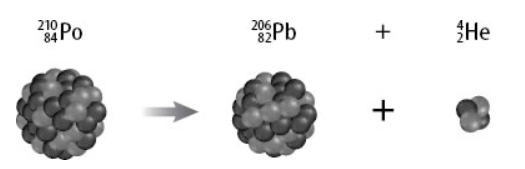
63.

What type of nuclear decay is represented in this illustration?

a)

beta decay

b)

gamma radiation

c)

alpha decay

d)

nuclear fusion

64.

The half-life of Po-218 is three minutes. If it is allowed to decay from 150.0 grams to 2.34 grams, how many half lifes have occured?

a)

6 half lifes

b)

3 half lifes

c)

8 half lifes

d)

5 half lifes

65.
The electron configuration of an atom is 1s22s22p6.  The number of electrons in the atom is 
a)
3
b)
6
c)
8
d)
10
66.
Which electron configuration belongs to Chlorine (Cl)?
a)
1s2 2s2 2p6 3s2 3p5
b)
1s2 2s2 2p6 3s2 3p6
c)
1s2 2s2 2p6 3s2 3p7
67.

The first electron shell holds _______ electrons and the second electron shell holds _________.

a)

2 , 8

b)

8 , 8

c)

8, 10

d)

2, 10

68.
Isotopes of the same element have different ____________. 
a)
 numbers of protons  
b)
numbers of electrons
c)
 symbols 
d)
numbers of neutrons
69.

What is the number of neutrons in Cesium?

a)

55 neutrons

b)

76 neutrons

c)

84 neutrons

d)

106 neutrons

e)

139 neutrons

70.

If there are 146 neutrons in 238U, how many neutrons

are found in the nucleus of 235U?

a)

141

b)

143

c)

145

d)

147

71.

4Si + S8 --> 2Si2S4


What type of reaction is this?

a)

Synthesis

b)

Decomposition

c)

Single displacement

d)

Double displacement

72.
Fe + H2SO4 --> Fe2(SO4)3 + H2
a)
Synthesis (combination)
b)
Decomposition
c)
Single replacement
d)
Combustion
73.
The reaction below is an example of?
AgNO3 + NaCl 
→ AgCl + NaNO3
a)
Single Replacement
b)
Double Replacement
c)
Decomposition
d)
Combustion
74.
What type of reaction is illustrated below?
2HI --> H2  +  I2
a)
synthesis
b)
decomposition
c)
single replacement
d)
double replacement
75.

What are the seven diatomic elements?

a)

H2, Cl2, Br2, O2, N2, I2, F2

b)

H2, Cl2, I2, F2, Hg2, Br2, Fe2

c)

H2, Cu2, Ni2, B2, O2, I2, Fe2

76.
Cl2 + 2KBr → Br2 + 2KCl
How many grams of potassium chloride (KCl) can be produced from 356 g of potassium bromide (KBr)?
a)
749 g
b)
223 g
c)
479 g
d)
814 g
77.

What are the products for a combustion reaction?

a)

Carbon Monoxide

b)

Carbon Dioxide

c)

Methane

d)

Water

78.

Complete the following reaction:

HCl + Mg(OH)2 -->

a)

MgCl2 + H2O

b)

Mg +H2O

c)

MgCl2 + H2

d)

MgCl2 + H2O + CO2