
Font size
 Worksheets
LC2 Revision Whole Course
Total questions: 126
Worksheet time: 1hrs 17mins
Information recorded in your experiment which is used to draw a conclusion is called
reliable
data
hypothesis
observation
Which of the following are an important reason to do repeated trials?
reliable
accurate
valid results
reliable, accurate, and valid results
The change that is tested in an experiment.
hypothesis
data
variable
observation
Uses your senses to gather information.
observation
variable
hypothesis
data
The general steps used when conducting an experiment.
observation
variable
hypothesis
scientific method
A written explanation of what you think will happen, an idea that is tested in an experiment, and may be proven to be true.
observation
variable
hypothesis
data
Study of the natural world through observation and investigation.
Science
Hypothesis
Experiment
Flying monkeys
A plan on how you will conduct your experiment
Data
Procedures
Monkeys
Hypothesis
Is something that is kept the same, remaining unchanged in an experiment.
Control
Variable
Data
P, B, & J
Is a procedure carried out under controlled conditions to test a hypothesis.
Science
Watching YouTube
Experiment
Hypothesis
The information you collect while doing your experiment is called
conclusions
data
hypotheses
procedures
How many independent variables should you have in an experiment?
two
as many as possible
four
one

What is the best source of carbohydrates from the list?
steak
pasta
butter
lucozade
Carbohydrates are made from the elements carbon, hydrogen, oxygen and nitrogen
true
false
Why do we need protein in our diet?
For energy
To grow taller
For growth and repair of muscles
For strong bones and teeth

What are the building blocks of protein?
Concrete blocks
Peptides
Amino acids
Poly peptides
Which of the following assist in digestion by keeping movement and bulk in the stool?
Monosaccharides
Fiber
Lipids
Amino Acids

Which vitamin is lacking when scurvy occurs
Vitamin A
Vitamin E
Vitamin C
Vitamin D
What is ecology?
the study of life
the study of the interactions (connections) among living things, and between living things and their environment
the study of fossils, embryos, homologous structures and how they are evidence of our evolution from a common ancestor
the study of atoms, molecules, organelles and cells

The frog eats the cricket. Give 3 words to describe the frog.
primary consumer (1°), carnivore, autotroph
secondary consumer (2°), herbivore, heterotroph
primary consumer (1°), omnivore, heterotroph
secondary consumer (2°), carnivore, heterotroph

What is a population?
groups of different species living in the same area
group of the same species living in the same area
includes all of the organisms and non-living things in an area
major regional or global community

What is a community?
Different populations of organisms living in the same environment.
One population of organism living in the same environment.
Different populations of organisms living in more than two environments.
One population of organism living in more than two environments.

What is an ecosystem?
The interactions among living and non-living things in an environment.
A type of organism that can only be seen with a microscope.
A bunch of moving parts that do work.
The newest craze in social media.
In an ecosystem, living things are called _ and non-living things are called _.
biotic, abiotic
abiotic, biotic
organisms, decomposers
herbivores, decomposers
Plants that make their own energy from the sun through photosynthesis are called (choose 2) -
carnivores
consumers
autotrophs
producers
Organisms that eat other organisms to get energy are called (choose 2) -
autotrophs
consumers
producers
heterotrophs
An organism that ONLY eats plants is called a(n) (choose 2) -
primary consumer
omnivore
herbivore
carnivore
An organism that only eats other animals is called a (choose 3):
heterotroph
carnivore
consumer
producer
An organism that eats both plants and animals is called a(n) (choose 3) -
a heterotroph
a consumer
an herbivore
an omnivore
Organisms like fungi and bacteria that eat dead organisms are called (choose 3) -
decomposers
consumers
autotrophs
heterotrophs
Which is more complex, a food chain or a food web?
food chain
food web
What is the initial (first or primary) source of energy in every ecosystem?
plants
higher level consumers
the sun
decomposers

The frog eats the cricket. Choose 3 words to describe the frog.
consumer
1° consumer
carnivore
2° consumer
omnivore
If a scientist goes out to a lake to count the number of turtles, this would be an example of what 2 types of observation.
direct
indirect
quantitative
qualitative
Which of the following are abiotic factors (choose 3)?
the number of trees in an area
the wind
the temperature
the amount of light in a place

Name ALL the 3° or tertiary level consumer(s) in the food web.
hawk
shrew
frog
snake

What do the arrows show in the food web?
they show which organisms are doing cellular respiration
they show which way the energy is flowing
they show which organisms are doing photosynthesis
What is the 10% rule?
90% of energy is LOST as you move up the food chain
10% of energy is LOST as you move up the food chain
90% of energy is GAINED as you move up the food chain

What is the function of an objective lens in a compound microscope?
It is where you look into the microscope
It magnifies the image
It controls what enters and leaves the cell
It makes ribosomes
What is the total magnification when using an eyepiece lens with a magnification of x10 and an objective lens with a magnification of x40?
x10
x50
x250
x400
What is the function of the cell membrane?
To give the cell strength and shape
To make protein
To store materials
To control what enters and leaves the cell
Which organelle is responsible for cellular respiration and energy production?
Chloroplasts
Mitochondria
Nucleus
Ribosomes
What is the function of chloroplasts?
To perform photosynthesis
To control the cell's activities
To store materials
To make ribosomes
Which of the following is NOT a difference between plant and animal cells?
Plant cells have a cell wall, while animal cells do not.
Plant cells have chloroplasts, while animal cells do not.
Plant cells have large vacuoles, while animal cells do not.
Plant cells have a nucleus, while animal cells do not.
Which type of cells do not have a nucleus or membrane-enclosed organelles?
Prokaryotic cells
Eukaryotic cells
Animal cells
Plant cells
What is the function of nuclear pores in the nucleus?
To make ribosomes
To control what enters and leaves the nucleus
To perform photosynthesis
To supply energy to the cell
Which microscope uses a beam of electrons to provide a surface view of the specimen?
Transmission electron microscope
Compound microscope
Simple microscope
Scanning electron microscope
Which organelle is responsible for the production of ribosomes?
Nucleus
Cytoplasm
Mitochondria
Chloroplasts
What is the purpose of the cell wall in plant cells?
To control what enters and leaves the cell
To store materials
To make protein
To give the cell strength and shape
Which type of microscope uses a beam of electrons to show the internal structure of a specimen?
Transmission electron microscope
Compound microscope
Simple microscope
Scanning electron microscope
What is the role of chlorophyll in chloroplasts?
To control the cell's activities
To store materials
To make ribosomes
To capture light energy for photosynthesis
What is the function of vacuoles in plant cells?
To control what enters and leaves the cell
To give the cell strength and shape
To store materials
To make protein
Which of the following is a characteristic of prokaryotic cells?
They have a nucleus
They are more advanced than eukaryotic cells
They do not have a membrane-enclosed organelles
They are found in animals, plants, and fungi
What is the purpose of the loop of DNA in mitochondria?
To control the cell's activities
To make ribosomes
To allow mitochondria to self-replicate
To store materials
What is the function of chromatin in a cell?
To control the cell's activities
To make ribosomes
To perform photosynthesis
To store genetic information
What is the function of the nucleolus in the nucleus?
To control the cell's activities
To make ribosomes
To perform photosynthesis
To store materials
What is the total magnification when using an eyepiece lens with a magnification of x5 and an objective lens with a magnification of x10?
x5
x10
x15
x50
What is the function of the cytoplasm in a cell?
To control what enters and leaves the cell
To give the cell strength and shape
To store materials
To provide a medium for chemical reactions
Which Kingdom does Bacteria belong too?
Fungi
Animal
Monera
Protista
What type of cell is bacteria
Prokaryotic
Eukaryotic
Which of the units below is not present in a bacterial cell?
Plasmid
Mitochondria
Flagella
Capsule
What is formed in unfavourable conditions in bacteria?
Zygospore
Endospore
Antibiotics
When an organisms makes their own food they are refereed to as?
Heterotrophic
Autotrophic
In the growth curve for microorganism what is the phase of growth refereed to when death and production rates are equal?
Log Phase
Lag Phase
Decline Phase
Stationary Phase
Antibiotics are chemicals produced by micro-organism that stop the growth of ________________
Microorganisms
Viruses
___________________ means preventing contamination
Sterile
Asepsis
Disinfect
Which food processing has a fixed amount of nutrient medium is added to the bioreactor and inoculated with micro-organisms?
Batch Food Processing
Continuous Flow Food Processing
Saprophytic bacteria are
Bacteria that feed on a living host
Bacteria that feed on dead organisms
Bacteria that use chemical reactions to provide energy
Osmosis is the diffusion of _____________ across a cell membrane.
Air
Oxygen
Water
Food
Why can't you drink salt water?
It's hypertonic to your cells
It's hypotonic to your cells
It's isotonic to your cells
It's paratonic to your cells
An organism that breaks down decaying organic matter for energy
and returns nutrients to the soil is called a _________.
producer
herbivore
consumer
decomposer
Fungi use _________ to reach out and absorb nutrients from animal
waste and decaying organic matter.
hyphae
caps
spores
gills
Wastes and decaying plants and animals are called _________.
fungi
organic matter
decomposers
nutrients
_________ are decomposers that live in animal wastes.
gills
decay
coprophilous fungi
nitrogen and phosphorus
A _________ is a substance needed by an organism to survive and
grow.
hyphae
nutrient
fungus
decomposer
What is the relationship between fungi and the atmosphere?
Fungi take in oxygen from the atmosphere and release carbon
dioxide back to the air.
Fungi take in carbon dioxide from the atmosphere and release oxygen back to the air.
Fungi take in animal waste from the atmosphere and release oxygen back to the air.
Fungi are plants that take in carbon dioxide and release oxygen.
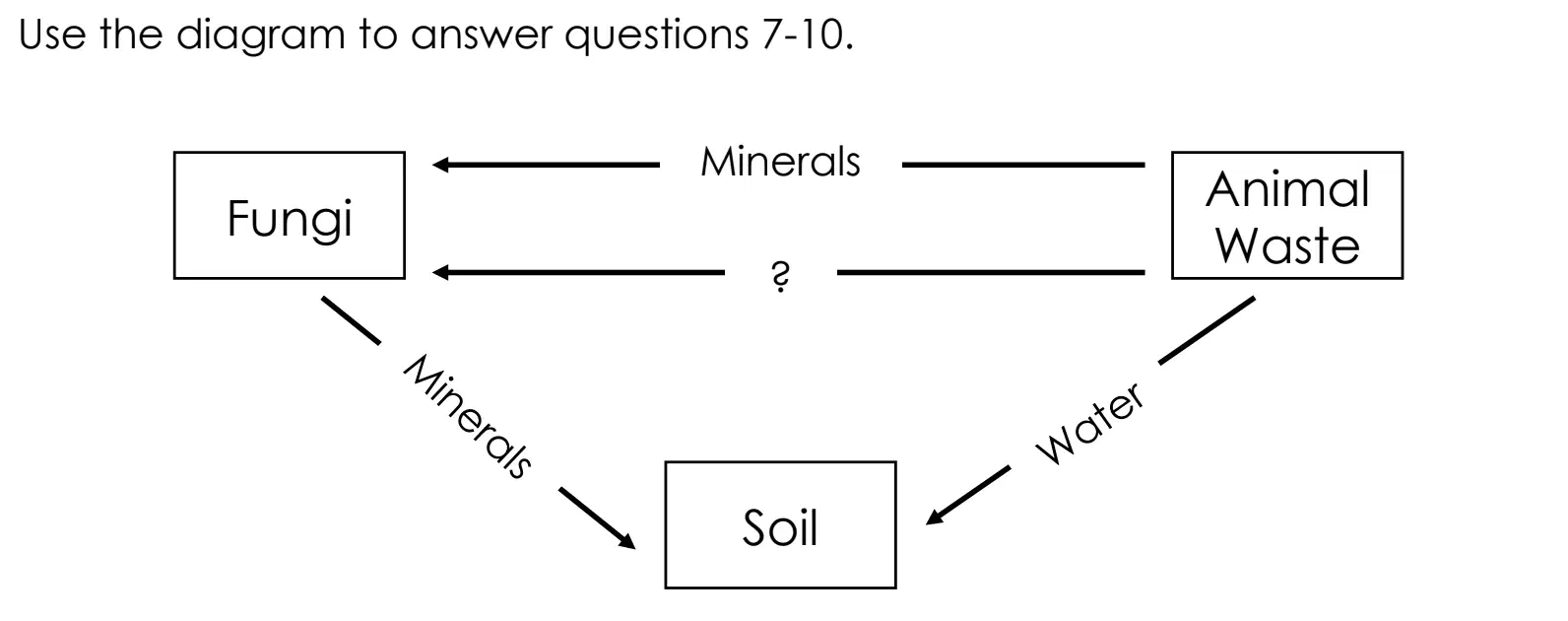
What is the relationship between animal waste and fungi?
Fungi provide starches, sugars, and minerals to animal waste.
Animal waste provides sugar, starches, and minerals to fungi.
Animal waste provides carbon dioxide and oxygen to fungi.
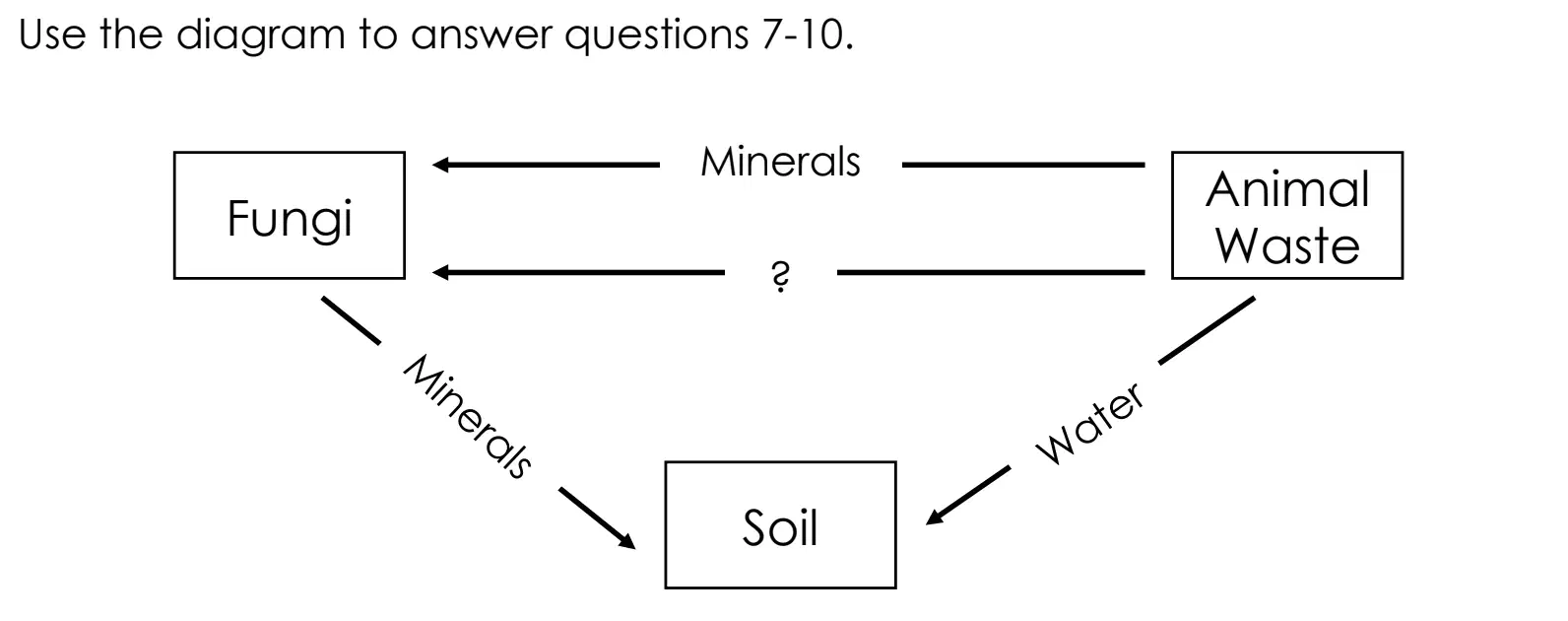
What should be included in place of the question mark?
water
sugar and starches
oxygen
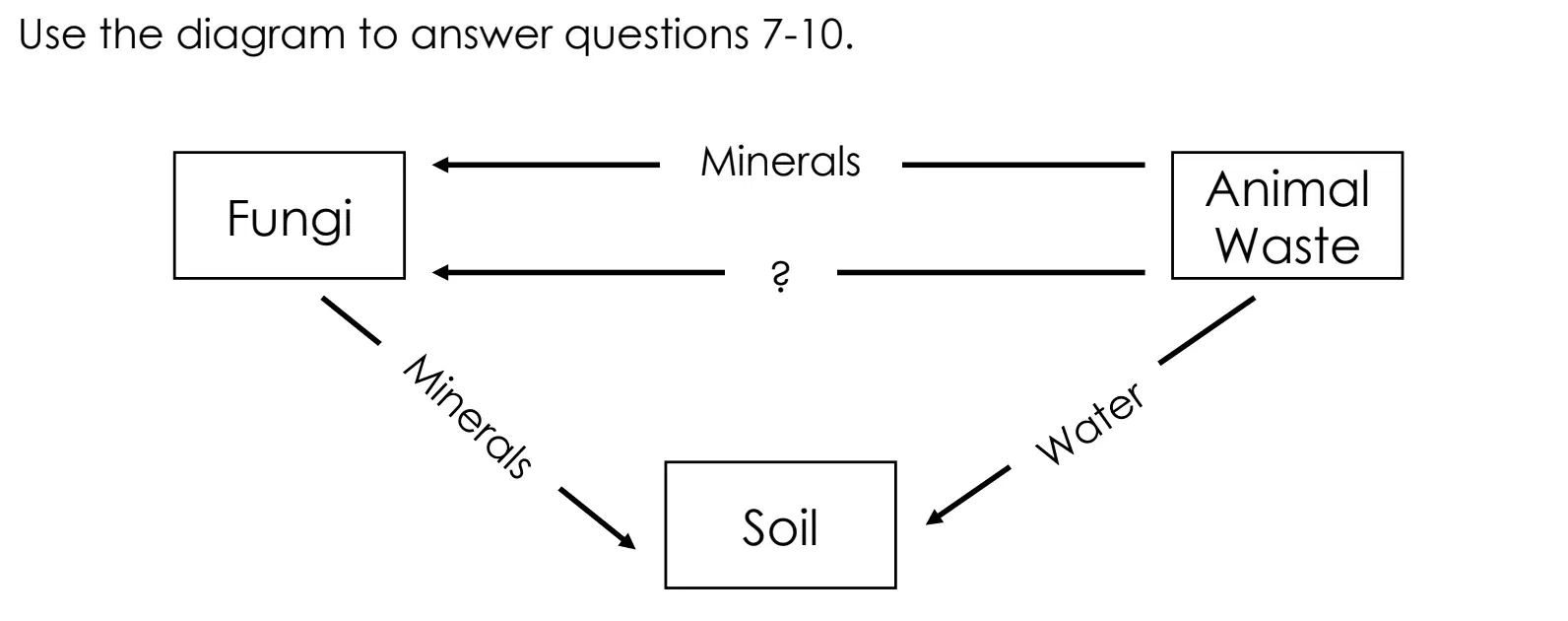
How do fungi connect animal waste to the soil?
Fungi take in water from animal waste and recycle water back
into the soil.
Fungi break down animal waste into simpler parts and recycle minerals back into the soil.
Fungi take in minerals from soil and recycle minerals back into
animal waste.
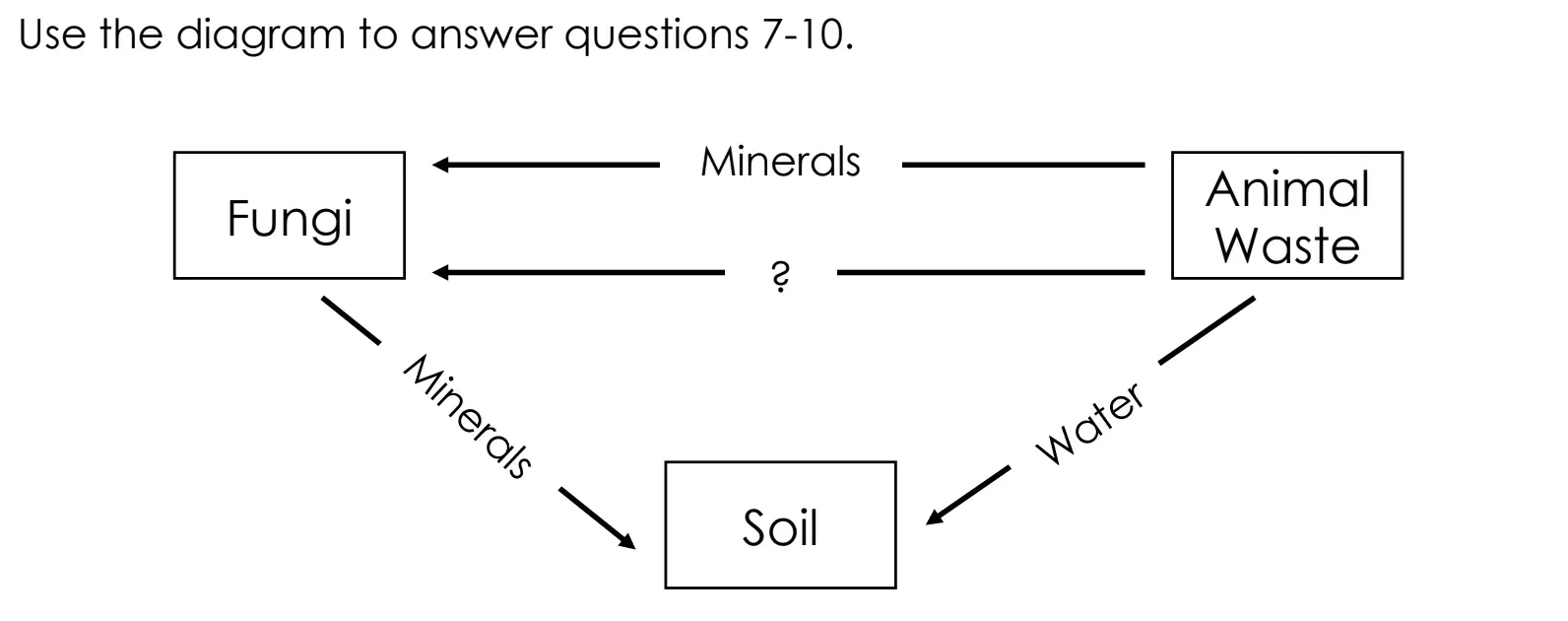
Coprophilous fungi are important because ________.
They keep animal waste from building up and recycle nutrients
into the soil.
They supply oxygen to the atmosphere for plants to use to make energy.
They create more animal waste.

What happens in interphase (choose 2)
Cell grows and developes
DNA lines up in middle
DNA pulls apart
DNA replicates
What happens in Prophase (choose 3)
DNA condenses (packs up)
Spindle fibers appear
Daughter cells separate
DNA lines up in middle
Nuclear envelope (membrane) dissolves
What happens in metaphase? (choose 1)
DNA splits apart
Cell divides
DNA lines up in middle
New nuclei form
What happens in anaphase? (choose 1)
DNA replicates
Chromatids pull apart to opposite sides
DNA lines up in middle
Cell divides
What happens in telophase? (choose 2)
Two new nuclei form
Daughter cells separate into two cells
DNA pulls apart to opposite sides
cytoplasm begins to pinch apart
What happens in cytokinesis? (choose 1)
Daughter cells separate completely as cytoplasm is split into two
Nuclear envelope dissolves
DNA separates apart to opposite sides of the cell
DNA replicates



