
 Worksheets
Standard 2.5 & 2.6 Review
Total questions: 84
Worksheet time: 1hrs 24mins

What is climate?
The temperature in a room at any given time.
Day-to-day changes in temperatures.
Daily rainfall amounts.
Average condition of an area over a long period of time.

What is weather?
Condition of the atmosphere at a particular time
The amount of average sunlight
Condition of the atmosphere over a period of time
Measurement of rain

The temperature of a tropical climate is?
Consistently moderate
Consistently warm
Consistently Cool
Warm & cool

Today it will be cloudy with a 60% chance of rain. Tomorrow it will be sunny and 70 degrees. This is an explanation of …..
Climate
Weather

Regions closest to ________________ tend to have warmer year-round climates.
South Pole
North Pole
Equator
Artic Circle

Higher elevations are warmer than lower elevations.
True
False
What climate does a desert have?
Temperate
Polar
Tropical
Dry/Arid

What climate region is this picture most likely displaying?
Tropical
Arid/Dry
Polar/Sub Artic
Continental
Which of the following would be the best description of the atmosphere?
A mixture of gases in space
Where airplanes fly
Layers of moisture that surround the Earth
Layers of gases that surround the Earth

Which layer contains most of the mass of Earth's atmosphere
Mesosphere
Troposphere
Ionosphere
Thermosphere

Which is true about the Mesosphere?
Home to the northern lights
Lowest layer of the atmosphere
Second layer of the atmosphere
Burns up most asteroids before they reach Earth

Which layer do airplanes and jet fly in?
Mesosphere
Stratosphere
Thermosphere
Troposphere
Which layer is above the Stratosphere?
Ionosphere
Thermosphere
Troposphere
Mesosphere
The lowest layer, where weather occurs is called the ___________________________.
Thermosphere
Mesosphere
Troposphere
Stratosphere
Layer furthest from Earth.
Troposphere
Stratosphere
Mesosphere
Thermosphere
Layer responsible for radio communication.
Troposphere
Stratosphere
Mesosphere
Thermosphere
Exosphere
Layer of the atmosphere where molecules are the furthest apart.
Troposphere
Stratosphere
Mesosphere
Thermosphere

Considered to be outer space.
Troposphere
Stratosphere
Mesosphere
Thermosphere
Exosphere
Which order is correct from the earth to space?
thermosphere
troposphere
exosphere
mesosphere
stratosphere
thermosphere
troposphere
stratosphere
exosphere
mesosphere
exosphere
thermosphere
mesosphere
stratosphere
troposphere
troposphere
thermosphere
stratosphere
exosphere
mesosphere
What are the layers of atmosphere?
Exosphere
Troposphere
Stratosphere
Mesosphere
Thermosphere
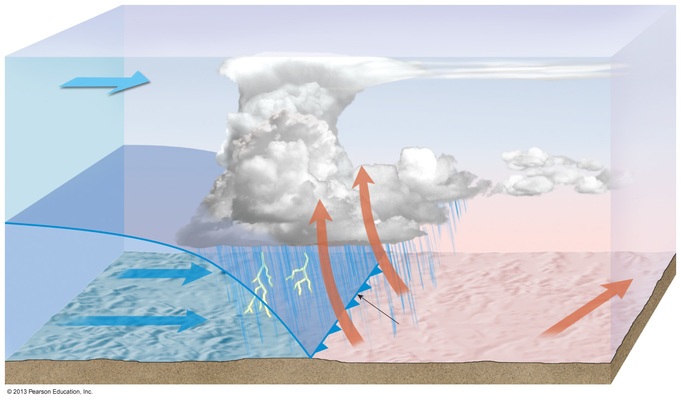
The symbol on a weather map for a cold front is what?
a blue line with triangles on it
a blue line with semi-circles on it
a red line with triangles on it
a red line with circles on it

The symbol on a weather map for a warm front is what?
a blue line with triangles on it
a blue line with circles on it
a red line with semi-circles on it
a red line with circles on it

What causes storm clouds to develop?
dry air rising and cooling
humid air rising and cooling
dry air descending and warming
humid air descending and warming
What might cause a thundercloud to start releasing rain?
increase in temperature
decrease in temperature
Place the following events in sequence: A) A tornado touches down; B) An updraft tilts a column of spinning air; C) Cool, dense air begins descending
C,B,A
B,C,A
A,B,C
C,A,B
In which U.S. state would a hurricane most likely strike?
Florida
Kansas
Vermont
Arizona
How are tropical storms in the Northern Hemisphere different from tropical storms in the Southern Hemisphere?
tropical storms cause more rain in the Southerm Hemisphere
the winds spin faster in the southern hemisphere
the winds spin in opposite direction
This is a disturbance in the atmosphere that is characterized by lightning and thunder.
Tornado
Hurricane
Thunderstorm
None of these
How do tornadoes form?
it forms when moist, warm air meets cool, dry air head on.
it forms when cool, moist air meets warm, dry air head on.
it forms when a warm front and a cold front meet.
it forms when two air masses collide.
How would a hurricane weaken?
move over cold water
move over land
move over warm water
How would a hurricane strengthen?
move over cold water
move over land
move over warm water
What is a hurricane?
warm, moist air rising rapidly, condensing, and forming a big storm cloud
clouds begin swirling, gaining speed, and increases in power
cold, dry air encounters warm moist air over the ocean
a lot of clouds in one area starts spinning and forming the 'eye'
A typhoon is another name for a....
hurricane
tsunami
earthquake
flash flood
The ozone layer protects us from (a)
The ozone layer is damaged by (a)
Dust, ash and pollen are examples of this air pollutant (a)
Indoor air pollution is caused by...
chemicals we bring into our homes and use
outdoor air pollution entering the home
fumes from cooking and baking
smog and acid precipitation
Natural causes of air pollution include all of the following (check all that apply)
forest fires
volcanic ash
wind
pollen
What is the Greenhouse Affect?
As carbon dioxide concentrations increase, temperatures increase
Condition that is caused by carbon dioxide, methane, and water vapor trapping heat in the Earth's atmosphere
causes sea levels to rise because it adds water to the ocean.
The cooling of Earth due to air pollution.
What is causing temperatures to get warmer on earth?
The earth is moving closer to the sun
The sun is just getting hotter; no one knows why
Carbon dioxide and other greenhouse gases are trapping more and more heat from the planet
Air pollution causes all of the following, except
holes in the ozone layer
increased particles in the air
acid rain
healthy air to breath
smog
How do humans cause air pollution?
plowing of fields
burning fossil fuels (coal, oil)
using solar power
driving electric cars
What is the main cause of air pollution?
plowing fields and releasing dust
using solar power
burning fossil fuels
using water power
Climate change caused by extra carbon dioxide in the air that causes heat to get trapped in the atmosphere is called
global warming
photosynthesis
smog
Gases released from power plants mix with water vapor in the sky to make ________________.
smog
acid rain
global warming
particulate matter
What are ways that we can decrease air pollution?
carpool
conserving electricity
follow laws made by the EPA
burning extra fossil fuels

What is the primary source of energy for Earth's climate system?
Heat from Earth's interior
The Sun
Electricity generating power plants
Oil & gas

Why are greenhouse gases like CO2 and methane important to Earth's climate?
They allow heat from Earth to escape the atmosphere
They trap the Sun's energy so that Earth's surface is warm

What happen when CO2 and other greenhouse gases increase in our atmosphere?
Average global temperatures decrease
Average global temperatures increase
The Earth's magnetic field changes direction

Will climate change impacts be the same in all locations on Earth?
The results are the same across the globe
There is no scientific evidence to support an answer
The impacts will vary
All answer choices are accurate

Which of the following would contribute most to sea level rise?
Melting of the Arctic sea ice
Melting of land ice in Greenland and Antarctica
Melting of the glaciers in the Himalayan mountains
Melting of glaciers in Alaska

A primary reason we know that human activity is causing global warming is:
CO2 has decreased in the atmosphere over the past 10 years
Earth's atmosphere is getting thinner
We can correlate the rise of CO2 with human activities
All answer choices are correct
Which of the following have been changed or altered due to climate change ?
droughts
flooding
melting of polar ice caps
all of the above
Which of the following is contributing to an INCREASE in carbon dioxide in the atmosphere?
deforestation
photosynthesis
oceans
all of the above
the loss of animal species

