
 Worksheets
Science Semester Exam Review
Total questions: 91
Worksheet time: 2hrs 31mins
What is produced in cells of ripening fruit?
Auxin
Ethylene
Chlorophyll
Gravity
The venus flytrap will close its “trap” when touched. What is this response called?
gravitropism
environmentaltropism
phototropism
thigmotropism
Which of the following is NOT involved in photosynthesis or cellular respiration?
water
carbon dioxide
chlorophyll
cytokinins

Which letter best represents the part of a seed which develops from the zygote?
A
B
C
D
The growth response related to the number of hours of daylight and darkness is called _____.
gravitropism
photoperiodism
phototropism
photosynthesis
Of the following, which is a short-day plant?
spinach
lettuce
poinsettia
roses
Light, touch, and gravity are all examples of different environmental _____.
auxins
cytokinins
photoperiodism
stimuli
What are the daughter cells of haploid structures called?
zygotes
ovules
conifers
spores
Which part of a flower is the male reproductive organ?
ovary
pistil
stamen
sepal
Which plant part produces the majority of the cytokinins found in plants?
chloroplasts
root tips
stoma
cuticle
Cellular respiration is the process in which organisms break down food to release _____.
energy
nutrients
sugar
oxygen
As much as 90 percent of the oxygen in our atmosphere is the result of _____.
photoperiodism
respiration
thigmotropism
photosynthesis
What cell organelle is necessary for cellular respiration?
mitochondria
chloroplasts
stomata
cell membrane
Which organisms use cellular respiration as a way to covert energy into useable form?
seedless plants only
chloroplasts
only mammals
all organisms
What raw materials does a plant need for photosynthesis?
sugar and carbon dioxide
water and carbon dioxide
water and nitrogen
sugar and water
Plants lean toward the light because of plant hormones called _____.
photoperiodism
auxins
ethylene gas
all of the above
The green color of tree leaves is due to green light energy reflected from _____.
auxins
carbon dioxide
chlorophyll
gibberellins
What are the names of the two categories most seed plants belong to?
haploid and diploid seed plants
angiosperm and pollinating seed plants
mosses and fern seed plants
flowerless and flowering seed plants
Which of the following completes the photosynthesis reaction below?
6CO2 + 6H2O ---> ?
6CO2 + 6H2O
12CO + 4H8O
6C6O2 + H12O
C6H12O6 + 6O2
What must happen to the egg before spores are produced?
The egg must first produce the heart-shaped plant.
The egg must first produce the sperm before fertilization can occur.
The egg must be fertilized before spores are produced.
The fern leaf must produce the egg prior to fertilization.
The two stages of a plant life cycle are called _____.
gymnosperms and angiosperms
spores and zygotes
alternation of generations
ovules and seeds
Plant cells that can develop into new organisms are called _____.
nonvascular plants
self-pollinators
angiosperms
spores
Why is the production of spores an example of asexual reproduction?
Spores use both male and female sex cells to form a new organism.
A spore is a diploid cell and begins reproduction with meiosis,
Spores are the male part of plants which combine with zygotes to form a new organisms.
This stage of reproduction requires only one cell to form a new
organism.

Which number from the image below represents the part of a plant leaf used to move gases in and out of the plant?
1
2
3
4
(a) is a plant's response to the number of hours of daylight and darkness is receives. Plants that require short nights to flower are called (b) , while plants that require 12 or more hours of darkness to flower are called (c) .
Structure D is a(n) ___________.
stamen
pistil
sepal
ovary
petal
Structure A is a(n) ___________.
stamen
pistil
sepal
ovary
petal
Structure E is a(n) ___________.
stamen
pistil
sepal
ovary
petal
Structure C is a(n) ___________.
stamen
pistil
sepal
ovary
petal
Structure B is a(n) ___________.
stamen
pistil
sepal
ovary
petal
Match the following terms to their definitions.
grows from a pollen grain into an ovule
pollen tube
female reproductive organ of a flower
pistil
the stalk part of the stamen
filament
where pollen grains form
anther
contains the reproductive organs of an angiosperm
flower
Match the following terms to their definitions.
can be external or internal
stimulus
can be positive or negative
tropism
plant process that produces food for nearly all the other organisms on Earth
photosynthesis
causes plant stems to exhibit positive response to light
auxin
changes food energy into a form all cells can use
cellular respiration
One cell that undergoes meiosis will yield how many independent cells?
1
2
3
4

How many chromosomes are in a fern's egg?
315
630
945
1260
Hydras reproduce by
Budding
Fission
Regeneration
Sexual reproduction
Each human skin cells has (a) PAIRS of chromosomes

This figures shows what type of asexual reproduction?
Budding
Vegetative reproduction
Animal regeneration
Meiosis
A new organism that results from budding that remains attached to its parent starts to form a ________
Colony
House
Family
Group
The chromatids line up in this phase of meiosis.
Prophase II
Metaphase II
Anaphase II
Telophase II
Parents pass their traits down to their offspring through their _________
Daughter cells
Son cells
Body cells
Reproductive cells
A Punnett square shows all the ways in which ________ can combine.
Alleles
Eggs
Sperm
Colours
A recessive trait is observed when __________ recessive genetic factors are present in offspring.
0
1
2
3
Gregor Mengel studied heredity using _______ plants.
Rose
Pea
Maize
Tundra
Mendel concluded that _______ factors control each inherited trait.
2
3
4
5
Which represents a homozygous recessive genotype?
TT
Tt
tt
TTT
Self-pollination is when the pollen lands on ______
The same plant
The next plant over
The person holding the plant
Back where it came from
Genetics is the study of ____________
Heredity
Dominance
Pea plants
Mutations
Select the traits Mendel recorded
Flower colour
Seed colour
Seed shape
Length of leaf
Which is NOT a human blood phenotype?
O
AB
B
C

If a type A and a type B couple produce offspring, the offspring can be:
Type A or B ONLY
Type O only
Type A, B, AB, or O
Type AB ONLY
A ________ is part of the DNA code on a chromosome.
Gene
Genotype
Phenotype
Gender

Bird a has the genotype bb for bill length, and Bird B is BB. The bills of their offspring would be:
Long in 100% of the offspring
Short in 100% of the offspring
Long in 50% of the offspring
Short in 75% of the offspring
Mendel thought the purple factor was the only factor seen because it _________ the white factor.
Emphasizes
Blocks
Cancels out
Adds to
A genetic factor that blocks another genetic factor is called a
Genetic train
Heredity trait
Recessive trait
Dominant trait
Mendel tested _________ plants
2
5
100
hundreds
Haploid numbers of chromosomes are usually found in the ____ of an organism.
tissues
body cells
sex cells
zygotes
What is the cell called that results from fertilization?
egg
sperm
zygote
diploid
How many times does a reproductive cell divide during meiosis?
1
2
3
4
Sort the terms into the correct categories.
Budding
Vegetative reproduction
Regeneration
Mitotic cell division
Fission
Meiosis
Fertilization
One parent organism
Identical to the parent
No genetic variation
Egg
Sperm
Pollination
Zygote
Genetic variation
Two parent organisms
No mate needed
Needs a mate
Cloning is performed in the (a) .
Chromosome pairs separate in this phase of meiosis.
prophase I
metaphase I
anaphase I
telophase I
A five-armed sea star is cut into five equal pieces. How many sea stars will regenerate?
3
4
5
6
In (a) a body part regrows and may form a new organism.
Sort the animals into the correct categories.
bacteria
archaea
protists
hydra
horses
dogs
trees
butterflies
Which of the following is an example of multiple alleles?
human height
pink flower
blood type
coat with red and white hairs
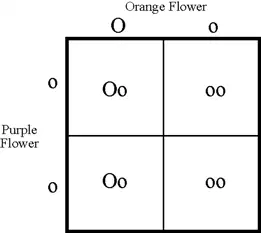
A heterozygous orange-flowered plant is crossed with a homozygous purple-flowered plant. If orange is a dominant allele and purple is recessive, what color ratio will the flowers of the offspring plants have?
1 purple: 3 orange
4 purple: 0 orange
2 purple : 2 orange
0 purple : 4 orange
What type of inheritance determines eye color?
incomplete dominance
codominance
multiple alleles
polygenic inheritance
Sort the information into the correct category.
2 daughter cells
1 nuclear division
Asexual reproduction
Identical daughter cells
4 daughter cells
2 nuclear divisions
Sexual reproduction
Haploid
Diploid
Different daughter cells
What is the main difference between a prokaryotic cell and an eukaryotic cell?
Only prokaryotic cells have vacuoles.
Eukaryotic cells are smaller than prokaryotic cells.
Prokaryotic cells have many organelles, each with their own specialized functions.
Only eukaryotic cells have its genetic material surrounded by a membrane.
Which best explains the function of a cell membrane?
Offers protection from the outside environment
Provides a framework to help the cell move
Transforms energy in the cell into ATP
Removes viruses from inside the cell
Which of these have prokaryotic cells?
Snails
Frogs
Bacteria
Food
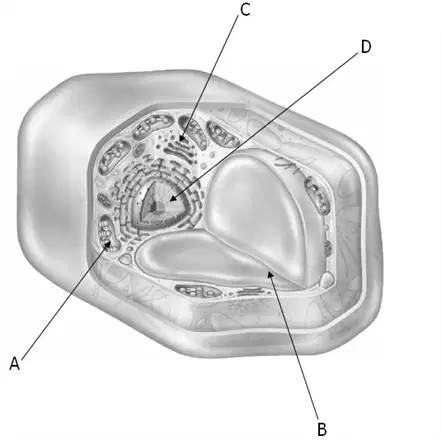
Which letter best represents where nucleic acids would be found?
A
B
C
D
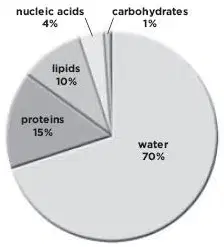
What percent of human cells is made up of macromolecules that provide energy?
11%
15%
25%
74%
Photosynthesis is the process in which plants use energy from light to produce ____.
New cells
Organelles
Food
None of the above
Which substance makes up the macromolecule carbohydrate?
Amino acids
Vitamins
Nucleotides
Sugar

Which type of fermentation is illustrated below?
Lactic-Acid Fermentation
Alcohol Fermentation
Photosynthesis
Cellular Respiration
Which organelle prepares proteins into vesicles to transport from one area of a cell to another?
Golgi apparatus
Chloroplasts
Mitochondrion
Rough endoplasmic reticulum
All of the following are principles of the cell theory EXCEPT _____.
The cell is the smallest unit of life
Water is the main ingredient in every cell
All new cells come from preexisting cells
All living things are made of one or more cells
During periods of strenuous activity, muscle cells run low on ____.
Oxygen
Glucose
Carbon dioxide
Lactic acid
Substances too large to pass through the cell membrane enter the cell in a process called ____.
Endocytosis
Passive transport
Exocytosis
Active transport
What scientist did not contribute to the development of the cell theory?
Theodor Schwann
Matthias Schleiden
Robert Hooke
James Watson
Plant cells that are long and hollow transport ____ and water throughout the plant.
Oxygen
Chlorophyll
Blood
Food
Which substance is broken down during glycolysis?
Glucose
Carbon dioxide
Cytoplasm
Water
Which of the following is NOT involved in photosynthesis or respiration?
Water
Carbon dioxide
Chlorophyll
Cytokinins
Which form of energy is necessary in photosynthesis?
ATP
Lactic acid
Glycolysis
Light
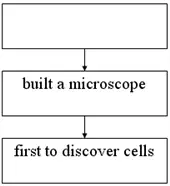
Which scientist belongs in the empty box?
Matthias Schleiden
Theodor Schwann
Rudolf Virchow
Robert Hooke
The green color of tree leaves is due to green light energy reflected from ____.
Auxins
Carbon dioxide
Chlorophyll
Gibberellins
Match each term with the correct description below.
cell membrane
protective layer around all cells
vacuoles
stores food, water, and waste
cytoplasm
gelatinlike material inside cell
cell wall
protects the cells of plants
Match each term with the correct description below.
Golgi bodies
flattened membranes that package protein
mitochondria
where the energy in food is stored
nucleus
directs all the activities of the cell
organelles
structures within the cytoplasm of cells
Match each person with his discovery.
Theodor Schwann
All animals are made up of cells.
Robert Hooke
Cork is made up of cells.
Rudolph Virchow
Cells divide to make new cells.
Matthias Schleiden
All plants are made up of cells.
Drag each type of transport to its correct category.
diffusion
facilitated diffusion
osmosis
endocytosis
exocytosis

