
 Worksheets
AP Chemistry Unit 4: IYKYK
Total questions: 138
Worksheet time: 6hrs 4mins
Unit 4: Combustion reactions produce what two substances?
Water Vapor and Carbon Dioxide
Carbon Dioxide and Oxygen
Oxygen and Water Vapor

Zn + H2O ------> ZnO + H2 During the reaction, which substance is oxidised?
Which half-reaction correctly represents reduction?
Ag --> Ag+ + e-
F2 --> 2 F- + 2e-
Au3+ + 3e- --> Au
Fe2+ + e- --> Fe3+

In any redox reaction, the substance that undergoes reduction will
lose electrons and have a decrease in oxidation number
lose electrons and have an increase in oxidation number
gain electrons and have a decrease in oxidation number
gain electrons and have an increase in oxidation number
Sn(s) → Sn4+(aq) + 4e−
What is oxidation number of Cr in Cr2O72-?
-2
+2
+6
+12
What is the oxidation state of H in H2?
+2
+1
0
None of the above
Reduction is the ___________ of electrons.
loss
gain
sharing
transfer
Oxidation is the _________ of electrons.
loss
gain
sharing
transfer
Half-reactions can be written to represent all
double-replacement reactions
neutralization reactions
fission and fusion reactions
oxidation and reduction reactions
All diatomic elements have an oxidation number of...
0
+1
-1
+2
-2
1. Which of the following processes involves a change in physical properties?
rusting
fermenting
boiling
burning
1. The resistance of a fluid to flow is called
Viscosity
Energy
Density
Pressure
1. If an object is broken in half, it will have
Less density
More volume
More mass
The same density
1. As the viscosity of a liquid increases, the liquid —
a. evaporates more quickly
a. pours more slowly
a. conducts electricity
a. pours more quickly
1. ____ Perfume evaporating on your skin
Physical property
Chemical Property
A nail rusting
Physical Property
Chemical Property
What two things are needed to find the density of an object?
Mass and Velocity
Mass and volume
Speed and mass
Is digesting food a
Chemical change
Physical change
Neither
What are the signs of a chemical change?
Bubbles
Gas
Odor
All of these
Which is a physical change?
dying your hair
dissolving sugar in water
What is the boiling point of water?
100 o C
O o C
32 o F
0 o F
What are sublimation and decomposition?Choose all that apply!
A subconscious suggestion and rotting
Chemical changes in matter that bypass the liquid state
Physical changes in matter that are solid to gas and gas to solid bypassing the liquid state
Physical changes in matter that happen in subzero temperatures that can happen in your freezer and other very cold places.
Physical property
Color
Physical property
Melts at 145 °C
Physical property
Good conductor of heat
Chemical property
Burns easily (flammable)
Chemical property
Reacts violently with chlorine
Chemical change
Burning gasoline
Chemical change
Milk sours
Chemical change
Digesting food
Physical change
Dissolving sugar in water
Physical change
Ethyl alcohol evaporates
CuCl2 + NaOH → Cu(OH)2 + NaCl
Which product is insoluble?
CuCl2(aq) + NaOH(aq) → Cu(OH)2(s) + NaCl(aq)
What is the molarity of a 0.5L sample of a solution that contains 60.0 g of sodium hydroxide (NaOH)
0.8 M
1.5M
3.0M
6.0M
A student is preparing solutions for a laboratory experiment by dissolving solid solutes in liquid solvents. Which action will increase the rate of solubility
lowering the temperature of the solvent
stirring the solute in the solution
increasing the pressure on the solution
increasing the particle size of the solute
Which of the following types of solutions has more room to dissolve solute?
supersaturated
saturated
unsaturated
Which of the following is the correct formula for calculating molarity?
moles/liters of solution
moles/kg of solvent
# particles/Avogadro's #
theoretical yield/actual yield
What is the molality of a solution in which 3.0 moles of NaCl is dissolved in 1.5 Kg of water?
2.0 M
0.22 m
135 m
2.0m
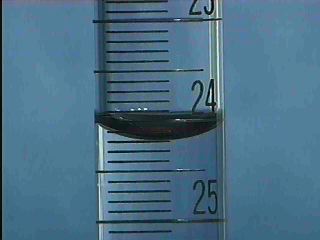
In acid-base titration, the equivalent point is when
a certain amount of acid has reacted completely with a certain amount of base according to stoichiometry
a certain amount of acid has reacted partially with a certain amount of base according to stoichiometry
H2SO4 + 2NaOH --> Na2SO4 + 2H2O
How many moles of H2SO4 will neutralise 14.2 L of 0.01 mol/L NaOH?
1.42 x 10⁴ mol
7.1 x 10⁻⁵ mol
1.42 x 10⁻⁴ mol
7.1 x 10⁵ mol
HCl + NaOH --> NaCl + H2O
What volume of 0.01 mol HCl solution will neutralise
50cm3 of 0.01 mol NaOH solution?
0.25cm3
25cm3
50cm3
100cm3
What of these is always soluble?
Nitrates
Phosphates
Carbonates
Hydroxides
The word "INSOLUBLE" meaning ________
Something which dissolve in water/liquid
Something which cannot dissolve in water/liquid
none
both
Which equation is a double displacement reaction?
Cl2 + 2KI --> 2KCl
Fe + O2 --> Fe2O3
CaCO3 --> CO2 + CaO
CaCO3 + 2HCl --> CaCl2 + H2CO3
___ Na2CO3 + ___ Ag3P → ___ Na3P + ___ Ag2CO3
3, 2, 1, 3
2, 2, 2, 3
3, 2, 2, 3,
3, 2, 3, 2

If making a cheese sandwich is represented by the following "equation": 2 Bd + Ch --> Bd2Ch
what you expect a sandwich to look like?
A
B
C
D

Hydrogen gas and nitrogen gas react in a synthesis reaction to form ammonia (NH3). If the 'before' box represents the reactants, which box correctly represents the contents after the reaction is complete? (Hint: first write a balanced eqn.)
A
B
C
D
E

Sulfur (S) reacts with oxygen gas to form sulfur trioxide. (Write a balanced equation). Which box would be correct for the end of the reaction, given the quantities of reactants in the 'before' box?
A
B
C
D
E
Sulfur (S) reacts with oxygen gas to form sulfur trioxide. (Write a balanced equation). Which box would be correct for the end of the reaction, given the quantities of reactants in the 'before' box?
A
B
C
D
E

The diagram shown represents the reaction of red A with blue B. Write a balanced equation for this reaction.
8 A + 4 B2 --> 4 A2B2
2 A + 2 B2 --> 4 A2B2
2 A + B2 --> A2B2
2 A + B2 --> 2 A2B2

The reaction represented in the boxes is the combustion of methane (CH4) in oxygen. Red = oxygen, black = carbon and white = hydrogen. Write a balanced equation. What is the limiting reactant in the picture shown?
methane (CH4)
oxygen (O2)
carbon dioxide (CO2)
water (H2O)

Which of the following equations best represents the chemical reaction between phosphorous (P4) and oxygen (O2) shown?
3 P4 + 10 O2 --> 4 P2O5 + P4
3 P4 + 10 O2 --> 4 P2O5
P4 + 5 O2 --> 2 P2O5
2 P4 + 10 O2 --> 4 P2O5
2 P4 + 5 O2 --> 2 P2O5 + P4

Hydrogen and oxygen react explosively to form water (write the balanced equation). If the explosion is louder if more water is formed, which balloon will make the loudest noise?
A
B
C
D
What is a limiting reagent in a chemical reaction?
A catalyst that speeds up the reaction
The product formed in the reaction
The reactant that is available in excess
The reactant that is completely used up first, stopping the reaction
What is the result when 2.40 g of Mg reacts with 10.0 g of O2?
Both react completely
No reaction occurs
Mg is the limiting reagent
O2 is the limiting reagent
What happens when the reactants are not mixed in the correct stoichiometric proportions?
One of the reactants will be entirely consumed while another will be left over
The reaction will not occur
The reaction will produce more products
All reactants will be used up completely
When 12 moles of O2 reacts with 1.1 mole of C10H8 what is the limiting reactant? C10H8 + 12 O2 --> 10 CO2 + 4 H2O
Oxygen
C10H8
Water
Carbon Dioxide
Identify the limiting reagent when 6.00 g HCl combines with 5.00 g Mg to form MgCl2.
Mg + 2HCl --> MgCl2 + H2
Mg
H2
MgCl2
HCl
Use the equation 2 Al + 3 Cl2 ---> 2 AlCl3. If 2 moles of aluminum and 2 moles of chlorine are reacted, identify the limiting reactant.
AlCl3
Cl2
Al
4NH3+6NO --> 5N2 + 6H2O
What is the limiting reactant if 3 moles of H2 react with 1 mole of O2?
H2 + 0.5 O2 --> H2O
H2
O2
H2O
Using the reaction 3 Fe + 4 O2 --> 2 Fe3O4, identify the limiting reagent if 5 moles of Fe and 5 moles of O2 are used.
Fe
O2
Fe3O4

Identify the limiting and excess reactants in the reaction shown.
N2 is limiting and H2 is excess.
H2 is limiting and N2 is excess.
NH3 is both limiting and excess.
There is no limiting reactant.
What allows us to know when the end point has been reached?
Bubbles
Feels warm
indicator changing color
Turns to a solid
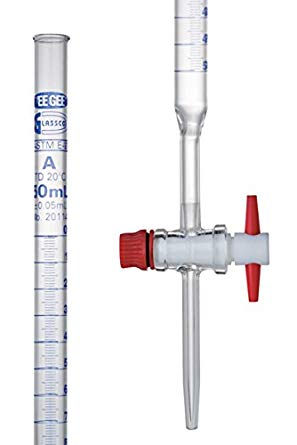
What is this piece of apparatus called
Pipette
Burette
Janette
Cuvette
Why do we perform a titration?
To determine the concentration of an unknown solution
To see if a reaction will occur between an acid and base
To find the mass of an unknown acid
To find the molar mass of an unknown solution
To calculate the viscosity of the solution
What are some things we will need for a titration?
A solution of known concnetration
A burette
indicator
mass balance
a bunsen burner
If it takes 54 mL of 0.1 M NaOH to neutralize 125 mL of an HCl solution, what is the concentration of the HCl? (record you answer with the correct unit)
0.043 M
0.034 M
0.065 M
0.77 M
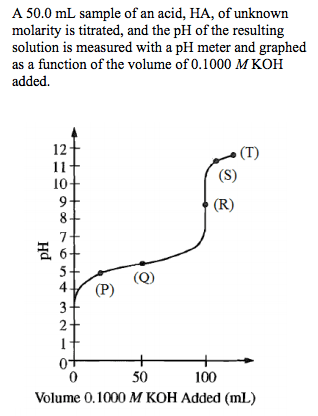
Which point on the titration curve corresponds to the point at which the moles of the added strong base are equal to the moles of the weak acid initially present?
Q
R
S
T

A titration curve is given below.
Which of the following statements is FALSE about this titration?
The acid and base are neutralized at 50 mL
Neutral salt is produced.
A base is neutralized by an acid
The indicator chosen should change color at pH 6-8
Phenolphthalein is a pH indicator. It does not tell the exact pH. It just changes color based on whether it is in an acid or base. Which statement is true for phenolphthalein?
it is colorless in acid and pink in base
it is colorless in base and pink in acid
it changes from green to pink
As the pH of a solution gets lower, the solution becomes more _____.
acidic
basic (or alkaline)
neutral
ionic
Equal amounts of an acid and a base are mixed in a beaker. When neutralization is complete, what is in the beaker besides salt?
acid only
base only
water
Which salt is formed in a reaction between HBr and LiOH?
LiBr
BrLi
NaCl
NaOH

NH3 + H2O → NH4+ + OH-
NH3 is a Bronsted Lowry
Acid
Base
conjugate acid
conjugate base
Which of the following is a neutralization reaction?
2Na + Cl2 → 2NaCl
CH4 + 2O2 → CO2 + 2H2O
HCl + KOH → KCl + H2O
CaCO3 → CO2 + CaO
What is the pH of a reaction between a strong acid and strong base?
0
5
10
7
HNO3 + H2O → H3O+ + NO31-
NO31- is the conjugate base of
H2O
HNO3
H3O+
none of the above
HCO3- + H2O → H3O+ + CO32-
Water is acting as
a Bronsted Lowry base
a Bronsted Lowry acid
a strong acid
a weak acid
HC2H3O2 + H2O → H3O+ + C2H3O21-
HC2H3O2 is acting as
a conjugate base
a Bronsted Lowry base
a Bronsted Lowry acid
none of the above
What is the conjugate base of H2SO4?
SO42-
H2SO3
HSO31-
HSO41-
HBr is the conjugate acid of
Br1-
Br2
H2Br
none of the above
Which of the following is a strong base?
NH3
Zn(OH)2
HCl
CsOH
Which of the following is a strong acid?
NaOH
HCl
HF
H2O


Cl-
How do Bronsted-Lowry conjugate acid-base pairs differ?
differ by one H+
Differ by one OH-
Differ by two H+
Differ by some number of H+
Which of the following correctly identifies an acid-base pair?
HCl, NaOH
H2CO3 , CO32-
H3O+ , OH-
NH4+, NH3
Which of the following correctly identifies an Acid-Base Pair?
HH4+ , OH-
H2O , OH-
CaCO3 ,CaCl2
HNO3 , H2SO4

What is NH4+ classified as?
Acid
Base
Conjugate Acid
Conjugate Base
Which of the following word pairs correctly completes the sentence below? _______ are corrosive substances characterized as having a strong smell, a sour taste, and are able to give up a H+ ion.
Acids
Amphoteric Compound
Bases
Electrolyte
An Arrhenius base:
donates H+
accepts H+
produces H+
produces OH-
Which of the following show an acid and its conjugate base pair (in that order)
H2SO4, SO42-
OH-, H2O
NH4+, H2O
H2CO3, HCO3-

Given the reaction above, which compound is the acid?
NH3
HCl
NH4+
Cl-

Given the reaction above, which compound is the conjugate base?
NH3
NH4+
Cl-
What is NH4+ classified as?
Acid
Base
Conjugate Acid
Conjugate Base
The conjugate acid of HCO3- is ___ and the conjugate base of HCO3- is ___.
Mg → Mg2+ + 2e–
Cl2 + 2e- --> 2Cl - is an example of:
a chemical reaction
redox
oxidation
reduction

