
 Worksheets
102-163, 80-101
Total questions: 80
Worksheet time: 20hrs 0mins
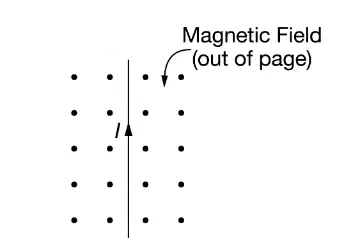
A straight wire carrying a current 𝐼 is in a uniform magnetic field that is directed out of the page, as shown in the figure. Which of the following best illustrates the direction of the magnetic force on the wire?


zero
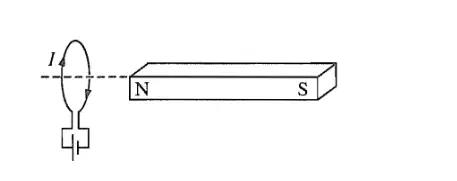
A bar magnet and a wire loop carrying current I are arranged as shown above. In which direction, if any, is the force on the current loop due to the magnet?
Toward the magnet
Away from the magnet
Toward the top of the page
Toward the bottom of the page
There is no force on the current loop.
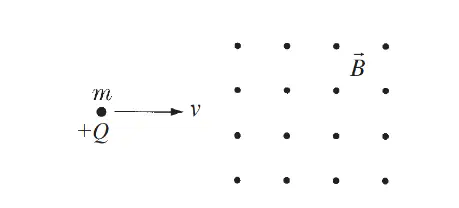
A particle of electric charge +Q and mass m initially moves along a straight line in the plane of the page with constant speed v, as shown above. The particle enters a uniform magnetic field of magnitude B directed out of the page and moves in a semicircular arc of radius R.
Question
Which of the following best indicates the magnitude and the direction of the magnetic force 𝐹→ on the charge just after the charge enters the magnetic field?
Magnitude: 𝑘𝑄^2/𝑅^2
Direction: Toward the top of the page
Magnitude: 𝑘𝑄^2/𝑅^2
Direction: Toward the bottom of the page
Magnitude: QvB
Direction: Out of the plane of the page
Magnitude: QvB
Direction: Toward the top of the page
Magnitude: QvB
Direction: Toward the bottom of the page

A particle of electric charge +Q and mass m initially moves along a straight line in the plane of the page with constant speed v, as shown above. The particle enters a uniform magnetic field of magnitude B directed out of the page and moves in a semicircular arc of radius R.
Question
If the magnetic field strength is increased, which of the following will be true about the radius R?
I. R increases if the incident speed is held constant.
II. For R to remain constant, the incident speed must be increased.
III. For R to remain constant, the incident speed must be decreased.
I only
II only
III only
I and II only
I and III only

Two long, straight, current-carrying wires are parallel to each other in the plane of the page and separated by a distance a, as shown above. The direction of the current I in each wire is toward the top of the page. Which of the following best represents the force per unit length acting on the wires?
A repulsive force of magnitude 2πaμ0I2
A repulsive force of magnitude 2πaμ0I
An attractive force of magnitude 2πaμ0I2
An attractive force of magnitude 2πaμ0I
Zero
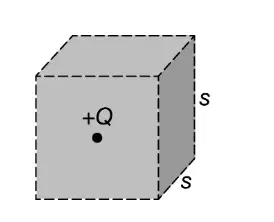
A Gaussian cube with sides of length 𝑠 encloses a single point charge +𝑄. The electric flux through one face of the cube is
0
ϵ0Q
6ϵ0Q
s2ϵ0Q
6s2ϵ0Q
Charge is distributed uniformly throughout a long nonconducting cylinder of radius R. Which of the following graphs best represents the magnitude of the resulting electric field E as a function of r, the distance from the axis of the cylinder?


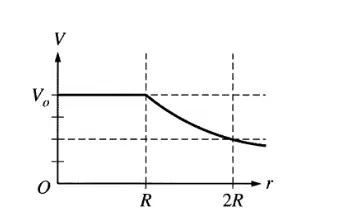
A solid metallic sphere of radius R has charge Q uniformly distributed on its outer surface. A graph of electric potential V as a function of position r is shown above. Which of the following graphs best represents the magnitude of the electric field E as a function of position r for this sphere?


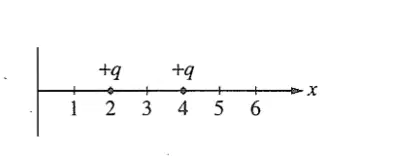
Two charged particles, each with a charge of +q, are located along the x-axis at x = 2 and x = 4, as shown above. Which of the following shows the graph of the magnitude of the electric field along the x-axis from the origin to x = 6?


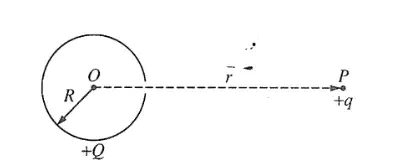
The nonconducting hollow sphere of radius R shown above carries a large charge +Q, which is uniformly distributed on its surface. There is a small hole in the sphere. A small charge +q is initially located at point P, a distance r from the center of the sphere. If k = 1/4𝛑𝛜0 , what is the work that must be done by an external agent in moving the charge +q from P through the hole to the center O of the sphere?
zero
kqQ/r
kqQ/R
kq(Q-q)/r
kqQ(1/R-1/r)
A charged particle can move with constant velocity through a region containing both an electric field and a magnetic field only if the
electric field is parallel to the magnetic field
electric field is perpendicular to the magnetic field
electric field is parallel to the velocity vector
magnetic field is parallel to the velocity vector
magnetic field is perpendicular to the velocity vector
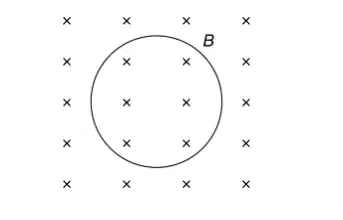
The circular wire loop shown above has resistance 30Ω and area 3.0m2 and is fixed in position in the plane of the page. A uniform magnetic field of magnitude 𝐵 is directed perpendicularly into the plane of the page. The magnetic field begins to decrease, inducing a current of 1.0mA in the loop. The average rate at which the magnitude of the magnetic field is decreasing is most nearly
Responses


A loop of wire enclosing an area of 1.5 m2 is placed perpendicular to a magnetic field. The field is given in teslas as a function of time t in seconds by
B(t)=320t−5
The induced emf in the loop at t = 3 s is most nearly
0 V
5V
10V
15V
20V
A hair dryer is rated as 1200 W, 120 V. Its effective internal resistance is
0.1 𝛀
10 𝛀
12 𝛀
120 𝛀
1440 𝛀
One of Maxwell's equations can be written as ∮𝐸⋅𝑑𝑠=−𝑑𝜙𝑚/𝑑𝑡. This equation expresses the fact that
a changing magnetic field produces an electric field
a changing electric field produces a magnetic field
the net magnetic flux through a closed surface depends on the current inside
the net electric flux through a closed surface depends on the charge inside
electric charge is conserved
Suppose that an electron (charge –e) could orbit a proton (charge +e) in a circular orbit of constant radius R. Assuming that the proton is stationary and only electrostatic forces act on the particles, which of the following represents the kinetic energy of the two-particle system?
4πϵ01⋅Re
8πϵ01⋅Re2
−8πϵ01⋅Re2
4πϵ01⋅R2e2
−4πϵ01⋅R2e2
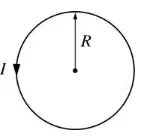
The single, circular wire loop of radius R shown above carries a current I that produces a magnetic field B at the center of the loop. If the current remains constant while the loop is enlarged to a radius of 2R, what happens to the magnetic field at the center?
It decreases to B ∕ 2.
It increases to 2B.
It changes to B2.
It changes to sqrt𝐵.
remains unchanged
In which of the following cases does there exist a nonzero magnetic field that can be conveniently determined by using Ampere's law?
Outside a point charge that is at rest
Inside a stationary cylinder carrying a uniformly distributed charge
Inside a very long current-carrying solenoid
At the center of a current-carrying loop of wire
Outside a square current-carrying loop of wire

A long, straight wire of radius a carries a current I out of the page, which is uniformly distributed over the cross section of the wire. The value of ∮𝐵⋅𝑑𝑙, the line integral of the magnetic field B around the wedge-shaped path, equals which of the following?


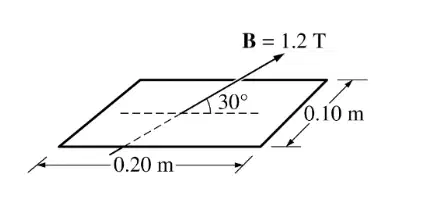
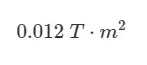
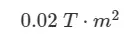
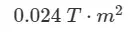
A uniform magnetic field B of magnitude 1.2 T passes through a rectangular loop of wire, which measures 0.10 m by 0.20 m. The field is oriented 30° with respect to the plane of the loop, as shown above. What is the magnetic flux through the loop?
Zero
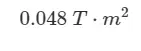
The electric potential is 50 V at point X and 70 V at point Y. What is the minimum average power needed by an external force to move a charge of 4 µC from rest at X to rest at Y in 5 s ?
1.0 × 10⁻³ W
9.6 × 10⁻⁴ W
4.0 × 10⁻⁴ W
8.0 × 10⁻⁵ W
1.6 × 10⁻⁵ W
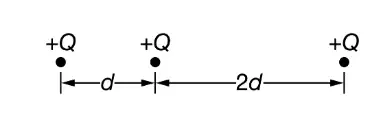
Three small spheres of mass 𝑚 and positive charge 𝑄 are held in the positions shown in the figure above. The object on the right is then allowed to move and is released from rest. Which of the following claims best describes the subsequent motion of the sphere on the right?
The sphere moves to the right with an acceleration that decreases with time.
The sphere moves to the right with a constant acceleration.
The sphere moves to the right with an acceleration that increases with time.
The sphere moves to the left with a constant acceleration.
The sphere moves to the left with an acceleration that decreases with time.
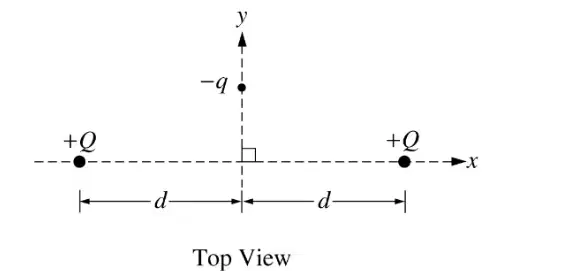
Two objects on a horizontal frictionless surface each have charge +Q and each are fixed in place on the x axis at the same distance d from the origin as shown in the figure above. A particle of charge -q constrained to move along the y axis is released from rest. After release, the particle will
stay where it is
exhibit oscillatory motion
move in the direction of increasing y
move in the direction of decreasing y and stop at the origin
move in the direction of decreasing y and keep going to negative infinity
If the only force acting on an electron is due to a uniform electric field, the electron moves with constant
acceleration in a direction opposite to that of the field
acceleration in the direction of the field
acceleration in a direction perpendicular to that of the field
speed in a direction opposite to that of the field
speed in the direction of the field

The following questions refer to two charges located on the line shown in the figure below, in which the charge at point I is +3q and the charge at point III is +2q. Point II is halfway between points I and III.
Question
The electric potential is negative at some points on the line in which of the following ranges?
To the left of I
Between I and II
Between II and III
To the right of III
None; this potential is never negative.

The following questions refer to two charges located on the line shown in the figure below, in which the charge at point I is +3q and the charge at point III is +2q. Point II is halfway between points I and III.
Question
Other than at infinity, the electric field strength is zero at a point on the line in which of the following ranges?
To the left of I
Between I and II
Between II and III
To the right of III
None: the field is zero only at infinity.
Question
A negatively charged conductor attracts a second object. The second object could be which of the following?
I. A conductor with positive net charge
II. A conductor with zero net charge
III. An insulator with zero net charge
I only
II only
I or III only
II or III only
I, II, or III
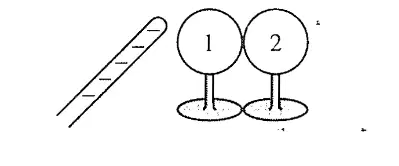
Two initially uncharged conductors, 1 and 2, are mounted on insulating stands and are in contact, as shown above. A negatively charged rod is brought near but does not touch them. With the rod held in place, conductor 2 is moved to the right by pushing its stand, so that the conductors are separated. Which of the following is now true of conductor 2?
It is uncharged.
It is positively charged.
It is negatively charged.
It is charged, but its sign cannot be predicted.
It is at the same potential that it was before the charged rod was brought near.
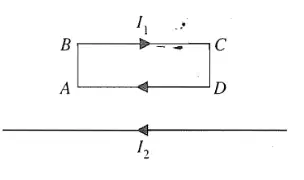
A rigid, rectangular wire loop ABCD carrying current I1 lies in the plane of the page above a very long wire carrying current I2, as shown above. The net force on the loop is
toward the wire
away from the wire
to the left
to the right
zero
Question
When two metal objects, X and Y, are connected to each other by a conducting wire, object X gains electrons. From this information, it can be inferred that before the connection was made, object X, compared with object Y, must have had
less capacitance
more electrical potential energy
a smaller dielectric constant
a greater electric charge
a greater electric potential

A particle of charge +e and mass m moves with speed v perpendicular to a uniform magnetic field B directed into the page. The path of the particle is a circle of radius r, as shown above.
Question
Which of the following correctly gives the direction of motion and the equation relating v and r ?
Direction: Clockwise
Equation: eBr = mv
Direction: Clockwise
Equation: eBr = mv2
Direction: Counterclockwise
Equation: eBr = mv
Direction: Counterclockwise
Equation: eBr = mv2
Direction: Counterclockwise
Equation: eBr2 = mv2
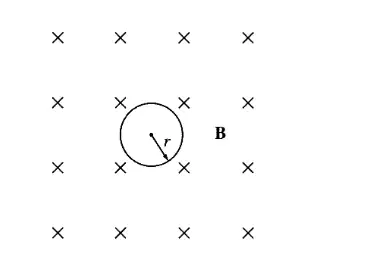
A particle of charge +e and mass m moves with speed v perpendicular to a uniform magnetic field B directed into the page. The path of the particle is a circle of radius r, as shown above.
Question
The period of revolution of the particle is
eBmr
eBm
eB2πm
2πeBm
2πeBmr
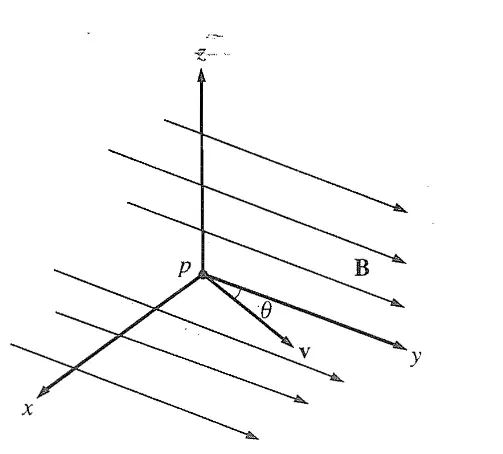
A uniform magnetic field B is parallel to the xy-plane and in the +y-direction, as shown above. A proton p initially moves with velocity v in the xy-plane at an angle 𝛳 to the magnetic field and the y-axis. The proton will subsequently follow what kind of path?
A straight-line path in the direction of v
A circular path in the xy-plane
A circular path in the yz-plane
A helical path with its axis parallel to the y-axis
A helical path with its axis parallel to the z-axis
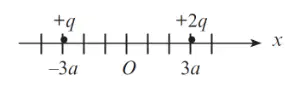
Two charges are located on the x-axis of a coordinate system as shown above. The charge +2q is located at x = +3a and the charge +q is located at x = –3a. Where on the x-axis should an additional charge +4q be located to produce an electric field equal to zero at the origin O?
x=-6a
x=-2a
x=+a
x=+2a
x=+6a
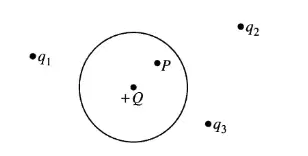
A point charge +Q is inside an uncharged conducting spherical shell that in turn is near several isolated point charges, as shown above. The electric field at point P inside the shell depends on the magnitude of
Q only
Charge distribution on the sphere only
Q and the charge distribution on the sphere
all of the point charges
all of the point charges and the charge distribution on the sphere
A positive point charge is initially at rest close to a bar magnet that is also at rest. The charge will
be attracted to the north pole of the magnet
be repelled by the north pole of the magnet
be attracted to the south pole of the magnet
be repelled by the south pole of the magnet
experience no magnetic force
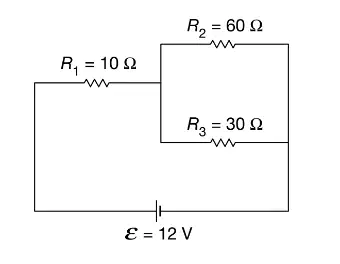
In the circuit shown above, the potential difference across 𝑅2 is most nearly
Zero
4.0V
6.0V
8.0V
12V
In a certain region, the electric field along the x-axis is given by
E = ax + b, where a = 40 V/m2 and b = 4 V/m.
The potential difference between the origin and x = 0.5 m is
-36V
-7V
-3V
10V
16V
A wire of resistance R dissipates power P when a current I passes through it. The wire is replaced by another wire with resistance 3R. The power dissipated by the new wire when the same current passes through it is
P/9
P/3
P
3P
6P
When two identical resistors are connected in series to a battery, the total power dissipated is P. When the same two resistors are connected in parallel to the same battery, the total power dissipated is
1/4 P
1/2 P
P
2P
4P
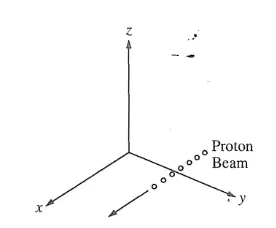
A beam of protons moves parallel to the x-axis in the positive x-direction, as shown above, through a region of crossed electric and magnetic fields balanced for zero deflection of the beam. If the magnetic field is pointed in the positive y-direction, in what direction must the electric field be pointed?
Positive y-direction
Positive z-direction
Negative x-direction
Negative y-direction
Negative z-direction
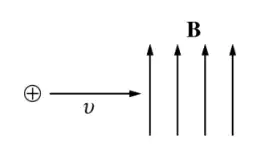
A proton moving to the right at constant speed u enters a region containing uniform magnetic and electric fields and continues to move in a straight line. The magnetic field B is directed toward the top of the page, as shown above. The direction of the electric field must be
into the page
out of the page
to the left
to the top of the page
to the bottom of the page
A parallel-plate capacitor has charge +Q on one plate and charge -Q on the other. The plates, each of area A, are a distance d apart and are separated by a vacuum. A single proton of charge +e, released from rest at the surface of the positively charged plate, will arrive at the other plate with kinetic energy proportional to
Responses
edQ/A
Q^2/eAd
AeQ/d
Q/ed
eQ^2/Ad
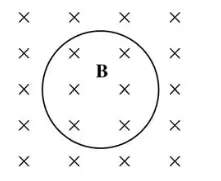
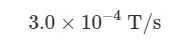
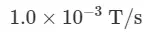
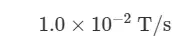
The circular wire loop shown above has resistance 30 𝛀 and area 3.0 m2, and is fixed in position in the plane of the page. A uniform magnetic field B is directed perpendicularly into the plane of the page. The constant rate at which the magnetic field would have to change in order to induce a current of 1.0 mA in this loop is most nearly
Responses
3.0 × 10⁻⁴ T/s
3.0 × 10⁻⁴ T/s
1.0 × 10⁻³ T/s
3.0 × 10⁻³ T/s
1.0 × 10⁻² T/s
3.0 × 10⁻² T/s
Two conducting cylindrical wires are made out of the same material. Wire X has twice the length and twice the diameter of wire Y. What is the ratio 𝑅𝑥/𝑅𝑦 of their resistances?
1/4
1/2
1
2
4

When the switch S is open in the circuit shown above, the reading on the ammeter A is 2.0 A. When the switch is closed, the reading on the ammeter is
doubled
increased slightly but not doubled
the same
decreased slightly but not halved
halved
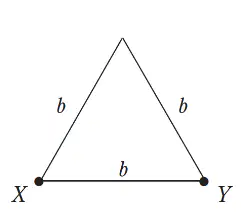
Wire of resistivity 𝜌 and cross-sectional area A is formed into an equilateral triangle of side b, as shown above. The resistance between two vertices of the triangle, X and Y, is
23ρbA
3ρbA
32⋅Aρb
23⋅Aρb
3⋅Aρb
Question
A metal wire has a resistance R when it is at a temperature T. The wire is melted and all of the metal is used to reform it into a new wire 4 times as long. What is the resistance of the new wire at temperature T ?
R
2R
4R
8R
16R
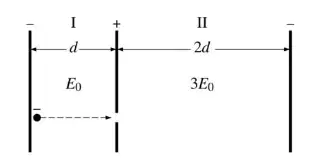
A negatively charged particle initially in region I, as shown above, is accelerated from rest by an electric field of magnitude E0 between two parallel plates separated by a distance d. The particle then enters region II, the space between two parallel plates with a separation 2d and an electric field of magnitude 3E0 in the opposite direction. How far into region II does the particle travel before reversing direction?
d/3
d/2
2d/3
d
3d/2

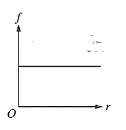
A negatively charged particle in a uniform magnetic field B moves in a circular path of radius r, as shown above. Which of the following graphs best depicts how the frequency of revolution 𝑓 of the particle depends on the radius r ?
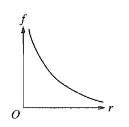
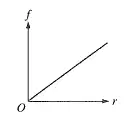
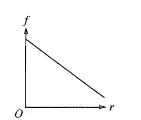
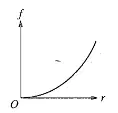
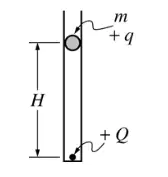
A small sphere of mass m and charge +q is constrained to move vertically in an insulating cylinder, as shown above. At the bottom of the cylinder is a point charge +Q. At what height H above the bottom of the cylinder will the small sphere of mass m be in equilibrium?
Responses


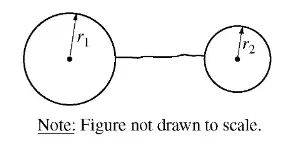
A metal sphere with radius r1 has a total electric charge of magnitude q. An uncharged metal sphere with radius r2 (with r1 > r2) is then connected by a wire to the first sphere, as illustrated above. The separation of the spheres is much greater than the radius of either sphere. When equilibrium is reached, the spheres will have
charges on their surfaces of equal magnitude and the same sign
charges on their surfaces of equal magnitude and opposite sign
equal electric fields at their surfaces
equal capacitances
equal electric potentials
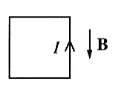
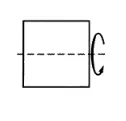
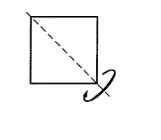
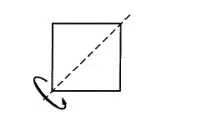
A square loop of wire carrying a current I is initially in the plane of the page and is located in a uniform magnetic field B that points toward the bottom of the page, as shown above. Which of the following shows the correct initial rotation of the loop due to the force exerted on it by the magnetic field?

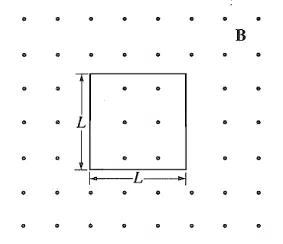
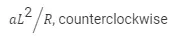
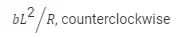
A square wire loop with side L and resistance R is held at rest in a uniform magnetic field of magnitude B directed out of the page, as shown above. The field decreases with time t according to the equation B = a – bt, where a and b are positive constants. The current I induced in the loop is
zero


All the following statements about an isolated, solid charged conductor are correct EXCEPT:
All parts of the conductor are at the same potential.
All excess charge resides on the outer surface.
The net charge enclosed by any surface lying entirely within the conductor must equal zero.
The electric field E just outside the conductor is directed parallel to the surface.
The electric field intensity inside the conductor is zero.
A capacitor charged to a potential difference V stores an amount of energy U0 . If the potential difference is doubled, what is the new stored energy?
U0/4
U0/2
U0
2U0
4U0
Three resistors having resistances of 3 Ω, 6 Ω, and 9 Ω, respectively, are connected in parallel with a 10 V battery. True statements about the circuit include which of the following?
I. The current in the 9 Ω resistor is three times the current in the 3 Ω resistor.
II. The potential difference across each resistor is the same.
III. The power dissipated in the 9 Ω resistor is greater than the power dissipated in either of the other two resistors.
I only
II only
I and II only
II and III only
I, II, and III
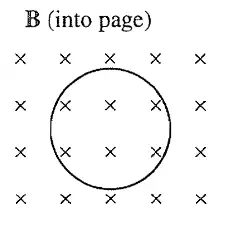
A wire loop of area A is placed in a time-varying but spatially uniform magnetic field that is perpendicular to the plane of the loop, as shown above. The induced emf in the loop is given by 𝜀=𝑏𝐴𝑡1/2, where b is a constant. The time-varying magnetic field could be given by


A student wants to construct an inductor of a given inductance using copper wire and a plastic tube. If a sufficient supply of copper wire is available, the student will also need a
meterstick only
secondary coil and a meterstick
resistor of known resistance and a meterstick
voltmeter and a meterstick
voltmeter and a DC power supply
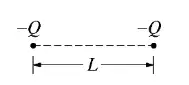
Two particles each with a charge -Q are fixed a distance L apart as shown above. Each particle experiences a net electric force F. A particle with a charge +q is now fixed midway between the original two particles. As a result, the net electric force experienced by each negatively charged particle is reduced to F/2. The value of q is
Q
Q/2
Q/4
Q/8
Q/16
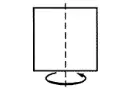
A loop of wire carrying a steady current I is initially at rest perpendicular to a uniform magnetic field of magnitude B, as shown above. The loop is then rotated about a diameter at a constant rate. The torque on the loop is maximum when the loop has rotated, with respect to its initial position, through an angle of
30°
45°
90°
180°
360°
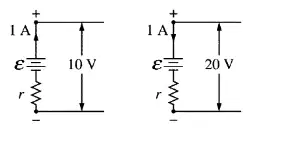
The figures above show parts of two circuits, each containing a battery of emf 𝜀 and internal resistance r. The current in each battery is 1 A, but the direction of the current in one battery is opposite to that in the other. If the potential differences across the batteries' terminals are 10 V and 20 V as shown, what are the values of 𝜀 and r ?


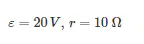
The values cannot be computed unless the complete circuits are shown.
A circular current-carrying loop lies so that the plane of the loop is perpendicular to a constant magnetic field of strength B. Suppose that the radius R of the loop could be made to increase with time t so that R = at, where a is a constant. What is the magnitude of the emf that would be generated around the loop as a function of t ?


The following questions are related to this scenario:
A circuit consists of a resistor R, an inductor L, and an open switch S connected in series with a battery. The switch is then closed at time t = 0.
If the current in the circuit is I at time t, what energy is stored in the circuit in addition to that stored in the battery?
LI
I2R

LI + I2R

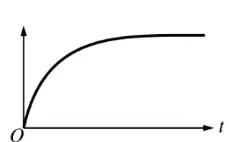
The following questions are related to this scenario:
A circuit consists of a resistor R, an inductor L, and an open switch S connected in series with a battery. The switch is then closed at time t = 0.
Which of the following quantities could be represented as a function of time by the graph shown above?
I. The potential difference across the resistor
II. The potential difference across the inductor
III. The current in the circuit
I only
II only
I and III only
II and III only
I, II, and III
The following questions are related to this scenario:
A circuit consists of a resistor R, an inductor L, and an open switch S connected in series with a battery. The switch is then closed at time t = 0.
The change in current when the switch is closed is determined by the inductive time constant t. If the inductance is doubled and the resistance is halved, the new inductive time constant t equals
41τ
21τ
τ
2τ
4τ
A 20 µF parallel-plate capacitor is fully charged to 30 V. The energy stored in the capacitor is most nearly
9 × 10³ J
9 × 10⁻³ J
6 × 10⁻⁴ J
2 × 10⁻⁴ J
2 × 10⁻⁷ J
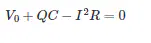
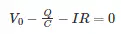
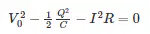
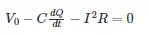
A resistor R and a capacitor C are connected in series to a battery of terminal voltage V0. Which of the following equations relating the current I in the circuit and the charge Q on the capacitor describes this circuit?

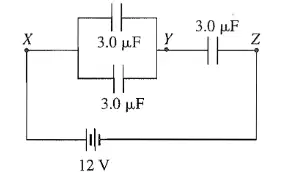
Three identical capacitors, each of capacitance 3.0 µF, are connected in a circuit with a 12 V battery as shown above.
The equivalent capacitance between points X and Z is
1.0 µF
2.0 µF
4.5 µF
6.0 µF
9.0 µF
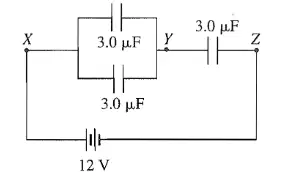
Three identical capacitors, each of capacitance 3.0 µF, are connected in a circuit with a 12 V battery as shown above.
The potential difference between points Y and Z is
zero
3V
4V
8V
9V
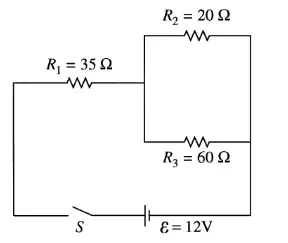
In the circuit shown above, the equivalent resistance of the three resistors is
10.5 𝛀
15 𝛀
20 𝛀
50 𝛀
115 𝛀
When two resistors having resistances R1 and R2 are connected in parallel, the equivalent resistance of the combination is 10 Ω. Which of the following statements about the resistances is true?
Both R1 and R2 are greater than 10 Ω.
Both R1 and R2 are equal to 10 Ω.
Both R1 and R2 are less than 10 Ω.
The sum of R1 and R2 is 10 Ω.
One of the resistances is greater than 10 Ω, and the other is less than 10 Ω.
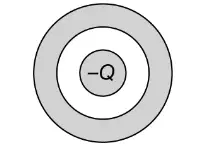
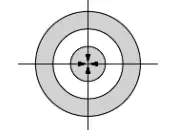
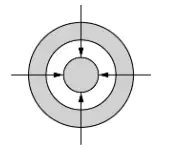
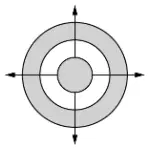
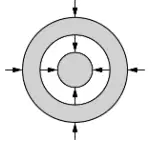
A conducting sphere has a charge −𝑄, and is surrounded by a concentric spherical conducting sphere that has no net charge. Which of the following best shows the electric field lines in the region of the two spheres?
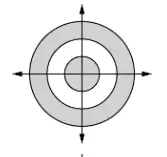
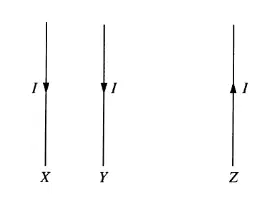
The currents in three parallel wires, X, Y, and Z, each have magnitude I and are in the directions shown above. Wire Y is closer to wire X than to wire Z. The magnetic force on wire Y is
zero
into the page
out of the page
towards the bottom of the page
towards the left
Resistors 1 and 2 are connected in series to the same battery. The resistors are made of the same material, but resistor 1 has twice the length and half the diameter of resistor 2. If the rate at which energy is dissipated in resistor 2 is 𝑃, what is the rate at which energy is dissipated in resistor 1?
81P
41P
P
4P
8P
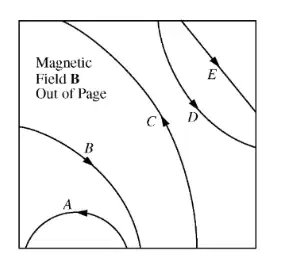
The figure above shows the paths of five particles as they pass through the region inside the box that contains a uniform magnetic field B directed out of the page. Which particle has a positive charge?
A
B
C
D
E
Two parallel wires, each carrying a current I, repel each other with a force F . If both currents are doubled, the force of repulsion is
2F
22F
4F
42F
8F
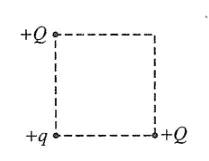
As shown above, two particles, each of charge +Q, are fixed at opposite corners of a square that lies in the plane of the page. A positive test charge +q is placed at a third corner.
What is the direction of the force on the test charge due to the two other charges?


As shown above, two particles, each of charge +Q, are fixed at opposite corners of a square that lies in the plane of the page. A positive test charge +q is placed at a third corner.
If F is the magnitude of the force on the test charge due to only one of the other charges, what is the magnitude of the net force acting on the test charge due to both of these charges?
Zero
2F
F
2F
2F
A magnetic field perpendicular to the plane of a wire loop is uniform in space but changes with time t in the region of the loop. If the induced emf in the loop increases linearly with time t, then the magnitude of the magnetic field must be proportional to
t3
t3
t
t0 (i.e., constant)
t1/2

