wayground logo

Free Printable Worksheets

Font size

S
M
L
XL
Worksheets

2024 Final Exam Review

Total questions: 134

Worksheet time: 1hrs 8mins

Name
Class
Date
1.
Microfossil is viewed under a microscope high power objective. If the magnification of the eyepiece is 10X and the magnification of the high power objective is 40X, how many times larger does the microfossil appear?
a)
4
b)
4000
c)
40
d)
400
2.
Shawn is planning a scientific experiment. He wants to learn whether the time of day has an effect on how far the roses in his mother's garden are open. He plans to measure the diameter of each flower on three rose bushes every hour during a week in the spring. What is the independent variable in Shawn's experiment?
a)
The time of day
b)
The diameter of the flowers
c)
The number of flowers
d)
The time of year
3.
What is the measurement shown here on the triple beam balance?
a)
130.2 g
b)
132.0 g
c)
132.5 g
d)
137.0 g
4.
Arturo was mixing chemicals in the science lab when some of the chemicals accidentally splashed up into his eyes. What will Arturo’s teacher tell him to do?
a)
Flush his eyes with running water for at least 15 minutes.
b)
Put contact lenses in.
c)
Put his safety goggles on.
d)
Look directly into the sun.
5.
The matter you see is made of particles you cannot see. The smallest part of an element is a (n) ____________________ .
a)
element
b)
mixture
c)
molecule
d)
atom
6.
Substances that cannot be broken down into any other substances by chemical or physical means is a (n) ____________.
a)
element
b)
mixture
c)
molecule
d)
compound
7.
Two or more different elements chemically combined is a (n) _____________.
a)
atom
b)
mixture
c)
molecule
d)
compound
8.
On the periodic table, identify the rules for writing element symbols
a)
All letters are capitalized
b)
First letter is capitalized, second letter is lowercase
c)
All letters are lowercase
d)
First letter is lowercase, second letter is capitalized
9.
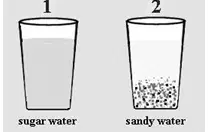
Ashley made a mixture of sugar and water and a mixture of sand and water. Which of the following is true?
a)
Both mixtures are homogeneous.
b)
Both mixtures are heterogeneous.
c)
The sugar and water is heterogeneous.
d)
The sand and water is heterogeneous
10.
The mass of the cube is 15 grams and the volume is 5 milliliters. What is the density of the cube?
a)
3 mL/g
b)
3 g/mL
c)
75 g/mL
d)
75 mL/g
11.
According to the law of conservation of matter, which statement about chemical reactions is true?
a)
Energy is created as atoms are destroyed in chemical reactions.
b)
Atoms are created by some reactions and destroyed by chemical reactions.
c)
Atoms cannot be created or destroyed by chemical reactions.
d)
Every atom destroyed in a chemical reaction must be replaced.
12.
You can describe a lemon as being oval, yellow colored, and sour tasting. All of these are _________________.
a)
Chemical properties
b)
Physical properties
c)
Chemical changes
d)
Physical change
13.
As the kinetic energy of an object increases, so does the _________ energy produced.
a)
heat
b)
potential
c)
atomic
d)
light
14.
A father and his 6 year old son race down a mountain on skis. If they're traveling at the same speed, who has more kinetic energy?
a)
the father
b)
the son
c)
they have the same kinetic energy
d)
neither the father or the son will have kinetic energy
15.
A hair dryer converts
a)
electrical energy into chemical energy
b)
electrical energy into thermal energy
c)
chemical energy into mechanical energy
d)
thermal energy into mechanical energy
16.
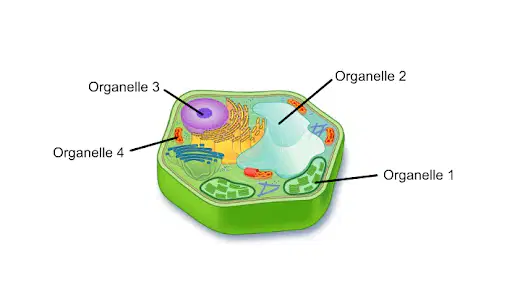
Which organelle uses energy from the sun in order to form food?
a)
Organelle 1 – chloroplast
b)
Organelle 2 – vacuole
c)
Organelle 3 – nucleus
d)
Organelle 4 – mitochondria
17.
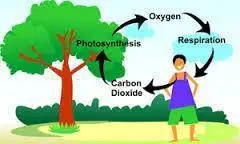
What cycle is the diagram showing?
a)
Carbon dioxide is necessary for respiration.
b)
Oxygen is produced during respiration.
c)
Oxygen is produced during photosynthesis
d)
Carbon dioxide is produced during photosynthesis.
18.
Which of these is required to complete the equation for respiration?
a)
Six molecules of carbon dioxide gas
b)
Six molecules of oxygen gas
c)
Six molecules of simple sugar
d)
Six molecules of water
19.
The main reason that cells carry out cellular respiration is to ______________.
a)
Release energy
b)
Eliminate waste
c)
Get glucose
d)
Breath
20.
Which choice below shows the organization of the biosphere from most specific to the broadest category?
a)
Organism → Population → Community → Ecosystem →Biosphere
b)
Organism → Community → Population → Biosphere → Ecosystem
c)
Organism → Community → Population → Ecosystem → Biosphere
d)
Organism → Population → Community → Biosphere → Ecosystem
21.
According to the energy pyramid, which level has the most energy available to it?
a)
Producers
b)
Primary consumers
c)
Secondary consumers
d)
Tertiary consumer
22.
Which of the following organisms is a producer in the food web?
a)
Grass
b)
Duck
c)
Snake
d)
Grasshopper
23.
What would be the result of an increase in the population of the snake?
a)
an decrease in the population of the grasshopper, and kookaburra
b)
an increase in the population of rabbits and mouse
c)
an increase in the population of both kookaburra and wedge-tailed eagle
d)
an increase in the grasshopper and mouse
24.
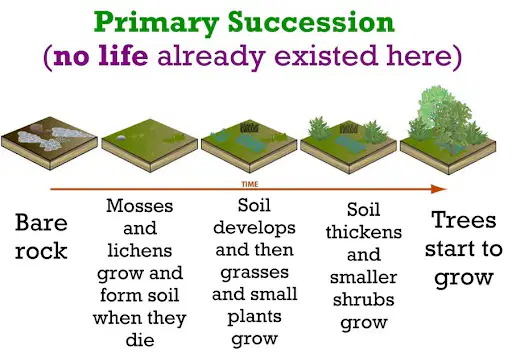
The process by which a new community forms where no community lived before is called_________?
a)
resource
b)
primary succession
c)
invasive species
d)
competition
25.
A pioneer species is
a)
a large organism.
b)
the best organism
c)
the first organism to adapt to a new environment
d)
abiotic factor
26.
What abiotic factor is formed during primary succession that doesn’t need to be formed during secondary succession?
a)
pioneer species
b)
soil
c)
climax community
d)
lichens
27.
What is the difference between a primary vs. secondary succession?
a)
secondary succession occurs when there was no previous community
b)
they are both the same
c)
secondary succession occurs only in an area that was partially destroyed
d)
primary succession occurs only in an area that was partially destroyed
28.
When the combustion engine was invented it had many positive effects on society, but years later it has been discovered that the burning of oil and coal has one major negative effect on the environment. What is that negative effect?
a)
It causes a hole in the ozone.
b)
It improves air quality.
c)
It uses renewable resources.
d)
It increases the greenhouse effect.
29.
An increase in Earth’s average temperature due to the buildup of carbon dioxide and other gases in Earth's atmosphere is called
a)
global warming
b)
thermal pollution
c)
ozone buildup
d)
bioremediation
30.
Ice cores from Antarctica allow scientists to measure the amounts of atmospheric carbon dioxide from long ago. These samples would BEST provide evidence for
a)
the big bang theory
b)
magnetic field reversal
c)
climate change
d)
continental drift.
31.
Every year the number of vehicles running on the roads is increasing. These vehicles release many harmful gases into the atmosphere. What effect does this have on living things?
a)
The gases mix with rain and add more nutrients to aquatic ecosystems.
b)
Microorganisms thrive under these conditions and grow in number.
c)
It causes respiratory disorders in humans and animals.
d)
Plants cannot complete the process of photosynthesis.
32.
Global warming is caused by an increase in the level of carbon dioxide gas in the atmosphere. How has this affected the world's oceans?
a)
The oceans reflect a great deal of the carbon dioxide gas back into the atmosphere.
b)
The oceans are absorbing the excess carbon, causing the oceans to become acidic.
c)
There is an overgrowth of algae.
d)
The oceans are cooling as a result of the excess carbon dioxide.
33.
The result of global warming is an increase in the earth's temperature. Which ecosystem would most likely be eliminated as a result of this temperature increase?
a)
desert
b)
tundra
c)
grassland
d)
marine
34.
There are many methods used to obtain energy for use in our daily lives. Some of these methods have possible environmental consequences to rivers, groundwater, and organisms. Which types of energy sources have very few or no negative environmental consequences?
a)
coal and petroleum
b)
solar and nuclear
c)
wind and solar
d)
petroleum and nuclear
35.
Fresh water is one of the most important natural resources on earth. Above is a chart that shows how water is used by a typical family. Below are four ways you can conserve water. Which would conserve the most water?
a)
Stopping all the leaks in your house.
b)
Taking showers only, no baths.
c)
Handwashing dishes instead of using a dishwasher.
d)
Taking showers that are only half as long.
36.
Based on the information in the chart, which list contains human-harnessed (produced by humans) sources of electricity?
a)
sunlight, lightning, water
b)
fossil fuels, wind, static
c)
static, water, fossil fuels
d)
sunlight, wind, water
37.
Based on information in the chart, which statement is true?
a)
Static is human-harnessed (produced by humans) because it requires friction between man-made objects.
b)
Sunlight is a naturally-occurring electricity source so it does not need to be converted.
c)
Human-harnessed sources, like wind, do not need to be converted to make electricity.
d)
Naturally-occurring sources, like lightning, do not need to be converted to make electricity.
38.
Wind energy is currently being used in the production of electricity. One way is through the use of windmills. What is the main advantage of using windmills?
a)
They are non polluting.
b)
They are 90 percent efficient.
c)
They can be used anywhere.
d)
They are quiet
39.
Farmer Brown is planting crops in his fields. He wants to prevent the topsoil from being blown away by the wind or washed away by water. Which of these steps should he take?
a)
leave the land free of crops for a long time
b)
plant crops close together
c)
water the crops often to wet soil
d)
plow the soil many times
40.
Emily writes on both sides of her paper at school. Her family also recycles newspapers at home. Which natural resource is Emily and her family conserving?
a)
energy
b)
animals
c)
water
d)
trees
41.
Beth's mother uses cloth bags to carry her groceries home from the grocery store. How does using cloth bags instead of paper bags help the environment?
a)
More paper bags are made.
b)
Fewer trees are cut down.
c)
More trees are cut down.
d)
There is more trash.
42.
Jill has decided that she wants to start conserving gasoline. Jill is concerned about the rising price of gas, as well as how the by-products from gas engines pollute the atmosphere. All BUT ONE would be a good solution to this problem. That is
a)
carpooling to and from work.
b)
purchasing a hybrid car that uses less gasoline.
c)
driving to work alone, in her minivan.
d)
using mass transit (buses, trains) more often.
43.
Most countries have outlawed whaling, but some countries have few or no laws protecting whales. Why are conservation groups pushing for worldwide restrictions on whaling?
a)
Whale oil is desperately needed as fuel worldwide.
b)
Whales are dangerous threats to fishing grounds.
c)
Oceans are over populated with whales and their numbers need to be reduced or man will starve.
d)
Unrestricted whaling could lead to their extinction.
44.
Based on the data, which of these would be considered a renewable resource?
a)
Coal
b)
Natural Gas
c)
Petroleum
d)
Timber
45.
Which of these energy resources is likely to be depleted(gone away) if these trends continue?
a)
Petroleum
b)
Natural Gas
c)
Coal
d)
Timber
46.
Which resource is a non-renewable and non-recyclable resource?
a)
iron
b)
rainforests
c)
beef cattle
d)
gasoline
47.
A resource, such as oil, that cannot regenerate in a reasonable amount of time is called
a)
restricted.
b)
nonrenewable.
c)
renewable.
d)
scarce.
48.
What is an advantage of recycling?
a)
It produces air pollution.
b)
It is a good way to save gasoline and other fuels.
c)
It cost a lot of money.
d)
It uses more energy.
49.
Scientists have discovered how to use electricity to power cars. We have all seen ads for the new hybrids on television. Running cars on electricity could help
a)
use up mineral resources.
b)
the big oil companies.
c)
pollute the atmosphere.
d)
conserve gasoline.
50.
These solar panels help us conserve nonrenewable natural resources that we use as fuel, such as
a)
wood.
b)
coal and oil.
c)
wind power.
d)
electricity.
51.
The long-ago deposited plant and animal remains, now buried, have been compacted and transformed into coal and oil. The use of these fossil fuels has both positive and negative consequences. All BUT one is a negative consequence of using fossil fuels.
a)
requirement for photosynthesis
b)
formation of ash & smog in the atmosphere
c)
contributes to acid rain
d)
contributes to global warming
52.
Common fibers include nylon, rayon, cotton, and linen. All the fibers come from natural sources but nylon and rayon differ from cotton and linen because they are considered synthetic materials and must be ___________________ into the structures and formed into fibers.
a)
totally manufactured
b)
synthetically formed
c)
chemically converted
d)
physically transformed
53.
Which statement is NOT true regarding natural vs. synthetic materials?
a)
Synthetic materials are made from natural resources.
b)
Synthetic materials only have a negative impact on society.
c)
An example of a natural material is sand..
d)
An example of a synthetic material is nylon
54.
Synthetic products can be made from:
a)
plants
b)
animals
c)
metals and minerals within Earth
d)
All of the above
55.
Which of the following is NOT a synthetic product?
a)
Plastic
b)
Bread
c)
Cotton
d)
Makeup
56.

Which instrument measures the length of an object?

a)

beaker

b)

graduated cylinder

c)

triple beam balance

d)

meter stick

57.

What mass is shown on each of the following balance?

a)

200.11g

b)

210.91g

c)

485.0g

58.

Measure the following volumes.

a)

85 ml

b)

82 ml

c)

80 ml

59.

If you do not understand a direction or part of a laboratory procedure, you should

a)

figure it out as you do the lab.

b)

try several methods until something works.

c)

ask the teacher before proceeding.

d)

skip it and go on to the next part

60.

After completing an experiment, all chemical wastes should be

a)

left at your lab station for the next class.

b)

disposed of according to your teacher's directions.

c)

dumped in the sink.

d)

taken home.

61.

Horseplay, practical jokes, or pranks in the lab are

a)

always against the rules.

b)

okay.

c)

not dangerous.

d)

Okay if you are working alone.

62.

When you finish working with chemicals, biological specimens, and other lab substances, always

a)

treat your hands with skin lotion.

b)

wash your hands thoroughly with soap and water.

c)

wipe your hands on a towel.

d)

wipe your hands on your clothes.

63.

Before you leave the science room, you should

a)

clean your work area and equipment.

b)

return all equipment to the proper area.

c)

wash your hands with soap and water.

d)

All of the above.

64.

When you work in the lab, long hair must be

a)

Cut off

b)

Tied back out of the way

c)

Held by both hands

d)

Combed nicely

65.

Lisa boiled 5 cups of water in the pot. This is an example of a (n)

a)

Qualitative observation

b)

Quantitative observation

c)

Inference

d)

Conclusion

66.

The grass turned brown and stiff at the end of July. This is an example of a (n)

a)

Hypothesis

b)

Qualitative observation

c)

Quantitative observation

d)

Inference

67.

For an experiment, a scientist put lime at the base of tomato plant A and baking soda at the base of tomato plant B. She then sealed the plants in plastic bags. Tomato plant A eventually died, and tomato plant B stayed healthy. What was the dependent variable in this experiment?

a)

Type of plant grown for the test

b)

Response of the plants to each substance

c)

Substance at the base of each plant

d)

Plastic bags wrapped around each plant

68.

A student planted the same kind of seeds in pots A and B. She planted five seeds in pot A and five seeds in pot B. The amount and type of soil in both pots was the same. She added the same amount of water to both pots each week. Pot A was placed in a sunny window. Pot B was placed in a dark room. After four weeks, she observed the plants in both pots. The plants in pot A were green, with tall, thick stems. The plants in pot B were yellow, with tall, thin stems. Which statement best explains why the plants in pot A were different from the plants in pot B?

a)

Pot A contained more soil than pot B.

b)

Pot A contained more seeds than pot B.

c)

Pot A received more sunlight than pot B.

d)

Pot A received more water than pot B.

69.

What is the smallest particle of matter?

a)

Cells

b)

Atoms

c)

Electricity

d)

Forces

70.

Which of the following examples is an element?

a)

Fe

b)

CO2

c)

H2O

d)

Salt water

71.

Carbon has a mass number of 12. Thus, it has neutrons.

a)

6, 6

b)

12, 12

c)

6, 12

d)

12, 6

72.

What element does the Bohr model represent?

a)

K: Atomic# 19 Atomic Mass: 39

b)

CI: Atomic# 17 Atomic Mass: 35

c)

Ar: Atomic# 18 Atomic Mass: 40

d)

F: Atomic# 9 Atomic Mass: 19

73.

A combination of substances that can easily separate into its original parts is known as a(n)

a)

Compound

b)

Mixture

c)

Element

d)

Atom

74.

Substance that cannot be broken down into any other substances by chemical or physical means is a(n)

a)

Element

b)

Mixture

c)

Compound

d)

Molecule

75.

Two or more different elements chemically combined is a(n)

a)

Atom

b)

Mixture

c)

Molecule

d)

Compound

76.

Which mixture will be considered an example of a homogeneous mixture?

a)

beaker of water and oil

b)

A beaker of sand and rocks

c)

A beaker of water and Kool-Aid powder

d)

A beaker of sand and water

77.

Examine the table for properties of various substances (A-E) shown here. Calculate the densities for each of these substances. Determine which substances will float in water, which has a density of 1.0 g/ml.

a)

A

b)

B

c)

C

d)

D

e)

E

78.

What is the density of an object that has a mass of 184g and a volume of 50mL?

a)
0.0368 g/mL
b)
3.68 g/mL
c)
18.4 g/mL
d)
92 g/mL
79.

Which state of matter typically has the HIGHEST density?

a)

gas

b)

liquid

c)

plasma

d)

solid

80.

A balanced chemical reaction obeys the law of

a)

definite proportions.

b)

conservation of energy.

c)

conservation of matter.

d)

ideal gas.

81.

Melting point is an example of a

a)

Chemical property

b)

Physical property

82.

Baking Bread is an example of a

a)

Chemical Change

b)

Physical Change

83.

Which is NOT a reactant in the chemical equation?

6CO2 + 6H₂O + Sunlight → 6O2 + C6H12O6 


a)

Water (H₂O)

b)

Carbon Dioxide (CO2)

c)

Sunlight

d)

Glucose (C6H12O6)

84.

Which element is not equal on both sides of the equation to support the Law of Conservation of Matter?

Ag + 2HCl → AgCl2 + H 

a)

H

b)

CI

c)

Ag

85.

According to the chemical equation above, in an Endothermic Reaction, heat energy is a

a)

Reactant

b)

Released

c)

Product

d)

Not present

86.

Taking a hot shower would be considered an

a)

Chemical

b)

Exothermic

c)

Endothermic

87.

Pepsi Vinegar Orange Juice

What property do all three of these common household substances have in common?

a)

They are all acidic.

b)

They all taste bitter.

c)

They all have a pH above 7.

d)

They all turn litmus paper blue.

88.

Phenolphthalein, changes to what color in an ammonia (base)?

a)

blue

b)

clear

c)

pink

d)

yellow

89.

A drop of clear liquid is placed on blue litmus paper, and the paper turns red. What does this tell us about the liquid? It is a(n)

a)

Acid

b)

Base

c)

Neutral

d)

mixture

90.

Maria's father started a fire in the fireplace. He crumpled some paper, lit a match, and soon the logs in the fireplace were burning. In this case, the stored chemical energy in the logs was changed into

a)

mechanical motion

b)

electrical energy.

c)

electrical and heat energy.

d)

heat and light energy.

91.

___ reactions transfer energy to the surroundings, usually as heat.

a)

Endothermic

b)

Synthesis

c)

Decomposition

d)

Exothermic

92.

The light bulb converts electrical energy into light and

a)

Electromagnetic

b)

Chemical

c)

Thermal (heat)

d)

Nuclear

93.

An example of kinetic energy being converted into heat energy is

a)

The Sun

b)

A Snickers Bar

c)

A Generator

d)

Rubbing your hands together

94.

A wet shirt is put on a clothesline to dry on a sunny day. The shirt dries because water molecules

a)

gain heat energy and condense

b)

gain heat energy and evaporate

c)

lose heat energy and condense

d)

lose heat energy and evaporate

95.

The energy of electromagnetic waves, or vacuum of space.

a)

radiant

b)

chemical

c)

thermal

d)

heat

96.

Your hands get warm by a fire because ________________energy is converted into heat energy.

a)

Electrical

b)

Nuclear

c)

Chemical

d)

Mechanical

97.

Marina is using a metal spoon to stir her hot soup. Why does the spoon feel warm?

a)

Heat energy from the soup is transferred to the spoon.

b)

Stirring creates heat energy in the spoon.

c)

Marina's hand warms the spoon she is holding.

d)

Heat energy from the spoon is transferred to the soup.

98.

Which instrument measures the length of an object?

a)

beaker

b)

graduated cylinder

c)

triple beam balance

d)

meter stick

99.

What mass is shown on each of the following balance?

a)

200.11g

b)

210.91g

c)

485.0g

100.

Measure the following volumes.

a)

85 ml

b)

82 ml

c)

80 ml

101.

If you do not understand a direction or part of a laboratory procedure, you should

a)

figure it out as you do the lab.

b)

try several methods until something works.

c)

ask the teacher before proceeding.

d)

skip it and go on to the next part

102.

After completing an experiment, all chemical wastes should be

a)

left at your lab station for the next class.

b)

disposed of according to your teacher's directions.

c)

dumped in the sink.

d)

taken home.

103.

Horseplay, practical jokes, or pranks in the lab are

a)

always against the rules.

b)

okay.

c)

not dangerous.

d)

Okay if you are working alone.

104.

When you finish working with chemicals, biological specimens, and other lab substances, always

a)

treat your hands with skin lotion.

b)

wash your hands thoroughly with soap and water.

c)

wipe your hands on a towel.

d)

wipe your hands on your clothes.

105.

Before you leave the science room, you should

a)

clean your work area and equipment.

b)

return all equipment to the proper area.

c)

wash your hands with soap and water.

d)

All of the above.

106.

When you work in the lab, long hair must be

a)

Cut off

b)

Tied back out of the way

c)

Held by both hands

d)

Combed nicely

107.

Lisa boiled 5 cups of water in the pot. This is an example of a (n)

a)

Qualitative observation

b)

Quantitative observation

c)

Inference

d)

Conclusion

108.

The grass turned brown and stiff at the end of July. This is an example of a (n)

a)

Hypothesis

b)

Qualitative observation

c)

Quantitative observation

d)

Inference

109.

For an experiment, a scientist put lime at the base of tomato plant A and baking soda at the base of tomato plant B. She then sealed the plants in plastic bags. Tomato plant A eventually died, and tomato plant B stayed healthy. What was the dependent variable in this experiment?

a)

Type of plant grown for the test

b)

Response of the plants to each substance

c)

Substance at the base of each plant

d)

Plastic bags wrapped around each plant

110.

A student planted the same kind of seeds in pots A and B. She planted five seeds in pot A and five seeds in pot B. The amount and type of soil in both pots was the same. She added the same amount of water to both pots each week. Pot A was placed in a sunny window. Pot B was placed in a dark room. After four weeks, she observed the plants in both pots. The plants in pot A were green, with tall, thick stems. The plants in pot B were yellow, with tall, thin stems. Which statement best explains why the plants in pot A were different from the plants in pot B?

a)

Pot A contained more soil than pot B.

b)

Pot A contained more seeds than pot B.

c)

Pot A received more sunlight than pot B.

d)

Pot A received more water than pot B.

111.

What is the smallest particle of matter?

a)

Cells

b)

Atoms

c)

Electricity

d)

Forces

112.

Which of the following examples is an element?

a)

Fe

b)

CO2

c)

H2O

d)

Salt water

113.

Carbon has a mass number of 12. Thus, it has neutrons.

a)

6, 6

b)

12, 12

c)

6, 12

d)

12, 6

114.

What element does the Bohr model represent?

a)

K: Atomic# 19 Atomic Mass: 39

b)

CI: Atomic# 17 Atomic Mass: 35

c)

Ar: Atomic# 18 Atomic Mass: 40

d)

F: Atomic# 9 Atomic Mass: 19

115.

A combination of substances that can easily separate into its original parts is known as a(n)

a)

Compound

b)

Mixture

c)

Element

d)

Atom

116.

Substance that cannot be broken down into any other substances by chemical or physical means is a(n)

a)

Element

b)

Mixture

c)

Compound

d)

Molecule

117.

Two or more different elements chemically combined is a(n)

a)

Atom

b)

Mixture

c)

Molecule

d)

Compound

118.

Which mixture will be considered an example of a homogeneous mixture?

a)

beaker of water and oil

b)

A beaker of sand and rocks

c)

A beaker of water and Kool-Aid powder

d)

A beaker of sand and water

119.

Examine the table for properties of various substances (A-E) shown here. Calculate the densities for each of these substances. Determine which substances will float in water, which has a density of 1.0 g/ml.

a)

A

b)

B

c)

C

d)

D

e)

E

120.

What is the density of an object that has a mass of 184g and a volume of 50mL?

a)
0.0368 g/mL
b)
3.68 g/mL
c)
18.4 g/mL
d)
92 g/mL
121.

Which state of matter typically has the HIGHEST density?

a)

gas

b)

liquid

c)

plasma

d)

solid

122.

A balanced chemical reaction obeys the law of

a)

definite proportions.

b)

conservation of energy.

c)

conservation of matter.

d)

ideal gas.

123.

Melting point is an example of a

a)

Chemical property

b)

Physical property

124.

Baking Bread is an example of a

a)

Chemical Change

b)

Physical Change

125.

Which is NOT a reactant in the chemical equation?

6CO2 + 6H₂O + Sunlight → 6O2 + C6H12O6 


a)

Water (H₂O)

b)

Carbon Dioxide (CO2)

c)

Sunlight

d)

Glucose (C6H12O6)

126.

Which element is not equal on both sides of the equation to support the Law of Conservation of Matter?

Ag + 2HCl → AgCl2 + H 

a)

H

b)

CI

c)

Ag

127.

According to the chemical equation above, in an Endothermic Reaction, heat energy is a

a)

Reactant

b)

Released

c)

Product

d)

Not present

128.

Taking a hot shower would be considered an

a)

Chemical

b)

Exothermic

c)

Endothermic

129.

Maria's father started a fire in the fireplace. He crumpled some paper, lit a match, and soon the logs in the fireplace were burning. In this case, the stored chemical energy in the logs was changed into

a)

mechanical motion

b)

electrical energy.

c)

electrical and heat energy.

d)

heat and light energy.

130.

___ reactions transfer energy to the surroundings, usually as heat.

a)

Endothermic

b)

Synthesis

c)

Decomposition

d)

Exothermic

131.

The light bulb converts electrical energy into light and

a)

Electromagnetic

b)

Chemical

c)

Thermal (heat)

d)

Nuclear

132.

An example of kinetic energy being converted into heat energy is

a)

The Sun

b)

A Snickers Bar

c)

A Generator

d)

Rubbing your hands together

133.

Your hands get warm by a fire because ________________energy is converted into heat energy.

a)

Electrical

b)

Nuclear

c)

Chemical

d)

Mechanical

134.

Marina is using a metal spoon to stir her hot soup. Why does the spoon feel warm?

a)

Heat energy from the soup is transferred to the spoon.

b)

Stirring creates heat energy in the spoon.

c)

Marina's hand warms the spoon she is holding.

d)

Heat energy from the spoon is transferred to the soup.