Wayground logo

Free Printable Worksheets

Font size

S
M
L
XL
Worksheets

8th Grade Final Review

Total questions: 110

Worksheet time: 2hrs 44mins

Name
Class
Date
1.
1. What causes the change in the amount of sunlight from season to season?
a)
The Earth's revolution around the sun
b)
The moon's gravity pulling on Earth
c)
The tilt of the Earth on it's axis
d)
The amount of sunlight does not change between seasons
2.
Mars is the ____ planet from the sun.
a)
1st
b)
2nd
c)
3rd
d)
4th
3.
Mars has _____ moons
a)
1
b)
2
c)
3
d)
4
4.
Mars is called the Red Planet because it has ____ in its soil.
a)
Sulfur
b)
Copper
c)
Iron
d)
Carbon
5.
The tallest mountain in our solar system, ______, is found on Mars
a)
Olympus Mons
b)
Gale Crater
c)
Valles Marinares
d)
Tharsis Rise
6.
Which of the following does Mars NOT have on its surface?
a)
water
b)
craters
c)
mountains
d)
trenches
7.
Mars is named after the Roman god of _______
a)
beauty
b)
war
c)
love
d)
space
8.
About how long does it take for a lander to reach Mars?
a)
3-4 weeks
b)
7-8 months
c)
2-3 years
d)
over 10 years
9.
Mars is _______ than Earth
a)
closer
b)
smaller
c)
bigger
d)
rainier
10.
What gas makes up most of Mars' atmosphere? (We EXHALE this gas)
a)
nitrogen
b)
oxygen
c)
hydrogen
d)
carbon dioxide
11.
Which of these storms are you most likely to see on Mars?
a)
dust storm
b)
hurricane
c)
blizzard
d)
thunderstorm
12.
The average temperature on Mars is closest to:
a)
-150 degrees F
b)
-80 degrees F
c)
0 degrees F
d)
75 degrees F
13.
Which of these did NOT land on Mars' surface
a)
Spirit
b)
Nomad
c)
Opportunity
d)
Curiosity
14.
Mars 2020 is related to this rover:
a)
Curiosity
b)
Sojourner
c)
Spirit
d)
Perseverance
15.
A year on Mars is:
a)
100 days
b)
365 days
c)
687 days
d)
12 years
16.
A rover is part of which type of mission?
a)
flyby
b)
orbiter
c)
lander
d)
probe
17.
A rover gets energy through lithium battery and __________ (sun).
a)
gasoline
b)
solar panels
c)
ethanol
d)
electricity
18.
All terrain wheels provide ____ for a rover
a)
mobility (movement)
b)
energy
c)
communication
d)
heating
19.
Which of the following allows a rover to "see"?
a)
antenna
b)
camera
c)
body
d)
wheels
20.
Which of the following is NOT used for landing?
a)
parachute
b)
retro rockets
c)
stage 1 rocket
d)
airbags
21.
Which of the following is a mission specific tool?
a)
drill
b)
camera
c)
wheels
d)
solar panel
22.
2. How often does Earth make one complete turn on its axis?
a)
once a year
b)
once a month
c)
once a week
d)
once a day
23.
3. Which of the following does NOT relate to a solstice?
a)
When sunlight is equal in both hemisphere.
b)
When sunlight is at a max. in one hemisphere and a min. in the other.
c)
June 21st
d)
December 21st
24.
4. Gravity is a force that
a)
pulls an object toward another object
b)
exists only on Earth
c)
causes two objects in contact to slow down or stop moving
d)
exists only on planets
25.
5. According to Albert Einstein,
a)
larger objects are pulled to smaller objects
b)
small objects do not contain gravity
c)
distance is the only factor in gravity
d)
smaller objects are pulled to larger objects
26.
6. Which of the following is not a feature of our moon?
a)
maria
b)
crater
c)
river
d)
highland
27.
7. When we do not see any moon in the night sky, it is a:
a)
New moon
b)
1st Quarter
c)
3rd Quarter
d)
Full Moon
28.
8. Which is a characteristic of a Lunar eclipse?
a)
The sun seems to darken the Moon
b)
The moon is blocked by Earth, so we do not see light from it
c)
It happens during the day
d)
They occur because of the moon's gravity
29.
9. The Moon's gravity on earth...
a)
Does not effect anything
b)
Causes the change in season
c)
Changes the tides every six hours
d)
Changes the tides monthly
30.
10. What is the correct arrangement of these structures from largest to smallest?
a)
universe, solar system, galaxy
b)
universe, galaxy, solar system
c)
solar system, universe, galaxy
d)
galaxy, solar system, universe
31.
11. What is the solar system?
a)
planets and smaller bodies that orbit Earth
b)
planets and smaller bodies that orbit the Sun
c)
stars and planets that orbit a galaxy
d)
stars and smaller bodies that orbit planets
32.
12. Which of these best describes the distance between relationships among the planets in our solar system?
a)
The inner planets are closer together than the outer planets
b)
The outer planets are closer together than the inner planets
c)
Each planet is 10 AU farther from the Sun than the previous planet
d)
Each of the inner planets is more than 1 AU from the Sun and each of the outer planets is more than 10 AU from the Sun
33.
13. How would you describe the orbits of the planets, asteroids, and comets?
a)
They form spheres within spheres around the Sun
b)
All are long ovals each in a different plane
c)
All form perfect circles around their centers
d)
All are ellipses, some more flattened than others
34.
14. Why is a comet sometimes bright?
a)
It has a coma and tail that reflect sunlight
b)
It heats up from friction in the Sun's atmosphere
c)
Lava inside it glows from its own heat
d)
It burns up in Earth's atmosphere
35.
15. Titan has a dense atmosphere and is larger than Pluto. Why is it considered a moon instead of a planet?
a)
It orbits a planet, not the Sun
b)
It didn't from when the planets did
c)
It doesn't reflect sunlight
d)
It doesn't follow an elliptical orbit
36.
16. The atmosphere of a gas giant is
a)
mostly made up of oxygen
b)
very thin and easy to see through
c)
dense and usually stormy
d)
calm and made up of mostly carbon
37.
17. Chunks of ice orbiting a gas giant's equator are called
a)
moons
b)
comets
c)
asteroids
d)
rings
38.
18. Unlike the atmosphere of a terrestrial planet, the atmosphere of a gas giant
a)
contains no gases
b)
composes most of the planet
c)
contains almost no clouds
d)
is the same temperature at any height
39.
19. Why are the outer planets so much larger than the inner planets?
a)
The gases freeze because the planet is so far from the Sun, and frozen gases are dense
b)
The planet's huge gravitational force holds many gases and pulls them together tightly
c)
Most of the gases have cooled to liquids and form vast seas on the surface
d)
Volcanoes constantly emit gases, which add to the depth of the planet's atmosphere
40.
20. The four inner planets are known as:
a)
the gas planets
b)
the dense planets
c)
the rocky planets
d)
the atmospheric planets
41.
21. Which of the following is NOT a main type of galaxy?
a)
Elliptical
b)
Spiral
c)
Irregular
d)
Circular
42.
22. What determines the brightness of a star?
a)
Color
b)
Shape
c)
Distance from Earth
d)
Density
43.
23. Which of the following statements is true?
a)
Red stars are larger than blue stars.
b)
Red stars are hotter than blue stars.
c)
Blue stars are larger than red stars.
d)
Blue stars are hotter than red stars.
44.
24. Which of these objects would be easiest to observe from Earth without a telescope?
a)
the moon
b)
a star located near Polaris
c)
the planet Venus
d)
a star 2000 light-years from Earth
45.
25. In a ____________ telescope, a mirror is used to create a magnified image.
a)
Radio
b)
Refracting
c)
Reflecting
d)
Hubble Space
46.
26. An object that orbits another, larger object in space is called a
a)
sun
b)
flyby
c)
probe
d)
satellite
47.
27. Which type of mission can provide information about more than one planet?
a)
flyby
b)
orbiter
c)
lander
d)
probe
48.
28. Which type of mission involves collecting and testing samples from a planet's surface?
a)
flyby
b)
orbiter
c)
lander
d)
probe
49.
Which of the following is NOT a fossil fuel?
a)
coal
b)
oil
c)
water
d)
natural gas
50.
More than one-third of the world's energy comes from:
a)
coal
b)
oil
c)
solar energy
d)
natural gas
51.
A species that influences the survival of many other species in an ecosystem is a.....
a)
Keystone Species
b)
Endangered species
c)
Threatened species
d)
Extinct species
52.
As you move from the poles towards the equator, you see....
a)
A decrease in the number of species
b)
An increase in the number of species
c)
The number of species stays about the same
d)
None of the above
53.
Which area would you expect to see the greatest number of species?
a)
Tundra
b)
Wooded area in Michigan
c)
Tropical Rain Forest
d)
Jungle
54.
The disappearance of all members of a species from Earth is
a)
Endangered species
b)
Threatened species
c)
Extinction
d)
Biodiversity
55.
Which shows the progression from the most healthy to least healthy species
a)
Extinct, Endangered, Healthy Species, Threatened
b)
Healthy Species, Threatened, Endangered, Extinct
c)
Healthy Species, Extinct, Threatened, Endangered
d)
Endangered, Extinct, Threatened, Healthy Species
56.
Which of the following is not an example of a renewable energy source?
a)
the sun
b)
coal
c)
the wind
d)
geothermal heat
57.
Wind and water energy are both indirect forms of
a)
nuclear energy
b)
electrical energy
c)
solar energy
d)
geothermal energy
58.
The ability to do work or cause change is called:
a)
velocity
b)
energy
c)
transfer
d)
friction
59.
Energy is measured in units called:
a)
joules
b)
pounds
c)
meters
d)
horsepower
60.
What type of energy does a spinning turbine have?
a)
electrical energy
b)
thermal energy
c)
nuclear energy
d)
kinetic energy
61.
Which of the following has kinetic energy?
a)
a rock ready to fall
b)
an archer's bow that is drawn back
c)
a rolling bowling ball
d)
a car waiting at a red light
62.
Potential energy that depends on height is called:
a)
kinetic energy
b)
gravitational potential energy
c)
elastic potential energy
d)
mechanical energy
63.
Which letter represents the position at which the basketball has the greatest potential energy?
a)
A
b)
B
c)
C
d)
D
e)
E
64.
A stretched rubber band has __________ energy.
a)
kinetic
b)
gravitational potential
c)
elastic potential
d)
chemical
65.
The total potential and kinetic energy of the particles of an object is the object's:
a)
nuclear energy
b)
electromagnetic energy
c)
thermal energy
d)
mechanical energy
66.
A measure of the average kinetic energy of the individual particles in an object is called:
a)
thermal energy
b)
conduction
c)
convection
d)
temperature
67.
Which of the following would have the greatest kinetic energy if they were traveling at the same speed:
a)
a 4 lb bowling ball
b)
a 6 lb bowling ball
c)
an 8 lb bowling ball
d)
a 10 lb bowling ball
68.
If you were riding your bike, at which speed would you have the least kinetic energy?
a)
10 m/s
b)
12 m/s
c)
15 m/s
d)
17 m/s
69.
Suppose four science books were on different shelves. Which one would have the greatest potential energy?
a)
The book at 2 m high.
b)
The book at 3 m high.
c)
The book at 4 m high.
d)
The book at 5 m high.
70.
Heat transfer occurs:
a)
in many directions
b)
both from warm objects to colder ones and from cold objects to warmer ones
c)
only from warm objects to colder ones
d)
only from colder objects to warm ones
71.
Which of the following is not a major way that heat can be transferred?
a)
radiation
b)
insulation
c)
conduction
d)
convection
72.
If you were cooking and accidentally touched the hot stove, which type of heat transfer does that represent?
a)
radiation
b)
insulation
c)
conduction
d)
convection
73.
Which of the following would have the greatest thermal energy?
a)
an 8 oz cup at 60 degrees F
b)
a 16 oz cup at 60 degrees F
c)
an 8 oz cup at 75 degrees F
d)
a 16 oz cup at 75 degrees F
74.
How does thermal energy transfer when you add ice cubes to lemonade?
a)
From the ice to the lemonade.
b)
From the lemonade to the ice.
c)
It would transfer equally between the two substances.
d)
It depends on how much ice is added.
75.
Which state of matter would have particles with the most kinetic energy?
a)
solid
b)
liquid
c)
plasma
d)
gas
76.
The transfer of heat through electromagnetic waves most closely relates to:
a)
radiation
b)
insulation
c)
conduction
d)
convection
77.
Electricity produced by moving water is known as:
a)
Solar energy
b)
Hydroelectric energy
c)
Biomass energy
d)
Nuclear energy
78.
The main "tool" used to create hydroelectric energy is:
a)
A solar cell
b)
A windmill
c)
A dam
d)
Magma
79.
The sun's uneven heating causes what differences in the atmosphere?
a)
temperature and precipitation
b)
precipitation and pressure
c)
temperature and pressure
d)
pressure and humidity
80.
Which of the following is not a biomass fuel?
a)
food waste
b)
manure
c)
hydrogen
d)
wood
81.
True or False: Burning biomass can create air pollution.
a)
True
b)
False
82.
The intense heat from Earth's interior is the primary source of energy for:
a)
combustion
b)
solar energy
c)
biomass energy
d)
geothermal energy
83.
The splitting of an atom to release large amount of energy is called _____________.
a)
fusion
b)
fixing
c)
fission
d)
neutron energy
84.
A ramp is another term for this simple machine:
a)
inclined plane
b)
wedge
c)
screw
d)
pulley
e)
wheel and axle
85.
A water well or flag pole is an example of:
a)
pulley
b)
wedge
c)
inclined plane
d)
screw
e)
wheel and axle
86.
A seesaw is an example of a(n):
a)
lever
b)
wedge
c)
inclined plane
d)
screw
e)
pulley
87.
A doorstop is an example of a(n):
a)
wedge
b)
inclined plane
c)
screw
d)
pulley
e)
wheel and axle
88.
A jar lid or water bottle top is an example of:
a)
screw
b)
wedge
c)
inclined plane
d)
pulley
e)
wheel and axle
89.

Match the following

a)

When the Earth spins on its axis

1.

Rotation

b)

The path an object takes around another object

2.

Orbit

c)

The shape of our orbit

3.

Ellipse

d)

When the Earth travels around the sun

4.

Revolution

90.

Match the following

a)

crescent

1.

A moon that is less than 1/2 lit

b)

gibbous

2.

A moon that is more than 1/2 lit

c)

waxing

3.

A moon that is "growing"

d)

waning

4.

A moon that is "shrinking"

91.

What gives Mars its distinctive red color?

a)

Its atmosphere rich in nitrogen

b)

High iron oxide content in its soil

c)

Reflection from the sun's rays

d)

Presence of water on its surface

92.

Which tool could be used to take humans to the moon?

a)

Rocket

b)

Space station

c)

Space probe

d)

Satellite

93.

Which of the following would NOT be a problem for astronauts when they get to Mars?

a)

ability to grow food

b)

light for solar panels

c)

oxygen in the atmosphere

d)

amount of water on the planet

94.

What is the force that pulls objects towards the Earth?

a)

Magnetism

b)

Gravity

c)

Friction

d)

Electricity

95.
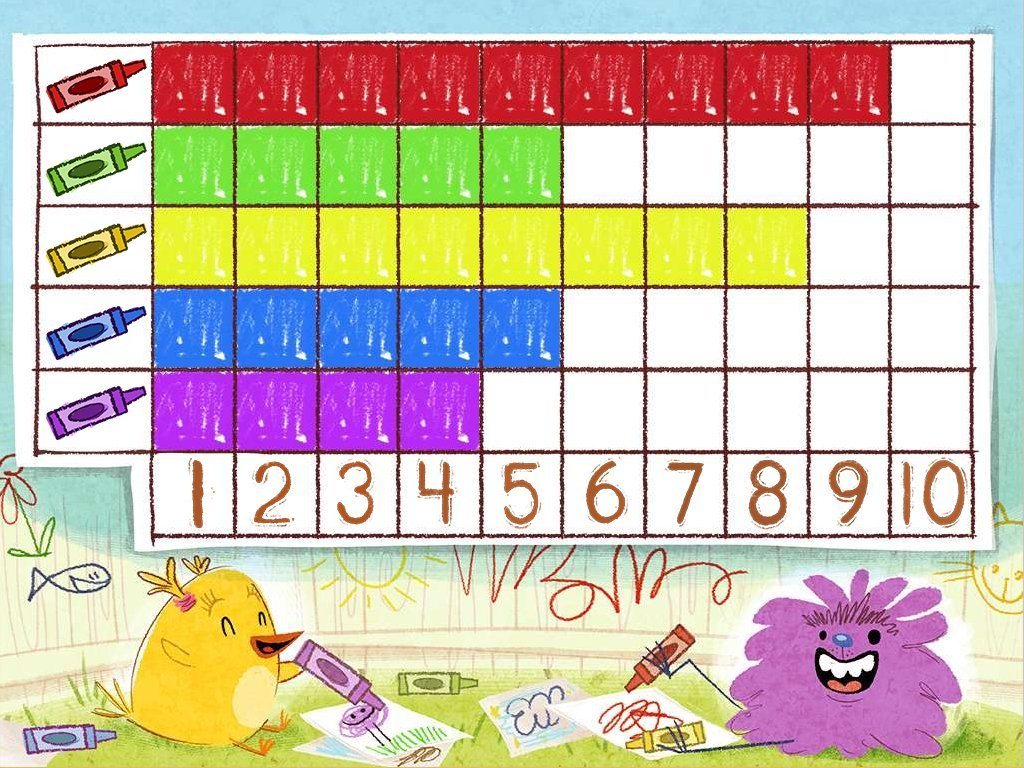
How many students take the bus to school?
a)
35
b)
20
c)
10
d)
15
96.
How many people voted for red as their favorite color?
a)
100
b)
2
c)
4
d)
9
97.
How many total people took the survey?
a)
50
b)
150
c)
100
d)
200
98.
At 60 seconds, how far had this object traveled? 
a)
0 m
b)
10 m
c)
20 m
d)
40 m
99.
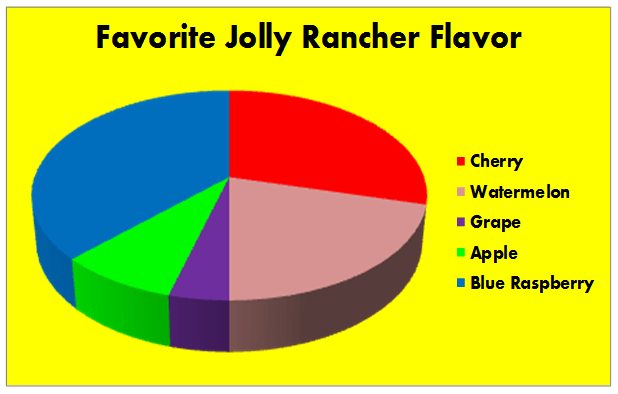
According to this circle graph, what is the least popular flavor of Jolly Rancher?
a)
Blue Rasberry
b)
Watermelon
c)
Grape
d)
Apple
100.

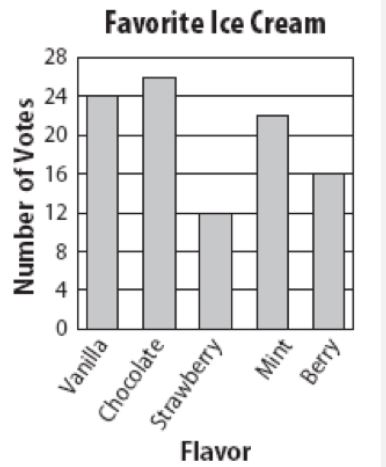
Which table represents the data in the graph?

a)
b)
c)
d)
101.

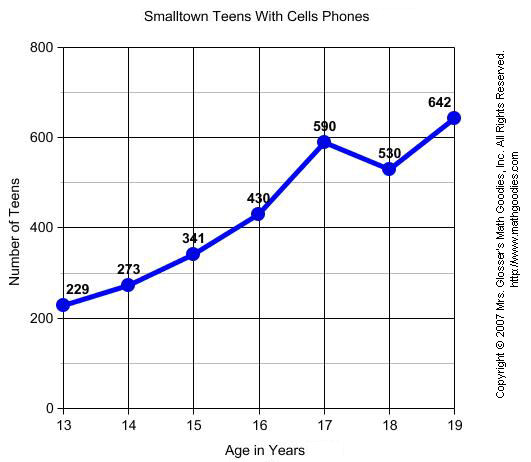
What label is along the y-axis in this graph?

a)

Copyright 2007

b)

Lines

c)

Age in Years

d)

Number of Teens

102.

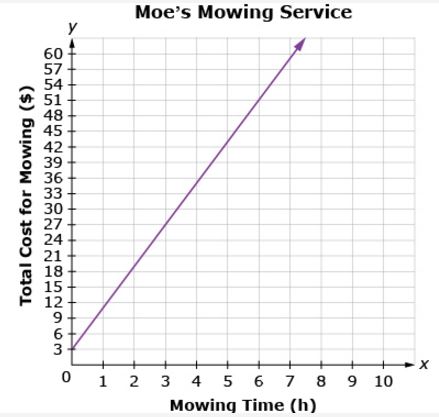
What is the general trend of this line graph?

a)

The more you mow, the less money you make.

b)

You make the same amount of money regardless of how long you mow.

c)

The more you mow, the more money you make.

d)

Mowing is dangerous.

103.

What conclusions can you draw from this graph?

a)

The deer population went down over time.

b)

The deer population went up over time.

c)

The dear population went up quickly, then down, but then stayed the same.

d)

There are less dear because of hunters

104.
How many more people have purple for a favorite color than red?
a)
3
b)
5
c)
7
d)
9
105.
What is the independent variable on the graph (x-axis)?
a)
Metro Bicycle Shop Weekly Sales
b)
Bicycles Sold
c)
Types of Bicycles
106.
What is the length of the comb?
a)
8 cm 
b)
3 cm 
c)
5 cm 
d)
7 cm 
107.
What is the mass on the triple beam balance? 
a)
290.2 g
b)
292 g
c)
290.5 g
d)
295.2 g
108.

The center of the flower is yellow

a)

Qualitative data

b)

Quantitative data

109.

The flower is 8cm tall

a)

qualitative data

b)

quantitative data

110.
Convert 300 cm to m:
a)
3 m
b)
30 m
c)
0.3 m
d)
0.03 m