wayground logo

Free Printable Worksheets

Font size

S
M
L
XL
Worksheets

15 Biology Final Exam Test Review (Chemistry)

Total questions: 85

Worksheet time: 59mins
Name
Class
Date
1.
Which of the following statements is true regarding the atomic number of an element?
a)
The atomic number is the number of protons in an element.
b)
The atomic number is the number of electrons in an element.
c)
The atomic number is the number of neutrons in an element.
d)
The atomic number is the mass of the nucleus of an element.
2.
Silicon (Si) is in period 3 on the Periodic Table. What does this tell you about this element?
a)
It is highly reactive with water.
b)
It has 3 valence electrons.
c)
It has 3 protons in its nucleus
d)
It has 3 energy levels/shells in its electron cloud.
3.
Mg + HCl → MgCl2 + H2
a)
Balanced
b)
Unbalanced
4.
3C + 2Fe2O3 → 4Fe + 3CO2
a)
Balanced
b)
Unbalanced
5.
Ba3N2 + 6H2O → 3Ba(OH)2 + 2NH3
a)
Balanced
b)
Unbalanced
6.
6CO2 + 6H2O → C6H12O6 + 6O2
a)
Balanced
b)
Unbalanced
7.
SnO2 + 2H2 → Sn + H2O2
a)
Balanced
b)
Unbalanced
8.
If an element’s symbol contains two letters, the first letter is capitalized and the second letter is lower case.
a)
True
b)
False
9.
The chemical formula for water is NaCl.
a)
True
b)
False
10.
In a chemical formula, elements are represented by lower case letters and compounds are represented by capital letters.
a)
True
b)
False
11.
If there is no subscript after an element’s symbol, then there are no atoms of that specific element present.
a)
True
b)
False
12.
If there is no coefficient at the beginning of a chemical formula, then there is just 1 molecule present.
a)
True
b)
False
13.
Chemical equations must be balanced in order to follow the Law of Conservation of Mass
a)
True
b)
False
14.
Which of the following chemical formulas contains the most molecules?
a)
5CO
b)
3H2O
c)
2Fe2O3
d)
4C3H8
15.
Which of the following chemical formulas contains the most total atoms?
a)
CO
b)
H2O
c)
Fe2O3
d)
C3H8
16.
Which of the following chemical formulas contains the most different kinds elements? (not atoms of each element)
a)
CO
b)
NaCl
c)
NaHCO3
d)
H2O
17.
Which of the answers below would be a correct chemical symbol of an element?
a)
BE
b)
Be
c)
be
d)
bE
18.
If the number of atoms of each element in a chemical equation are not equal on both sides of a chemical equation, then the equation is -
a)
Balanced
b)
Unbalanced
19.
Which number in a chemical formula tells you how many molecules of an element you have?
a)
Coefficient
b)
Chemical symbol
c)
Subscript
d)
Capitals
20.
Which number in a chemical formula tells you how many atoms of an element you have?
a)
Coefficient
b)
Chemical symbol
c)
Subscript
d)
Capitals
21.
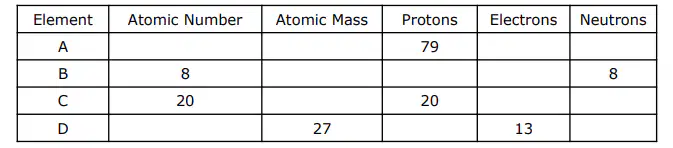
Which of the following is the identity of Element D?
a)
Oxygen (O)
b)
Aluminum (Al)
c)
Platinum (Pt)
d)
Calcium (Ca)
22.
Which of the following is the identity of Element C?
a)
Oxygen (O)
b)
Gold (Au)
c)
Platinum (Pt)
d)
Calcium (Ca)
23.
Which of the following is the identity of Element B?
a)
Oxygen (O)
b)
Gold (Au)
c)
Platinum (Pt)
d)
Bromine (Br)
24.
Which of the following is the identity of Element A?
a)
Selenium (Se)
b)
Gold (Au)
c)
Platinum (Pt)
d)
Bromine (Br)
25.
Which of the following determines the identity of an atom?
a)
Protons
b)
Neutrons
c)
Electrons
d)
None of the above
26.
Which of the following statements is accurate?
a)
The nucleus makes up the majority of the volume of an atom.
b)
The nucleus makes up the majority of the size of an atom.
c)
The electron cloud makes up the majority of the mass of an atom
d)
The electron cloud makes up the majority of the volume of an atom.
27.
What does the atomic mass of an atom tell you?
a)
The number of electrons in an atom.
b)
The number of protons in an atom
c)
The total number of protons and neutrons in an atom
d)
The total number of protons and electrons in an atom
28.
What is contained in the area outside the nucleus of an atom?
a)
Protons only
b)
Electrons only
c)
Electrons and Protons
d)
Protons and Neutrons
29.
What is contained in the nucleus of an atom?
a)
Protons only
b)
Electrons only
c)
Electrons and Protons
d)
Neutrons and Protons
30.
Is this chemical equation balanced or unbalanced?SnO2 + 2H2 → 2Sn + 2H2O
a)
Balanced
b)
Unbalanced
31.
How many sodium atoms are there on the product side of this equation?2As + 6NaOH → 2Na3AsO3 + 3H2
a)
3
b)
6
c)
2
d)
8
32.
What are the reactants of this equation?2As + 6NaOH → 2Na3AsO3 + 3H2
a)
2As + 6NaOH
b)
2Na3AsO3 + 3H2
c)
2 As
d)
6NaOH
33.
What are the products of this equation?2As + 6NaOH → 2Na3AsO3 + 3H2
a)
2As + 6NaOH
b)
2Na3AsO3 + 3H2
c)
2 As
d)
6NaOH
34.
Al2(CO3)3 + H3PO4 → AlPO4 + CO2 + H2O
a)
Balanced
b)
Unbalanced
35.
6CO2 + 6H2O → C6H12O6 + 6O2
a)
Balanced
b)
Unbalanced
36.
S8 + F2 → SF6
a)
Balanced
b)
Unbalanced
37.
3KOH + H3PO4 → K3PO4 + 3H2O
a)
Balanced
b)
Unbalanced
38.
FeCl3 + NH4OH → Fe(OH)3 + NH4Cl
a)
Balanced
b)
Unbalanced
39.
Zn + HCl → ZnCl2 + H2
a)
Balanced
b)
Unbalanced
40.
This is a balanced equation 4FeS + 7O2 → 2Fe2O3 + 4SO2
a)
True
b)
False
41.
The nucleus of an atom contains which of the following subatomic particles?
a)
electrons
b)
only protons
c)
protons and electrons
d)
protons and neutrons
42.
The atomic number of an element is determined by which of the following:
a)
The number of protons
b)
The number of electrons
c)
Then number of neutrons
d)
The number of protons and neutrons
43.
Click the elements below that have 3 energy levels (choose all that apply)
a)
Sodium
b)
Aluminum
c)
Sulfer
d)
Lithium
e)
Neon
44.
Click the elements below that are all in the Halogen Family on the periodic table of elements (Choose 3)
a)
Flourine
b)
Iodine
c)
Chlorine
d)
Argon
e)
Selenium
45.

​ (a)   are in the ​ (b)   and contribute to the overall mass of an atom. They are the ​ (c)   particles inside the atom. the ​ (d)   are in the ​ (e)   and DO NOT contribute to the overall mass of an atom.

Choose from the below words
Protons and neutrons
electrons
nucleus
heaviest
cloud
protons and electrons
protons
neutrons
lightest
46.

At the very center of an atom, is the ​ (a)   . It contains positively charged particles called ​ (b)   . Every atom of the same element has the same number of protons, called the ​ (c)   . ​ (d)   can be identified by their atomic number.

Choose from the below words
nucleus
protons
atomic number
Elements
electrons
47.

A neutron is found in the ​ ​ (a)   and has a ​ (b)   charge.

Choose from the below words
positive
negative
neutral
electron cloud
nucleus
48.

Moving around the space outside the nucleus are ​ (a)   charged particles called ​ (b)   . A ​ (c)   atom has the same number of electrons as it has protons. 


Choose from the below words
negatively
shells
protons
electrons
nucleus
neutral
49.

In 3P2O5, there are ​ (a)   phosphorus (P) atoms and ​ (b)   oxygen (O) atoms.

Choose from the below words
6
15
8
3
12
21
50.

In a chemical equation, a ​ (a)   is a number that shows how many atoms of an element are in a particle of a compound, while a ​ (b)   is a number that tells you how many particles of that compound you have.

Choose from the below words
subscript
coefficient
multiple
molar mass
51.

Say how many atoms of oxygen are in each of the following.

a)

2

1.

NaNO2NaNO_2

b)

4

2.

2NaNO22NaNO_2

c)

8

3.

2Mg(NO2)22Mg\left(NO_2\right)_2

52.

How many elements are in 2 C6H12O7? (a)  

How many C: ​ (b)  

How many H: ​ (c)  

How many O: ​ (d)  

How many TOTAL atoms: ​ (e)  

Choose from the below words
3
12
24
14
50
7
6
25
52
60
53.
an atom with atomic number 6 would have how many protons 
a)
6
b)
12
c)
3
d)
cannot be determined 
54.

A neutron is found in the ​ ​ (a)   and has a ​ (b)   charge.

Choose from the below words
positive
negative
neutral
electron cloud
nucleus
55.

Which of the following elements is a halogen?

a)

Helium

b)

Carbon

c)

Fluorine

d)

Sodium

56.

In the periodic table, elements are arranged in order of increasing:

a)

Atomic mass

b)

Atomic number

c)

Number of neutrons

d)

Electronegativity

57.

Which group in the periodic table contains the noble gases?

a)

Group 1

b)

Group 2

c)

Group 17

d)

Group 18

58.

Which element has the chemical symbol "O"?

a)

Oxygen

b)

Gold

c)

Osmium

d)

Olmium

59.

How many periods are on the periodic table?

a)

5

b)

6

c)

7

d)

8

60.
Elements arranged in vertical columns in the periodic table are called periods.
a)
true
b)
false
61.
The periodic table has __ periods.
a)
18
b)
8
c)
2
d)
7
62.

Boron

a)

B

b)

Bo

c)

Bn

d)

Br

63.

Which group do the alkaline metals belong to?

a)

Group 1

b)

Group 2

c)

Group 17

d)

Group 18

64.

Elements in the same group have similar ___________

a)

Properties

b)

Protons

c)

Electrons

d)

Lithium (Li)

65.

Which period does the element Calcium (Ca) belong to?

a)

2

b)

3

c)

4

d)

5

66.

How many elements are in C6H12O6?

a)

1

b)

2

c)

3

d)

4

67.

How many atoms of carbon (C) are in C6H12O6?

a)

3

b)

6

c)

12

d)

24

68.

Element or Compound?

H2O

a)

Element

b)

Compound

69.

Which of the following is a compound?

a)

Co

b)

O2

c)

C

d)

CO2

70.

The blue numbers in the image below represent _______

a)

I don't know, and don't want to try

b)

Coefficients

c)

Subscripts

d)

none of the answers are correct

71.

How many TOTAL atoms are in:

H2SO4

a)

6

b)

5

c)

7

d)

3

72.

How many atoms of Sodium (Na) are in 6NaCl?

a)

1

b)

12

c)

3

d)

6

73.

The substances at the beginning of a chemical equation are called the ______

a)

product

b)

yield

c)

chemical symbol

d)

reactants

74.

What are the products?

NH3 -------> N2 + H2

a)

N2 + H2

b)

N2

c)

H2

d)

NH3

75.

How many hydrogen atoms are there?

a)

1

b)

4

c)

5

d)

6

76.

CH4 is an example of a--

a)

chemical equation

b)

chemical formula

c)

chemical reaction

d)

chemical symbol

77.

Coefficients in chemical formulas...

a)

Multiply just the first atom

b)

Add to the subscripts at the end of the molecule

c)

Multiply elements without subscripts

d)

Multiply EVERYTHING!

78.

How many atoms of carbon (C) are in C6H12O6?

a)

3

b)

6

c)

12

d)

24

79.

How many different kinds of elements are there?

a)

1

b)

3

c)

5

d)

8

80.

How many atoms of oxygen are there?

a)

4

b)

3

c)

2

d)

1

81.

How many total atoms are there?

a)

8

b)

5

c)

3

d)

1

82.
What carries no charge 
a)
Neutrons
b)
Electrons
c)
Protons
83.
Fe2O3 has
a)
2 Iron atoms, 3 oxygen atoms
b)
6 iron atoms, 6 oxygen atoms
c)
3 iron atoms, 2 oxygen atoms
d)
1 iron atom, 6 oxygen atoms
84.
Which equation follows law of conservation of mass?
a)
C5H12 + 7O2 → 5CO2 + 6H2O
b)
2K + Ca(NO3)2 → K(NO3) + Ca
c)
6CO2+ 6H2O C6H12O6+ 6O2
d)
2VCl2 + H2 → 2HCl + V
85.
How many oxygen atoms are in the following compound 2Al2(CO3)3 
a)
1
b)
3
c)
6
d)
18