wayground logo

Free Printable Worksheets

Font size

S
M
L
XL
Worksheets

2nd year summer revision

Total questions: 148

Worksheet time: 3hrs 36mins

Name
Class
Date
1.
The main source of energy for all life comes from ____.
a)
the Earth
b)
the moon
c)
the sun
d)
the food we eat/make
2.

Does the following definition describe photosynthesis or cellular respiration?

"The process by which plants capture energy from the sun and use it to make food"

a)

photosynthesis

b)

cellular respiration

3.

Does the following definition describe photosynthesis or cellular respiration?

"The process by which cells obtain energy from glucose"

a)

photosynthesis

b)

cellular respiration

4.

Does the following equation refer to photosynthesis or cellular respiration? glucose + oxygen --> carbon dioxide + water + energy

a)

photosynthesis

b)

cellular respiration

5.

Does the following equation refer to photosynthesis or cellular respiration? sunlight + carbon dioxide + water --> glucose + oxygen

a)

photosynthesis

b)

cellular respiration

6.

Cellular Respiration's goal is to

a)

make water

b)

make energy

c)

make glucose

d)

make oxygen

7.

A plant's goal for photosynthesis is to:

a)

make food (glucose)

b)

make carbon dioxide

c)

make oxygen

d)

make water

8.
What gas is released into the air during cellular respiration?
a)
oxygen
b)
carbon dioxide
c)
water 
d)
glucose
9.

What gas is released into the air during photosynthesis?

a)

oxygen

b)

carbon dioxide

c)

water

d)

glucose

10.

O2 is the chemical formula for

a)

Oxygen

b)

Carbon Dioxide

c)

Glucose

d)

Water

11.

Is OXYGEN a product of photosynthesis or cellular respiration?

a)

photosynthesis

b)

cellular respiration

12.

Is CARBON DIOXIDE a product of photosynthesis or cellular respiration?

a)

photosynthesis

b)

cellular respiration

13.

Is GLUCOSE a reactant of photosynthesis or cellular respiration?

a)

photosynthesis

b)

cellular respiration

14.

What are the reactants of cellular respiration? (Mark all of them!)

a)

oxygen

b)

glucose

c)

carbon dioxide

d)

water

e)

energy

15.

What are the products of cellular respiration? (Mark all of them!)

a)

oxygen

b)

glucose

c)

carbon dioxide

d)

water

e)

energy

16.

What are the reactants of photosynthesis? (Mark all of them!)

a)

oxygen

b)

glucose

c)

carbon dioxide

d)

water

e)

sunlight

17.

What are the products of photosynthesis? (Mark all of them!)

a)

oxygen

b)

glucose

c)

carbon dioxide

d)

water

e)

sunlight

18.

Which organelle is responsible making food (Glucose) using sunlight?

a)

Ribosomes

b)

Nucleus

c)

Chloroplast

d)

Mitochondria

19.

Any substance that cannot be broken down is a(n)

a)

atom

b)

element

c)

compound

d)

carbohydrate

20.

A pure substance is made of two or more elements chemically combined is a(n)

a)

element

b)

compound

c)

mixture

21.

A substance made up entirely of one type of atom is a(n)

a)

element

b)

compound

c)

mixture

22.

A substance made up of two or more types of atoms that are NOT chemically combined is called a(n)

a)

element

b)

compound

c)

mixture

23.

Is SULFUR (S) an element or a compound?

a)

ELEMENT

b)

COMPOUND

24.

Is CARBON DIOXIDE (CO2) an element or a compound?

a)

ELEMENT

b)

COMPOUND

25.

Is ALUMINUM (Al) an element or a compound?

a)

ELEMENT

b)

COMPOUND

26.

Is METHANE (CH4) an element or a compound?

a)

ELEMENT

b)

COMPOUND

27.

Is WATER (H2O) an element or a compound?

a)

ELEMENT

b)

COMPOUND

28.

Is NITROGEN (N) an element or a compound?

a)

ELEMENT

b)

COMPOUND

29.
a)
Element
b)
Compound
c)
Mixture
30.
a)
Element
b)
Mixture
31.
a)
Element
b)
Compound
c)
Mixture
32.
a)
Element
b)
Compound
c)
Mixture
33.
This picture represents which of the following?
a)
element
b)
compound
c)
mixture
d)

atom

34.
This picture represents which of the following?
a)
element
b)
compound
c)
mixture
d)

atom

35.

Is salt (NaCI) a compound or an element?

a)

Compound

b)

element

36.

What is the definition of a compound?

a)

The smallest part of any substance which can exist on its own

b)

Two or more atoms chemically joined together (can be the same or can be different)

c)

A simple substance in which all the atoms are identical

d)

Two or more different elements chemically joined together

37.
All matter is made of .....
a)
energy 
b)
atoms 
c)
air
d)
chemistry
38.

Two or more physically combined substances form

a)

a compound.

b)

an acid.

c)

an element.

d)

a mixture.

39.

What is an example of a mixture?

a)

Table salt

b)

Water

c)

Oxygen

d)

Air

40.
Salt is a _________. 
a)
compound 
b)
element 
c)
mixture 
41.

True or False: All molecules are compounds.

a)

true

b)

false

42.

Which of the following is a mixture?

a)

oxygen

b)

gold

c)

sand

d)

water

43.

Matter is anything that has mass and takes up space.

a)

true

b)

false

44.

Which of the following demonstrates a property of a metal?

a)

Malleable

b)

Dull

c)

Brittle

d)

None of these

45.
Which of these is a property of metals?
a)
It's malleable
b)
It can't conduct electricity
c)
They are used in food
d)
It's very brittle
46.
Where are the non-metallic elements found in the periodic table?
a)
In the middle
b)
In the top rows
c)
On the left-hand side
d)
On the right-hand side
47.
I have an object that is dull, brittle, and an insulator, what is it?
a)
metalloid
b)
non-metal
c)
metal
d)
matter
48.
If you have a material that can conduct electricity well it is probably a...
a)
Metalloid
b)
Matter
c)
Non-metal
d)
Metal
49.
What physical properties are used to classify elements as metals, non-metals, or metalloids?
a)
Color, smell, physical state
b)
Reactivity, streak, hardness
c)
Ability to burn, mass, density
d)
Luster, conductivity, malleability
50.
Which of the following would help a student classify an unknown element as a metal, metalloid, or non-metal?
a)
Measure its conductivity
b)
Determine its density
c)
Find its melting point
d)
Observe its color
51.
Non-metals are good conductors of heat and electricity. 
a)
TRUE
b)
FALSE
52.
Metals are ductile, meaning they can be drawn into wire
a)
True
b)
False
c)
Never
53.
Unlike non-metals, most metals tend to —
a)
conduct electricity and heat well.
b)
be gases at room temperature.
c)
break easily when hammered.
d)
have less luster and shine.
54.

An element obtains the properties of brittle, and doesn’t have strong shine (dull). The element has similar properties to Iodine. The element has a period of number 3.

a)

Fluorine

b)

Astatine

c)

Chlorine

d)

Radon

55.

Which could be a correct symbol for a chemical element?

a)

Ca

b)

n

c)

CO

d)

Alu

56.
Some students conducted a laboratory investigation to learn more about the physical properties of different elements. They observed four samples and recorded their observations in the table . Based on these observations, which sample is most likely a nonmetal?
a)
Sample 1
b)
Sample 2
c)
Sample 3
d)
Sample 4
57.
If a material can easily be drawn into the shape of a wire, it is
a)
Ductile
b)
Magnetic
c)
Malleable
d)
Reactive
58.
John was observing the physical properties of elements in order to classify them as either a metal, nonmetal, or metalloid. The first element was dull, brittle, and did not conduct heat. What would its classification be? 
a)
metal 
b)
nonmetal 
c)
metalloid
59.
A student tested the conductivity of four elements using an incomplete electrical circuit. When the element is placed in the circuit, the bulb lights up brightly, lights up dimly, or does not light up at all based on the element’s ability to conduct electricity. The table below shows the results of her investigation. Based on the results of the conductivity test, which element is classified as a metal? 
a)
Hydrogen
b)
Arsenic
c)
Krypton
d)
Copper
60.
Which table below correctly lists the properties of metals and nonmetals? *
a)
A
b)
B
c)
C
d)
D
61.
A student is given a sample of an unknown substance. He is asked to determine if it is classified as a metal, a metalloid, or a nonmetal. He discovered that the unknown element conducted some heat and electricity, had a shiny luster, and broke easily. This element is most likely a 
a)
metal
b)
nonmetal
c)
metalloid
d)
cannot be determined
62.
Which element is a metalloid?
a)
Titanium
b)
Selenium
c)
Potassium
d)
Polonium
63.

When water falls from clouds in liquid or solid form

a)

precipitation

b)

condensation

c)

accumulation

d)

evaporation

64.

water vapor given off by plants

a)

runoff

b)

transpiration

c)

evaporation

d)

condensation

65.

When water turns from liquid form to a gas

a)

evaporation

b)

precipitation

c)

condensation

d)

transpiration

66.

When water vapor turns into a liquid

a)

condensation

b)

runoff

c)

transpiration

d)

evaporation

67.

What word do we give to water when it is the form of a gas

a)

ice

b)

rain

c)

snow

d)

water vapor

68.

Which of the following is associated with transpiration

a)

plants

b)

animals

c)

rocks

d)

humans

69.

What do water droplets form?

a)

condensation

b)

humidity

c)

clouds

d)

runoff

70.

Where does the all the water go or end up? Look at the chart

a)

Evaporation

b)

Runoff

c)

collection/accumulation

d)

Transpiration

71.

What is the water running down the hill called? Look at the chart

a)

Surface runoff

b)

condensation

c)

evaporation

d)

transpiration

72.

Which part of the water cycle makes the clouds? Look at the chart.

a)

evaporation

b)

condensation

c)

transpiration

d)

runoff

73.

The circulation of the element Carbon among Earth's atmosphere, land, oceans, and organisms is called _____________.

a)

the Carbon Cycle

b)

the Oxygen Cycle

c)

the Carbon dioxide Cycle

d)

the Water Cycle

74.

_____________ is an essential element of all living creatures.

a)

Gold

b)

Carbon

c)

Carbon dioxide

d)

Silver

75.

Carbon is used in the process called __________ by plants and algae to make food and the building blocks for growth.

a)

carbon cycle

b)

life

c)

photosynthesis

d)

decomposition

76.

Bacterias that decompose dead plants release _____________ back into the atmosphere.

a)

water

b)

nitrogen

c)

oxygen

d)

carbon

77.

Since the mid- 1800's, _____________ activity has significantly altered the carbon cycle.

a)

animal

b)

plant

c)

unknown

d)

human

78.

Burning fossil fuels has raised the concentration of ___________ in the atmosphere.

a)

oxygen

b)

rain

c)

carbon

d)

nitrogen

79.
When humans burn fossil fuels, most of the carbon quickly enters the                       as carbon dioxide.
a)
Water
b)
Atmosphere
c)
Sun
d)
Air
80.
Which one of these does not add CO2 to the atmosphere?
a)
cooking with gas
b)
planting trees
c)
burning wood
d)
riding in a bus
81.
Combustion is another word for _______________.
a)
a train
b)
a bus
c)
a dog
d)
burning
82.
In the carbon cycle, producers take in the gas __
a)
carbon dioxide
b)
oxygen
c)
nitrogen
d)
carbon monoxide
83.

Carbon enters the soil through dead plant or animal matter.

a)

Decomposition

b)

Respiration

c)

Photosynthesis

d)

Diffusion

84.

Organic matter, burred over millions of years

a)

Fossil Fuels

b)

Decomposition

c)

Combustion

d)

Subduction

85.
What does NOT produce carbon dioxide?
a)
Photosynthesis
b)
Burning Fossil Fuels
c)
Animal respiration
d)
Plants decaying
86.
TRUE or FALSE?
All of the carbon in existence is continually recycled in the carbon cycle.
a)
True
b)
False
87.
Organisms that do not decompose can be buried and become what?
a)
water
b)
nutrients
c)
air
d)
fossil fuels
88.
Carbon can be found in...
a)
The atmosphere
b)
Soil
c)
Fossil fuels
d)
All of the above
89.
Which of the following removes carbon from the atmosphere?
a)
Combustion
b)
Respiration
c)
Photosynthesis
d)
Death
90.
What process occurs when coal (fossil fuel) is used for energy?
a)
Decomposition
b)
Combustion
c)
Pressurization 
d)
Respiration 
91.
Respiration is the process by which animals take in _____ and release _____. 
a)
photosynthesis, air
b)
carbon, oxygen
c)
oxygen
d)
oxygen, carbon dioxide
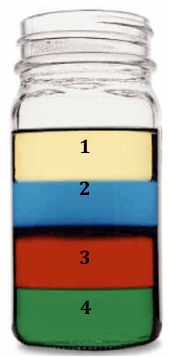
92.
Put the liquids in order from most dense to least dense?
a)
4, 3, 2, 1
b)
1, 2, 3, 4
c)
3, 4, 2, 1, 
d)
4, 3, 1, 2
93.
What is the formula for density?
a)
density = mass x volume
b)
density = mass / volume
c)
density = mass + volume
d)
density = mass - volume
94.
Frank has a paper clip. It has a mass of 9g and a volume of 3cm3. What is its density?
a)
3 g/cm3
b)
1/3 g/cm3
c)
27 g/cm3
d)
39 g/cm3
95.
A piece of copper has a mass of 89g and a volume of 10 cm3.  What would be the density of the copper?
a)
0.89 g/cm3
b)
89 g/cm3
c)
8.9 g/cm3
d)
890 g/cm3
96.

Calculate the density in the following question: A flower pot has a mass of 95 g and a volume of 92 mL.

a)

1.03 g/mL

b)

0.97 g/mL

c)

1.01 g/mL

d)

0.99 g/mL

97.
In the picture, the mass of the block is 200 g, the dimensions of the block are 6 cm by 4 cm by 5 cm.  What is its density?
a)
1.67g/cm3
b)
13.33 g/cm3
c)
0.60 g/cm3
d)
 24000 g/cm3
98.

The amount of water displaced is the same as the volume of the object. What is the VOLUME of the object?

a)
40 mL
b)
65 mL
c)
20 mL
d)
25 mL
99.
An irregularly shaped rock was lowered into a graduated cylinder holding a volume of water equal to 50 ml. The height of the water rose to 75 ml. If the mass of the stone was 250 g, what was its density?
a)
15 g/mL
b)
5 g/mL
c)
10 g/mL
d)
20 g/mL
100.
What is the volume of 150 grams of lead if it has a density of 11.3 g/cm3?
a)
13.3 g
b)
13.3 cm3
c)
.075 g
d)
1695 cm3
101.

The density of a material is 2 g/cm3. The volume is 24 cm3 . What is the mass?

a)
12 grams
b)
48 grams
c)
12 g/cm3
d)
48 g/cm3
102.

There are 4 objects listed with their densities. Which of the following will float on water? (SELECT 2)

a)

Object A:

0.7 g/cm3

b)

Object B:

1.2 g/cm3

c)

Object C:

0.25 g/cm3

d)

Object D:

11.4 g/cm3

103.
A train travels 25 km in .5 hrs. How fast is the train going?
a)
25 miles/hr
b)
5 miles/hr
c)
125 km/hr
d)
50 km/hr
104.
What is the equation to calculate distance?
a)
distance = speed/time
b)
distance = time/speed
c)
distance = speed/distance
d)
distance = speed x time 
105.
A car travels 30 miles/hr for 3 hours, calculate the distance it will travel
a)
90 miles
b)
10 miles
c)
600 miles
d)
90 km
106.
What is the speed of a man who runs 10 miles in 1 hr?
a)
20 miles
b)
10 m/min
c)
10 miles/hr
d)
20 hrs
107.
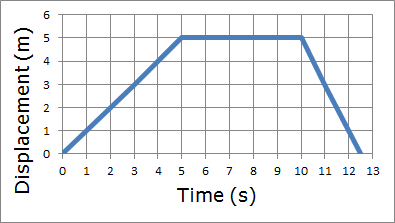
According to the graph how far does the person travel in the first 5 seconds?
a)
2 m
b)
10 m
c)
0 m
d)
5 m
108.
What is the person doing from 5 seconds to 10 seconds?
a)
Walking 
b)
Running
c)
Standing Still 
d)
Walking Fast
109.
How far is the person from the starting point after 3 seconds?
a)
0 m
b)
2 m 
c)
3 m
d)
6 m 
110.
What is the average speed of the person during the first 5 seconds?
a)
0 m/s
b)
1 m/s 
c)
3 m/s
d)
6 m/s 
111.
Acceleration: is the rate of change in ___________.
a)
speed
b)
distance
c)
velocity 
d)
displacement 
112.

A roller coasters accelerates from an initial speed of 6.0 m/s to a final speed of 70 m/s over 4 seconds. What's the acceleration?

a)

24 m/s2

b)

18 m/s2

c)

16 m/s2

d)

16 m/s

113.
The SI unit for acceleration is
a)
mph
b)
ft/sec2
c)
m/s2
114.
How long did it take this object to travel 10 m?
a)
0 s
b)
10 s
c)
15 s
d)
20 s
115.
Which runner won the race?
a)
A
b)
B
c)
C
116.
What is happening at E?
a)
Stationary
b)
Accelerating
c)
Fast steady speed; moving away from the starting position
d)
Steady speed; returning to start position
117.
What is happening at D?
a)
Stationary
b)
Accelerating
c)
Fast steady speed; moving away from the starting position
d)
Slower steady speed; moving away from the starting position
118.

The second letter of a chemical symbol is always a

a)

Capital

b)

Lowercase

c)

Number

d)

Symbol

119.

Scientists use a _____________ as an abbreviation for an element name.

a)

Atom

b)

Molecule

c)

Compound

d)

Chemical Symbol

120.

The first letter of a chemical symbol is always a

a)

Capital

b)

Lowercase

c)

Number

d)

Symbol

121.

Which symbol is written correctly?

a)

Au

b)

AU

c)

au

d)

ua

122.

Flourine

a)

Fl

b)

F

c)

fl

d)

Fe

123.

Iodine

a)

io

b)

Fe

c)

Io

d)

I

124.

Sodium

a)

NaCl

b)

Na

c)

S

d)

So

125.

Phosphorus

a)

pH

b)

K

c)

P

d)

ph

126.

Potassium

a)

Pt

b)

Po

c)

P

d)

K

127.

Calcium

a)

Ca

b)

C

c)

ca

d)

Cl

128.

Helium

a)

He

b)

H

c)

Hi

d)

he

129.

Zinc

a)

Z

b)

Zi

c)

Zn

d)

Zr

130.

Iron

a)

Fe

b)

I

c)

Ir

d)

Fn

131.

Magnesium

a)

Mn

b)

Mg

c)

mg

d)

Me

132.

Gold

a)

Go

b)

G

c)

Ag

d)

Au

133.

Chlorine

a)

Cl

b)

Ch

c)

C

d)

Co

134.

Silver

a)

Si

b)

Au

c)

Ag

d)

S

135.

Oxygen

a)

Oy

b)

O

c)

X

d)

Og

136.

Aluminum

a)

Am

b)

A

c)

Ai

d)

Al

137.

Nitrogen

a)

Ni

b)

N

c)

ni

d)

O

138.

Copper

a)

C

b)

Co

c)

Cu

d)

Cp

139.

Carbon

a)

C

b)

Ca

c)

Co

d)

Cn

140.

Silicon

a)

S

b)

Si

c)

Sc

d)

Sn

141.

Hydrogen

a)

H

b)

Hy

c)

He

d)

Hn

142.

What element has the chemical symbol - C ?

a)

Calcium

b)

Copper

c)

Chlorine

d)

Carbon

143.

What element has the chemical symbol - Li?

a)

Lead

b)

Lithium

c)

Potassium

d)

Sodium

144.

What element has the chemical symbol - Mg?

a)

Mercury

b)

Sodium

c)

Iron

d)

Magnesium

145.

What element has the chemical symbol - Ne?

a)

Nitrogen

b)

Nickel

c)

Neon

d)

Mercury

146.

What element has the chemical symbol - N?

a)

Nickel

b)

Nitrogen

c)

Neon

d)

Iron

147.

What element has the chemical symbol - S?

a)

Sodium

b)

Sulfur

c)

Silicon

d)

Silver

148.

What element has the chemical symbol - B ?

a)

Lead

b)

Hydrogen

c)

Boron

d)

Mercury