
 Worksheets
REVIEW 2
Total questions: 89
Worksheet time: 3hrs 40mins
Newton's first law is also called the Law of ...
Friction
Inertia
Unbalanced forces
Newtons
Newton's first law applies
to both moving and nonmoving objects
only to moving objects
only to objects that are not moving
Because of inertia, a moving object will keep ________ unless acted on by an unbalanced force.
at rest
moving
in one spot
inertia
Objects want to keep doing what they are already doing?
True
False
Objects in motion want to maintain _____.
their same speed
their same location
their same direction.
their same mass.
An object at rest will stay at (a) unless acted on by an unbalanced force.
An object in motion will stay in (a) unless acted on by an unbalanced force.

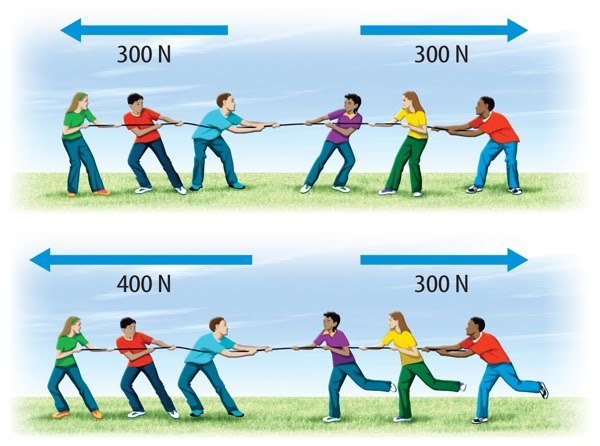
How will this object move?
It will not move
It will move in both directions
It will move to the right
It will move to the left

How will this object move?
It will not move
It will move in both directions
It will move to the right
It will move to the left
Shadell pushes a box 35 N to the right. Nazai pushes the box 25 N in the same direction. What is the net force?
60 N balanced to the right
10 N balanced to the right
60 N unbalanced to the right
10 N unbalanced to the right
What are unbalanced forces?
forces that are not equal in size and opposite in direction.
forces that are equal in size and opposite in direction.
What are balanced forces?
forces that are not equal in size and are opposite in direction
forces that are equal in size and opposite in direction.

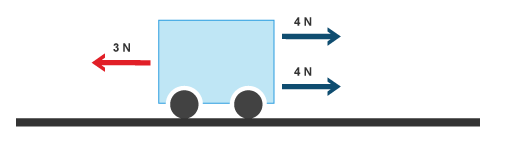
What is the net force?
30 N left
25 N right
55 N right
5 N left
Which of the answer choices is not a characteristic of a balanced force?
no change in motion
moving at a constant speed
causes a change in motion
net force of zero
If forces are going in the same direction, you should
add the forces
subtract the forces
multiply the forces
divide the net force
Two ice skaters moving in a straight line at a constant speed.
Balanced Force
Unbalanced Force
A car accelerating around a mountain curve.
Balanced Force
Unbalanced Force
Cars in a NASCAR race speeding around the track.
Balanced Force
Unbalanced Force
A soccer ball sitting on the ground motionless.
Balanced Force
Unbalanced Force

Which of the following objects will experience an unbalanced force?
A bike rider on a smooth and level road, pedaling at a constant rate.
A train pulling on another train, each with the same amount of force.
A chair sitting on the floor with balanced forces acting in opposite directions.
A ball rolling across the floor with friction acting in the opposite direction.
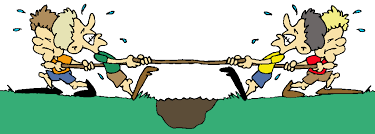
What is a Free Body Diagram?
Visual representation of force
Visual representation of objects
Visual representation of force and objects interactions
Visual representation of gravity
How is a force represented in a Free Body Diagram?
A straight line with an arrowhead
A curved line with an arrowhead
An arc with an arrowhead
Multiple lines with arrowheads
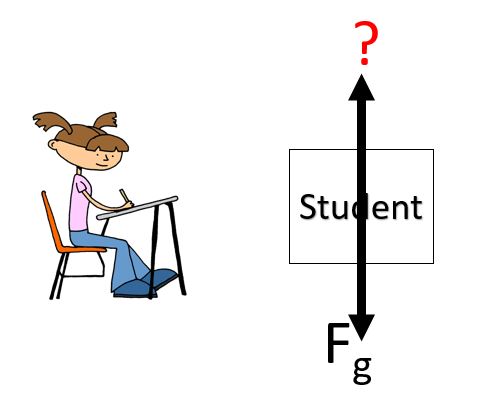
Name the missing force.... (shown by the ?)
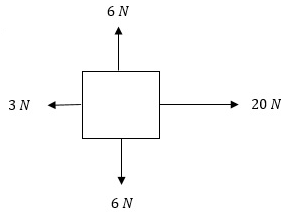
What is the NET FORCE of this diagram?
17 N, right
17 N, left
23 N, right
12 N, up
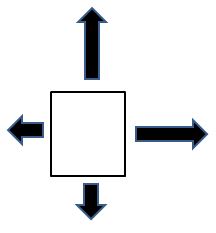
This object would be moving (pick all that are correct):
up
down
left
right
The down-arrow in this diagram is most-likely:
gravity
normal
a push or pull
friction
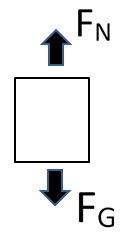
Which of the following is true about this free-body diagram?
the forces are are balanced
the object is free-falling
the object is moving upward
the forces are unbalanced
You push a refrigerator with a horizontal force of 100 N. If you move the refrigerator a distance of 5 m while you are pushing, how much work do you do?
Newton (N)
Joule (J)
Second (s)
Watt (W)
You do 20 J of work in pushing a crate up a ramp. If the output work from the inclined plane is 11 J, then what is the efficiency of the inclined plane?
A crate weighs 950 N. If you can use a pulley system to lift that crate with a force of only 250 N, then what is the mechanical advantage of the pulley system?


1500 N
15 N
1.5 N
150 N


Two people are lifting the same weight as shown in the animation. If they both do 10 reps, who will do the most work?
Bro A
Bro B
They both will do the same work
Can't tell without knowing the weight they are lifting
If you push against an object and it doesn't move, are you doing work?
No
Yes
In order for work to be done, what two things need to happen?
Object needs to move in any direction
Object needs to have acceleration and speed
Object must move and must move in the direction of the force applied
Object needs to feel force, it doesn't matter if it moves
When the force is perpendicular to the motion, the work being done is 0.
True
False
If force and motion are parallel, the work done is...?
force times the distance
force
distance and speed
force in N
A ___________ is a device that changes the force or increases the motion from work.
Work
Job
Machine
Calculator
A __________ is a combination of two or more simple machines
Simple Machine
Compound Machine
Efficient Machine
Useful Machine
What is the equation for efficiency (%)
output work divided by input work x 100
input work divided by output work x 100
output work divided by net force x 100
Input work divided by net force x 100
Machines change the way work is done in what way?
Increase speed
change the direction of a force
Increase force
All of the above
(a) = output force / input force
List any type of energy you can think of
What is energy?
moving energy
stored energy
renewable energy
The ability to do work.
A jogger with a mass of 60.0 kg is moving forward at a speed of 3.0 m/s. What is the jogger’s kinetic energy from this forward motion?
What is the unit for the previous problem?
Watts
Joules
Newtons
kg
A 4.0-kg ceiling fan is placed 2.5 m above the floor. What is the gravitational potential energy of the Earth-ceiling fan system relative to the floor?
What is the unit for the previous problem?
Watts
Joules
Newtons
kg
You transform 950 J of chemical energy into mechanical energy to push a sofa. If it took you 5.0 s to move the sofa, what was your power?
What is the unit for the previous problem?
Watts
Joules
Newtons
kg
An electric blanket warms a bed on a chilly night.
mechanical to chemically
thermal to electrical
electrical to thermal
mechanical to thermal
A rock in Death Valley, California, becomes hot during a summer afternoon.
radiant (light) to radiant (thermal)
thermal to chemical
radiant to chemical
radiant (thermal) to chemical
A deputy sheriff rides a horse while directing traffic.
chemical to thermal
chemical to kinetic
radiant to kinetic
electrical to thermal
A chandelier brightens a ballroom after a waiter moves a switch.
electrical to thermal
radiant to radiant (no change)
chemical to radiant
electrical to radiant
A swallow sitting on a fence sings a song for anyone who will listen.
sound to radiant
chemical to sound
thermal to radiant
gravitational potential to kinetic
A jet plane rapidly accelerates on the runway.
Chemical to mechanical/kinetic
Gravitational to mechanical/kinetic
Radiant to mechanical/kinetic
Chemical to thermal
A walnut falls to the ground from a lofty branch on a walnut tree.
Thermal to radiant
Electrical to thermal
Mechanical to potential
gravitational potential to kinetic
A placekicker sends a football through the uprights of a goalpost.
Chemical to kinetic
Chemical potential to thermal
Gravitational potential to kinetic
Chemical potential to kinetic
A base runner slides safely into third base.
Potential to kinetic
Electrical to thermal
Chemical to mechanical
Thermal to mechanical
An athlete eats a bowl of pasta, then rides in a bicycle race.
Chemical to kinetic
Gravitational potential to kinetic
Mechanical to radiant
Kinetic to potential
The law of conservation of energy states that (a) cannot be (b) or (c)
Power is...
the difference of work and energy
how fast work changes
how fast energy changes
how strong you are
Energy stored by something that can stretch or compress.
elastic potential energy
gravitational potential energy
chemical potential energy
potential energy
Energy stored in chemical bonds.
mechanical energy
chemical potential energy
elastic potential energy
kinetic energy
Energy stored by objects due to their position above Earth’s surface.
potential energy
kinetic energy
gravitational potential energy
mechanical energy
What is the unit of measurement for potential energy?
Watts
Joules
Newtons
Meters
The acceleration due to gravity (on Earth) is _____
98 m/s2
9.8 m/s2
9.81 m/s
0.98 m/s
The ability to do work comes from:
Work
Force
Energy
Gravity
Match the following terms to the correct definition
Kinetic Energy
Energy in motion
Potential Energy
Stored energy
Work
Force that causes motion
Force
A push or pull

