
 Worksheets
Ionic and Covalent Compounds Review
Total questions: 141
Worksheet time: 47mins
Which of these are oxides?
Na₂O
CaCl₂
NaF
MgO
NO
What charge does the magnesium ion (Mg) have after it forms an ionic bond with oxygen?
Mg+
Mg2+
Mg3+
Mg4+
What charge does the oxygen ion (O) have after it forms an ionic bond with magnesium?
O+
O2+
O2-
O3-
In the process of forming an ionic bond, magnesium donates two electrons to oxygen.
True
False


Cr3+ O2-
Al3+ O2-
Pb4+ O2-
What compound is formed when Cr3+ bonds with O2- ?
CrO
Cr3O2
Cr2O3
CrO3
Which of the following could NOT form an ionic compound? Check all that apply.
Li+ and Cl-
F- and O2-
Ba2+ and Ag+
Mg2+ and S2-
In an ionic bond, the ions are held together because...
the positive nucleus of each ion attracts the other ion's negatively charged electrons
the ions have opposite charges
as the electron moved from one atom to another it pulled the atom along with it
electrons are being shared
Aluminum forms a compound with a halogen (X). What will the formula of this ionic compound be?
Al2X3
Al3X2
Al3X
AlX3
Oxygen will form an ionic compound with which of the following?
Nitrogen
Fluorine
Boron
Lithium
Which of the following Roman Numerals represents the charge on the copper in CuO?
III
L
I
Name the ionic compound CuCl 2 .
Copper chloride
Copper (I) chloride
Copper (II) chloride
Cupric chloride
Which is true of ionic compounds?
They are electrically neutral when dissolved in a solution
They are made by sharing electrons
They are made of metals and nonmetals
They are good conductors as solids

In general, how many electrons does carbon have?
2
4
6
12
Write the configuration for Phosphorus (P)
2s2 2p6 3s2 3p3
1s2 2s3 2p6 3p3
1s2 2s2 2p6 3s2 3p3
1s2 2s2 2p5 3s2 3p3
1s22s22p63s2
Choose the Noble Gas that you would use to begin the shorthand configuration of the following element.
Plutonium (Pu)
[Xe]
[Ne]
[Rn]
[Kr]

What is this element?
Boron
Carbon
Nitrogen
Lithium

This is a Bohr Diagram of Aluminum. How many valence electrons does Aluminum have?
3
4
5
Where do you find electrons? Check all that apply.
Nucleus
Electrons cloud
Outside the nucleus
In general, how many electrons does carbon have?
2
4
6
12


Choose the correct electron configuration for Chlorine (Cl).
1s2 2s2 2p1
1s2 2s2 2p6 3s2
1s2 2s2 2p6 3s2 3p5
Which noble gas is used in the shorthand electron configuration for Potassium (K)?
Helium (He)
Neon (Ne)
Argon (Ar)
Krypton (Kr)
What is a key difference between ionic and covalent bonds?
Ionic bonds occur only in organic compounds, while covalent bonds occur in inorganic compounds.
Ionic bonds involve the sharing of electrons, while covalent bonds involve the transfer of electrons.
Ionic bonds involve the transfer of electrons, while covalent bonds involve the sharing of electrons.
Covalent bonds can only form between two metals, while ionic bonds can form between a metal and a nonmetal.
Which of the following best describes the formation of an ionic bond?
Two atoms share their valence electrons equally.
An atom donates its valence electron to another atom, creating ions that attract each other.
Two atoms exchange neutrons to achieve stability.
Electrons are shared unequally between two atoms.
Which of the following is a characteristic feature of substances with covalent bonds?
High solubility in water.
High electrical conductivity in solid form.
Low boiling points.
High melting points.
What is the result of an atom achieving a full outer shell through ionic bonding?
The atom becomes a stable molecule.
The atom remains unchanged.
The atom becomes an ion with a net charge.
The atom becomes a covalent compound.
Which of the following is a property of ionic compounds?
Low melting and boiling points.
Poor electrical conductivity in solid state.
High melting and boiling points.
Easily vaporized.
Bonds between atoms in a molecule (covalent compound) form as a result of the sharing of?
formulas
electrons
atoms
chemicals
Name for NaH
sodium hydrogen
potassium hydride
sodium hydride
potassium hydrogen
Formula for barium sulfide
B2S3
BaS
Ba2S
BaS2
Formula for lead (II) chloride
PbCl2
Pb2Cl
Pb2Cl3
Pb3Cl2
Name for PBr2
phosphorus bromide
phosphorus dibromide
phosphorus dibromine
phosphorus bromine
Formula for Disilicon Heptasulfide
SiS6
SiS7
Si2S6
Si2S7
Formula for iron (II) carbonate
FeCO3
Fe2CO3
FeCO2
Fe2CO2
Formula for Cobalt (II) bromide
CoBr
Co2Br2
Co2Br
CoBr2
Name the ionic compound, CaCO3
calcium carbide
calcium carbon trioxide
calcium carbon oxide
calcium carbonate
Pb4+ O2-

What is the name for As4O10?
arsenic oxide
arsenide decoxide
tetraarsenic decoxide
arsenic decoxide
Hexaboron monosilicide
B5S
B6S
B6Si
Br6Si1
Br6Si
Antimony tribromide
AnBr3
AtBr3
Sb1Br3
SbBr3
P4S5
phosphorus sulfide
quadphosphorus hexasulfide
tetraphosphorus pentasulfur
tetraphosphorus pentasulfide
SeF6
silicon fluoride
selenium fluoride
selenium hexafluoride
selenium heptafluoride
Si2Br6
silicon bromide
disilicide bromide
disilicon hexabromide
disilicide hexabromide
NF3
mononitrogen trifluorine
mononitrogen trifluoride
nitrogen trifluoride
ammonia
The electrons in a polar covalent molecule are shared...
Evenly
Unevenly
Electrons are not shared
None of the Above
The electrons in a nonpolar covalent molecule are shared...
Evenly
Unevenly
Electrons are not shared
None of the Above
The electrons in an ionic molecule are shared...
Evenly
Unevenly
Electrons are not shared
None of the Above

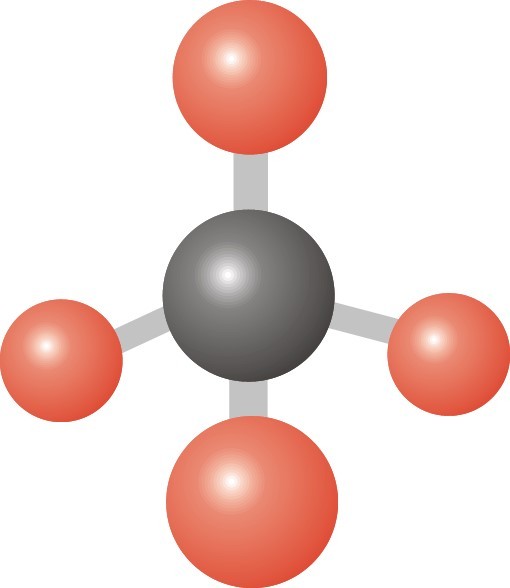
What is the name of this molecule's shape?
Bent
Linear
Tetrahedral
Trigonal pyramidal

What is the name of this molecular shape?
trigonal pyramid
tetrahedral
bent
trigonal planar

Binary Naming
What is the name of CaCl2?
calcium, chlorine
calcium chloride
calcide chlorine
calcium dichloride
Name the compound using appropriate rules: FeCl3
Chloride Iron
Iron III Chloride
Chloride III Iron
I have no clue
What type of compound is cobalt (II) sulfate? Check all that apply.
Ionic compounds
Covalent compounds
Transition Metals
Acids
Polyatomic compounds
What is the formula for phosphorous acid?
H3PO4
H2PO4
H3P
H3PO3

carbonic acid
H2CO3
H2CrO4
H2C2O4
HCO3
H3PO4
hydrophsophorus acid
phosphoric acid
hydrogen phosphorous
phosphori hydroxide
Binary acids start with the prefix "____________"
acid
nitric
hydraulic
hydro
When naming binary acids, the ending always changes to:
-ate
-ite
-ic
-ous
When naming oxyacids, change "-ite" to:
-ate
-ic
-ous
-ite
Name this acid: HNO2
hydronitrous acid
hydrogen nitrogen oxygen
nitrous acid
hyponitrous acid
3KOH + H3PO4 --> K3PO4 + 3H2O
Combustion
Double Displacement
Single displacement
Neutralization
What are the seven diatomic elements?
H2, Cl2, Br2, O2, N2, I2, F2
H2, Cl2, I2, F2, Hg2, Br2, Fe2
H2, Cu2, Ni2, B2, O2, I2, Fe2
What are diatomic elements?
Elements that form two-atom molecules when not combined in a compound.
Two elements that combine with one atom from each element.
Elements that are always in pairs no matter what.
Indicate the correct diatomic molecule
H2
N2
C2
Br2

The following properties are all characteristics of ionic compounds EXCEPT
high melting and boiling points
soft
crystal lattice structure
conduct electricity when dissolved in water
Ionic compounds can conduct electricity
always
as long as they are dissolved in water
as long as they are molten (melted)
never
A repeating pattern of alternating positive and negative charged ions is called a(n)
crystal lattice
crystal ladder
table salt
diamond
The following properties are all characteristics of ionic compounds EXCEPT
high melting and boiling points
soft
crystal lattice structure
conduct electricity when dissolved in water
Is the following compound ionic or covalent?
A material that has a low boiling point
Ionic
Covalent
Metallic bonds are characterized by:
The transfer of electrons from metal atoms to non-metal atoms.
The sharing of electron pairs between non-metal atoms.
A sea of delocalized electrons surrounding positively charged metal ions.
The formation of hydrogen bonds between metal atoms.
Which model describes metals as being composed of a collection of atoms that contribute their valence electrons to form a sea of electrons around them?
A) Bohr model
B) Electron cloud model
C) Electron sea model
D) Orbital model
How can metals be modeled according to their atomic structure in metallic bonds?
As isolated neutral atoms
As anions surrounded by a sea of protons
As cations surrounded by a sea of freely moving valence electrons
As covalently bonded clusters
Which of the following substances is an example of a material with metallic bonding?
Water (H 2 O)
Sodium chloride (NaCl)
Copper (Cu)
Methane (CH 4 )
Which substance would have the weakest intermolecular forces of attraction?
CH4
NaCl
H2O
MgF2
The weaker the intermolecular forces of a substance the _____________ the boiling point
higher
lower
When two nonmetals do not share electrons evenly, the resulting covalent bond will be
nonpolar
polar
ionic
metallic
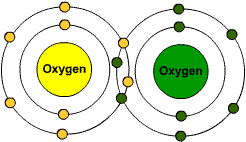
How many PAIRS of electrons are shared in a triple bond?
(a)
How many PAIRS of electrons are shared in a double bond?
(a)

How many covalent bonds are created in a single water molecule?
0
1
2
3
4

Chlorine is a diatomic element which means in nature, it is found in two's. (Cl2) Chlorine shares one pair of electrons to make sure each atom complete the octet rule. This creates a...
single bond
double bond
triple bond
The following properties are all characteristics of ionic compounds EXCEPT
solid at room temperature
soft
crystal lattice structure
conduct electricity when dissolved in water
Molecules:
have covalent bonds and are always polar
have covalent bonds and are always non-polar
have covalent bonds and can be polar or non-polar
have ionic bonds and are always polar
Which types of elements become cations?
non-metals
metals
metalloids
What set of elements is most likely to form a covalent compound?
Na and O
Na and K
O and C
Which set of elements is most likely to form an ionic compound?
Na and O
C and O
Na and K
Which of the following describes covalent bonds?
Bonds form because of opposite charges
electrons are shared to fill outer electron shells
Electrons are transferred between atoms
Covalent bonds are magical

Is the following compound ionic or covalent?
A material with a high melting point
Ionic
Covalent
Is the following compound ionic or covalent?
A material that is hard and brittle
Ionic
Covalent
Is the following compound ionic or covalent?
A material that LOSES and GAINS electrons
Ionic
Covalent

Is the following a property of ionic or covalent compounds?
form molecules
ionic
covalent
A small amount of NaCl is dissolved in water to make a solution. In this solution
water is the precipitate
water is the solute
NaCl is the solvent
NaCl is the solute

