wayground logo

Free Printable Worksheets

Font size

S
M
L
XL
Worksheets

Compounds Unit Test Review

Total questions: 146

Worksheet time: 3hrs 23mins

Name
Class
Date
1.
AgF
a)
silver fluoride
b)
silver fluorine
c)
monosilver monofluoride
d)
silver monofluorine
2.
Nonmetals tend to 
a)
gain electrons
b)
lose electrons
3.
Metals tend to 
a)
gain electrons
b)
lose electrons
4.
How do the following two elements bond together?
Na1+  F1-         
a)
NaF
b)
NaF3
c)
Na3F
d)
Na1F2
5.
How do the following two elements bond together?
K1+  S2- 
a)
KS
b)
K8S
c)
K6S3
d)
K2S
6.
How do the following two elements bond together?
Al3+  O2-         
a)
AlO
b)
Al2O3
c)
Al3O6
d)
Al3O2
7.
The proper formula for magnesium hydroxide:
a)
MgOH
b)
Mg2OH
c)
Mg(OH)2
d)
Mg2OH2
8.
What is the charge on the hydroxide ion?
a)
0
b)
-1
c)
-2
d)
-3
9.
Name the following ionic compound: LiNO3
a)
lithium nitrate
b)
lithium III nitrate
c)
lithium nitride
d)
lithium oxide
10.
Name the following ionic compound: MgSO4
a)
magnesium sulfoxide
b)
magnesium sulfide
c)
magnesium sulfate
d)
magnesium oxide
11.
Name the following ionic compound: BeCl2
a)
beryllium chlorine
b)
beryllium II chloride
c)
beryllium chloride
d)
beryllium dichloride
12.
What would be the proper chemical formula for combining Al3+ and Cl- :
a)
AlCl3
b)
Al3Cl
c)
AlCl
d)
Al3Cl3
13.
The chemical formula of lead (IV) nitrate is
a)
PbN₄
b)
PbNO₃₄
c)
Pb(NO₃)₄
d)
Pb₃NO₄
14.
The chemical formula of iron (III)bromide is
a)
FeBr
b)
Fe(III)Br
c)
FeBr₃
d)
Fe₂Br₃
15.
The chemical formula of iron (III)bromide is
a)
FeBr
b)
Fe(III)Br
c)
FeBr₃
d)
Fe₂Br₃
16.
When naming ionic compounds you always write the name of the positive element  _______ .
a)
first
b)
second
c)
with "ide"
d)
with a prefix
17.
In most cases, when naming you change the ending of the second element to ________.
a)
-ate.
b)
-ite.
c)
-ide.
d)
-ine.
18.
What is the formula for calcium phosphide?
a)
CaP
b)
Ca2P3
c)
Ca3P2
d)
Ca2P
19.
What is the formula for copper(I) sulfate?
a)
CuSO3
b)
CuSO4
c)
Cu2SO3
d)
Cu2SO4
20.
The chemical formula for an ionic compound of potassium and oxygen is
a)
KO.
b)
K2O.
c)
K2O2.
d)
KO2.
21.
What is the name of N2O3
a)
Nitrogen trioxide
b)
Dinitrogen oxide
c)
Dinitrogen trioxide
d)
Nitrogen oxide
22.
What is the chemical formula for Tetrasulfur pentoxide?
a)
SO
b)
S4O
c)
S4O5
d)
S5O4
23.
What is the name of C3Cl?
a)
Carbon octachloride
b)
Tricarbon octachloride
c)
Carbon trichloride
d)
Octacarbon trichloride
24.
What is the chemical formula for Nitrogen triiodide?
a)
NI
b)
N3I
c)
NI3
d)
None of these
25.
What is the name of Br6F10 ?
a)
Bromium fluoride
b)
Hexabromine fluoride
c)
Bromium decafluoride
d)
none of the above
26.
What is the name of CO
a)
Carbon oxide
b)
Carbon dioxide
c)
Carbon monoxide
d)
Carbon II oxide
27.
What is the chemical formula for CP ?
a)
Carbon phosphide
b)
Monocarbon phosphide
c)
Carbon monophosphide
d)
none of the above
28.
phosphorus trichloride
a)
KCl3
b)
PCl3
c)
K3Cl
d)
P3Cl
29.
The chemical formula of sulfur hexabromide is
a)
SBr₆
b)
S₆Br
c)
S(VI)Br
d)
S6Br
30.
The chemical formula of dinitrogen textroxide is
a)
Ni₂O₄
b)
NiO
c)
N₂O₄
d)
NiO₂
31.
The chemical formula of tetraphosphorus heptaoxide is
a)
F₄O₁₀
b)
P₄O7
c)
PO
d)
P₁₀O₄
32.
What's the formula for chlorine dioxide
a)
ClO2
b)
CLO
c)
ClO3
d)
HClO2
33.
What is the formula for Hexaboron Monosilicide
a)
B6Si
b)
BSi
c)
BSi6
d)
B6Si6
34.
What is the OFFICIAL name for H2O
a)
Hydrogen Oxide
b)
Oxygen Dinitride
c)
Agua
d)
Dihydrogen Monoxide
35.
BrO3
a)
bromine oxide
b)
monobromine trioxide
c)
bromine trioxide
d)
bromine (III) oxide
36.
What is the formula for Tricarbon Octahydride?
a)
Ca3O
b)
C2H8
c)
C3H8
d)
Ca3H8
37.
A binary covalent bond exists between
a)
2 metals
b)
1 metal and 1 nonmetal
c)
2 nonmetals
d)
Any 2 elements
38.
Which of the following is NOT an ionic compound:
a)
CaO
b)
NaOH
c)
BaCl2
d)
Br2
39.

Which following is a covalent compound?

a)
SO2
b)
K2O
c)
CaO
d)
BeO
40.
Which of the following is NOT an ionic compound:
a)
CaO
b)
NaOH
c)
BaCl2
d)
CH4
41.

A covalent bond is a chemical bond where two atoms share__________.

a)

protons

b)

neutrons

c)

valence electrons

d)

the same group on the periodic table

42.

A molecule that has a partial positive end and a partial negative end because of unequal sharing of electrons is a _______________.

a)

nonpolar molecule

b)

polar molecule

c)

ionic compound

d)

metalic compound

43.

Atoms of a polar molecule share their atoms ___________.

a)

Equally

b)

Unequally

44.

Phosphorus has an electronegativity value of 2.1. Chlorine's electronegativity value is 3.0. What type of bond will these two elements form?

a)

ionic

b)

nonpolar covalent

c)

polar covalent

d)

metallic

45.

Use your knowledge and electronegativity sheet to predict what the following compound is classified as.

a)

polar covalent

b)

nonpolar covalent

c)

ionic

d)

metallic

46.

Use your knowledge and electronegativity sheet to predict what the following compound is classified as.

a)

nonpolar covalent

b)

polar covalent

c)

ionic

d)

metallic

47.

Use your knowledge and electronegativity sheet to predict what the following compound is classified as.

a)

non-polar covalent

b)

polar covalent

c)

ionic

d)

metallic

48.
In this Lewis structure, the symbol above F means...
a)
electrons are being transferred to Fluorine
b)
electrons are less attracted to F than H
c)
electrons are more attracted to F than H
d)
Fluorine has formed a cation
49.
A molecule containing polar covalent bonds is always polar.
a)
True
b)
False
50.

Using your electronegativity handout and the types of atoms involved predict. What type of bond would form between F and Cl?

a)

Non polar Covalent

b)

Polar Covalent

c)

Ionic

d)

Metallic

51.

Use your knowledge and electronegativity sheet to predict what type of bond would form between calcium and bromide?

a)

Non polar Covalent

b)

Polar Covalent

c)

Ionic

d)

Metallic

52.

When you are asked to find bond polarity, you should compare electronegativity values of each bonding atom to the central atom.

a)

TRUE

b)

FALSE

53.

The electronegativity difference in the bonds of CH4 is:

a)

0.4

b)

-0.4

c)

1.7

d)

5.9

54.
If Boron bonds with Hydrogen, a ____________ bond forms.
a)
polar covalent
b)
nonpolar covalent
c)
metallic
d)
ionic
55.
According to the octet rule most elements need _______ valence electrons.
a)
2
b)
8
c)
6
d)
18
56.
Hydrogen needs _____ electrons in its valence shell to be stable.
a)
4
b)
6
c)
8
d)
2
57.
Which of the following is the correct Lewis dot structure for the molecule fluorine (F2)?
a)
A
b)
B
c)
C
d)
D
58.
What is the correct structure for BF3?
a)
Option A.
b)
Option B. 
c)
Option C.
d)
Option D.
59.
How many valence electrons are in Phosphorus?
a)
15
b)
4
c)
5
d)
31
60.
When writing Lewis Structures, only __________ electrons are used.
a)
Inner shell
b)
Core 
c)
Valence
d)
Stable
61.

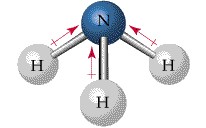
What is the correct Lewis Dot Structure for ammonia NH3

a)
b)
c)
d)
62.

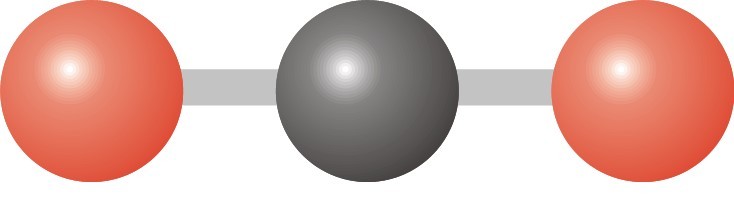
Which is the correct molecular structure for carbon dioxide?

a)
b)
c)
d)
63.

Is this the correct structure for CH2O?

a)

Yes

b)

No

64.

What is the charge of a Strontium ion?

a)

-2

b)

-1

c)

+1

d)

+2

65.

How many valence electrons are in an atom of Silicon?

a)

2

b)

4

c)

6

d)

8

66.

How many valence electrons are in an atom of Magnesium?

a)

2

b)

3

c)

4

d)

5

67.

Which type of bond is being formed in this diagram?

a)

covalent bond

b)

energy bond

c)

ionic bond

68.

The ionic compound that forms between Calcium and Fluorine requires how many of each element?

a)

1 calcium, 1 fluorine

b)

1 calcium, 2 fluorine

c)

2 calcium, 1 fluorine

d)

2 calcium, 3 fluorine

69.

The ionic compound that forms between Potassium and Nitrogen requires how many of each element?

a)

1 potassium, 1 nitrogen

b)

1 potassium, 3 nitrogen

c)

3 potassium, 1 nitrogen

d)

2 potassium, 3 nitrogen

70.

Which of the following is the correct Lewis dot between Rb and O?

a)
b)
c)
d)
71.

Which intermolecular force results from a hydrogen bonded to O, F or N?

a)

Dipole-Dipole

b)

Hydrogen Bonding

c)

London Dispersion

d)

Ion-Dipole

72.

The polarity of a bond is determined by...

a)

The sum of the electronegativities of the two atoms

b)

The difference in the electronegativities of the two atoms

c)

The charges of the atoms

d)

The number of electrons shared in the bond

73.

In a polar covalent bond, the electrons gather around...

a)

Mostly the atom with the greatest electronegativity

b)

The atom with the lowest electronegativity

c)

Each atom equally

d)

Only the atom with the greatest electronegativity

74.
Intermolecular forces are the forces
a)
within molecules
b)
between molecules
75.

Which type of IMF is responsible for the attraction pictured above?

a)

Dipole-Dipole Interaction

b)

Ion-Dipole Interaction

c)

Hydrogen Bonds

d)

Covalent Bond

e)

Ionic Bond

76.

_____________ – a bond characterized by equal sharing of electrons. The atoms in a bond have the same electronegativity (or a difference less than

or equal to 0.4).

a)

Nonpolar Covalent

b)

Polar Covalent

c)

Ionic

d)

Metallic

77.

All polar covalent molecule samples contain:

(Check all that apply)

a)

Hydrogen bonds

b)

Dipole Dipole

c)

London Dispersion Forces

d)

Ionic Bonds

78.

Samples of H2O, NH3, and HF all contain:

(Check all that apply)

a)

Hydrogen Bonds

b)

Dipole Dipole

c)

London Dispersion Forces

d)

Ionic Bonds

79.

Nonpolar molecule samples all contain

(Check all that apply)

a)

Hydrogen Bonding

b)

Dipole Dipole

c)

London Dispersion Forces

d)

Ionic Bonds

80.

When one polar molecule attracts another polar molecule it is called:

a)

Hydrogen Bonds

b)

Dipole Dipole

c)

London Dispersion Force

d)

Ionic Bond

81.

Which of these forces is always the strongest?

a)

Hydrogen bonds

b)

Dipole Dipole force

c)

London Dispersion force

d)

Ionic bonds

82.
Calculate the Formal Charge for the Oxygen Labeled 1 
a)
-1
b)
+1
c)
0
d)
-2
83.
Calculate the Formal Charge for the Oxygen Labeled 2 
a)
-1
b)
+1
c)
0
d)
-2
84.
Calculate the Formal Charge for the Nitrogen
a)
-1
b)
+1
c)
0
d)
-2
85.
What is the formal charge for each of the Fluorine atoms
a)
-1
b)
+1
c)
0
d)
+2
86.
What is the formal charge for Xenon
a)
-1
b)
+1
c)
0
d)
+2
87.
What is the formal charge for Selenium
a)
+1
b)
-1
c)
0
d)
-2
88.
What is the formal charge for each Chlorine atom
a)
+1
b)
-1
c)
0
d)
-2
89.
What is the Molecular Geometry of the molecule?
a)
Linear
b)
Bent, 120o
c)
Bent, 109.5o
d)
Trigonal Planar
90.
What is the Molecular Geometry for the Molecule?
a)
Tetrahedral
b)
SeeSaw
c)
Square Planar
d)
T-Shape
91.

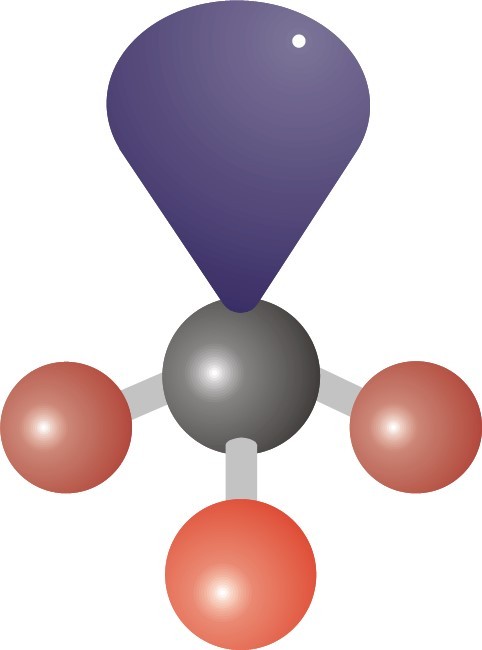
What molecular geometry would PH3 have?

a)

Trigonal Pyramidal

b)

Trigonal Bipyramidal

c)

Bent

d)

Linear

92.
What is the Molecular Geometry of the molecule?
a)
Linear
b)
Bent, 120o
c)
Bent, 109.5o
d)
Trigonal Planar
93.
The bond angle for a trigonal planar molecule is 
a)
90 Degrees
b)
109.5 Degrees
c)
120 Degrees
d)
180 Degrees
94.

What is the molecular shape of a molecule with 3 bonded atoms and 1 lone pairs around the central atom?

a)

trigonal pyramid

b)

Trigonal Bipyramid

c)

See-Saw

d)

Square Planar

95.

What is the molecular shape of a molecule with 5 bonded atoms and 1 lone pair?

a)

Octahedral

b)

Pentagon

c)

Square Pyramid

d)

Square Planar

96.
What is the molecular shape of CH3Cl?
a)
trigonal pyramidal
b)
trigonal bipyramidal
c)
tetrahedral
d)
not enough information
97.

What is the name of the shape with 5 bonded atoms and no lone pairs?

a)

trigonal pyramidal

b)

trigonal bipyramidal

c)

octahedral

d)

seesaw

98.

What is the name of the shape with 6 bonded atoms and no lone pairs?

a)

Octahedral

b)

square planar

c)

trigonal bipyramidal

99.

What is the name of the shape with 4 bonds and two lone pairs?

a)

Square planar

b)

seesaw

c)

trigonal pyramidal

100.
 A lone pair is defined as
a)
A pair of bonding electrons
b)
One non-bonding electron
c)
A pair of non-bonding electrons
d)
A pair of electrons on the central atom
101.
What is the VSEPR theory used to predict?
a)
Bond Strength
b)
Polarity
c)
Molecular Shape
d)
Electronegativity
102.
Which of the following shapes has an unshared pairs of electrons on the central atom? 
a)
Bipyramidal
b)
Bent
c)
Trigonal Planar
d)
Tetrahedral
103.
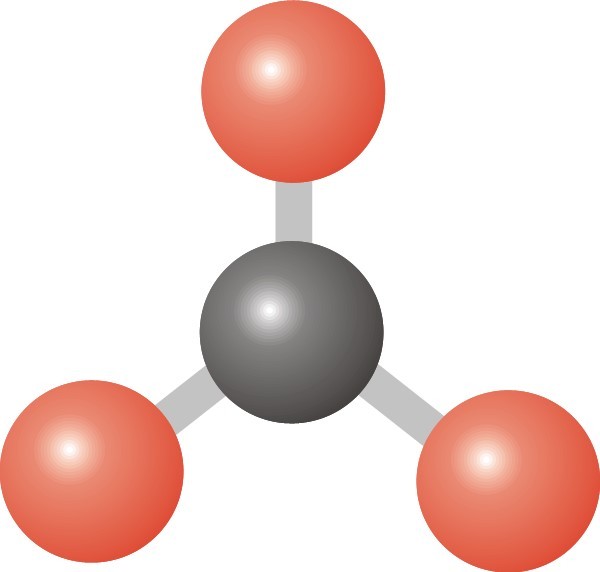
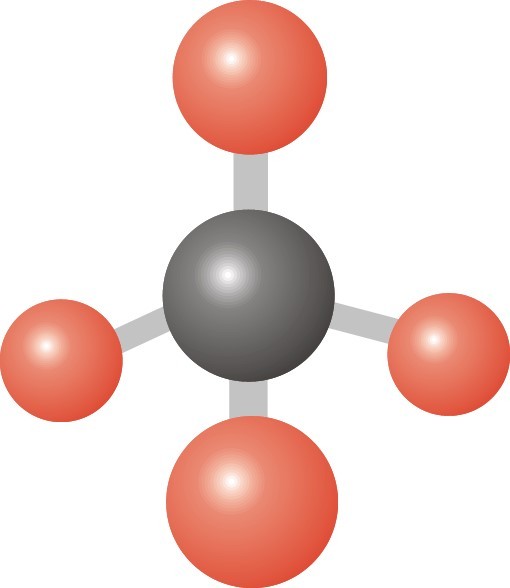
Which molecule would have this molecular geometry?
a)
BF3
b)
CH4
c)
PCl5
d)
CO2
104.
What molecule could this be? 
a)
BF3
b)
CH4
c)
H2O
d)
CO2
105.
Who could this molecule be?
a)
CH4
b)
CO2
c)
PCl5
d)
BF3
106.
Who could this be?
a)
H2O
b)
NH3
c)
CO2
d)
CH4
107.

What molecular geometry would PH3 have?

a)

Trigonal Pyramidal

b)

Trigonal Bipyramidal

c)

Bent

d)

Linear

108.
How many lone pairs of electrons are on the P atom in PF3?
a)
1
b)
2
c)
3
d)
0
109.
A molecule with a lone pair on the central atom would have the same electron and molecular geometry
a)
True
b)
False
110.

Is this molecule polar?

a)

No

b)

Yes

111.
According to VSEPR, molecules adjust their shapes to keep which of the following as far away as possible?
a)
Pairs of valence electrons
b)
Inner shell electrons
c)
Mobile Electrons
d)
Electrons closest to the nucleus
112.
Which of the following molecular shapes would have a bond angle of 180 Degrees?
a)
Bent
b)
Trigonal Planar
c)
Tetrahedral
d)
Linear
113.
Will this molecule be polar or nonpolar? CS2
a)
polar
b)
nonpolar
114.

What shape would this have?

a)

Trigonal planar

b)

Pyramidal

c)

Tetrahedral

d)

Bent

115.
How many electrons are shared in a triple bond?
a)
6
b)
3
c)
6 pairs
d)
5
116.
What is the shape of H2O?
a)
linear
b)
tetrahedral
c)
bent
d)
trigonal pyramidal
117.
VSEPR stands for ________ theory.
a)
Valence Structure of Electron Pyramids and Regression
b)
Varied Structures of Electrons Paired and Replaced
c)
Varied Shell Energy of Protons and Radiation
d)
Valence Shell Electron Pair Repulsion
118.

When two atoms share electrons, a chemical bond is formed. This type of bond is called _________.

a)

metallic bond

b)

ionic bond

c)

covalent bond

119.

An ionic bond can form between (a)   and nonmetals.

Choose from the below words
metals
two or more metals
two or more nonmetals
120.

Match the following types of bonds with their descriptions.

a)

single bond

1.

Atoms share one pair of electrons.

b)

double bond

2.

Atoms share two pairs of electrons.

c)

polyatomic bond

3.

A bond involving multiple atoms.

121.

A chemical bond is formed when electrons are lost by one atom and gained by another, so that they both get full outer shells. This type of bond is called (a)   .

Choose from the below words
metallic bond
ionic bond
covalent bond
122.

A substance which has a high melting point, conducts electricity when dissolved in water, and has a crystalline structure probably has what type of bond?

a)

metallic bond

b)

ionic bond

c)

covalent bond

123.

Match the following types of bonds with their descriptions.

a)

metallic bond

1.

Electrons are freely shared between metal atoms.

b)

ionic bond

2.

Electrons are transferred from one atom to another, creating charged ions.

c)

covalent bond

3.

Electrons are shared between atoms, typically between nonmetals.

124.

A covalent bond can form between what kinds of elements?

a)

metals and nonmetals

b)

two or more metals

c)

two or more nonmetals

125.

A solid substance is an excellent conductor of electricity. The chemical bonds in this substance are most likely?

a)

ionic, because the valence electrons are shared between atoms

b)

metallic, because the valence electrons are mobile

c)

covalent, because the valence electrons are mobile

126.

Which subatomic particle is most involved in forming chemical bonds?

a)

the proton

b)

the neutron

c)

the electron

127.

(a)   are unlikely to form chemical bonds.

Choose from the below words
noble gases
halogens
alkali metals
128.

Why do atoms form chemical bonds?

a)

to gain valence electrons

b)

to create a new element

c)

to make their outer electron shells more stable

129.

What are valence electrons?

a)

electrons in the outer shell

b)

the electrons that form a cloud surrounding the nucleus of an atom

c)

the electrons in the inner shells

130.

Match the following types of bonds with their descriptions.

a)

metallic bond

1.

Electrons are freely shared between metal atoms.

b)

ionic bond

2.

Electrons are transferred from one atom to another, creating charged ions.

c)

covalent bond

3.

Electrons are shared between atoms, typically between nonmetals.

131.

A covalent bond can form between what kinds of elements?

a)

metals and nonmetals

b)

two or more metals

c)

two or more nonmetals

132.

A solid substance is an excellent conductor of electricity. The chemical bonds in this substance are most likely?

a)

ionic, because the valence electrons are shared between atoms

b)

metallic, because the valence electrons are mobile

c)

covalent, because the valence electrons are mobile

133.

Which subatomic particle is most involved in forming chemical bonds?

a)

the proton

b)

the neutron

c)

the electron

134.

What are valence electrons?

a)

electrons in the outer shell

b)

the electrons that form a cloud surrounding the nucleus of an atom

c)

the electrons in the inner shells

135.

Conducts electricity when dissolved in water:

a)

ionic

b)

covalent

c)

metallic

d)

none of these

136.

Opposite charged ions attract:

a)

ionic

b)

covalent

c)

metallic

d)

none of these

137.

Electrons are shared:

a)

ionic

b)

covalent

c)

metallic

d)

none of these

138.

Ductile:

a)

ionic

b)

covalent

c)

metallic

d)

none of these

139.

Brittle solids:

a)

ionic

b)

covalent

c)

metallic

d)

none of these

140.

Mostly liquids, gases or low melting point solids:

a)

ionic

b)

covalent

c)

metallic

d)

none of these

141.

Malleable:

a)

ionic

b)

covalent

c)

metallic

d)

none of these

142.

Mobile electrons are referred to as an electron sea:

a)

ionic

b)

covalent

c)

metallic

d)

none of these

143.

What type of bond forms CaF2

a)

covalent bond

b)

ionic bond

c)

metallic bond

d)

all answers are correct

144.

Properties of metallic compounds include:

a)

brittle, conducts electricity (aqueous state), high melting points

b)

usually gas or liquid, relatively low melting points, does not conduct electricity

c)

shiny, malleable, ductile, conducts electricity, usually a solid

145.

Properties of ionic compounds include:

a)

brittle, conducts electricity (aqueous state), high melting points, solid at room temperature

b)

usually gas or liquid, relatively low melting points, does not conduct electricity

c)

shiny, malleable, ductile, conducts electricity, usually a solid

146.

Properties of covalent compounds include:

a)

brittle, conducts electricity (aqueous state), high melting points

b)

usually gas or liquid, relatively low melting points, do not conduct electricity

c)

shiny, malleable, ductile, conducts electricity, usually a solid