
 Worksheets
3rd Geo End of Year Review 2024
Total questions: 112
Worksheet time: 1hrs 24mins

Number of deaths each year per 1,000 people
population growth
population density
birth rate
death rate
All of the people in a particular area
migration
demographics
population
census
Study of population patterns and change
census
demographics
migration
death rate
Number of births each year per 1,000 people
birth rate
population growth
population density
migration
Which is true about population density? Click ALL that are correct--there can be more than just one answer
urban areas are more crowded
population density is how many people there are per square mile
the size of the area helps determine population density
A country that has a high population density means that they have a high population.
Why did the earth's population begin to rise dramatically in the 1800s and continue?
better medicines and healthcare were available
better farming techniques allowed for more food production
the Industrial Revolution allowed for technology to assist humans in transportation and mass production of goods
All of these factors led to population growth
What are characteristics of countries that have higher life expectancies? You will choose more than one answer
they value education
they are at war
easier access to medical care and medicines
good government; democratic; freedoms
lack of sanitation and access to clean water
A country with slow or negative growth is usually...
Developed
Developing
All of the following are characteristics of a developing countries EXCEPT...
A large rural population
A low life expectancy
Lack of access to education
Advanced technology

Which state has the greatest population density?
New Jersey
Rhode Island
Connecticut
Vermont
The average number of people living in an area
population distribution
population density
urbanization
population rate
Birth Rate + Migration - Death Rate =
population growth
population density
Population divided by Area =
population density
population growth
Birth rates tend to be higher in
less developed countries
developed countries
industrialized countries


3. The population pyramid of Japan shows two bulges. What age groups make up those bulges?
35-39 and 60-64
25-29 and Over 80
50-54 and 0-4
30-34 and Over 80

How would you describe the population of this country?
They are experiencing stable population growth
They are experiencing negative population growth
They are experiencing rapid population growth

Which state has the largest population?
New Hampshire
Pennsylvania
New Jersey
New York

Which state has the population density of 41 people per square mile?
Connecticut
Maryland
Maine
New York
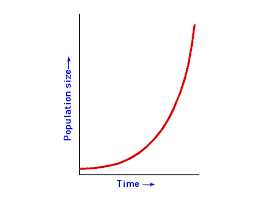
What type of growth is shown in the diagram?
exponential growth
logistic growth
predator-prey cycle
boom-bust curve
Largest number of individuals of a population that the environment can support...
carrying capacity
population
biome
mutualism
Imagine the city of Springfield has a population density of 5000 people per square mile and currently has a population of 2,500,000. What would be the area of Springfield in square miles?
500 square miles
400 square miles
300 square miles
250 square miles
If the city of Springfield covers an area of 100 square miles and has a population density of 3000 people per square mile, what is its population?
300,000 people
200,000 people
400,000 people
500,000 people
The city of Metropolis has a population of 1,000,000 and a population density of 2500 people per square mile. What is the area of the city in square miles?
400 square miles
500 square miles
600 square miles
250 square miles
Imagine a city named GreenVille that has a population of 450,000 people living in an area of 150 square miles. What is the population density of GreenVille?
2000 people per square mile
3000 people per square mile
4000 people per square mile
5000 people per square mile
If the city of Springfield covers an area of 75 square miles and has a population of 150,000, what is the population density of Springfield?
1000 people per square mile
2000 people per square mile
3000 people per square mile
4000 people per square mile
The city of Springfield has a population density of 1000 people per square mile and covers an area of 50 square miles. What is the total population of Springfield?
25,000 people
50,000 people
75,000 people
100,000 people
What is the area of a city in square miles if it has a population of 800,000 and a population density of 4000 people per square mile?
100 square miles
200 square miles
300 square miles
400 square miles
If the city of Springfield has a population density of 2500 people per square mile and a total population of 625,000, what is the total area of Springfield in square miles?
150 square miles
250 square miles
350 square miles
450 square miles
Imagine a bustling city, Metropolis, covers an area of 120 square miles and has a population of 480,000. What is the population density of Metropolis?
3000 people per square mile
4000 people per square mile
5000 people per square mile
6000 people per square mile
If New York City has a population of 1,200,000 and covers an area of 300 square miles, what is the population density?
3000 people per square mile
4000 people per square mile
5000 people per square mile
6000 people per square mile
the pattern or spread of people in a given area
census
death rate
population distribution
demographics
The following features are formed by wave erosion, except
Spits
Cliffs
Caves
Arches
Which of the following is NOT formed by wave erosion?
Cave
Cliff
Bar
Stack
The most common process occurring at the mouth of a river is
Erosion
Deposition
Transportation
None of the above
Large masses of water moving horizontally in a specific direction from one point to another for a long period of time are called
Waves
Tides
Ocean currents
Linear deposits of material that are roughly parallel to the coast are known as
Bars
Tombolos
Spits
Beaches
Attrition occurs when?
Little rocks get picked up by the waves and smashed on to the cliffs
Small rocks are smashed against each other, making smaller rocks.
Chemicals in the sea water dissolve the rocks
At low tide when animals enter the coastal environment.
What wave type is associated with Erosion?
Constructive Waves
Destructive Waves
Radio Waves
Polar Waves
What causes coral bleaching?
oil spills
warmer water temperatures
overfishing
red tide
How is the rise in global temperature affecting coral reefs?
Increase in coral reefs
Leads to the death of coral reefs
Greater variety of coral reefs
Improvement in breeding grounds for fish
These trees are adapted to brackish water
Rainforest
Semi-Evergreen Forest
Dry Woodland
Tropical Montane Forest
Mangrove


A river's ________________ is the starting point of the river.
source
triutaries
mouth
drainage basin
The place where the river end in the sea or large lake is called the ___________.
source
tributaries
mouth
drainage basin
The area of land DRAINED by a river system is called the _____________
drainage basin
mouth
tributaries
source


What landform can you see in the picture?
U shaped valley
V Shaped Valley
Floodplain
Waterfall

Which landform can be seen in the photo?
Waterfall
Estuary
Inter-locking Spur
Meander
What is the deep water called beneath a waterfall?
Plunge bath
Mermaids retreat
Plunge pool
Pool

What landform can you see in the picture?
Meanders
Rapids
Estuary
V shaped valleys


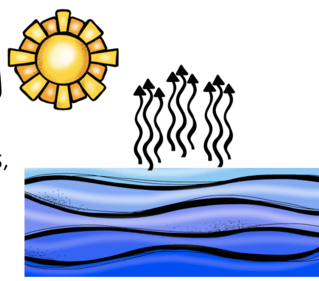
As a part of the water cycle, water from Earth's surface enters the clouds and finally falls back to the ground in the form of rain. What is the correct sequence of processes water undergoes?
Evaporation, Condensation, Precipitation
Precipitation, Condensation, Evaporation
Condensation, Evaporation, Precipitation
Evaporation, Precipitation, Condensation

What is another name or synonym for the water cycle?
Geologic cycle
Hydrologic cycle
Geosphere
Carbon cycle
The _________ is an area of land that separates water flowing into different drainage basins.
Watershed
Source
Confluence
Tributary
The valley walls of a river are the steepest at which river course?
Upper
Middle
Lower
Where does deposition mostly occur?
Upper Course
Middle Course
Lower Course

What do we call the point where one river joins another?
confluence
tributary
delta
erosion

Sediment deposits that form where a river flows into still water. Shaped like a triangle.
confluence
valley
delta
tributary

The force of the moving water and air wears away the banks and bed of the river. Water forces air to be trapped in the banks and the pressure eventually cracks and breaks the banks.
attrition
abration
solution
hydraulic action

Which one of these processes is the movement of particles 'leap frogging' along the river bed?
traction
suspension
saltation
solution

Which one of these processes is the movement of material that is carried within the water flow?
traction
suspension
saltation
solution

Which one of these river processes is the movement of material that is dissolved in water?
traction
suspension
saltation
solution
Which term best describes the general flow of water over land?
runoff
precipitation
transpiration
condensation
What are the 2 macro scale types of erosion?
Lateral and vertical
Horizontal and diagonal
Dendritic and radial
Zig-zag and random
Match the verb to the correct process: Rolling
Traction
Suspension
Saltation
Solution
Which process does the following link to : Sandpaper effect
Attrition
Abrasion
Hydraulic action
Saltation
Match the verb to the correct process: bouncing
Traction
Saltation
Solution
Suspension
The river discharge is greater in the...
Upper course
Lower course
The occupied channel width is greater in the...
upper course
lower course
What do we call a chart of a river from source to mouth?
long profile
length profile
extent profile
elongated profile
The load particle size is greater in the...
Upper course
Lower course
The channel depth is greater in the...
Upper course
Lower course
Channel bed roughness is greater in the...
Upper course
Lower course
The slope angle (gradient) is greater in the...
Upper course
Lower course
Average velocity is greater in the...
Upper course
Lower course
Load quantity is greater in the...
Upper course
Lower course

A diagram that pretends to slice a river like a cake, so you can see sideways bank-to-bank is called a...
Cross profile
Width profile
Side profile
Intersect profile

What is the CORRECT order of the features labelled I, II, III and IV?
Cave, arch, cliff, stack
Arch, cave, stack, cliff
Stack, cliff, arch, cave
Cliff, cave, arch, stack
Which of the following conditions are needed for coral growth?
Cloudy (turbid) water
Warm water temperatures
Fresh (low salinity) water
Very gentle wave action
Which of the following statements is NOT true about waves?
They are caused by wind blowing over the surface of the water
On nearing the beach, the speed slackens and the tops are thrown forward
On approaching the coast, the body of water forming the wave increases rapidly
The stronger the wind and the greater the fetch, the more powerful the waves are
A coral reef which is separated from the mainland by a wide lagoon is known as
an atoll
a patch reef
a barrier reef
a fringing reef
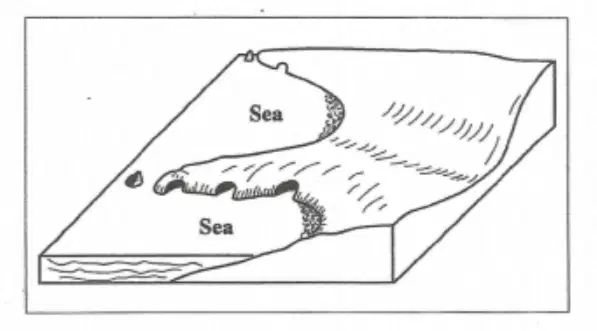
Which of the following features is NOT shown on the diagram?
Cliff
Headland
Bayhead Beach
Wavecut Platform

