
 Worksheets
BIG CHEM QUIZ
Total questions: 145
Worksheet time: 3hrs 41mins
C3H8
What is the molecular formula of ethane?
C2H4
C2H6
C3H6
C3H8
Identify the compound with the formula C4H10.
Butane
Propane
Ethane
Methane

What chemical is this? (C5H10)
Pentene
Pentane
Hexane
Heptene
Which of the following shows the structure of ethene?


Which of the following shows the structure of propene?

What is the name of this hydrocarbon?
1 - butane
1 - butene
2 - butane
2 - butene
Which of these functional groups is a methyl?
-COOH
-CH3
-PO4-
-SH


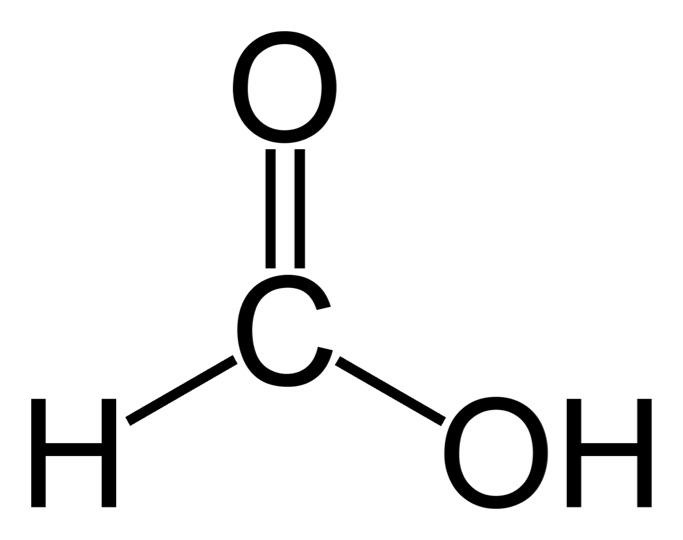
What is the "ending" used in alcohols?
al
ol
oilo
alco

What is the correct name for the alkyne shown?
butyne
1-butyne
2-butyne
1-methyl-1-propyne

Name the functional group shown.
sulfhydryl
hydroxyl
amine
phosphate

Name the compound based on the functional group present.
ethanamine
methanamine
amino acid
propanamine

Name this structure.
methylpropanoate
methylethanoate
ethylpropanoate

Amine
Amide
Neither

propan-2-amide
hexanamide
pentan-3-amide
pentanamide

This compound is an example of
a primary amine
a secondary amine
a tertiary amine
cannot be classified as a primary, secondary or tertiary amine
A weak acid is one which....
partially dissociates
completely ionizes
totally dissolves
has a higher pH
Esterification is an example of a...
A condensation reaction
An addition reaction
A subtraction reaction
An evaporation reaction
What is the difference between aldehyde and ketones?
position of C=O group
position of C atoms
the number of bonds carbon can form
the number of oxygen atoms

Name this molecule:
Propanone
Propanal
Butanone
Butanal

Name this molecule and give its functional group.
Carboxylic acid - propanoic acid
Ester - methyl ethanoate
Ester - ethyl methanoate
Carboxylic acid - methyl ethanoic acid
What makes alkynes different from the other hydrocarbons?
It is saturated
It contains one or more double bonds
It contains one or more triple bonds
It contains the most amount of hydrogen

Which of the following is the correct name for this hydrocarbon?
Hexene
2 - Hexene
2,3 - Hexene
3 - Hexene

Carbon is able to bond with atoms of other elements in many different ways because it has
six protons
four electrons
six valence electrons
four valence electrons

Which of these compounds has the maximum possible number of hydrogen atoms on its carbon chain?
hydrocarbon with double bonds
hydrocarbon with triple bonds
saturated hydrocarbon
unsaturated hydrocarbon

How many chemical bonds can each carbon atom form?
one
two
three
four
A very large organic molecule made up of chains of smaller molecules is called a
monomer
polymer
saturated hydrocarbon
substituted hydrocarbon
Condensation reactions are accomplished by
the removal of a water molecule and two smaller molecules are combined
addition of a carbon dioxide from the carbon chain of two monomers
the splitting of a covalent bond with a water molecule
the transfer of an -OH group to an amine group
Which of the following is 1-bromopropane?


What is the name of this haloalkane?
1-chloroethane
2-chloroethane
3-chloroethane
2-chloropropane

Name this haloalkane:
1,1-difluoropropane
1-difluoropropane
1-fluorobutane
difluorobutane


SO2 + O2 <=> SO3
If the concentration of SO2 is increased, the equilibrium position of the reaction will shift ___________.
2 NO(g) + O2(g) ⇌ 2 NO2(g)
2SO2(g) + O2(g) <=> 2SO3(g): ΔΗ = - 197 kJ mol -1
Which of the following will NOT shift the equilibrium position to the right?
Raising the pressure, by decreasing the volume of the container, will...

Fe3O4(s) + 4H2(g) <=> 3Fe(s) + 4H2O(g)
Kc =
What is the concentration equilibrium constant expression?
4Br2(g) + CH4(g) ↔ 4HBr(g) + CBr4(g)
The forward reaction forms the substance __________.
SO2 + O2 <−> SO3
If the concentration of SO2 is increased, the equilibrium of the reaction will shift ___________.
SO2 + O2 <−> SO3
If the equilibrium shifts to the right, the concentration of O2 will ___________.
heat + N2 + O2 <−> 2NO
If NO is removed from the system, the concentration of N2 will _______.
H2 (g) + Cl2 (g) <−> 2HCl (g) + heat
If the temperature is cooled, the _________ reaction will be favored.
N2 (g) + 3 H2 (g) <−> 2 NH3 (g)
If the pressure in the system is increased, which substance will increase in concentration?
What is the effect of increasing the pressure on the following equilibrium: 2NO(g) + O2 (g) ⇌2NO2(g)?
The yield of NO2 increases
The yield of NO2 decreases
The reaction is slower
The concentration of O2 increases.
If a solution has a [OH-] of 2.3x10⁻⁴, it must be a(n)...
Acid
Base
Neutral
If a solution has a [H+] of 9.3x10⁻¹¹, what is the pH?
10.0
4.0
3.5
8.2
What is the equation for calculating pH?
pH = [H+]
pH = log [H+]
pH = -log[OH-]
pH = -log [H+]
The Kw at room temperature (25 degrees C) is equal to 1.0 x 10⁻¹⁴. It can also be defined as:
the pH and pOH of a solution
the product of the hydronium ion and the hydroxide ion concentrations
-log [hydronium ion]
antilog -pH
If the hydronium ion H3O+ concentration is equal to the hydroxide ion OH- concentration, the solution is a(n)
acid
base
salt
neutral solution
What is the hydronium ion concentration of 4.0 M H2SO4?
4.0 M
8.0 M
1.0 x 10⁻⁴ M
2.5 x 10⁻¹⁵ M
Kw = [OH- ][H3O+]
Kw = 14
Kw = 1 x 10-14
Kw = 1 x 10¹⁴
Kw = 0
A substance that is more basic has a _____ pH than a substance that is acidic.
In a test of pH levels, a baking soda has a pH of 9 and bleach has a pH of 12. What is true about there relationship?
Both of the solution are Bases
Both of the solution are Acids
The Baking soda is an acid and the Bleach is a base
The baking soda is a base and the Bleach is an Acid.
What does pH measure?
the amount of hydrogen (H+) ions
the amount of hydroxide (OH-) ions
amount of water
all of the above
Which of the following is the strongest acid?
1
5
3
8
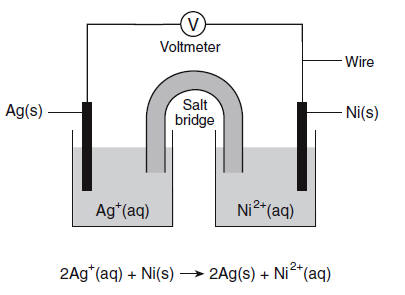
2 CaO--> 2 Ca + O2
Which energy conversion shown below takes place in a voltaic cell?
Electrical to chemical
Mechanical to chemical
Mechanical to electrical
Chemical to electrical
which element, if any, is oxidized?
4Fe + 3O2 --> 2Fe2O3
Which of the following represents oxidation?
C → CH4
Fe3+ → Fe2+
Cl2 → 2Cl-
Zn → ZnO
Mg → Mg2+ + 2e–
In a redox reaction, spectator ions...
become oxidised
become reduced
remain unchanged
In a Galvanic Cell, the anode is...
positive
negative
Reduction occurs at the...
anode
cathode
In a Galvanic Cell, the salt bridge...
completes the circuit so that electrons can flow through the wire
maintains charge balance
is soaked in an unreactive electrolyte such as KNO3
all of the above
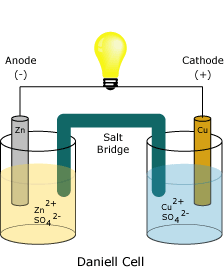
In the above Galvanic Cell, which half cell is undergoing reduction?
Cu | Cu2+
Zn | Zn2+

What is the direction of electron flow.
From Zn to Cu through the external circuit
From Zn to Cu through salt bridge
From Cu to Zn through the external circuit
From Cu to Zn through salt bridge
What is an anode?
It is the electrode where oxidation takes place.
It is the electrode where reduction takes place.
It is an aqueous solution containing an electrode.
It is the salt bridge that connects half-cells.
Consider the galvanic cell reaction Zn (s) + Cu2+ (aq) → Cu (s) + Zn2+ (aq) When the cell is running spontaneously, which is the only true statement?
The copper electrode loses mass and the zinc electrode is the cathode.
The copper electrode gains mass and the copper electrode is the cathode.
The zinc electrode gains mass and the zinc electrode is the anode.
The zinc electrode loses mass and the zinc electrode is the cathode.
Primary alcohols oxidise to form first (a) and then (b) .
Secondary alcohols oxidise to form (c) .
Match the following

This is not funny - grow up!

ketone

aldehyde

ester

acid
Arrange from lowest to highest boiling point
methane
ethane
ethanone
ethanoic acid
pentanoic acid
Which TWO things are needed to form an ester?
ethanoic acid
alcohol
alkane
ketone
aldehyde
Match each reactant with what it will make when added to an ALKENE
Cl2
Dichloroalkane
HCl
Chloroalkane
Water
Alcohol
Hydrogen
Alkane
Br2
Dibromoalkane
Markovnikov's rule applies in (a) reactions. The (b) will attach to the carbon with more hydrogens. The (c) will attach to the carbon with less hydrogens.
What will each of these reactants produce when added to an alkane in a substitution reaction?
Halogen
Haloalkane
NaOH
Alcohol
Ammonia
Amine
KCN
Nitrile
Amide synthesis is a condensation reaction between which TWO compounds
Carboxylic acid
Amine
Nitrile
Amide
Aldehyde
Which TWO Addition reactions DO NOT require special conditions such as heat or catalysts?
Halogenation
Hydrohalogenation
Hydrogenation
Hydration
Can you oxidise a tertiary alcohol
Yes
No
Nitriles can be reduced to form an:
(a)
Primary protein stucture involves (a) bonding
secondary protein structure involves (a) bonding
polysaccharides are held together by (a) bonds
How many fatty acids bond to glycerol to form a fat?
1
2
3
4
Match the following types of polypropylene to the arrangements of the methyl groups
syntactic
Alternating
sides
isotactic
all on same side
atactic
randomly arranged on the two sides
Stronger
Many branches
Few branches
Weaker
More flexible
Less flexible
Match the following
sucrose
glucose + fructose
lactose
Glucose + galactose
amylose
chain of glucose without branching
amylopectin
chain of glucose with branching
Match the following types of fatty acids
saturated
NO double bonds
mono- unsaturated
One double bond
Poly- unsaturated
Multiple double bonds
Amino acids are joined together by (a) bonds
Match the following protein structures
Primary
Covalent bonding
Secondary
Hydrogen bonding
Tertiary
Many different types of bonding
Quaternary
Bonding between chains
Which two types of linkages are found in amylopectin
1-2
1-3
1-4
1-6
In the Haber process AND contact process, what is the effect of each of these changes?
Low temperature
High pressure
High temperature
Use of catalyst
The Haber process is the name we give to the industrial production of
Ammonia
Sodium Hydroxide
Salt
Soap
Which equation represents the formation of ammonia
N2 + H2 ₋> NH3
N + 3H ₋> NH3
N2 + 3H2 ₋> NH3
N2 + 3H2 ₋> 2NH3
Nitrogen + hydrogen −> ammonia is exothermic . What will happen if we increase the temperature
The reaction will slow down
There will be no change in ammonia production
Less ammonia will be produced
More ammonia will be produced

If we increase the pressure, what will happen to the reaction
It will slow down
More ammonia will be produced
Less ammonia will be produced
Nothing will change
What are the optimum conditions for the Haber process?
200 atm and 450°C
450 atm and 200°C
2 atm and 450oC
4 atm and 250oC
What is the effect of increasing the pressure of a Haber process?
Equilibrium shifts to the left, more ammonia is produced
Equilibrium shifts to the left, less ammonia is produced
Equilibrium shifts to the right, less ammonia is produced
Equilibrium shifts to the right, more ammonia is produced
The Contact process is used for the manufacture of...
Sulfur
Sulfur dioxide
Sulfur trioxide
Sulfuric acid
What are the conditions used in the Contact process?
1 atm and 450 °C
200 atm and 450 °C
450 atm and 1 °C
450 atm and 200 °C
What is the name of manufacturing process of sulfuric acid?
contact
frasch
haber
ostwald
Why is the contact process performed at atmospheric pressure.
(MULTIPLE CORRECT ANSWERS)
Low pressure gives a better yield
Saves the expense of high pressure
Avoids the risk of high pressure
It works perfectly well at low pressure
Low pressure gives a faster reaction rate

