
 Worksheets
1960's and Vietnam
Total questions: 114
Worksheet time: 1hrs 22mins
Who was the leader of South Vietnam in 1969, when Nixon was sworn in as President?
Ngo Dinh Diem
Ho Chi Minh
Mao Zedong
Nguyen Van Thieu
President Nixon tried to give more power to local and state governments through his economic policy of
The Great Society
New Federalism
Detente
The New Deal
If Nixon wanted to reduce government spending, then what option below explains why Social Security, Medicaid, and Medicare payments increased under his administration
He did not want the Chinese economy to surpass the USA
He needed to ensure the USA could afford to enter int the STrategic Arms Limitation Talks
He needed to gain the support of the Democrats, who controlled Congress for ther issues
All of these
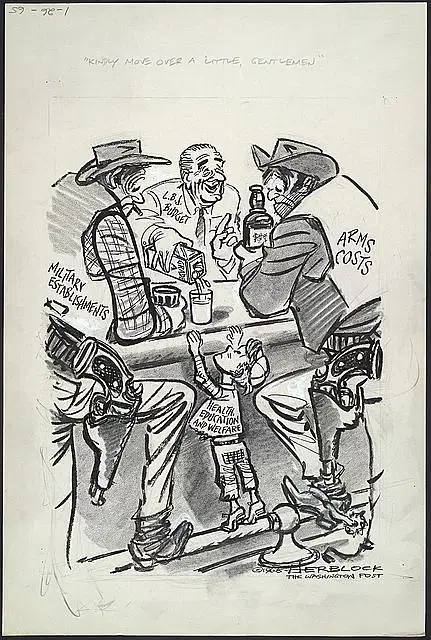
The cartoon "Kindly Move Over a Little Gentlemen" was published in 1965. Which initiatives does the message of the cartoon support?
the implementation of the New Deal policies
the implementation of the Great Society Policies
Efforts against nuclear proliferation
efforts against the draft
How did President Lyndon Johnson's Great Society attempt to extend the New Deal?
the government provided more loans to small businesses
New regulations made it easier for citizens to borrow money from banks
New programs like Medicare provided funding for health care
the social security administration introduced unemployment benefits to those out of work
Why did OPEC refuse to trade with the USA in 1973?
The USA weakend on their stance against Communism by opening up trade with China
Nixon refused to recognize any Communist nation as a legitimate country
the USA supported Israel in the Yom Kippur War
The USA was developing solar energy initiatives that made oil use unnecessary
What two reporters were known for persistently reporting on the Watergate Scandal?
Edward R. Murrow and Peter Jennings
Dan Rather and Ed Bradley
H.R. Haldeman and Thomas Nast
Carl Bernstein and Bob Woodward
What was the role of the news media during the Vietnam War?
News reports provided consistent support to the war effort in Vietnam
news reports led the public to question American involvement in Vietnam
the news media provided a favorable representation of South Vietnamese leaders
the news media were unable to report significant news from Vietnam because of censorship
Who did Nixon lose to in the Election of 1960?
Lyndon Baines Johnson
John F. Kennedy
Dwight D. Eisenhower
John Ehrlichman
What was the goal of Vietnamamization?
To gradually withdraw American troops out of Vietnam and allow the Southern Vietnamese troops to defend themselves
to start intense bombing raids on North Vietnam until they officially recognized South Vietnam as a Democracy
to unite North Vietnam and South Vietnam as one nation in which Democracy ruled both areas
to initiate a massive airstrike attack against North Korea
What option describes the Watergate Scandal?
The USA was using massive amounts of napalm to attack Cambodia, which put civilians at risk
me working for the President broke into a building
Richard Nixon was secretly working to build back a relationship with China
papers were released known as the "Pentagon Papers" that proved the USA was increasing military action in Vietnam, despite claims that the government was trying to reduce tension
How did Richard Nixon avoid facing charges in the Watergate Scandal and with other issues?
it was proven that John Ehrlichman was in charge of the break in at Watergate and that Nixon knew nothing about it
President Ford pardoned Nixon of all crimes related to the scandals
it was discovered that the Washington Post fabricated many aspects of the Watergate incident
Since Nixon was impeached, Congress felt no further action was needed
What lesson did US leaders learn from Watergate?
the President is accountable for obeying the law
the president is responsible for enforcing the law
the president is not allowed to hold secret talks with foreign governments
the president is not allowed to have private meetings with Cabinet membners
The excerpt is from the Tonkin Gulf Resolution passed by both Houses of Congress
" The Congress approves and supports the determination of the President, as Commander in Chief, to take all necessary measures to repel any armed attack against the forces of the US and to prevent further aggression."
What was significant about the Resolution?
Congress showed its support for a policy of isoltionism
Congress authorized the President to take military action in Southeast Asia
Congress provided the President with new constitutional powers to declare war
Congress denied the President the revenues he needed to fight a war in Indochina
The passage below is taken from a resolution by Congress.
" Whereas the United States is assisting the peoples of southeast Asia to protect their freedom and has no territorial, military or political ambitions in that area, but desires only that these peoples should be left in peace to work out their own destinies in their own way. Now, therefore, be resolved... That Congress approves and supports the determination of the President, as Commander in Chief, to take all necessary measures to repel any armed attack against the forces of the United States and to prevent further aggression."
Which of the following was an outcome of the policy described in the passage?
Increased efforts t Vietnamization in the war in Vietnam
Expansion of ground forces in Vietnam
increased government stability in Vietnam
Successful suppression of guerillas in Vietnam
Which group of draft age American men were exempt from active combat duty during the Vietnam War?
Conscientious objectors
active anti-war protestors
men who married in 1965
en who were against the war.
How did conscientious objectors respond to the draft?
refusing to pay taxes
supporting the policies of war hawks
enlisting in the armed forces
refusing to serve in armed combat
In which case did the Supreme Court rule that a person accused of a serious crime must be provided with an attorney if he/she could not afford one.
Gideon v Wainwright
Yates v United States
Miranda v Arizona
Roe v Wade
President Johnson made the following statement in a speech in New York in 1966
"our purpose in Viet-Nam is to prevent the success of aggression. It is, simply put, just to prevent the forceful conquest of South Viet-Nam by North Viet-Nam"
Which of the following would have most likely agree with the statement
a Dove
a Hawk
a Feminist
a Vietcong member
Which of the following in an example of an alliance formed in response to the Domino Theory?
Southeast Asia Treaty Organization
World Trade Organization
United Nations
Warsaw Pact
What led to a withdrawal of all United States ground troops from Vietnam?
Gulf of Tonkin Resolution
Paris Peace Accords
Geneva Accords
Tet Offensive
Which quote reflects the perspective of the Doves on the Vietnam War?
"North Vietnam cannot defeat or humiliate in the United States. Only Americans can do that"
"I think a long protracted war will disclose our weakness, not our strength."
"This war in Vietnam is I believe a war for civilation."
"We are going to bomb them back into the Stone Ages."
Kent State Protesters were demonstrating against the Vietnam War escalation into
Cambodia
Laos
China
Madagascar
Increased US fears of Soviet influence,
Agreed to negotiate a partial test ban,
Led to the creation of a hotline between the US and the Soviet Union
The following descriptions illustrate the impact of an event in US foreign policy.
Tet Offensive
Cuban Missile Crisis
Bay of Pigs Invasion
Gulf of Tonkin Incident
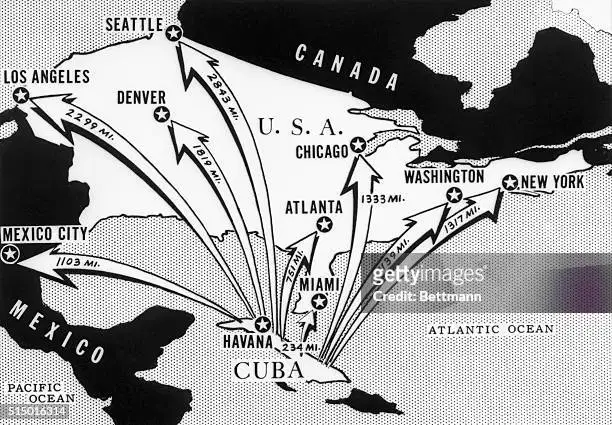
The map demonstrates which event?
Bay of Pigs
Tet Offensive
Open Door Policy
Cuban Missile Crisis
Most Cubans who were escaping the Castro regime fled to
Florida
Texas
Canada
England

How did American citizens react to the Tet Offensive?
They were discouraged
They became more committed to the war
They were indifferent
In response to the Soviets removing missiles from Cuba, the U.S. removed missiles from:
West Germany
India
Turkey
Alaska
Which groups were fighting for democracy in Vietnam? (choose all that apply)
North Vietnamese
South Vietnamese
VietCong
Americans
Which presidents deployed troops to Vietnam?
Truman
Eisenhower
Johnson
Kennedy
What was the objective of the Bay of Pigs invasion?
To prevent the spread of communism in Vietnam
To remove Fidel Castro from power in Cuba
To negotiate a peaceful resolution during the Cuban Missile Crisis
To protect American interests in Southeast Asia
Which conflict lasted the longest and became the most controversial U.S. involvement in the 20th century?
Cuban Missile Crisis
Bay of Pigs
Vietnam War
Tinker v Des Moines
What was one prominent movement that emerged in response to the Vietnam War?
Draft
26th Amendment
Role of the media
Anti-war movement
Which landmark Supreme Court case affirmed the constitutional rights of students in public schools?
Cuban Missile Crisis
Bay of Pigs
Tinker v Des Moines
Vietnam War
Who did President Richard Nixon refer to as the "silent majority"?
The protesters opposing the Vietnam War
The soldiers fighting in Vietnam
The American citizens who supported his policies but did not voice their opinions publicly
The communist nations involved in the conflict
What was the main belief behind the Domino Theory?
The United States had to contain the spread of communism to prevent its domino effect on neighboring countries.
The United States needed to establish economic dominance in foreign countries to ensure national security.
The United States aimed to promote democracy and human rights globally.
The United States sought to form alliances with foreign countries for mutual defense.
What was the significance of the 26th Amendment?
It granted women the right to vote.
It lowered the voting age from 21 to 18.
It reinforced the separation of church and state.
It established the principle of "one person, one vote."
What term refers to the gap between what the U.S. government said and what was actually happening during the Vietnam War?
Draft
26th Amendment
Role of the media
Credibility gap
Which event brought the United States closest to nuclear conflict with the Soviet Union during the Cold War?
Cuban Missile Crisis
Bay of Pigs
Vietnam War
Tinker v Des Moines
How did the media influence public opinion and shape the perception of the Vietnam War?
By censoring information about the war
By discrediting the credibility of government officials
By providing unbiased coverage of the conflict
By glorifying military victories without showing the true costs of war
The Vietcong were-
South Vietnam force
North Vietnam force
North Vietnamese forces in South Vietnam
Another name for Communists
Guerrilla Warfare was-
Fighting by small groups using tactics such as the ambush
Using gorillas to fight against enemy soldiers
Dressing up as gorillas and fighting while hitting your chest


The idea that if South Vietnam fell to communism, other nations would soon follow...
Vietnamization
Communism
Domino Theory
Imperialism


The American people strongly supported U.S. involvement in the war
True
False

As a result of the Vietnam War, many Americans believe that U.S. forces should only be sent to world troublespots if U.S. security or vital interests are at stake.
True
False
Our Vietnam Vets were welcomed with open arms when they returned home
No
yes

In 1975, two years after the last American troops left Vietnam,:
South Vietnam defeated the Viet Cong
the United Nations drew up a treaty ending the war
South Vietnam surrendered to North Vietnam
The Vietnam War was a war of ATTRITION because
It began and ended quickly
both sides used a tactic of wearing down the enemy until they were severely weakened and overcome, depleting their supplies and personnel
The decided to come to peaceful negotiations
Nuclear weapons were used
POW's are
Partners of war
the children that were used as decoys
Prisoners of war
people who sided with communism
What was the objective of the Bay of Pigs invasion?
To prevent the spread of communism in Vietnam
To remove Fidel Castro from power in Cuba
To negotiate a peaceful resolution during the Cuban Missile Crisis
To protect American interests in Southeast Asia
Which conflict lasted the longest and became the most controversial U.S. involvement in the 20th century?
Cuban Missile Crisis
Bay of Pigs
Vietnam War
Tinker v Des Moines
What was one prominent movement that emerged in response to the Vietnam War?
Draft
26th Amendment
Role of the media
Anti-war movement
Which landmark Supreme Court case affirmed the constitutional rights of students in public schools?
Cuban Missile Crisis
Bay of Pigs
Tinker v Des Moines
Vietnam War
Who did President Richard Nixon refer to as the "silent majority"?
The protesters opposing the Vietnam War
The soldiers fighting in Vietnam
The American citizens who supported his policies but did not voice their opinions publicly
The communist nations involved in the conflict
What was the main belief behind the Domino Theory?
The United States had to contain the spread of communism to prevent its domino effect on neighboring countries.
The United States needed to establish economic dominance in foreign countries to ensure national security.
The United States aimed to promote democracy and human rights globally.
The United States sought to form alliances with foreign countries for mutual defense.
What was the significance of the 26th Amendment?
It granted women the right to vote.
It lowered the voting age from 21 to 18.
It reinforced the separation of church and state.
It established the principle of "one person, one vote."
What term refers to the gap between what the U.S. government said and what was actually happening during the Vietnam War?
Draft
26th Amendment
Role of the media
Credibility gap
Which event brought the United States closest to nuclear conflict with the Soviet Union during the Cold War?
Cuban Missile Crisis
Bay of Pigs
Vietnam War
Tinker v Des Moines
How did the media influence public opinion and shape the perception of the Vietnam War?
By censoring information about the war
By discrediting the credibility of government officials
By providing unbiased coverage of the conflict
By glorifying military victories without showing the true costs of war
Which group best represented the counter-culture of the 1960s?
Grandparents
Black Panthers
Hippies
Yuppies
What reason did the US have to get involved in Vietnam?
To promote the United Nations
To stop the spread of communism
To open trading routes in Asia
Gain control of their oil reserves
Which piece of legislation restricted the president's ability to send troops without approval?
War Powers Act
Gulf of Tonkin Resolution
Vietnamization
Open Door Policy
Which Cold War event signifies the closest the US and USSR actually came to the brink of war?
Cuban Missile Crisis
Sputnik Launch
Bay of Pigs Invasion
Korean War
The major American achievement during the Space Race was _____.
the moon landing
reaching the Martian atmosphere
capturing a star
examining meteorite pieces
Which of the following programs was used to improve living conditions in foreign countries?
The Peace Corps
The War on Poverty
NASA
Vista

What FAILED (Ineffective) invasion of Cuba was led by Cuban exiles in an attempt to overthrow the socialist government?
Bay of Turtles
Bay of Horses
Bay of Pigs
Bay of Dogs
What event was unique to the 1960 Presidential election?
First Democratic candidate elected to the Presidency.
First televised debate.
Last Republican nominated for the Presidency.
No Vice-Presidential candidates on the ticket.
Kennedy's domestic programs were nicknamed
The New Deal
The Fair Deal
The New Frontier
The Fair Frontier

What were the defining characteristics of the Cold War?
Prohibition, Flappers, Jazz
Arms Race, Space Race, Red Scare
Holocaust, Nazi Germany, Pearl Harbor
Poverty, Unemployment, Dust Bowl
What foreign policy guided American presidents during the Cold War to stop the spread of communism?
Open Door Policy
Dollar Diplomacy
Big Stick Policy
Containment
The theory that if one country fell to communism, then other countries would fall as well, and eventually communism would take over the world is called
The Communism Theory
The Red Theory
The Dominating Theory
The Domino Theory

Martin Luther King Jr. & Malcolm X both wanted to achieve civil rights for Americans. However, they had different strategies to achieve this goal. MLK Jr. believed in
a militant approach through fighting back
segregation
peaceful, non-violent protests
neither apply
Who did LBJ take over for?
Franklin Roosevelt
John F. Kennedy
Harry Truman
What were LBJ's policies called?
The New Deal
The Changing World
The Great Society
Protests over military missions in Cambodia resulted in a confrontation between protestors and police, with four students killed on May 4, 1970.
Kent State University
Vietnamization
Domino Theory
Viet Cong
The sustained bombing of North Vietnamese and Viet Cong troops, ordered by Johnson in 1965
Domino Theory
Operation Rolling Thunder
Gulf of Tonkin Resolution
Tet Offensive

What was the result of the Brown v. Board of Education case?
Segregation in public schools became illegal.
African-Americans began playing professional sports.
Rosa Parks refused to give up her seat on the bus.
MLK led a March on Washington.

What was the purpose of the Civil Rights Act of 1964?
It made Jim Crow laws illegal.
It allowed African-Americans to run for political office.
It ended segregation in schools.
It made poll taxes illegal.

The March on Washington is most famous for...
causing race riots in Washington, D.C.
200,000 people working together to get the right to vote
the KKK becoming an illegal organization
MLK giving his famous 'I Have a Dream' speech
What were the defining characteristics of the Civil Rights Movement?
Increased participation of minorities in the political process, protests, boycotts, marches, desegregation, integration, struggle for equality, and strengthened due process.
Communism, containment, arms race/space race, Red Scare, McCarthyism.
OPEC oil problems, conflict in the Middle East, Reaganomics, large military, end of the Cold War, NAFTA.
Economic instability, unemployment, breadlines, poverty.

Which protest involved SNCC setting up a schedule for students to replace each other at a lunch counter?
Freedom Summer
Freedom Rides
Sit Ins
Selma
Who is famous for not giving up their seat on the bus to a white passenger?
Frederick Douglass
Harriet Tubman
Ida B. Wells
Rosa Parks
Martin Luther King, Jr.
What is it called when people are separated by race?
Boycotting
Suffrage
Prohibition
Civil Rights
Segregation
What leader of the boycott later became the leader of the Civil Rights Movement?
Booker T. Washington
Frederick Douglass
Martin Luther King, Jr.
W.E.B. Du Bois
Rosa Parks

