
Font size
 Worksheets
last test of the year (cells/microscope)
Total questions: 85
Worksheet time: 2hrs 8mins

What part of the microscope is 2?
revolving nosepiece
body tube
objective lens
What part of the microscope is 3?
revolving nosepiece
body tube
objective lens
What part of the microscope is 6?
stage
stage clips
diaphragm
What part of the microscope is 7?
diaphragm
stage
base
What part of the microscope is 8?
diaphragm
base
light source
What part of the microscope is 9?
stage
body tube
ocular lens (eyepiece)
What part of the microscope is 10?
arm
stage
base
What part of the microscope is 11?
arm
stage
base
What part of the microscope is 12?
coarse adjustment knob
fine adjustment knob
revolving nosepiece
What part of the microscope is 13?
coarse adjustment knob
fine adjustment know
revolving nosepiece
What part of the microscope is 14?
base
arm
stage


What is the basic unit of structure and function of all living things?
atom
molecule
cell
nucleus
What organelle is a storage area for food and water? Plants have a large, central one.
cell wall
chloroplast
vacuole
nucleus

What is the "powerhouse" of the cell? It produces energy that the cell need to carry out all life's processes.
nucleus
chloroplast
cell membrane
mitochondria
Which organelle directs all of a cell's activities?
nucleus
chloroplast
cell membrane
mitochondria

What is the gel-like fluid that holds a cell's organelles in place called?
organelle
cytoplasm
cellulose
Golgi body
What organelle in the plant cell captures the sun's energy and uses it to make food?
nucleus
cell wall
chloroplast
large, central vacuole
Which organelle is like a factory. It makes proteins.
nucleus
endoplasmic reticulum
ribosomes
chloroplast

Is the following an image of a plant or animal cell?
plant
animal

Is the following an image of a plant or animal cell?
plant
animal
Osmosis is the movement of what across a membrane?
Glucose
Sodium
Water
Lipids
An animal cell placed in a hypertonic (salty) solution will ___________
Shrink (get smaller)
Swell up (grow bigger)
Stay the same
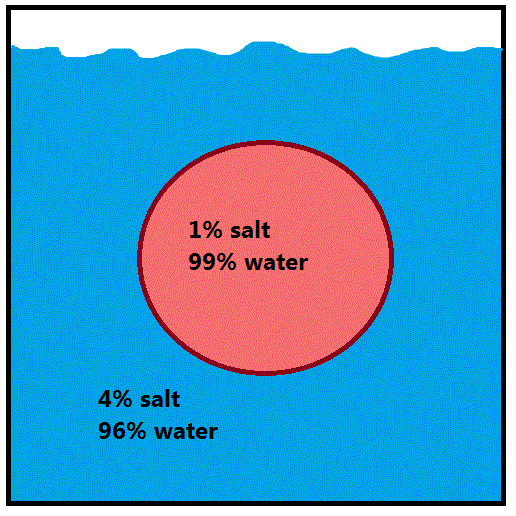
Where will the water go?
Into the cell
Out of the cell
Equally in & out - it's isotonic
There is no water
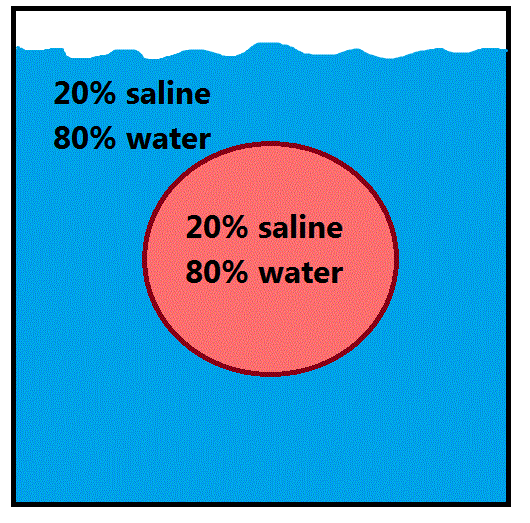
A blood cell is placed into the jar, as seen. Where will the water go?
Into the cell
Out of the cell
Equally in & out - it's isotonic
The water is a lie

If the dots represent sugar which is more concentrated
Inside the cell
Outside the cell
Neither they are equal (equilibrium)

If the dots represent sugar, what direction will water flow?
Into the cell
Out of the cell
Into and out equally (equilibrium)
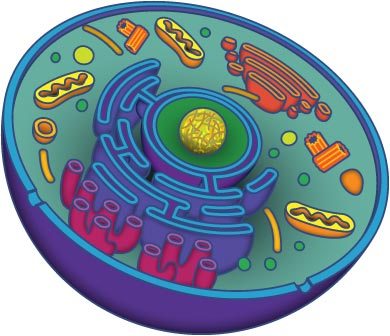
There are three parts to the cell theory. Which is NOT one of those parts?
All organisms are composed of one or more cells.
The cell is the basic unit of structure and organization in organisms.
Cells spontaneously arise from carbon and nutrients carried in the bloodstream.
All cells come from pre-existing cells.
A cell without a true nucleus
Prokaryotic
Eukaryotic
A cell that has a true nucleus
Prokaryotic
Eukaryotic
Bacteria is an example of a(n)
prokaryotic cell.
eukaryotic cell.
Plants and animal cells are examples of ___ cells
prokaryotic cells
eukaryotic cells
both eukaryotic and prokaryotic
neither


What is A?
Golgi body
vacuole
nucleus
mitochondria
What is B?
ER
vacuole
nucleus
mitochondria
What is C?
chloroplast
vacuole
lysosome
mitochondria
What is D?
chloroplast
cytoplasm
ribosome
mitochondria
What is E?
vacuole
cytoplasm
ribosome
nucleus
What is F?
ER
ribosome
nucleus
Golgi apparatus
What is G?
nucleus
lysosome
chloroplast
mitochondria
What is H?
chloroplast
lysosome
nucleus
mitochondria
What is I?
chloroplast
lysosome
nucleus
ribosome

What is K?
cell membrane
lysosome
cell wall
ribosome

What is A?
ER
mitochondria
nucleus
chloroplast
What is B?
cytoplasm
mitochondria
nucleus
chloroplast
What is C?
cytoplasm
mitochondria
nucleus
Golgi body
What is D?
cytoplasm
mitochondria
nucleus
Golgi body
What is E?
cell membrane
ER
nucleus
cytoplasm
What is F?
cell membrane
lysosome
nucleus
cytoplasm
What is G?
cell membrane
lysosome
mitochondria
cytoplasm


protective barrier that encloses all cells
controls the movement of materials into and out of the cell
cell membrane
cell wall
endoplasmic reticulum
golgi body
What type of microscope requires light passing through a specimen?
TEM
Light
SEM
NBA
To calculate total magnification of a light microscope you multiply ____________x ____________
ear piece, objective lens
aperture, eye piece
eye piece, objective lens
light, ear piece
Instead of light, a TEM and SEM utilize ____________ to create an image
a colored pencil
neutrons
protons
electrons


